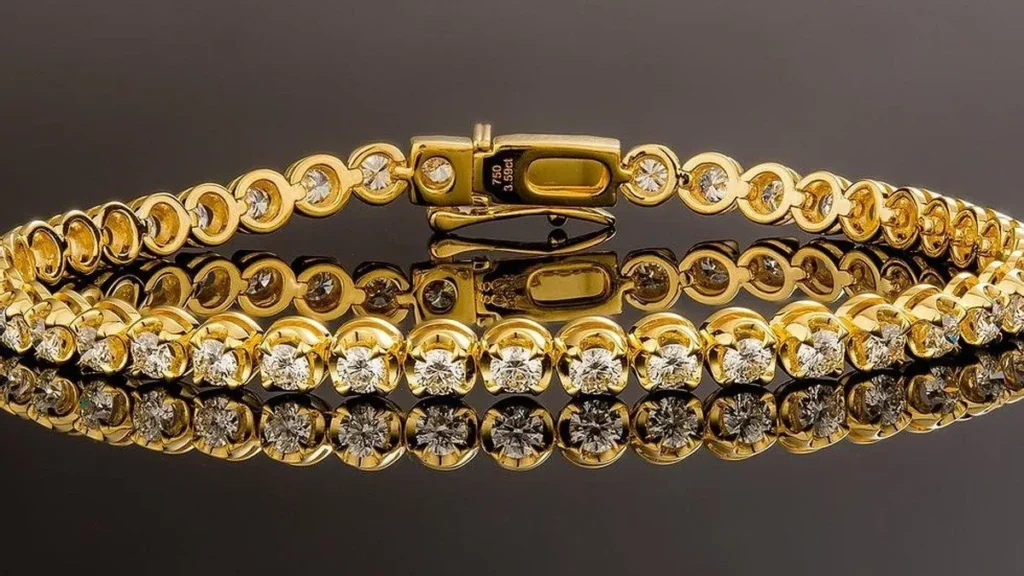
A diamond bracelet looks like the simplest jewellery you can buy: a line of sparkling stones circling the wrist. Yet two bracelets that look almost identical in a shop window can differ enormously in quality, durability and value. The difference is in details you can check in minutes: cut, clarity, setting, and whether the clasp will still hold in five years.
Unlike a ring, a bracelet lives on the most active part of your body. It knocks against desks and door handles, flexes with every movement, and its clasp is opened and closed hundreds of times a year. A diamond bracelet therefore has to be judged as an engineered object as well as a beautiful one.
This guide covers what matters before you buy: the four Cs, the settings, the choice between a tennis bracelet, a bangle and a cuff, the metal, natural versus lab-grown diamonds, and certification. Where our diamond buying guide covers loose stones and rings, this one is specific to the bracelet on your wrist.
Key takeaways
- Cut matters most: well-cut small stones outshine larger, poorly cut ones.
- VS2 or SI1 clarity is usually the sweet spot, since bracelet stones are small and worn at a distance.
- Choose the setting for your life: bezel and channel settings protect stones far better than high prongs.
- A tennis bracelet drapes, a bangle is rigid and bold; fit and comfort decide which one you will actually wear.
- Get carat weight, origin, metal and grading report in writing before you pay, and check the clasp twice.
The four Cs, bracelet edition
Gemologists grade every diamond on cut, colour, clarity and carat weight. In a bracelet, twenty or forty small stones are judged as a group, and the most important quality is that they match each other: one dull stone in a bright line will catch your eye every time you look down.
| Factor | What to look for | Best value |
|---|---|---|
| Cut | Even sparkle; no dead or glassy stones | Very Good cut |
| Colour | Stones matching; near-colourless looks white | G to H in white metal; I to J in yellow gold |
| Clarity | No inclusions visible to the eye | VS2 to SI1, eye-clean |
| Carat weight | Evenly shared weight; check per-stone weight | 2 to 4 total carats |
| Setting | Prongs even and tight; stones level, no wobble | Four-prong or bezel |
| Metal | 14k or 18k gold, or platinum | 14k white gold; platinum for durability |
| Clasp | Box clasp with a safety catch | Box clasp plus safety, always |
| Certification | Grading report plus written origin | GIA or IGI report |
Cut: the sparkle factor
Cut decides how much a diamond sparkles. A well-cut round brilliant returns light through its top in bright flashes; one cut too deep looks dark, one cut too shallow looks flat and glassy. In a bracelet this matters more than in almost any other piece, because the stones are small and there are many of them: a line of well-cut stones seems to glitter continuously as you move your arm, while poorly cut ones look dull even under shop lighting. Inspect it under normal room light, not only under the jeweller’s spotlights. The sparkle should be even from one end to the other, with no stone staying dark while its neighbours flash. The small stones, known as melee, are rarely graded one by one, so ask how the parcel was matched.
Clarity: what you can and cannot see
Clarity measures the tiny internal features, called inclusions, and surface marks, called blemishes. The scale runs from Flawless down through VVS, VS, SI and Included grades. For a bracelet, you do not need the top of the scale, and paying for it is usually wasted money. The stones are small, usually 0.05 to 0.25 carats each, and sit at arm’s length, so an inclusion found under ten-times magnification is invisible in wear. The sweet spot is VS2 to SI1, provided the stones are eye-clean, with no inclusion visible to the naked eye. Hold the bracelet at arm’s length in daylight: if you cannot see dark spots, cloudy patches or cracks, the clarity is good enough. Be more careful with SI2 and below, where inclusions near the edge can weaken a stone.
Colour and carat weight
Diamond colour runs from D, colourless, to Z, visibly yellow or brown; for a bracelet, D to J matter most. In white gold or platinum, G to H stones look white to almost everyone and cost less than D to F. In yellow gold, I to J stones can look perfectly white and offer even better value. More important is matching: stones should sit within one or two grades of their neighbours. Carat weight is always quoted as total carat weight, and that number needs unpacking. A three-carat tennis bracelet could be thirty stones of 0.10 carats each, or sixty of 0.05 carats, and the two look very different: larger stones give a bolder sparkle, smaller ones a finer shimmer. A classic everyday piece sits between two and four total carats; above five, weight itself becomes a comfort question.
Settings: prong, bezel, channel and pavé
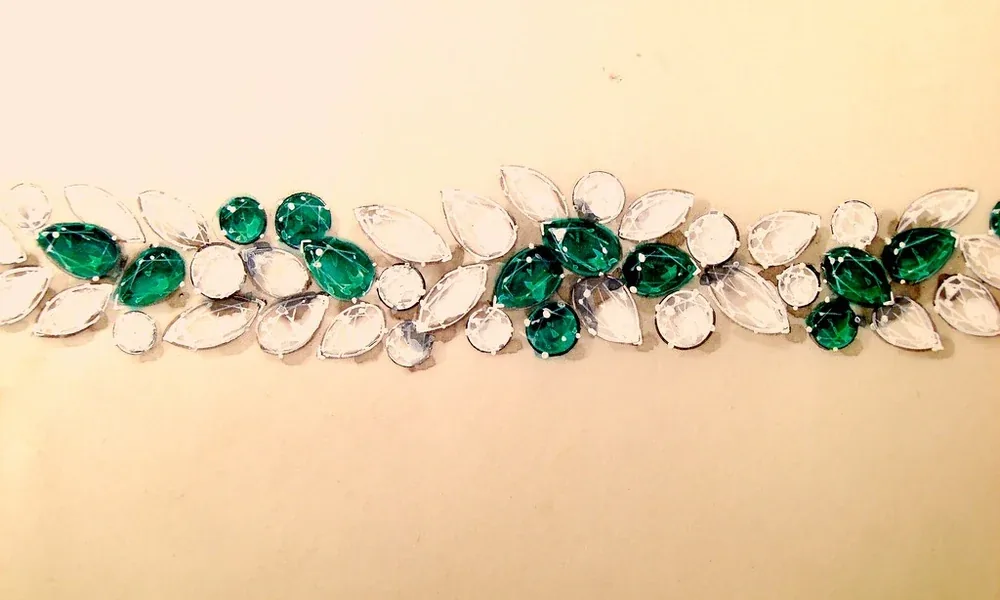
In a bracelet, the setting is a safety feature as much as a design choice. The classic tennis bracelet uses a four-prong setting, which holds the diamond high and gives the brightest sparkle. The trade-off is exposure: prongs can snag on clothing and bend if the bracelet is knocked, and a bent prong is how stones are lost. If you choose prongs, check each one is even, smooth and tight, and that no stone moves when pressed gently. A bezel setting wraps a rim of metal around each stone. It gives slightly less sparkle but is far tougher: bezels do not snag, protect the stone’s edges, and suit daily wear best. Channel settings offer similar protection with a clean, modern line, while pavé settings give a glittering carpet effect but are the hardest to repair. Whatever you choose, check the back of the bracelet too: it should be smooth, with no sharp edges, and the links should move freely without kinking.
Tennis bracelet, bangle or cuff
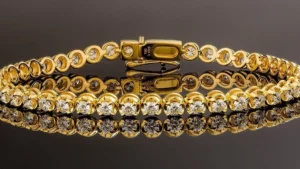
The tennis bracelet is a flexible line of individually set stones joined by links, named after the bracelet Chris Evert lost on court at the 1978 US Open. It drapes, moves with the wrist, and is the most versatile of the three, working with a T-shirt or evening dress. Buy the best clasp you can afford and have it checked yearly. A bangle is a rigid circle, with diamonds usually set into the front half or all the way around. Bangles make a bolder statement and have no clasp to fail. The trade-off is fit: a bangle must slide over your hand, so it is sized to your knuckles rather than your wrist, and one that is too loose will spin and knock, while one too tight is hard to remove. A cuff is an open-ended rigid bracelet, slipped on from the side and squeezed to fit. For a first diamond bracelet, the tennis bracelet is the safest choice.
Natural versus lab-grown diamonds
Lab-grown diamonds are real diamonds, chemically identical to mined diamonds, grown in a laboratory over weeks rather than formed underground over billions of years. They are graded on the same four Cs and cost fifty to eighty percent less than a mined stone of the same size and quality. For a bracelet, that gap is enormous: a lab-grown tennis bracelet can offer twice the total carat weight of a mined one for the same money. The trade-off is resale value: mined diamonds hold value better, and lab-grown diamonds currently resell for very little. If you are buying to wear and enjoy, that may not matter at all. If you hope to pass it on or sell it one day, mined diamonds are the safer store of value. What matters is that the seller tells you which one you are buying, in writing, and prices it accordingly.
Certification, fluorescence and paperwork
For a bracelet, certification works differently than for a single-stone ring. The small stones are rarely certified individually; instead, the parcel may carry a grading report, or the finished bracelet a maker certificate stating total carat weight, colour and clarity range, and metal. For bracelets above three total carats, ask for a GIA or IGI report covering the largest stones. A report from the seller’s own laboratory is not the same thing, and an insurance appraisal is not a grading report. Fluorescence can also matter: strong fluorescence can make a stone look hazy in daylight, so ask whether the parcel was screened for it. Before you pay, get the total carat weight and stone count, the colour and clarity range, natural versus lab-grown, any treatments, and the metal in writing.
Your before-you-buy checklist
- Hold it at arm’s length in daylight: sparkle should be even, with no dark or hazy stone breaking the line.
- Press each stone gently and tug the clasp: nothing should move or open without deliberate pressure.
- Check the clasp has a safety catch or chain, and open and close it yourself three times.
- Confirm the total carat weight, number of stones, colour and clarity range, and natural versus lab-grown, in writing.
- Inspect the back for sharp edges and stiff or kinked links before you try it on.
- Wear it for five minutes with your normal sleeve and watch: it should sit flat, not spin, pinch or catch.
Frequently asked questions
How many carats should a diamond tennis bracelet be?
For most buyers, two to four total carats is the sweet spot. Below one carat the bracelet can look delicate to the point of disappearing, while above five carats it becomes heavy and expensive. Try the same bracelet in two total weights before deciding.
What is the best diamond clarity for a bracelet?
VS2 to SI1, provided the stones are eye-clean, is the best value. The stones are small and worn at a distance, so inclusions seen under magnification are invisible in wear. That money is better spent on better cut or a stronger setting.
Are lab-grown diamonds a good choice for a bracelet?
Yes, for a bracelet you plan to wear and enjoy. Lab-grown diamonds are chemically identical to mined diamonds and cost far less, so the same budget buys a larger or better-quality bracelet. The trade-off is resale value, currently very low for lab-grown stones. Mined diamonds hold value better if you might sell one day.
Tennis bracelet or bangle: which is better?
A tennis bracelet is more versatile and easier to fit, because it flexes and its length can be adjusted, and it suits almost any outfit. A bangle makes a bolder statement and has no clasp to fail, but it must be sized to your hand and can be awkward with a watch. For a first diamond bracelet, most people prefer tennis.
How do I know if a diamond bracelet is real?
Start with the paperwork: a grading report or a written statement of the stones’ origin, weight and grades from a reputable seller. Then look at the metal: real diamond bracelets are set in gold or platinum, with a hallmark such as 14k, 18k or PT950.
How should a diamond bracelet fit?
A tennis bracelet should sit flat with about a finger’s width of slack, enough to move slightly but not to spin or slide over the hand. If you can fit two fingers underneath it, it is too loose; if it leaves a mark after a few minutes, it is too tight. Try it on with the sleeve and watch you would normally wear.
The bottom line
The best diamond bracelet is not the one with the biggest carat weight or the highest grades on paper. It is the one whose stones are well cut and evenly matched, whose setting suits the way you live, whose clasp you trust, and whose fit you forget you are wearing. Put your money into cut and construction first, accept eye-clean clarity and near-colourless colour, and choose natural versus lab-grown with your eyes open about resale. Then check the clasp, get the details in writing, and wear it for a few minutes in the shop before you commit. For style inspiration, see our round-up of the best diamond necklaces of 2027 and the best diamond earrings of 2027.
Note: Prices and carat ranges here are broad 2027 market guides, not quotes. Always inspect the actual bracelet, confirm origin, treatments and grading in writing, and check the returns policy before buying.