An emerald ring is one of the most beautiful pieces of jewellery you can own, and one of the easiest to buy badly. Two rings can look almost identical in a shop window, yet one holds a vivid green stone worth thousands and the other a pale, heavily oiled stone worth a fraction.
Emerald is the green variety of beryl, and it plays by different rules from sapphire and ruby. It is softer and more brittle, almost every stone has visible inclusions, and nearly every emerald has been oiled. It is a stone worth understanding before you pay for it.
This guide covers what matters most: colour, clarity and the jardin, cut, oiling, origin, natural versus lab-created stones, protective settings, prices, and the paperwork that protects you.
Key takeaways
- Colour matters most: vivid, bluish green, strongly saturated, medium to medium-dark in tone, checked in daylight.
- Emeralds are almost always oiled, which is normal, but the amount of oil changes the value.
- Inclusions are expected: a fine stone has a soft jardin, not visible cracks or a cloudy, dull look.
- Emerald is 7.5 to 8 on the Mohs scale but brittle, so a bezel or halo setting matters more than with sapphire or ruby.
- Buy the stone you can see, not the origin story, and get a lab report on any costly emerald ring.
Start with colour, because it decides almost everything
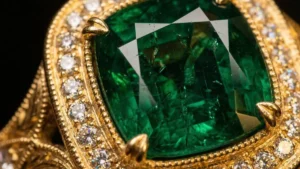
With emerald, colour comes first and drives both beauty and price. Jewellers describe hue, the colour family; tone, how light or dark it looks; and saturation, how strong the colour is. The most prized emerald is a vivid green with a slight bluish cast, strongly saturated, and medium to medium-dark in tone, and it should look alive in ordinary light.
Check the colour in daylight, not only under shop spotlights, which flatter every gem. An emerald that looks glowing under a halogen lamp can turn dull or yellowish by a window, while a good one holds its green in dimmer conditions. A slightly bluish green is the most valuable; a yellowish or greyish cast makes a stone look muddy, and a smaller stone with vivid colour beats a larger one with weak colour.
Clarity and the jardin: inclusions are part of the stone
Emerald is a Type III clarity gem, which means inclusions are expected in almost every stone, even fine ones. The French word jardin, meaning garden, describes the soft, mossy network of tiny inclusions inside most emeralds. A fine jardin is delicate and even, and a completely clean emerald is so rare that you should be suspicious of one at an ordinary price.
What matters is how the inclusions affect the stone. Look for one that is lively and transparent, with a jardin that softens the colour rather than clouding it. Avoid large, dark inclusions near the centre, surface-reaching cracks, or a milky haze that dulls the green.
Cut: the emerald cut exists for a reason
Cut is how the stone has been shaped and faceted, and emerald has its own classic shape. The emerald cut, a rectangular step cut with cropped corners, was developed for this gem: its long, parallel facets show off the colour in broad flashes, and its shape puts less pressure on the stone during cutting, which matters for a brittle gem. Oval and cushion cuts are also common.
A well-cut emerald looks balanced, with even colour and no pale window in the centre, and it should look bright and alive, not sleepy or glassy. Our roundup of the best emerald rings of 2027 shows how each cut looks in a finished ring.

Treatments: oiling is the question that changes the price
Almost every emerald on the market has been oiled, and that is not a scandal. Oiling is the traditional treatment: the stone is immersed in colourless cedarwood oil, which fills tiny surface-reaching fissures and makes them less visible. It improves the apparent clarity without changing the colour. A lightly oiled emerald is a normal, honest purchase.
What matters is how much oil the stone has taken, because that changes the value. Laboratories grade oiling as minor, moderate or significant. A stone with minor oiling is close to untreated and commands the highest price, while one with significant oiling has many filled fissures and is worth considerably less.
Other treatments must also be disclosed. Some emeralds are filled with resin or polymer instead of oil, which is more durable but still lowers the value. A few are dyed, which is serious: dye can fade, and the colour you are paying for is not entirely natural. Ask the seller to state every treatment and the oiling level in writing. If they cannot explain it, or claim the stone is untreated without a lab report, shop elsewhere.
Origin: beautiful, but never the whole story
Emerald origins carry romance and real price differences. Colombia is the most famous source: Muzo produces vivid, slightly bluish green stones, Chivor a more yellowish green, and Coscuez fine, bright material. Zambian emeralds tend toward a deeper, slightly bluish green with good clarity and are often excellent value. Origin is the laboratory’s opinion and only worth paying for on a lab report: a fine Zambian stone beats a dull Colombian one every time.
Natural, lab-created or imitation: know what you are buying
A natural emerald formed in the earth over millions of years. A lab-created emerald, also called lab-grown, is real beryl with the same composition and structure, grown in a laboratory. It is not a fake, and it can be beautiful, but it costs far less than a natural stone of similar appearance. Lab-created emeralds are often very clean, which is itself a clue.
Imitation emeralds are a separate category: green glass, green synthetic spinel or green YAG sold as emerald. Green glass is the most common trap in cheap jewellery. There is nothing wrong with choosing a lab-created emerald ring; the mistake is paying a natural price for one. Our guide to the best emerald engagement rings of 2027 compares emerald with diamond, sapphire and ruby in the same setting styles.
Settings and metals that protect an emerald
Emerald scores 7.5 to 8 on the Mohs hardness scale, which sounds hard enough, but hardness is not the whole story. Emerald is brittle: its inclusions and fissures make it more likely to chip if knocked hard. The setting is therefore more important for emerald than for sapphire or ruby.
A bezel setting, where metal wraps around the stone’s edge, is the most protective option and suits anyone who works with their hands. A halo of small diamonds protects the centre stone’s corners, adds sparkle and makes the emerald look larger. A four-prong solitaire shows off the stone and lets in the most light, but it leaves the corners exposed, so it suits occasional wear.
Yellow gold warms an emerald and is the classic pairing. White gold and platinum cool the green, while rose gold adds a soft blush. Try each metal in daylight, and take the ring off for gardening and heavy housework.
What an emerald ring should cost
Emerald prices vary enormously, more than almost any other gem, because colour, clarity, oiling and origin all move the price at once. Small commercial-quality emeralds, often heavily oiled and included, appear in rings costing a few hundred, while fine one-carat natural emeralds with vivid colour typically start in the low thousands. Stones over two carats with top colour can reach five figures per carat.
As a rough guide for 2027, a commercial-grade emerald of around one carat, heavily oiled and included, costs roughly $200 to $600 per carat. A good-quality stone with vivid colour and minor to moderate oiling runs $600 to $2,500 per carat. A fine stone with vivid, bluish green colour and minor oiling runs $2,500 to $8,000 per carat, and premium Colombian stones can exceed $10,000 per carat.
For a complete ring, a lab-created emerald ring can start under $1,000, a natural one typically runs $3,000 to $15,000, and a luxury ring with a rare Colombian stone can exceed $20,000. If two rings look similar but one costs a tenth of the other, the difference is almost always in the oiling, the clarity, or whether the stone is natural. Our diamond buying guide follows the same principle.
Emerald ring qualities at a glance
| Quality | What to look for | What to avoid |
|---|---|---|
| Colour | Vivid, bluish green, even | Yellowish, greyish or washed-out green |
| Clarity | Soft, even jardin; lively | Large dark inclusions; surface cracks; haze |
| Cut | Emerald, oval or cushion; symmetrical | Lopsided; pale patch in the middle |
| Treatments | Minor oiling, disclosed in writing | Undisclosed heavy oiling, resin or dye |
| Origin | A bonus, not the reason to buy | Premium for origin over colour |
| Setting | Bezel or halo for daily wear | Exposed corners on a daily ring |
| Certificate | Lab report stating oiling level | No paperwork on a costly emerald |
| Care | Warm soapy water and a soft brush | Ultrasonic or steam cleaning; harsh chemicals |
Certificates and sellers: the paperwork that protects you
For any natural emerald ring costing more than a modest amount, an independent certificate is not optional. Recognised labs include GIA, GRS, SSEF and AGL; their reports state whether the stone is natural or lab-created, its treatments and oiling level, and sometimes its origin. Ask to see the report before you pay, and check the report number with the laboratory.
Buy from a jeweller with a clear returns policy and a written treatment statement. If a seller rushes you or cannot produce paperwork, the ring is not worth the risk however beautiful it looks.
Checklist: what to look for in an emerald ring
- View the emerald in daylight and check the green stays vivid, with no yellowish or grey cast.
- Ask for the oiling level in writing, and whether the filler is oil or resin.
- Look for a soft, even jardin rather than large dark inclusions, surface cracks or a milky haze.
- Check the cut for symmetry and even colour, with no pale window in the centre of the stone.
- Choose a bezel or halo setting for daily wear, and check the prongs grip the stone firmly.
- Insist on a lab report for any costly emerald, and check the report number.
Frequently asked questions
Are emeralds suitable for everyday wear?
Yes, with the right setting and a little care. Emerald is hard enough at 7.5 to 8 on the Mohs scale, but it is brittle, so a bezel or halo setting protects it far better than exposed prongs. Take it off for heavy work and sport.
Is oiling bad for an emerald?
No. Oiling is the standard treatment for emerald and is done to almost every stone. What matters is the amount: minor oiling barely affects value, while significant oiling lowers it considerably. The level must be disclosed on the lab report and receipt.
How can you tell a real emerald from a fake one?
Look for the jardin, the soft network of inclusions almost every natural emerald has. A flawless emerald at a low price is almost certainly lab-created or glass. A report from GIA, GRS, SSEF or AGL confirms the stone is beryl.
Which emerald origin is best?
Colombia is the most famous, with Muzo stones prized for vivid, slightly bluish green. Zambian emeralds are often deeper green with good clarity and excellent value. The best origin is the one whose colour you love most.
Can you clean an emerald ring in an ultrasonic cleaner?
No. Never use an ultrasonic or steam cleaner, and avoid harsh chemicals and high heat, because they can drive the oil out of the stone and leave it cloudy. Clean it with warm water, mild soap and a soft brush.
Do emeralds hold their value?
Fine natural emeralds with vivid colour and minor oiling can hold their value well. Commercial-grade and heavily oiled stones hold value poorly, and lab-created emeralds hold almost none. Buy an emerald because you love it, and spend on colour and light oiling rather than size.
The bottom line
Buy colour first, then clarity, then a light oiling level, and let origin come last. Choose a setting that protects a brittle stone, insist on a lab report for anything costly, and clean the ring gently. An emerald chosen that way is a ring you will still love in twenty years.
Note: Prices are rough 2027 ranges for natural emeralds and vary with colour, clarity, oiling, size and origin. Confirm the treatment level and certification of the exact stone before you buy.