
Sunglasses get dirty in ways you barely notice until you put them on in bright sun. Fingerprints, sunscreen, face cream, dust, sea salt and the faint film that builds up over weeks all scatter light, and scattered light is what makes your vision feel hazy, your eyes tired, and your expensive lenses look cheap. The fix is simple, but the method matters, because the wrong cloth or the wrong cleaner can scratch a coating that cost more than the frame.
That is why this guide is organised as a proper routine, not a single tip. Cleaning sunglasses well is a short sequence: rinse first, wash gently, dry carefully, and store them properly, with a few extra steps for salt, sunscreen, and stubborn smudges.
Below are nine steps that cover the whole job, from the daily wipe to the deep clean after a beach holiday. They work for acetate and metal frames, polarised and gradient lenses, and prescription sunglasses, and none of them needs a special product beyond a mild soap, clean water, and a proper microfibre cloth.
Key takeaways
- Always rinse sunglasses under clean water before wiping, because dry dust and grit are what scratch lenses.
- Use a drop of mild, lotion-free soap and lukewarm water, and dry with a clean microfibre cloth, never a shirt, tissue or paper towel.
- Never use household glass cleaner, acetone, or alcohol-based wipes on coated lenses, because they can damage the coating.
- Clean the nose pads, hinges and frame edges too, because sunscreen and skin oils build up there and cause slipping and irritation.
- No cleaning method restores a scratched coating or a lens that has been cleaned dry for months, so prevention matters as much as the clean itself.
Why sunglasses get dirty and why it matters
Sunglasses sit close to your face all day, so they collect everything your face produces and everything the air carries. Skin oils and sweat transfer to the nose pads and the inside of the lenses. Sunscreen and moisturiser smear across the glass when you push the frames up or take them off. Dust, pollen and fine sand settle on the surface, and sea salt dries into tiny crystals after a swim. Each of these is harmless on its own, but together they form a film that scatters light.
That film is why your vision feels tired after a few hours in the sun, even when the lenses are dark enough. Scattered light reduces contrast, so your eyes work harder to see clearly, and you end up squinting behind dark lenses, which defeats the purpose.
The other reason method matters is the coating. Most modern lenses carry coatings: anti-scratch, anti-reflective, polarised film, and sometimes a water-repellent layer. These coatings are thin and can be damaged by abrasion and by harsh chemicals. A single wipe with a dry, gritty cloth can leave fine scratches that never come out, and a spray of glass cleaner can cloud a coating over time. The right routine protects the coating while it cleans the lens.
What you need before you start
You need very little. Clean lukewarm water, a drop of mild dish soap or hand soap without lotion or moisturiser, and a clean microfibre cloth made for lenses. A soft toothbrush or a cotton bud helps for the frame, and a hard case protects the pair when you are done. That is the whole kit, and it costs less than a single replacement lens.
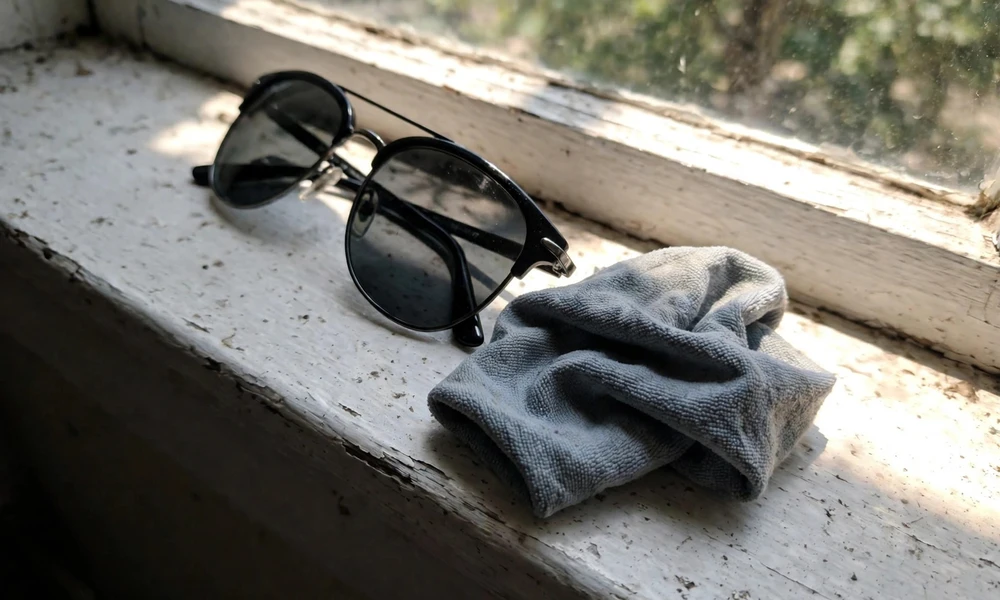
What you do not need is also worth stating. You do not need a special lens spray, although a proper one is fine if you already own it. You do not need vinegar, baking soda, toothpaste, or any home remedy that promises to remove scratches, because none of them works and most of them damage coatings. A guide to buying sunglasses covers lens coatings in more detail, and it is worth knowing what your own pair carries before you choose a cleaner.
Finally, check your lenses before you clean them. Hold them up to a light and look for scratches, peeling coating, or a cloudy patch that does not move when you breathe on the lens. If the coating is already damaged, cleaning will not fix it, and a harsh clean can make it worse. In that case, clean gently and consider a lens replacement rather than a stronger method.
The 9 steps to clean sunglasses properly
Step 1: Rinse under clean lukewarm water
What to do: Hold the sunglasses under a gentle stream of lukewarm water for a few seconds, letting the water run over both sides of each lens and the frame. What to avoid: Do not use hot water, which can stress the frame and coatings, and do not wipe the lenses while they are still dry. Best for: Every clean, every time. Time needed: 10 seconds. Standout tip: If you are outdoors with no tap, a bottle of clean water works just as well, and it is far better than wiping dry.
Step 2: Add a drop of mild soap
What to do: Put a single small drop of mild, lotion-free dish soap or hand soap on each lens, then rub it gently over the lens and the frame with clean fingertips. What to avoid: Do not use soap with moisturiser, antibacterial agents, or citrus oils, because they leave a film and can affect coatings. Best for: Removing sunscreen, skin oils and everyday grime. Time needed: 30 seconds. Standout tip: A little soap goes a long way, and a second drop is rarely needed, even for a very dirty pair.
Soap breaks down the oils that water alone cannot shift, which is why a rinse without soap often leaves a faint smear behind.
Step 3: Wash the frame, not just the lenses
What to do: Work the soapy water over the nose pads, the hinges, the temple arms and the frame edges, where sweat, sunscreen and skin oils collect. What to avoid: Do not force the hinges open or bend the arms while you wash them. Best for: Pairs that slip down your nose or feel greasy at the temples. Time needed: 30 seconds. Standout tip: A soft toothbrush reaches the hinge screws and the grooves around the nose pads, where a fingertip cannot.
Step 4: Rinse again thoroughly
What to do: Rinse the whole pair under clean lukewarm water until no soap remains, checking the lenses from an angle to be sure no suds are left. What to avoid: Do not leave soap on the lenses to dry, because it dries into a cloudy film that is harder to remove than the original dirt. Best for: Every clean, without exception. Time needed: 15 seconds. Standout tip: Hold the pair up to a light after rinsing, because soap residue shows up clearly against a bright background.
Step 5: Shake off the excess water
What to do: Give the sunglasses a gentle shake over the sink to remove most of the water, then hold them still for a few seconds so the rest runs off. What to avoid: Do not shake them hard, and do not blow on the lenses, because breath carries tiny droplets that dry into spots. Best for: Reducing drying time and preventing water marks. Time needed: 10 seconds. Standout tip: Hold the pair by the bridge when you shake it, so you do not put pressure on the arms or the hinges.
Most water marks come from water drying on the lens, not from the water itself, so removing the bulk of it before you dry is a simple way to get a clearer finish.
Step 6: Dry with a clean microfibre cloth
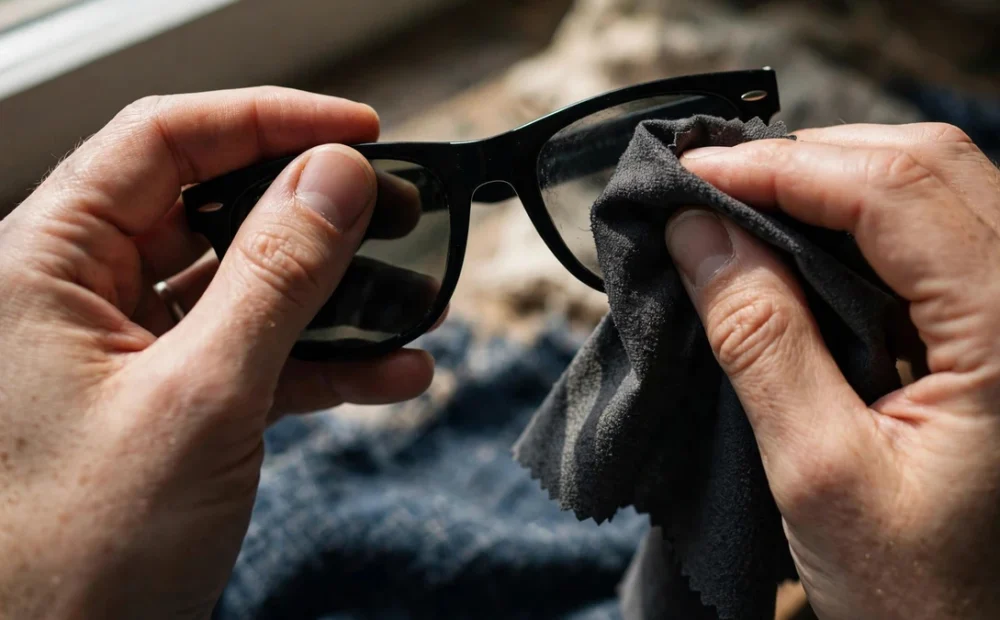
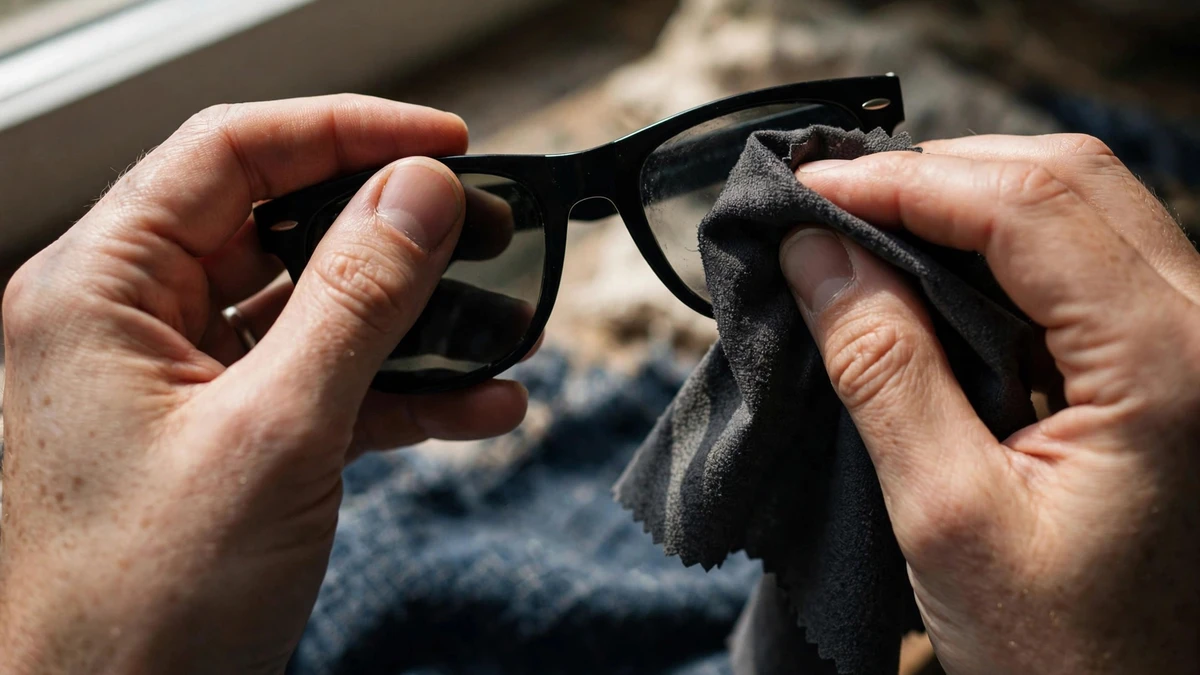
What to do: Pat and wipe the lenses gently with a clean, dry microfibre cloth, using light, straight strokes rather than circles. What to avoid: Never use a shirt, a tissue, a paper towel or a tea towel, because all of them can scratch coatings, and never use a dirty cloth. Best for: The final finish on every clean. Time needed: 30 seconds. Standout tip: Keep one microfibre cloth in the case and one at home, and wash them regularly with plain detergent and no fabric softener.
Step 7: Clean off salt and sunscreen after the beach
What to do: Rinse the pair under clean water as soon as you can after swimming or sunbathing, then wash with soap as usual, paying attention to the frame and the nose pads. What to avoid: Do not let salt water dry on the lenses, and do not wipe sunscreen off with a dry cloth, because both leave residue that hardens. Best for: Holidays, beach days and outdoor sport. Time needed: 2 minutes. Standout tip: Carry a small bottle of clean water and a microfibre cloth in your beach bag, so you can rinse the pair before the salt has time to dry.
Salt crystals are sharp at a microscopic level, and dried sunscreen is sticky enough to hold grit against the lens. A quick rinse at the beach saves a scratched lens later.
Step 8: Deal with stubborn smudges the gentle way
What to do: If a smudge survives the soap wash, repeat the rinse and soap step once more, and for the frame, use a cotton bud dipped in soapy water to reach tight corners. What to avoid: Do not press harder, do not use a nail or a hard object, and do not reach for glass cleaner, acetone, or alcohol wipes. Best for: Smudges that survive a normal wash, and grime around hinges and nose pads. Time needed: 2 minutes. Standout tip: If a mark still will not move after a second wash, it is probably a scratch or a damaged coating, not dirt, and no amount of rubbing will fix it.
Stubborn marks are usually a sign to wash again, not to scrub harder. Pressure is what damages coatings, and a second gentle wash removes almost everything a first wash missed.
Step 9: Store them properly so they stay clean
What to do: Put the sunglasses in a hard case, lenses facing up, whenever you are not wearing them, and keep the case somewhere cool and dry. What to avoid: Do not leave them lens-down on a table, do not hang them from your shirt where they swing and pick up dust, and do not leave them on a car dashboard in the heat. Best for: Keeping a clean pair clean, and protecting the frame. Time needed: 5 seconds. Standout tip: Keep the microfibre cloth inside the case, so it is always there when you need it, and so the lenses are never resting against bare case lining.
What not to use on sunglasses
Household glass cleaner is the most common mistake. It is made for windows, not for coated lenses, and the ammonia in many formulas can cloud or strip lens coatings over time. Acetone and nail polish remover are worse: they can dissolve acetate frames and damage coatings in seconds. Alcohol-based wipes are a grey area, because some lens manufacturers allow them and others do not, so the safe rule is to use soap and water instead, which works for every pair.
Toothpaste, baking soda and vinegar are home remedies that promise to remove scratches, and none of them should be used. Toothpaste is mildly abrasive, which is how it cleans teeth and how it scratches lenses. Baking soda is abrasive too, and vinegar is acidic enough to affect some coatings. A scratched lens cannot be polished back to new, and trying usually makes it worse. Our general sunglasses guide is a useful reminder of what a good pair should look like when it is clean, and it helps you judge whether a mark is dirt, a scratch, or a coating that has had enough.
Paper products deserve a special mention, because they feel soft and are everywhere. Tissues, paper towels and toilet paper are made from wood fibres, and wood fibres scratch lens coatings. They feel gentle on skin and they are rough on lenses, which is a combination that has damaged more sunglasses than any other single habit.
The caveats that matter
Cleaning cannot undo damage. A lens that has been wiped dry for months, a coating that has peeled, or a scratch that catches your fingernail will not improve with a better routine. In those cases, the honest answer is a lens replacement, not a stronger cleaner.
| Detail | What is known |
|---|---|
| First step, always | Rinse under clean lukewarm water to remove dust and grit |
| Best cleaner | A drop of mild, lotion-free soap; no special product needed |
| Best drying cloth | Clean microfibre, washed regularly, no fabric softener |
| Never use | Glass cleaner, acetone, toothpaste, baking soda, vinegar |
| Never wipe with | Shirts, tissues, paper towels or tea towels |
| After the beach | Rinse salt and sunscreen off quickly, before they dry |
| Frame care | Clean nose pads and hinges, where oils and sunscreen collect |
| What cleaning cannot fix | Scratches, peeling coatings, or cloudy damaged lenses |
Prescription sunglasses need the same routine, with one extra care: check the coating type with your optician before using any spray or wipe, because some prescription coatings are more sensitive than standard ones. Polarised lenses also deserve care, because the polarising film sits within the lens and a damaged surface coating can make the glare-cutting effect uneven. A comparison of polarised and non-polarised sunglasses explains what that film does, and why it is worth protecting with a gentle clean rather than a quick wipe.
Checklist: cleaning sunglasses properly
Use these checks every time you clean a pair, and keep the routine short enough to actually do it.
- Rinse first: always rinse under clean water before anything touches the lenses.
- Use mild soap: one drop of lotion-free soap, rubbed gently with clean fingertips.
- Clean the frame too: nose pads, hinges and temple arms collect oils and sunscreen.
- Dry with microfibre only: a clean cloth, light straight strokes, never circles with pressure.
- Never use glass cleaner, acetone, toothpaste or paper products on lenses.
- Store in a hard case: lenses up, cloth inside, away from heat and dashboard sun.
Frequently asked questions
Can I clean sunglasses with just water?
Water alone removes dust and salt, but it does not cut through skin oils, sunscreen or face cream. A drop of mild soap is needed for a proper clean, and it is safe for almost every lens and frame.
Is it safe to use lens spray on sunglasses?
A spray made for coated lenses is fine, but it is not necessary. Soap and water do the same job for less money, and they are safe for every coating. Avoid sprays that contain ammonia or alcohol unless your optician has confirmed they suit your lenses.
Can I use my shirt to clean my sunglasses?
It is best not to. Shirts collect dust and grit through the day, and the fabric can drag that grit across the lens. A clean microfibre cloth is the only safe dry wipe, and a rinse first is safer still.
How often should I clean my sunglasses?
As often as they need it, which for daily wear is usually every day or two. A quick rinse and dry takes a minute, and it is far better than letting a film build up for a week and then scrubbing at it.
Can scratches on sunglasses be removed?
No, not reliably. Polishing a scratched lens usually damages the coating further. Small scratches can sometimes be made less visible by a professional, but a deep scratch means a lens replacement.
Why do my sunglasses keep slipping after I clean them?
Usually because the nose pads or the frame are still oily, or because the fit has loosened. Clean the nose pads and hinges properly, and if the pair still slips, ask an optician to adjust the arms and the bridge. A good fit is part of keeping sunglasses clean and comfortable.
The bottom line
Cleaning sunglasses properly takes about two minutes and needs nothing more than clean water, a drop of mild soap, and a microfibre cloth. Rinse first, wash gently, dry carefully, and store them in a hard case, and your lenses will stay clear and your coatings will last for years. The whole routine is simple, but the order matters, and rinsing before wiping is the single habit that prevents most scratches.
Make it a habit, not a chore. Clean them well, store them properly, and they will look after your eyes for as long as you look after them.