Butterfly locs look effortless, and that is exactly what makes oiling them tricky. The style is built by wrapping hair around a braid and pulling loops out along the length, so the finished locs are soft, wispy, and full of air. It is a beautiful effect, and it is also a fragile one: a single heavy-handed oiling can press those loops flat and leave the style looking tired for the rest of the week.
The mistake most people make is treating butterfly locs like faux locs. With a smooth faux loc, you can rub a drop of oil down the length and the loc still looks tidy. With a butterfly loc, the same move coats the loops, weighs them down, and turns the airy texture into a limp one. The oil has to go to three places only — the scalp, the braided roots, and the curly ends — and it has to stay away from everything else.
This guide walks through the nine steps that keep butterfly locs soft and full, in the order you should do them, from install day to take-down.
Key takeaways
- Oil goes on the scalp, the braided roots, and the curly ends. The loops and the wrapped lengths stay dry.
- Light oils and a nozzle bottle are the whole method. Heavy oils and wide jars are the two things that flatten this style.
- One or two drops per parting is the right amount. If you can see the oil on the hair, you have used too much.
- Dampen the loops with water before you add any oil nearby, so the oil seals in moisture instead of sitting on dry hair.
- No oiling routine fixes a style that was wrapped too tightly or left in for months, and soreness is a sign to take the locs down.
What butterfly locs are and why they need a lighter hand with oil
A butterfly loc starts as a braid, usually your own hair with added braiding hair, which is then wrapped in a second layer of hair. As the wrapper goes on, the stylist pulls small loops out of the wrap at intervals, and those loops are what give the style its name — they stick out like wings and make each loc look soft and full. The ends are often left curly and loose, which adds to the airy effect.
Because the loops are only held in place by the tension of the wrap, they are the most delicate part of the style. Oil adds weight, and weight pulls a loop down against the loc. That is why the first rule of oiling butterfly locs is simple: the loops stay dry, always.
The second thing to understand is that the scalp is harder to reach than it looks. The locs sit close together and the loops fill the gaps between them, so you cannot see most of your partings once the style is in. That is why a nozzle bottle or a dropper matters so much here. Our guide to using hair oil on faux locs covers the same scalp-access problem in a smoother style, and the tool is the same: a nozzle bottle, used slowly, one parting at a time.
Before you start: what to have ready
You need three things before the first drop of oil touches your hair: a light oil in a nozzle bottle or with a dropper, a spray bottle filled with plain water, and a satin bonnet or scarf for the night. The light oil matters because it disappears into the scalp instead of sitting on the loops.
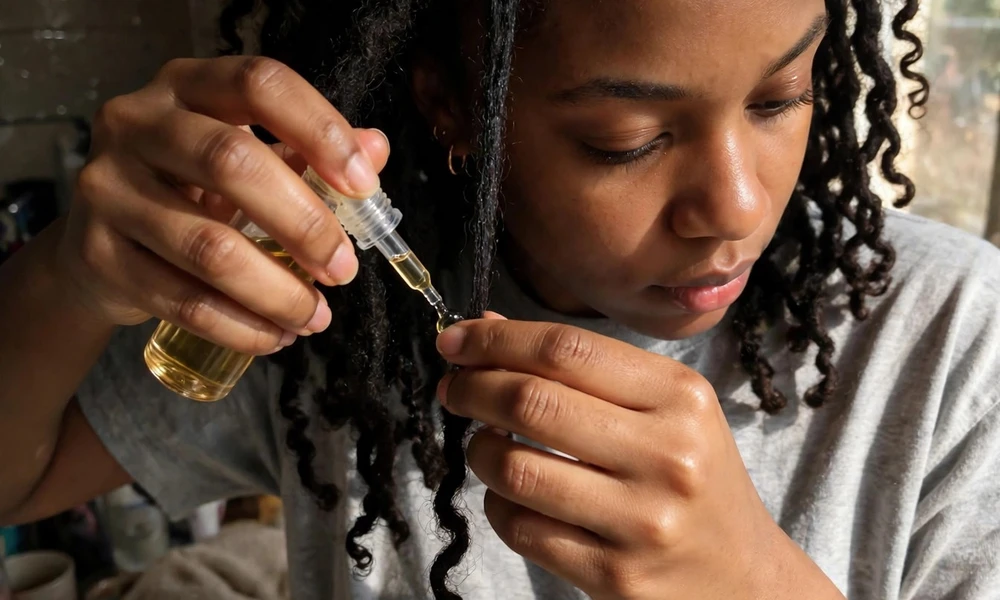
Choose the oil before install day, not after. A scalp oil with a nozzle tip, such as the TGIN serum, works for the skin between the locs, and a shine serum such as the Matrix Food For Soft serum works for the curly ends. Keep both on hand, because they do different jobs and one cannot stand in for the other. A heavy castor oil can work on the scalp in very small amounts, but it should never go near the loops, and if you are new to this style, a light oil is the safer first choice.
Finally, wash your hands before you start. It sounds obvious, but oiled fingers pick up lint and dust from the room, and that lint ends up in the loops, where it is almost impossible to remove.
How to use hair oil on butterfly locs, step by step
Oil the braided base before the first loop is wrapped
What to do: On install day, smooth a thin layer of light oil over each braided base before your stylist starts wrapping it, so the hair underneath starts soft instead of dry.
What to avoid: Do not oil the wrapping hair itself — the wrap needs grip to hold its loops, and an oiled wrap slips while it is being rolled. Best For: Install day, on every braid. Time Needed: A few seconds per braid. Standout Tip: Oil the braid underneath, not the hair that will become the loops.
Press oil into the partings, not onto the loops
What to do: Part two locs with your fingers, place one drop of oil on the skin you can see, and press it in with your fingertip. Work from the front hairline to the back, one parting at a time.
What to avoid: Do not drag your oiled fingers across the locs to reach the next parting — that is how oil ends up on the loops. Best For: Dry, itchy scalps between washes. Time Needed: About five minutes, front to back. Standout Tip: Lift each loc out of the way with your free hand before you place the drop.
If you cannot find a parting, skip it and come back to it next time. Forcing your fingers through the loops only tangles them.
Smooth one drop over the curly ends to keep them soft
What to do: Rub one drop of a light shine oil between your palms, then glide your hands over the curly ends only, from the middle of the curl to the tip.
What to avoid: Do not work the oil up into the wrapped lengths, and do not rub the ends between your palms — that frizzes the curl. Best For: Dry, frizzy ends in the second and third week. Time Needed: About a minute. Standout Tip: If the ends still look dry after one drop, add a second drop to your palms, not to the hair directly.
Spray the locs with water and let them sit a minute first
What to do: Mist the locs lightly with plain water from your spray bottle, wait a minute for the moisture to settle, and only then oil the scalp or the ends.
What to avoid: Do not soak the locs — a light mist is enough, and wet loops take hours to dry. Best For: Refresh days, when the style looks dry overall. Time Needed: Two minutes, plus a minute of waiting. Standout Tip: Water first, oil second, every time — oil on dry hair just sits there.
This order matters more with butterfly locs than with any other style, because the loops dry out faster than the wrapped lengths and oil cannot reach them directly.
Oil the edges with a fingertip, never a brush, so the loops stay loose
What to do: Put a single drop of light oil on one fingertip and smooth it along the hairline, pressing the baby hairs into place with the flat of your finger.
What to avoid: Do not use a brush or an edge tool near the locs — the bristles catch the loops and pull them out of shape. Best For: Smoothing the hairline before going out. Time Needed: Less than a minute. Standout Tip: One fingertip, one drop, no tools — that is the whole technique.
Keep your hands off the knots where each loop was pulled out
What to do: When you oil the scalp or the ends, keep your hands away from the little knots where each loop was pulled out of the wrap, and let those knots stay completely dry.
What to avoid: Do not smooth oil over a knot to tidy it — an oiled knot slips, and a slipped knot lets the loop fall flat. Best For: The whole wear, from install to take-down. Time Needed: No extra time — it is a habit, not a step. Standout Tip: If a knot looks messy, leave it alone; a messy knot holds better than a sleek one.
Reach the scalp through the gaps with a dropper bottle
What to do: Fill a dropper bottle with your scalp oil, find a gap between two locs with your fingers, and place two drops directly on the skin you can see there.
What to avoid: Do not squeeze the dropper over the top of the locs and hope the oil runs down — it will coat the loops on the way. Best For: Itchy spots you cannot reach with your fingertips. Time Needed: About three minutes for the whole head. Standout Tip: Tilt your head to one side so gravity helps the drop reach the skin.
A dropper is slower than a nozzle bottle, but it is more precise, and precision is what this style rewards. The passion twists oiling guide makes the same point about placing oil rather than pouring it, and it is even more true here, where the loops catch everything.
Pile the locs loosely on top of your head for the night
What to do: Before bed, gather the locs into a loose pile on top of your head, cover them with a satin bonnet, and let the scalp oil you applied earlier sink in overnight.
What to avoid: Do not tie the locs tightly or twist them into a bun — a tight pile crushes the loops while you sleep. Best For: Every night of the wear. Time Needed: About a minute. Standout Tip: A loose pile and a satin bonnet protect the loops better than any product.
Open the loops first, then slide the wrap off the braid
What to do: At take-down, oil your fingers, then open each loop gently with your fingertips before you slide the wrapping hair off the braid underneath.
What to avoid: Do not pull the wrap off while the loops are still closed — the loops tangle into the braid and take your own hair with them. Best For: Take-down day, one loc at a time. Time Needed: About an hour for a full head. Standout Tip: Re-oil your fingers every few locs, so the loops slide open instead of snagging.
Take your time with this step. The loops are the reason the style looked good, and they are also the reason take-down takes longer than a plain faux loc. Our guide to the different types of faux locs explains how butterfly locs sit in the wider family, and why their take-down needs the extra care.
How often to oil butterfly locs
Two or three times a week is the right rhythm for most people. Oil the scalp on the days it feels dry, oil the ends when they look dull, and leave the style alone on the other days.
Wash the style once a week with diluted shampoo, and re-oil the scalp after the wash, once the hair is mostly dry. A weekly wash stops build-up from dulling the loops, and it is the only reliable way to remove oil that has crept onto the wrapped lengths.
As the style ages, the roots will show new growth and the loops will loosen. That is normal, and it is not a sign to oil more. Four to six weeks is the usual life of butterfly locs, and pushing past six weeks risks matting at the roots that no oil can undo.
The caveats that matter
Oil will not fix a style that hurts. If your butterfly locs were installed too tightly, the scalp will ache, the edges will thin, and oiling will only mask the problem for a day or two.
| Detail | What is known |
|---|---|
| How often to oil the scalp | Two or three times a week, or when the scalp feels dry |
| How much per parting | One or two drops, pressed in with a fingertip |
| Where oil belongs | Scalp, braided roots, and curly ends only |
| Where oil does not belong | The pulled-out loops, the loop knots, and the wrapped lengths |
| Best applicator | A nozzle bottle for the scalp, a dropper for tight gaps |
| Water before oil | Mist the locs lightly first, so the oil seals in moisture |
| How long the style lasts | Four to six weeks, with a weekly wash |
| What oil cannot fix | A too-tight install, traction pain, or a style kept in too long |
If your scalp is broken, sore, or flaking heavily, skip the oil and see a dermatologist before you try another product. Oil on broken skin can sting and trap irritation. Try any new oil on the skin behind your ear first, and wait a day before putting it on your whole scalp.
Checklist: oiling butterfly locs without flattening the loops
Use these checks before you oil, and again after a week of wear.
- Check the oil is light: it should feel thin on the back of your hand, not thick or sticky.
- Check your tools: nozzle bottle for the scalp, dropper for tight gaps, spray bottle of water for the loops.
- Check the loops after oiling: if they look flatter than before, you used too much or touched the wrong place.
- Check the knots: they should stay dry — an oiled knot slips and the loop falls flat.
- Check the pile at night: loose on top of your head, under a satin bonnet, never tied tight.
- Check the calendar: weekly wash, four to six weeks total, then take the style down on time.
Frequently asked questions
Will hair oil flatten the loops in butterfly locs?
Yes, if it touches them. Oil adds weight, and a weighted loop falls flat against the loc instead of standing out from it. Kept to the scalp and the curly ends, oil does not flatten anything — the loops only suffer when oil lands on them directly.
How do I oil my scalp when the loops cover the partings?
Use a nozzle bottle or a dropper, and lift each loc out of the way with your free hand before you place the drop. Tilt your head to one side so gravity helps the oil reach the skin.
Should castor oil stay away from butterfly locs?
For the loops, yes — castor oil is far too heavy and will flatten them in one use. For the scalp, a small amount of castor oil can work, placed with a nozzle tip on the skin only.
How many times a week should butterfly locs be oiled?
Two or three times a week is right for most people, on the scalp and the ends only. Very dry scalps can be oiled daily, but the loops should never be oiled daily — they build up fast and lose their shape within days.
What oil keeps the curly ends from drying out?
A light shine serum or a glossing oil, such as the Matrix Food For Soft serum or the Joico Luster Lock oil. One drop smoothed over the ends is enough, and it should be applied to the ends only, never up into the wrapped lengths.
Can I wash butterfly locs with regular shampoo after oiling?
Regular shampoo straight from the bottle is too strong — use diluted shampoo in a squeeze bottle instead, aimed at the scalp, and let the suds run down through the locs. Rinse well, squeeze the locs gently in a towel, and let them air-dry.
The bottom line
Butterfly locs reward a light hand. A light oil, placed precisely on the scalp and the curly ends, keeps the style soft and full for the whole four to six weeks. A heavy oil, or oil in the wrong place, flattens the loops that make the style what it is, and no product brings them back.
Oil the scalp two or three times a week, mist the loops with water before you start, keep the knots dry, and take the style down on time. That is the whole routine, and it is all you need.