

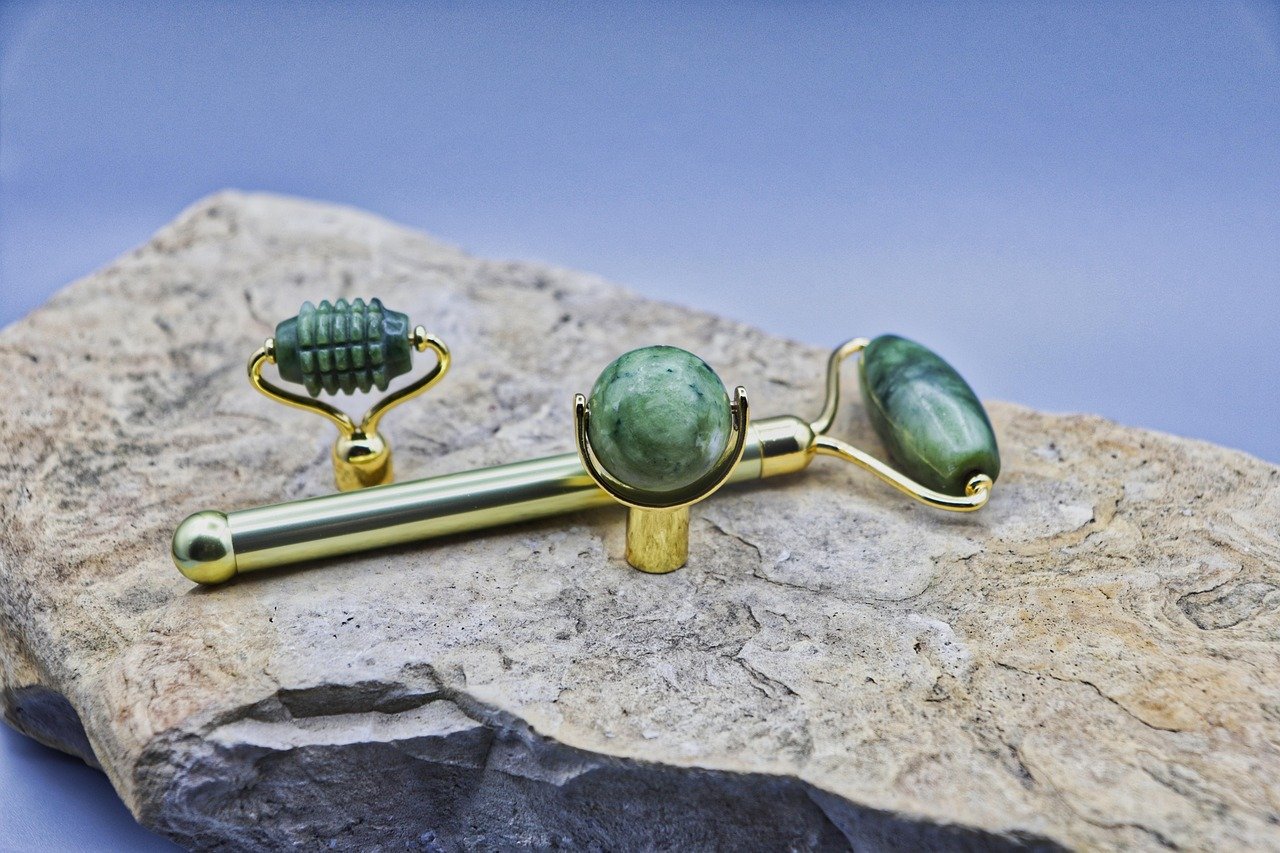

Does a cold green stone really shrink under-eye bags, or is it just a fancy way to waste five minutes? The short answer is that a jade roller can do some genuine, if modest, things for the skin under your eyes, and it can’t do several others that marketing photos imply. Understanding which is which saves you money, protects thin skin, and sets realistic expectations.
What the Jade Roller Actually Does Under the Eye
The tool is simple: a smooth stone cylinder mounted on a handle, rolled gently across the face. Under the eye, its effects come from three things, and none of them are the jade itself.
First, cold. A chilled stone on skin causes vasoconstriction, meaning blood vessels narrow. That can temporarily reduce visible puffiness and redness. This is general physiology, not a special property of stone.
Second, massage. Gentle rolling moves fluid around in the tissue. Manual massage is used in some clinical settings to help shift edema, though evidence for cosmetic under-eye results is limited and short-lived.
Third, ritual. Taking two quiet minutes, using a cool object, and expecting a result can change how you perceive your own face. That’s a real effect, even if it isn’t dermatology.
What’s missing is roller-specific proof. There is no published randomized controlled trial of jade rollers for under-eye concerns that would let anyone claim clinical efficacy. Any confident “clinically proven” language you see is borrowing credibility from facial massage and cold therapy studies, not from the device.
The Honest Limits: What No Roller Can Do

Under-eye appearance has many causes, and a roller only touches a couple of them. Here’s the practical breakdown.
| Under-eye concern | Main cause | Will a jade roller help? |
|---|---|---|
| Morning puffiness | Fluid retention, sleep, salt | Yes, temporarily |
| Redness or heat | Blood flow, irritation | Somewhat, briefly |
| Dark circles from vessels | Thin skin showing veins | Marginally, via cold |
| Dark circles from pigment | Melanin, genetics | No |
| Hollowness or tear troughs | Volume loss, bone structure | No |
| Bags from fat pads | Herniated fat, ligament changes | No |
| Fine lines | Collagen loss, sun damage | No |
That last group matters most. Herniated fat pads, the structural “eye bags” that become more common with age, are not fluid. No amount of rolling moves them. Neither does rolling fix pigment-based dark circles or restore lost volume. If those are your main concern, a roller will feel like a disappointment, and it isn’t the roller’s fault. It was the wrong tool for the job.
Cold Is the Real Active Ingredient
If you want the best odds from the tool, treat temperature as the whole game. A room-temperature jade roller does very little. A chilled one does noticeably more.
Practical approaches that work:
- Store the roller in the fridge, not the freezer. Stone straight from a freezer can be uncomfortably cold and, in rare cases, cause cold injury to thin skin.
- Roll for 60 to 90 seconds per eye, no longer. More time does not mean more benefit.
- Work from the inner corner outward, with feather-light pressure, following the bone that rims the eye socket.
- Use it in the morning, when puffiness peaks, rather than at night.
- Skip it entirely on days when the skin is irritated, sunburned, or broken.
A spoon left in the fridge for ten minutes does much of the same job. That’s worth knowing before you spend anything. The stone is a delivery system for cold and gentle pressure, and it’s a pleasant one, but it isn’t magic.
Jade Is a Marketing Word, Not a Mineral
Here’s a fact that surprises people: “jade” isn’t one material. It covers nephrite and jadeite, two different minerals with different compositions and different thermal behavior. Claims that jade is uniquely cooling, or that it “detoxifies” skin, don’t hold up. Materials science doesn’t support the detox idea at all, and the cooling effect depends far more on how cold the stone is than on what it’s made of.
Many rollers sold as jade are actually other stones, dyed materials, or glass. That’s not necessarily dangerous, but it does mean you’re paying for a look and a feel, not a therapeutic mineral. If a seller leans hard on the mystical properties of the stone, that’s a signal to trust the product claims less, not more.
Thin Skin Means Real Risks
The skin around the eyes is among the thinnest on the body. That has consequences.
Pressure and friction. Rolling too hard, or rolling over the same spot repeatedly, can irritate skin and, over time, aggravate broken capillaries. Anyone prone to visible veins under the eyes should use almost no pressure at all, or skip the tool.
Active skin problems. Rolling over acne, eczema, or a healing breakout spreads bacteria and irritates inflamed skin. Wait until the area is calm.
Hygiene. This is the risk most people ignore. Rollers get reused, stored in bathrooms, and rarely cleaned. Residue and microorganisms accumulate, and there’s no standard cleaning protocol for these devices. A sensible routine: wipe the stone with soap and water after each use, dry it fully, and keep it out of damp drawers. If you share a roller, stop.
There’s a related caution for anyone whose under-eye issue is medical rather than cosmetic. Persistent swelling, one-sided puffiness, or changes that don’t settle should go to a doctor, not a beauty tool. The same logic applies to eye alignment and vision concerns, which are a separate universe from cosmetic rolling; a look at what a cross eye operation actually involves shows how far the medical lane sits from the cosmetic one. (Sac timing term means eye tracking beyond)
How to Use It Without Wasting Your Time
A short, repeatable routine beats an elaborate one you abandon after a week.
Step 1. Cleanse your face and pat dry. Apply a light eye gel or moisturizer so the stone glides rather than drags.
Step 2. Take the chilled roller and start at the inner corner, below the eye. Roll outward toward the temple with light pressure. Six to eight slow passes.
Step 3. Repeat on the other side with the second roller head, if your tool has one.
Step 4. Finish with a fingertip tap of eye cream, then leave the area alone.
Step 5. Clean and dry the roller before storing it back in the fridge.
Common mistakes worth naming: pressing hard because light pressure feels like it isn’t “doing anything,” rolling back and forth rapidly, using the roller on dry skin, and expecting a structural change that no topical tool can deliver. Light and slow is the whole technique.
Where the Roller Fits in a Real Routine
Think of the jade roller as an optional extra, not a treatment. Dermatology guidance for under-eye concerns tends to be conservative: sun protection, adequate sleep, and treating underlying causes such as allergies come first. Rollers show up, when they show up at all, as low-risk adjuncts.
That framing is useful because it protects you from over-investing. If your puffiness is driven by late nights and salty dinners, a cold roller in the morning is a reasonable assist. If it’s driven by allergies, an antihistamine will outperform the stone every time. If it’s structural, nothing topical will change it.
There’s also a quiet psychological benefit worth acknowledging. A two-minute morning ritual can make people feel more in control of their appearance, and that’s not nothing. The mistake is letting the ritual substitute for the basics.
What to Look For If You Buy One
If you’re going to spend money, spend it on the right things.
- Smooth, chip-free surface. Rough edges scratch thin skin.
- A handle you can grip lightly. If it forces a tight grip, you’ll press too hard.
- A roller head small enough for the under-eye area. Oversized heads are clumsy near the nose.
- Honest marketing. A seller who promises to erase bags is telling you something about their standards.
Price is a weak signal here. Expensive stone doesn’t outperform cheap stone at delivering cold. If budget is tight, and you want to see whether the habit even suits you, a chilled spoon or a cold gel compress is a fair trial run. The same “does the cheap version actually deliver” logic shows up in plenty of product categories, from kitchen gear to beauty tools; it’s the same reasoning behind asking whether an airless sprayer works well enough to beat a roller before spending on the premium option.
The Placebo Question, Handled Fairly
Some of what people feel after rolling is expectation. That’s not an insult. Placebo effects are real, measurable, and part of why any ritual works. The honest position is that jade rollers likely produce a mix of genuine cooling, mild fluid movement, and expectation, and separating those in a home setting is impossible.
What matters practically is that the tool is low-risk when used gently and cleanly, and low-cost relative to most skincare. The danger isn’t the roller. It’s the story around it, the idea that a stone can replace sleep, sunscreen, or a doctor’s visit.
Conclusion
A jade roller under the eye is a modest tool with a narrow, honest job: it delivers cold and gentle massage to thin skin, and it can temporarily reduce morning puffiness and redness. It will not erase structural bags, fix pigment-based dark circles, or reverse volume loss, and the jade itself is doing far less than the temperature is. Used chilled, lightly, briefly, and cleanly, it’s a pleasant low-risk addition to a routine that already covers the basics. Used as a substitute for sleep, sun protection, or medical advice, it’s an expensive way to avoid the things that actually work.
Frequently Asked Questions
Do jade rollers actually work for under-eye bags?
They can temporarily reduce puffiness caused by fluid retention, mainly through cold and gentle massage. They do not work on bags caused by herniated fat pads or age-related structural changes, which require medical assessment rather than a beauty tool.
How long should you roll a jade roller under the eye?
About 60 to 90 seconds per eye is plenty. Longer sessions don’t add benefit and increase the risk of irritation to skin that is already very thin.
Should a jade roller be kept in the fridge or freezer?
The fridge is the better choice. A chilled roller gives the vasoconstriction effect you want, while a frozen one can be uncomfortably cold and may irritate or damage delicate under-eye skin.
Can a jade roller make dark circles worse?
Not directly, but rough rolling, heavy pressure, or rolling over irritated skin can aggravate visible capillaries and cause redness. Pigment-based dark circles won’t change either way.
How often should you clean a jade roller?
After every use. Wash the stone with mild soap and water, dry it completely, and store it somewhere dry. Rollers kept damp in bathrooms can accumulate residue and microorganisms.
Is jade roller material important, or is any stone fine?
The material matters far less than the temperature and smoothness of the surface. “Jade” covers both nephrite and jadeite, and claims about unique detoxifying properties aren’t supported. A smooth, chip-free stone that holds cold well is what you actually need.
One last note on storage: keep the roller somewhere dry and ventilated rather than sealed in a damp cabinet, and check the stone and frame periodically for hairline cracks, loose fittings, or chips that could scratch. Replace a damaged roller rather than smoothing it down yourself. None of this is complicated, and that’s rather the point. A tool this simple deserves simple handling: chill it, glide it lightly, clean it, and put it away. Do that, and the jade roller under eye earns its small place in your morning—no more, and no less.









