

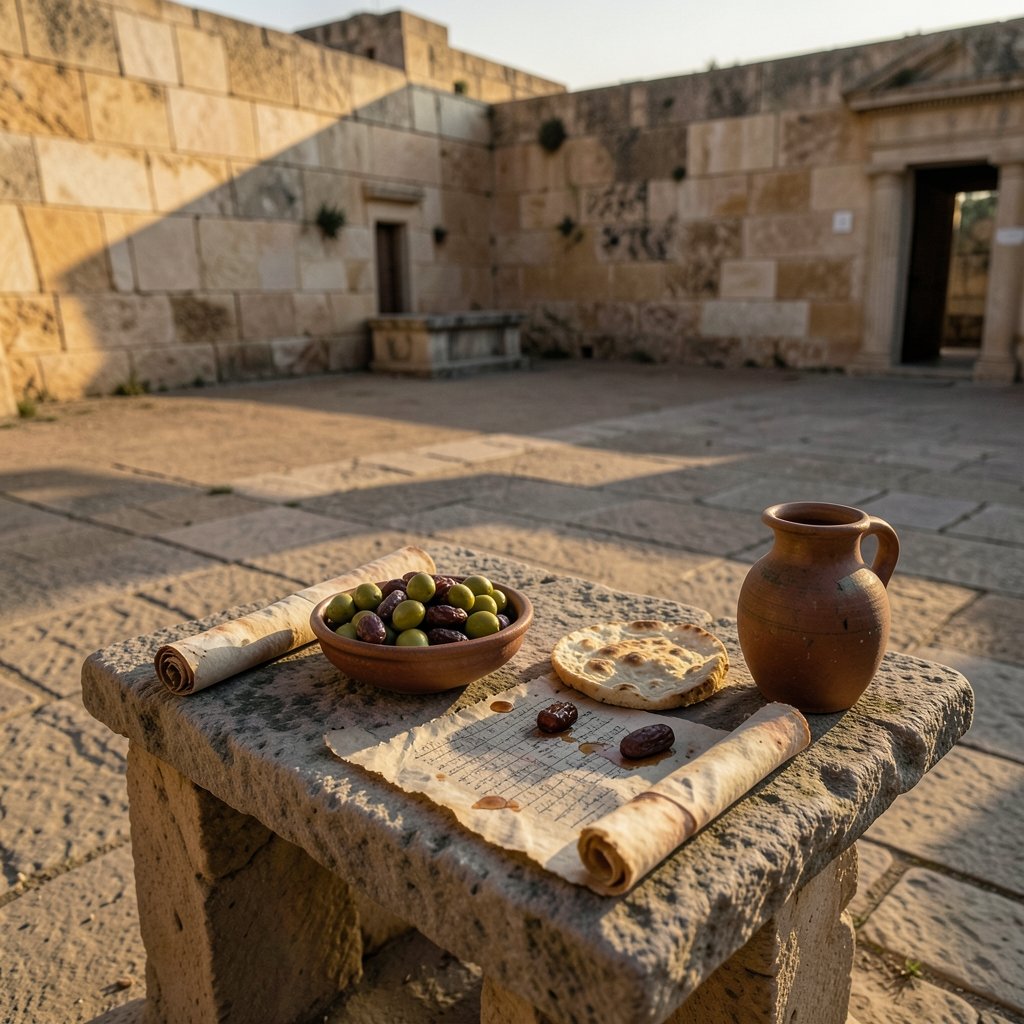
What would you say to a room full of people who just started sobbing in public? That is the scene behind one of the most quoted lines in the Bible. A crowd has gathered in Jerusalem. A scroll is opened. The words are read aloud for hours, and the people begin to weep. Instead of joining them, their leaders tell them to stop, go home, eat well, and share their food with anyone who has nothing. The reason given is a single sentence: “the joy of the LORD is your strength.”
That line, from Nehemiah 8:10, now lives on coffee mugs, worship screens, and social media captions. But the setting it comes from is far more grounded than most people realize. It is a story about a public gathering, a failed national recovery, and a meal shared with the poor. Understanding that backdrop changes how the verse works in everyday life.
The Scene Behind the Verse
The book of Nehemiah is set in the fifth century BCE, in the period after Jewish exiles returned from Babylon to a ruined Jerusalem. Nehemiah, a cupbearer to the Persian king who later governed the province of Judah, has overseen the rebuilding of the city wall. The wall is finished. The people are gathered at the Water Gate, and Ezra the scribe reads from the Law of Moses from early morning until midday.
The response is not applause. It is grief. Nehemiah 8:9 records that the people wept when they heard the words of the Law. Many had never heard the text read this way. The gap between what the Law asked and how they had been living became painfully visible all at once.
Nehemiah, Ezra, and the Levites respond with a counterintuitive instruction. They tell the people the day is holy, so mourning is out of place. They say to go eat rich food and drink sweet drinks, and to send portions to those who have nothing prepared. Only then comes the famous line. The joy of the LORD is their strength.
Notice the order. The joy comes before the strength, and the generosity comes alongside both. This is not a private pep talk. It is a public command to celebrate and to share.
What the Hebrew Actually Says

Two words carry the weight of the verse. The first is ḥedwat YHWH, “the joy of the LORD.” The second is māʿoz, usually translated “strength.” That second word is more concrete than the English suggests. A Hebrew lexicon entry for māʿoz (Strong’s H4581) shows it can mean a fortified place, a stronghold, or a refuge. It is the kind of strength a stone tower provides, not a mood boost.
That one detail reframes the verse. The joy of the LORD is not merely a feeling that makes a person braver. It is a defensive position. It is the place a person stands when everything else has given way.
There is an honest interpretive question here. Does the phrase mean “the joy the LORD gives” or “joy in the LORD”? The grammar allows both readings, and commentators genuinely disagree. Some read it as God’s own joy becoming the believer’s strength. Others read it as the joy that comes from belonging to God. The verse does not settle the argument, and pretending it does would be dishonest.
Translation choices add a second layer. Some English versions render māʿoz as “strength,” others as “stronghold,” and still others as “refuge.” Readers comparing versions will notice the variation. It reflects a translation decision, not a doctrinal dispute.
Why the Context Matters More Than the Slogan
The most common mistake people make with this verse is lifting it out of its paragraph. Quoted alone, it sounds like a formula for personal optimism: feel joyful, and you will feel strong. That reading is not wrong, but it is thin.
In context, the joy is tied to three things that have nothing to do with mood:
- Covenant renewal. The people have just heard the Law and recommitted themselves to it. The joy flows from restored relationship, not from a good day.
- Celebration. The leaders command a feast, with rich food and sweet drinks. Joy here is embodied and physical.
- Economic sharing. The instruction includes sending portions to those with nothing prepared. Joy that stops at a person’s own table is incomplete in this passage.
Scholars of the Hebrew Bible have noted how often the verse gets detached from this setting. When it is treated as a standalone slogan, the generosity command and the communal setting disappear. What remains is a warm feeling with no obligation attached.
There is a practical test here for anyone who uses the verse. If the joy of the LORD is the strength, and the verse sits inside a command to feed people who have nothing, then a claim of joy that never reaches the wallet or the pantry is worth questioning. That is not a guilt trip. It is simply what the text says.
Joy as Strength in Practice
So what does this look like outside a Jerusalem courtyard? A few patterns show up again and again for people who take the verse seriously.
Joy is a discipline, not a mood
The people in Nehemiah 8 are not told to feel joyful. They are told to act joyful: eat, drink, share. The feeling follows the obedience in this passage, not the other way around. Anyone waiting to feel strong before taking the next step has the order backwards. (4c hair)
Joy is social
The feast is not a solo event. The command assumes a table with other people around it. Isolated joy tends to burn out fast. Shared joy has staying power, which is one reason gathering with others regularly matters more than most people admit.
Joy is physical
Rich food and sweet drinks are part of the instruction. That is worth noting in a culture that often treats spiritual strength as purely mental. The body is not an obstacle to joy. It is the place joy gets expressed, whether through a good meal, a hard workout, or a long walk. Anyone building a home training space knows this dynamic well: the discipline of moving weight or logging cardio is often less about the body and more about the mind. A luxury home gym is one way people turn physical effort into a steady source of resilience, and the same principle applies to strength training equipment used consistently over months rather than in bursts. The parallel is not a stretch. Strength, whether spiritual or physical, comes from repeated small choices made in community and sustained over time.
Joy is not denial
The people were weeping for a reason. Their grief was real. The leaders did not tell them the grief was fake. They told them the day was holy and grief had done its work. There is a difference between ignoring pain and refusing to let pain have the final word. That distinction is one of the most useful things this verse offers.
The Verse Beyond Its Original Setting
The line has traveled far. It appears in Christian worship and hymnody, including a well-known chorus often attributed to Twila Paris in the 1980s, though the exact authorship and first-publication details of popular settings should be verified before being stated as fact. It has a strong presence in African American church traditions and gospel music, where the verse functions as a declaration of resilience in the face of hardship.
In Jewish liturgical settings, Nehemiah 8 is read in synagogue cycles, and the passage is associated with Rosh Hashanah in some traditions because of its themes of covenant renewal and public Torah reading. The precise lectionary mapping varies by tradition, so anyone citing a specific association should check their own tradition’s sources.
Christian commentators often connect the verse to thematic parallels elsewhere in Scripture, such as Psalm 28:7, where the LORD is described as strength and shield, and Philippians 4:4, which calls believers to rejoice in the Lord always. These are thematic echoes, not direct quotations of one another. Treating them as cross-references is fair. Treating them as textual dependencies is not.
Common Mistakes People Make
A few missteps come up often enough to be worth naming.
Treating the verse as a command to fake happiness. The text commands a feast, not a performance. There is a difference between choosing celebration and pretending pain does not exist.
Reading “strength” as willpower. The Hebrew word points to a stronghold, a place of safety. The strength is not something a person manufactures. It is something a person stands in.
Skipping the sharing command. The instruction to send portions to those with nothing is part of the same sentence block. Leaving it out turns a communal obligation into private encouragement.
Assuming one translation settles the meaning. Strength, stronghold, and refuge are all legitimate renderings. Comparing versions is useful, not confusing.
Quoting the verse without the reason for the weeping. The joy lands harder when a reader knows what the people had just heard and why it broke them.
How to Use the Verse Well
For anyone who wants to get more out of Nehemiah 8:10, a few practical habits help.
- Read the whole chapter, not only verse 10. The chapter is short, and the context does most of the interpretive work.
- Compare two or three translations side by side. Watch what each one does with the word for strength.
- Pair the verse with its command to share. Pick one concrete way to send a portion to someone who has nothing prepared.
- Treat joy as a practice with a body attached. A shared meal, a workout, a walk, a phone call. Joy that stays in the head tends to fade.
- Let grief be real without letting it be final. The people wept. Then they ate.
The verse rewards this kind of attention. It is not a slogan about staying positive. It is a command, given to a weeping crowd, to stand in a strong place and pass the food along. That is a harder instruction than the mug version, and a far more useful one.
Conclusion
The joy of the LORD is my strength is one of the most quoted lines in Scripture and one of the most frequently flattened. Read in context, it is a public command issued to people who had just been undone by what they heard. It ties joy to celebration, celebration to generosity, and generosity to a strength that behaves more like a fortress than a feeling. The Hebrew word behind “strength” supports that reading. So does the scene around it.
For readers who want to carry the verse into daily life, the practical takeaway is simple. Stand in the strong place. Eat the good food. Share it with someone who has nothing prepared. The strength shows up in the standing, not before it.
What does “the joy of the LORD is my strength” mean?
It means that joy rooted in God functions as a stronghold, not merely a mood. The Hebrew word for strength, māʿoz, can also mean a fortified place or refuge. In Nehemiah 8:10, the phrase is spoken to a crowd that had just wept over the Law, and it comes attached to a command to feast and share food with those who had nothing.
Where does the phrase come from in the Bible?
It comes from Nehemiah 8:10, set in fifth-century BCE Jerusalem after the exiles returned from Babylon. Ezra reads the Law aloud at the Water Gate, the people weep, and Nehemiah, Ezra, and the Levites tell them to stop mourning, eat rich food, and send portions to those in need. The verse sits inside that instruction.
Does the verse mean joy in the Lord or joy that the Lord gives?
Both readings are grammatically possible, and commentators genuinely differ. Some read it as God’s own joy becoming the believer’s strength. Others read it as the joy that comes from belonging to God. The text does not settle the question, so readers should hold both options with some humility.
Why do some translations say “stronghold” instead of “strength”?
Because the Hebrew word māʿoz carries the sense of a fortified place, a refuge, or a stronghold. Translators choose between these options depending on style and context. The variation reflects a translation decision, not a disagreement over doctrine.
Is the verse about personal happiness?
Not primarily. In its setting, the joy is tied to covenant renewal, public celebration, and economic sharing. Quoted alone, it can sound like a formula for private optimism. Read in context, it includes a clear obligation to include people who have nothing prepared.
How can someone apply this verse in daily life?
Treat joy as a practice rather than a feeling. Read the full chapter, compare translations, and pair the verse with one concrete act of sharing. Keep celebration physical and social, whether through a shared meal or steady physical training. Let grief be honest without letting it have the final word.









