


What happens when a brand known for driving feel borrows a hybrid system from the company that perfected the mass-market hybrid? That question sits at the center of the Mazda CX-50 Hybrid, one of the more interesting compact crossovers to arrive in recent years. Mazda spent decades telling buyers that fuel economy and fun-to-drive were opposites. The CX-50 Hybrid is the company’s attempt to prove that claim wrong, and it does so with an assist from an unlikely partner.
This article walks through what the CX-50 Hybrid is, how its powertrain actually works, what it changes about the CX-50 formula, and where it still asks buyers to compromise. Along the way, it separates what is confirmed from what still needs a trip to the dealer lot to verify.
What the Mazda CX-50 Hybrid Actually Is
The CX-50 Hybrid joined the lineup for the 2025 model year in the United States, announced in 2024 as Mazda’s first hybrid in the CX-50 family. It sits alongside the gasoline CX-50 and the more rugged, off-road-flavored trims rather than replacing them. The pitch is straightforward: keep the CX-50’s chunky proportions, its slightly wider stance, and its outdoorsy marketing, then swap in a powertrain that sips fuel instead of gulping it.
That last part matters because the standard gasoline CX-50 has never been a fuel miser. Buyers who loved the looks but winced at the fuel bill finally got an answer. The hybrid targets the compact crossover segment’s most fuel-conscious shoppers, a group that has spent years defaulting to the Toyota RAV4 Hybrid and the Honda CR-V Hybrid.
The CX-50 Hybrid is also a product of a real corporate relationship. Mazda and Toyota have collaborated for years, and the hybrid hardware here is adapted from Toyota’s hybrid technology, the same family of systems used in the RAV4 Hybrid. Mazda has been open about that lineage rather than hiding it. For buyers, that is mostly good news: Toyota’s hybrid architecture has a long track record of durability and low running costs.
The Powertrain: Toyota Bones, Mazda Tuning
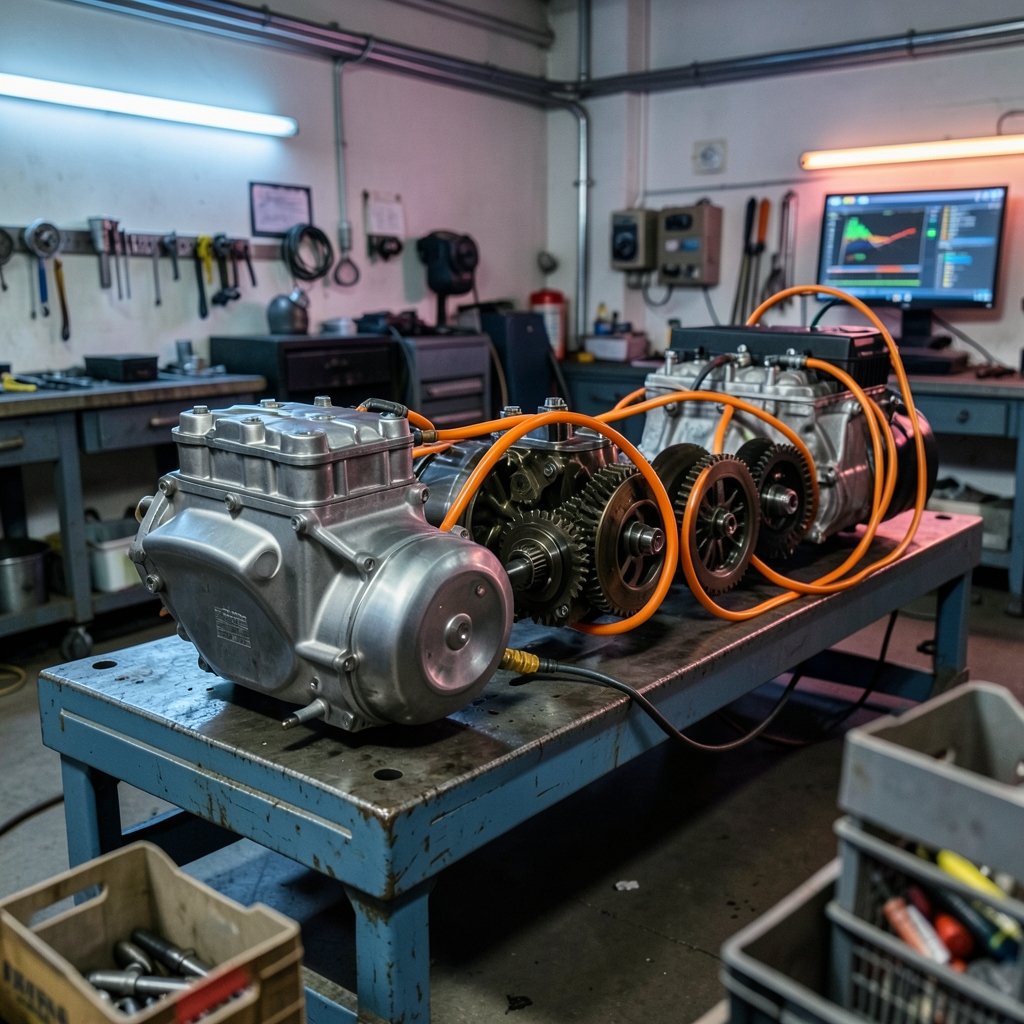
Under the hood, the CX-50 Hybrid pairs a 2.5-liter four-cylinder gasoline engine with electric motor assistance and an electronically controlled continuously variable transmission, usually shortened to e-CVT. If that recipe sounds familiar, it should. It is the classic Toyota-style hybrid layout, where the transmission is not a belt-driven CVT at all but a set of planetary gears and motors that manage the blend of engine and electric power.
That distinction is worth understanding because it explains how the car feels. Traditional CVTs sometimes drone under hard acceleration. Toyota-style hybrid systems behave differently because the electric motors carry a lot of the low-speed work. The engine can spin up to a steady, efficient speed while the motors handle the rest. The result is smoother than a conventional CVT and often quieter around town.
The CX-50 Hybrid also comes with all-wheel drive in the Toyota style, meaning a rear electric motor provides power to the back wheels rather than a mechanical driveshaft running the length of the car. That setup can react quickly and adds traction without the weight penalty of a traditional AWD system. One caveat: whether every trim is AWD should be confirmed with a dealer, since trim-specific drivetrain details are the kind of thing that shifts between model years.
Why the Toyota Connection Is a Selling Point
Shoppers sometimes worry that a “borrowed” powertrain means a compromised car. In practice, the opposite is often true. Toyota’s hybrid system is one of the most proven electrified drivetrains on the road, refined over multiple generations. Mazda’s job was to wrap its own steering, suspension tuning, and interior around that hardware. That division of labor is a sensible one: let the hybrid experts handle the hybrid, and let the chassis engineers handle the part that makes a Mazda feel like a Mazda.
Fuel Economy: The Headline Number
The whole reason this model exists is fuel economy. EPA-estimated combined fuel economy lands in the high-30s mpg range, with roughly 38 mpg combined commonly cited for the 2025 model year. That is a substantial jump over the gasoline CX-50, which is the comparison most shoppers will make.
| Factor | Gasoline CX-50 | CX-50 Hybrid |
|---|---|---|
| Powertrain | 2.5L four-cylinder (plus turbo options) | 2.5L four-cylinder plus electric motors |
| Transmission | Conventional automatic | Electronically controlled CVT (e-CVT) |
| AWD setup | Mechanical driveshaft | Rear electric motor |
| Fuel economy | Lower | High-30s mpg combined (EPA estimate) |
| Character | More engine options, including turbo | Smoother, quieter low-speed driving |
Two things are worth flagging honestly. First, exact EPA figures vary by trim and drivetrain, so anyone comparing window stickers should check the official government fuel economy database rather than trusting a single number from a review. Second, real-world economy depends heavily on how you drive. Hybrids reward smooth inputs and punish highway speeds more than city traffic, which is the reverse of what many drivers expect.
Practical Tips for Getting the Most Out of It
A few habits make a measurable difference in a hybrid like this:
- Brake early and gently. Regenerative braking sends energy back to the battery. Hard, late braking wastes that opportunity.
- Use the eco display. Watching the instantaneous economy readout trains you to stay in electric mode longer at low speeds.
- Accept slower highway speeds. Aerodynamic drag climbs steeply above 65 mph. Dropping five mph often gains a couple of mpg.
- Precondition in hot weather. Running the air conditioning before you load the car, while plugged into nothing, still helps because the cabin cools faster once moving.
- Do not baby it constantly. Short bursts of normal acceleration are fine. What kills economy is repeated hard launches and constant speed fluctuation.
The most common mistake new hybrid owners make is treating the car like a conventional automatic and stomping the throttle from a stop. That forces the engine on immediately and skips the electric-only low-speed phase where the biggest savings live.
Driving Feel and Everyday Use
Here is where expectations need calibrating. The CX-50 has always leaned more toward “rugged compact” than “sports sedan,” and the hybrid does not change that. The electric motors add instant low-speed response, which makes the car feel peppy in parking lots and city traffic. On the highway, the engine takes over and the experience settles into something calm and unremarkable, which is exactly what most buyers want.
The trade-off is that enthusiasts who loved the turbo gasoline CX-50 may find the hybrid’s power delivery less thrilling at high speeds. That is what an efficiency-first powertrain does. If outright acceleration matters more than fuel bills, the gasoline turbo remains the choice. If the daily commute is the priority, the hybrid wins without much debate.
Inside, the CX-50 Hybrid uses Mazda’s latest infotainment setup and its i-Activsense suite of driver-assistance features. The cabin follows the same design language as the gasoline model: clean lines, a wide center console, and materials that punch above the segment’s price point. Buyers stepping out of a 2b hair routine of endless product comparisons will recognize the same principle here: the details you touch every day matter more than the spec sheet.
Practical considerations matter too. The CX-50 is a compact crossover, so rear-seat space is adequate rather than generous. Cargo room is competitive but not class-leading. If you routinely haul adults in the back or pack for long family trips, sit in one before committing. The sloping roofline looks great and costs a little headroom.
Manufacturing and the Bigger Picture
The CX-50, hybrid included, is built at Mazda Toyota Manufacturing in Huntsville, Alabama, a joint plant between the two companies that has been operating since 2021. That detail matters for buyers who care about where their car comes from, and it reinforces how deep the Mazda-Toyota relationship runs. This is not a badge-engineered rebadge, but it is a genuine shared-platform story.
The broader context is that compact hybrid crossovers have become the default choice for a huge slice of the market. Buyers who once dismissed hybrids as slow or strange now treat them as the sensible option, and Mazda needed an answer in that conversation. The CX-50 Hybrid is that answer, delivered with borrowed expertise and Mazda’s own chassis tuning on top.
Pricing for the 2025 model year started in the mid-$30,000s, though buyers should treat any figure they read online as a starting point rather than gospel. Prices move, incentives appear and disappear, and 2026 model year details may differ. Anyone shopping seriously should confirm current pricing and any model-year updates directly with a dealer rather than relying on older reviews.
Where It Fits Against Rivals
The obvious comparison is the RAV4 Hybrid, which shares the underlying hybrid concept and has a head start on reputation. The CX-50 Hybrid counters with sharper styling, a more premium-feeling cabin, and a slightly more distinctive personality. The Honda CR-V Hybrid offers more interior space and a smoother ride. The Hyundai Tucson Hybrid undercuts on price and piles on features.
| Model | Strength | Weakness |
|---|---|---|
| Mazda CX-50 Hybrid | Style, cabin quality, driving refinement | Less rear space, smaller dealer network |
| Toyota RAV4 Hybrid | Proven reliability, strong resale | Busier interior, less premium feel |
| Honda CR-V Hybrid | Roominess, ride comfort | Less distinctive styling |
| Hyundai Tucson Hybrid | Value, feature count | Less engaging to drive |
The honest summary is that the CX-50 Hybrid is not the obvious class leader on paper. It is the one you buy because you like how it looks and how it feels, and because the fuel economy finally stops being a reason to walk away. That is a narrower pitch than “best in class,” but it is an honest one.
For drivers with textured or coily hair who care about cabin airflow on long trips, the climate system and seat materials are worth a test sit. A 4c hair care routine depends on consistent moisture and temperature control, and a car’s HVAC performance matters more than most reviews admit. Likewise, anyone following the row of trim-by-trim comparisons should note that features like heated seats and upgraded audio often appear only on higher trims, so the base price rarely tells the full story.
Common Mistakes Buyers Make
A few pitfalls show up again and again with this model:
- Assuming every trim is identically equipped. Feature content varies, and the cheapest hybrid may lack items shoppers expect.
- Comparing hybrid and gasoline prices without doing the math. The fuel savings are real but take years to offset a price premium. Run the numbers for your own annual mileage.
- Skipping the test drive because “it’s just a hybrid.” The low-speed electric character is genuinely different, and some drivers love it while others miss engine sound.
- Ignoring tire choice. Hybrids are sensitive to rolling resistance. Replacing tires with aggressive all-terrains can quietly erase several mpg.
- Forgetting maintenance intervals still apply. Hybrids need less brake wear but still need oil changes, coolant checks, and cabin filter replacements.
Conclusion
The Mazda CX-50 Hybrid is a sensible answer to a question Mazda spent years avoiding. By borrowing Toyota’s proven hybrid architecture and wrapping it in one of the better-looking compact crossovers on sale, Mazda built a vehicle that finally lets style-conscious buyers stop apologizing for their fuel bills. It is not the fastest CX-50, not the roomiest hybrid in its class, and not the cheapest. What it is, is a well-rounded package with a clear personality and a genuinely efficient heart.
Buyers should verify current pricing, exact EPA figures, and trim-specific features before signing anything, since those details shift between model years. But the core story holds: if you want a compact hybrid crossover that looks good, feels solid, and sips fuel around town, the CX-50 Hybrid deserves a spot on your test-drive list.
FAQ
What is the Mazda CX-50 Hybrid?
It is a hybrid version of Mazda’s compact CX-50 crossover, introduced for the 2025 model year. It pairs a 2.5-liter four-cylinder engine with electric motors and an e-CVT, using hybrid technology adapted from Toyota.
Does the CX-50 Hybrid use a Toyota engine?
The hybrid system is adapted from Toyota’s hybrid technology, the same family used in the Toyota RAV4 Hybrid. The engine itself is a 2.5-liter four-cylinder, and the overall hybrid architecture follows Toyota’s proven design.
What kind of fuel economy does it get?
EPA-estimated combined fuel economy is in the high-30s mpg range, with roughly 38 mpg combined commonly cited for the 2025 model year. Exact figures vary by trim and drivetrain, so check the official government fuel economy database.
Is the CX-50 Hybrid all-wheel drive?
It is offered with all-wheel drive using a rear electric motor rather than a mechanical driveshaft. Whether every trim includes AWD should be confirmed with a dealer, since drivetrain details can vary by model year and trim.
Where is the CX-50 Hybrid built?
It is built at Mazda Toyota Manufacturing in Huntsville, Alabama, a joint plant between Mazda and Toyota that has operated since 2021.
How much does the CX-50 Hybrid cost?
Pricing for the 2025 model year started in the mid-$30,000s. Prices change frequently and 2026 model year details may differ, so confirm current pricing with a dealer rather than relying on older reviews.









