What colors make brown is a question with a satisfyingly simple answer: red, yellow, and blue mixed together make brown. Those three primary colours, blended in roughly equal parts, produce a rich mid-brown, and small changes to the balance shift it warmer, cooler, lighter, or darker. Brown is not a colour you buy in one tube and leave alone; it is a colour you build.
That is why brown feels so different from other colours. It has no single place on the colour wheel, and it appears in so many forms, from chestnut and coffee to caramel, tan, and rust. This guide explains how brown is made, how to adjust it, and how to use it well in paint, in the kitchen, and on screen.
Whether you are painting a room, mixing a shade for a canvas, colouring icing, or choosing a palette for a design, the same ideas apply. Start with the primaries, watch what each addition does, and test the result before you commit. Brown rewards patience more than boldness.
Key takeaways:
- Red, yellow, and blue mixed together make brown; roughly equal parts give a balanced mid-brown.
- Complementary pairs also make brown: orange and blue, red and green, or yellow and purple.
- More red or yellow makes a warm brown; more blue or green makes a cooler brown.
- Add white to lighten brown, and add black or a little more blue in small steps to darken it.
- Always test a small amount first, because a tiny addition can change brown quickly.
Why brown is a colour you build, not a colour you find
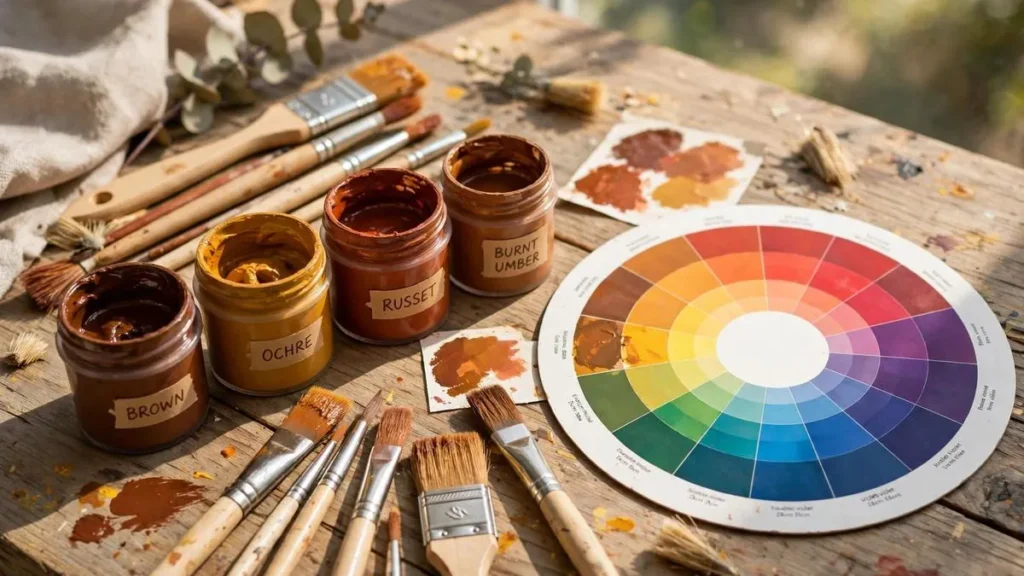
Brown sits outside the neat order of the rainbow. The colour wheel shows red, orange, yellow, green, blue, and purple in a circle, with no brown anywhere in sight. That absence is the first clue to how brown works: it is a dark, muted form of orange, created when bright colours are softened and darkened.
Think of orange as the starting point. Orange itself is red plus yellow, a warm and vivid colour. Add a little of its opposite, blue, and the orange loses its brightness and sinks into brown. Add a little more blue, and the brown turns cooler and deeper. Add white, and it lifts towards tan.
This is why brown has so many names. Chestnut, chocolate, coffee, caramel, walnut, rust, and tan are all browns with different balances of warmth, lightness, and depth. They are not separate colours in the way red and blue are separate; they are points along the same sliding scale.
How to mix brown from the three primaries
The most reliable way to make brown is to mix the three primary colours: red, yellow, and blue. In paint, these are the colours that cannot be made by mixing other colours, and every other colour can, in principle, be built from them. Brown is what you get when all three are present together.
Start with roughly equal amounts of red and yellow, and mix them into orange. Then add blue a little at a time, mixing well after each addition. The orange will dull, deepen, and settle into brown. Stop as soon as you reach the shade you want, because the next drop of blue will take it further than you expect.
The exact brown you get depends on the reds, yellows, and blues you start with. A warm red and a warm yellow give a warmer brown, while a cooler blue pulls it towards a deeper, greyer brown. That is normal, and it is why two painters following the same recipe can end up with slightly different browns.
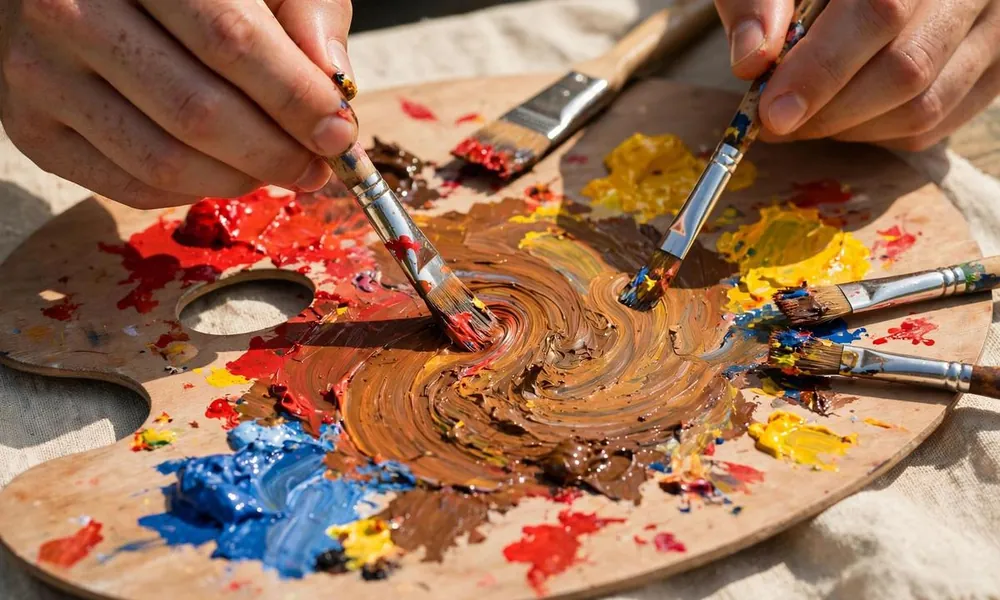
Mixing on a palette, rather than straight onto the canvas or wall, gives you room to test. Put a small dab of your brown on a scrap of paper or card, and look at it in daylight. Colours often look different on the palette from how they look once they are spread thin, so the test dab is worth the extra minute.
What colours make brown: the recipes at a glance
The table below sets out the main ways to make brown, with the result each one tends to give. Use it as a starting point, and adjust in small steps. The names are general descriptions, not fixed formulas, because every paint and every dye behaves a little differently.
| Method | Colours to mix | Result | Best for |
|---|---|---|---|
| Three primaries | Red, yellow, and blue | Balanced mid-brown | A reliable starting brown |
| Orange and blue | Orange plus a little blue | Warm, natural brown | Wood, earth, and skin tones |
| Red and green | Red plus a little green | Deep, reddish brown | Mahogany and autumn leaves |
| Yellow and purple | Yellow plus a little purple | Soft, golden brown | Caramel and honey tones |
| Brown plus white | Any brown plus white | Light tan or beige | Walls and pale wood |
| Brown plus black | Any brown plus a little black | Dark chocolate brown | Shadows and rich depth |
Notice how each recipe starts from a pair of complementary colours, colours that sit opposite each other on the wheel. Complementary colours cancel out each other’s brightness when mixed, and that cancelling is exactly what turns a bright colour into brown. It is the same idea in every row of the table.
Mixing brown from complementary colours
Complementary colours are pairs that sit opposite each other on the colour wheel: red and green, blue and orange, yellow and purple. Mix any pair together, and the result is a brown, because each pair contains all three primaries between them. Orange, for example, is red plus yellow, so orange plus blue contains red, yellow, and blue.
Orange and blue is the most useful pair for brown. Start with orange, add blue in tiny amounts, and you can walk the shade from a bright rust through a warm chestnut to a deep, cool brown. It is a forgiving route, because you can see the brown forming step by step.
Red and green give a different family of browns. Start with red, add green a little at a time, and the result leans towards mahogany and burgundy-brown. This pair is useful for autumn leaves, dark wood, and the warm browns found in old furniture.
How to make warm, cool, light, and dark brown
Once you have a basic brown, adjusting it is a matter of knowing which direction to move in. Warm and cool, light and dark, are the four directions, and each one has a simple adjustment. The trick is to make the change in small steps and to test as you go.
Warm brown
Warm browns lean towards red, orange, and gold. To warm a brown, add a little more red or yellow, or a little orange. A warm brown feels inviting and rich, and it suits wood, leather, autumn, and food. Think of the brown in a loaf of bread, a leather chair, or a cup of coffee made from good beans.
Cool brown
Cool browns lean towards blue, green, and grey. To cool a brown, add a little more blue, or a touch of green. A cool brown feels calm and restrained, and it suits stone, shadow, winter trees, and modern interiors. Think of the brown in wet bark, in slate, or in a well-worn pair of jeans.
Light brown and tan
Light browns, including tan and beige, are browns with white added. Start with your brown, then add white a little at a time until you reach the lightness you want. The result will also look a little cooler and softer, because white mutes the warmth as it lightens.
Dark brown and chocolate
Dark browns are browns with black added, or with more blue and red in the mix. Add black in very small amounts, because black is powerful and can flatten a brown quickly. A little black deepens the brown; a lot of black turns it into something closer to black itself.
Brown in paint, food colouring, and on screen
The ideas above work in paint, but brown behaves a little differently in other media. In food colouring, for example, you can make brown from red, yellow, and blue food colouring, or from orange and blue, in the same way as in paint. The amounts are tiny, so add one drop at a time and mix well.
When colouring icing or dough, remember that the colour often deepens as it sits. A brown that looks right when you first mix it may look darker an hour later, so aim a shade lighter than you want and let it settle. If you are icing a cake, our guide to frosting a cake covers the practical steps, and a brown icing can be a lovely finish for a chocolate cake.
Your brown-mixing checklist
Mixing brown is a practical skill, and a short checklist helps you keep the steps in order. Run through it each time you mix, and you will waste less paint and reach the shade you want sooner.
- Start with clean brushes and a clean palette, so old colours do not muddy the mix.
- Mix red and yellow first to make orange, then add blue a little at a time.
- Add the cooler colour in tiny amounts, and mix well after each addition.
- Test a small dab on scrap paper or card, and look at it in daylight.
- To warm the brown, add red or yellow; to cool it, add blue or green.
- To lighten the brown, add white; to darken it, add black in very small steps.
- Write down the mix that worked, so you can repeat it next time.
- Keep a little of the finished brown aside for touch-ups later.
Frequently asked questions
What two colours make brown?
Two complementary colours make brown: orange and blue, red and green, or yellow and purple. Each pair contains all three primaries between them, so mixing them dulls the brightness and leaves a brown. Orange and blue is the most useful pair for a warm, natural brown.
What three colours make brown?
Red, yellow, and blue make brown. Mix red and yellow into orange first, then add blue a little at a time until the orange deepens into brown. Roughly equal parts give a balanced mid-brown, and small changes to the balance shift it warmer or cooler.
How do you make light brown?
Add white to brown a little at a time until you reach the lightness you want. The result is often called tan or beige. If the light brown looks too pale or chalky, add a tiny amount of yellow or orange to restore a little warmth.
How do you make dark brown?
Add black in very small amounts, or add a little more blue and red to deepen the brown without flattening it. Dark brown is best used for accents, shadows, and furniture, rather than for large walls, where it can make a room feel smaller.
Why does my brown look grey or muddy?
Brown often looks grey or muddy when too much blue or black has been added too quickly, or when the colours on the palette were not clean. Start again with a fresh orange base, add the cooler colour in smaller steps, and test each stage on scrap paper.
Brown is simpler than it looks
What colours make brown turns out to be a short answer with a long, enjoyable tail. Red, yellow, and blue make brown, and so do orange and blue, red and green, and yellow and purple. From that starting point, small additions take you to warm chestnut, cool bark, pale tan, and deep chocolate. Try mixing a small amount on a palette next, and test it on scrap paper.