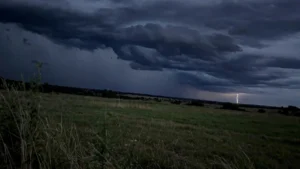
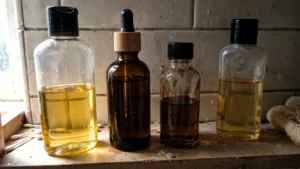
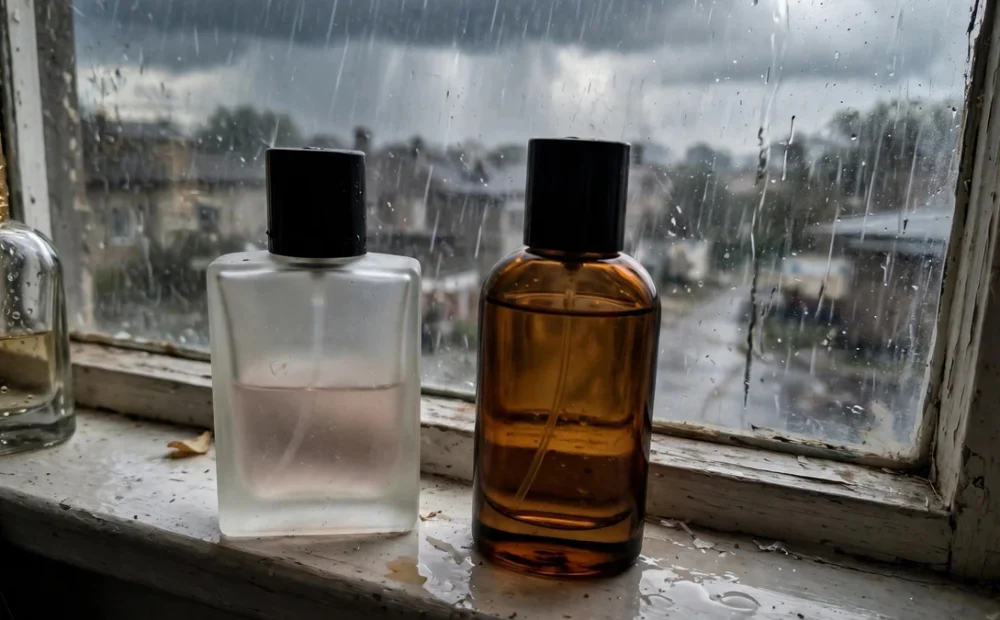
A rain perfume is a fragrance built around the smell of rain itself. Not a flower that happens to smell fresh, and not a generic aquatic scent, but a deliberate attempt to bottle the moment rain hits dry ground, the cool air that follows, and the wet earth left behind.
That is what makes the family interesting. Perfumers cannot press rain into a bottle, so they rebuild it from parts: the earthy smell of wet soil, the electric edge of a storm, the clean lift of water, and the green of wet leaves. When the parts are balanced, the result is unmistakable.
Key takeaways
- A rain perfume is an accord built from petrichor, ozone, aquatic and green notes, because rain itself cannot be extracted or distilled.
- Petrichor is the earthy smell of rain on dry soil, made by plant oils and soil bacteria, and recreated in perfume with geosmin.
- The ozone edge in a rain scent is an impression of lightning and fresh air, built with light, volatile molecules that fade quickly.
- Rain perfumes are usually light and short-lived, lasting about four to five hours, and they suit cool, damp and grey weather best.
- An earthy rain perfume can smell like damp soil rather than fresh rain on warm skin, so always test before buying a full bottle.
What a rain perfume actually is
A rain perfume is a fragrance whose central accord imitates the smell of rain. That accord is built, not harvested. No part of a rain perfume comes from rainwater, and no essential oil of rain exists. Instead, the perfumer combines materials that the nose reads as rain: geosmin for wet earth, ozone notes for the cold, electric air after lightning, aquatic notes for water, and green notes for wet leaves.
This puts rain perfumes in a small family of weather scents, alongside sea salt and driftwood. Like driftwood perfumes, they are built around an idea rather than an ingredient. The difference is that driftwood is a material with a smell of its own, while rain is an event. A rain perfume has to capture a moment in time: the first drops, the height of the storm, or the quiet afterwards.
Most rain perfumes are light, fresh and close to the skin. They are rarely sweet, rarely heavy, and rarely loud. They are designed to be worn in the weather they imitate, and they are at their best on cool, damp days, when the air itself does half the work.
How a rain scent is built and what to look for
A rain accord is built in layers, and each layer does a different job. The top is usually ozone or an aquatic note, which gives the first impression of cold, clean air. The heart is usually green or floral, wet leaves, water lily or a soft white flower, which gives the scent its body. The base is usually vetiver, soft woods or clean musk, which holds the freshness up and stops the scent from vanishing in twenty minutes.
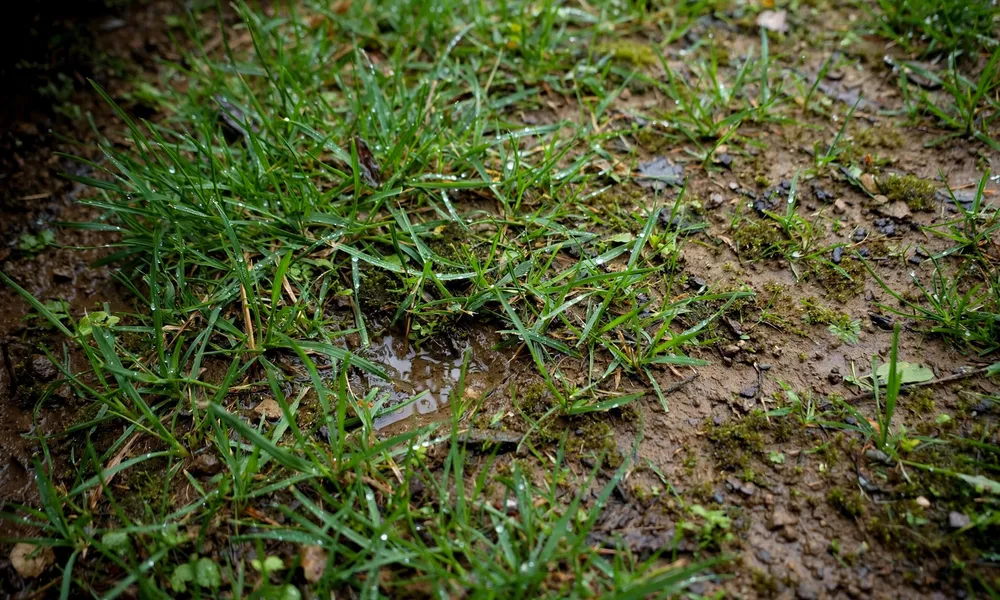
Look for a base you can name. A rain perfume that lists vetiver, cedarwood or musk in its base will usually last longer and smell more complete than one that lists only water and ozone. Look too at the concentration. Most rain scents are eau de toilette, which suits the family, because a heavier concentration would make the airiness feel thick.
Finally, look at what the perfume is not trying to be. A good rain scent does not need flowers, fruit or sweetness to work. The ones that add vanilla, amber or heavy woods have usually stopped being rain perfumes and become something else entirely, a woody scent with a watery opening. There is nothing wrong with that, but it is not what you came for.
9 facts about rain perfumes
Petrichor is a real smell with a real name, and it comes from the soil
What it shows: The word petrichor was coined in 1964 by two Australian scientists to name the scent released when rain falls on dry soil, and it comes from plant oils trapped in soil and rocks, plus a compound called geosmin made by soil bacteria. What to consider: Because petrichor is a soil smell, a perfume built heavily on it can read as earthy or muddy on warm skin. Best for: Understanding why the most literal rain perfumes smell like a garden path, not like clean water. Material: Geosmin, used in tiny amounts. Price range: Petrichor-focused scents are usually affordable, around $35 to $135. Standout feature: The only fragrance note named after a weather event rather than a plant or a place.
The lightning smell in rain perfume is ozone, and it is not actually ozone
What it shows: The sharp, electric smell after a thunderstorm is often called ozone, but perfumers cannot use real ozone, which is a gas, so they build the impression with light, metallic-smelling molecules that the nose reads as cold, clean air. What to consider: Ozone notes are the fastest to evaporate, which is why the lightning edge of a rain perfume is usually gone within an hour. Best for: Anyone who loves the first five minutes of a rain perfume and wants to know why it changes so fast. Material: Ozone accords, built from aldehydes and marine notes. Price range: Found in scents from around $35 to $195. Standout feature: The most recognisable and the most fleeting part of any rain scent.
Rain has no top note of its own, so perfumers borrow one from water
What it shows: Real rain has no essential oil and no single molecule a perfumer can extract, so the opening of a rain perfume is borrowed from aquatic notes, cucumber, melon or green tea, chosen to suggest cold water and clean air. What to consider: The borrowed top note decides the character of the perfume, so a cucumber opening smells like a soft morning and a marine opening smells like a storm. Best for: Reading a note list and predicting how a rain perfume will open. Material: Aquatic notes, cucumber, calone or green tea. Price range: Aquatic-led rain scents run from around $60 to $160. Standout feature: The top note is the least rain-like part of a rain perfume, and the most important to get right.
A drizzle and a downpour are two different accords
What it shows: A light drizzle smells mostly of ozone and clean air, while a heavy downpour smells mostly of wet earth, wet leaves and running water, so perfumers build them as different accords with different weights. What to consider: Drizzle scents are lighter, quieter and easier to wear daily, while downpour scents are earthier, louder and harder to wear in warm weather. Best for: Choosing between a soft daily rain scent and a dramatic, realistic one. Material: Ozone and musk for drizzle, geosmin and vetiver for downpour. Price range: Drizzle scents are usually cheaper, around $35 to $100, while downpour scents run to $135 and above. Standout feature: The same family, split by intensity, like a whisper and a shout.
Geosmin is so strong that a single drop flavours a swimming pool
What it shows: Geosmin, the molecule behind petrichor, is detectable by the human nose at a few parts per trillion, which is why perfumers use it in almost homeopathic amounts, and why a rain perfume can smell earthy even when geosmin is barely present. What to consider: Because the nose is so sensitive to geosmin, small differences in skin chemistry can make the same perfume smell fresh on one person and muddy on another. Best for: Explaining why rain perfumes are the most skin-dependent scents in the fresh family. Material: Geosmin, diluted to a fraction of a percent. Price range: It appears in scents at every price, from $35 to $195. Standout feature: The most powerful smell molecule in perfumery, used in the smallest dose.
Rain perfumes fade fast because their best molecules are the lightest
What it shows: The molecules that smell like cold air and clean water are small and volatile, which means they evaporate quickly, so a rain perfume loses its freshest notes within the first hour and relies on its base for the rest of its life. What to consider: A rain perfume with no vetiver, wood or musk base will often disappear entirely within two hours, while one with a solid base can last four to five. Best for: Setting honest expectations about how long a rain perfume will last. Material: Light aldehydes and aquatic molecules on top, vetiver and musk underneath. Price range: Longevity does not track price closely in this family. Standout feature: The freshness and the short life are the same property, not two different ones.
Vetiver is the grass that rain stands on
What it shows: Vetiver, a grass root with a smoky, green, earthy smell, is the most common base note in rain perfumes, because it smells like damp grass and wet earth without being heavy, and it holds the fresh top notes up for hours. What to consider: Vetiver can add a smoky edge that surprises people expecting a purely clean scent, especially in darker, woodier rain perfumes. Best for: Understanding why so many rain perfumes share a grassy, earthy drydown. Material: Vetiver oil, from the roots of Vetiveria zizanioides. Price range: Vetiver-based rain scents run from around $60 to $195. Standout feature: The note that turns a fleeting rain impression into a wearable perfume.
The same rain perfume smells different in January and in July
What it shows: Heat speeds up evaporation, so in summer the fresh top notes leave faster and the earthy base arrives sooner, while in winter the cold air slows everything down and the ozone notes stay sharp and clean for longer. What to consider: A rain perfume that smells muddy in July can smell crisp and beautiful in January, so a single test in the wrong season can mislead you. Best for: Anyone who tried a rain perfume once, in summer, and gave up on the family. Material: The same molecules, behaving differently at different temperatures. Price range: Season affects every rain perfume, at every price. Standout feature: Rain perfumes are the most weather-sensitive scents you can buy.
Rain is the only weather note that works as a base for other scents
What it shows: Because a rain accord is light, clean and neutral, it can sit underneath almost any other family, softening a heavy floral, cooling a warm amber, or adding air to a dense woody scent, which is why perfumers use rain as a layering base as well as a lead note. What to consider: Layering works best when the rain scent goes on top of a heavier scent, not underneath it, so the freshness stays the leading note. Best for: People who own one rain perfume and want to get more use out of it. Material: Ozone and aquatic accords, which do not fight with other notes. Price range: Any rain perfume can be layered, from $35 to $195. Standout feature: A weather note that behaves like a neutral background, not a solo star.
Who rain perfumes suit best
Rain perfumes suit people who like light, fresh, quiet scents and who live in climates where grey weather is common. They are a natural choice for spring and autumn, for offices and shared spaces, and for anyone who finds sweet or heavy perfumes overwhelming.
They suit people who are happy to reapply. A rain perfume is not a spray-and-forget scent, and if you want a fragrance that lasts from morning to midnight without a second thought, this family will frustrate you. You can spray more without ever smelling overdone.
They are less suited to people who want a signature scent that announces them, or to people who live in very hot climates and want a perfume that survives a full day of heat. Our guide to green tea perfumes covers a family that shares rain’s freshness but holds up better in warm weather, and the two families layer well together.
The caveats that matter
The main caveat with rain perfumes is the gap between the idea and the reality. The idea is rain itself, clean and universal. The reality is a perfume that smells like rain on one person and like damp soil, a swimming pool or a wet basement on another. That gap is wider for rain than for almost any other fragrance family, because the key molecule, geosmin, is so powerful and so skin-dependent. The same skin test applies to sea salt perfumes, another light family that changes on warm skin.
| Detail | What is known |
|---|---|
| What it is | An accord built from petrichor, ozone, aquatic and green notes |
| What it is not | It contains no rainwater and no extract of rain |
| Key molecule | Geosmin, detectable at a few parts per trillion |
| How long it lasts | Usually 4 to 5 hours; literal rain scents often less |
| Best season | Spring and autumn, and cool or damp days in any season |
| Who should test first | People sensitive to earthy or mineral notes, and warm skin |
| Storage | Cool, dark place; light and heat fade aquatic notes fast |
| What it does not do | It does not project far, and it does not smell the same on everyone |
The second caveat is longevity. Rain perfumes are short-lived by design, and no amount of money fixes that. Buy the scent you love, in a size you are happy to reapply, and do not pay extra expecting extra hours.
Checklist: buying a rain perfume honestly
Use these checks before you buy, and again after a full day of wear.
- Test on skin, on a cool or damp day, and wait a full hour before deciding.
- Decide which rain you want: literal petrichor, clean aquatic, or green and woody.
- Check the base for vetiver, woods or musk, which decide how long it will last.
- Spray once on skin and once on fabric, and compare which holds the scent better.
- Try it over a soft musk or a vetiver scent to see how it layers.
- Buy a small size first if the perfume is petrichor-heavy, because geosmin is very skin-dependent.
Frequently asked questions
Does a rain perfume actually contain rainwater?
No. There is no rainwater in any rain perfume, and there could not be, because rainwater has no smell of its own. The scent is built from fragrance materials, mainly geosmin for wet earth, ozone accords for cold air, and aquatic notes for water, combined to create an impression the nose reads as rain.
Why does my rain perfume smell like a swimming pool on me?
That is usually the aquatic notes, particularly calone, reading as chlorinated water on warm skin. Try it on a cooler day, spray less, or choose a greener or earthier rain scent with less calone.
How long does a rain perfume last on skin?
Usually four to five hours, and less for the most literal petrichor scents. The fresh top notes fade within the first hour, and what remains is the base, usually vetiver, woods or musk.
Can I wear a rain perfume to a wedding?
Yes, and it is a good choice for a daytime or outdoor wedding, because it is light, inoffensive and close to the skin. It is less suited to a formal evening wedding, where most rain perfumes are too quiet to carry. If you want rain at an evening event, layer it over a soft musk or a light floral for extra presence.
What is the difference between a rain perfume and an aquatic perfume?
A rain perfume imitates weather, with petrichor, ozone and wet earth added to the water. Aquatic perfumes are usually brighter and cleaner. Rain perfumes are usually earthier, greener and more atmospheric.
Which rain perfume should I try first?
Start with Demeter Rain if you want the most literal smell of rain, or Clean Reserve Rain if you want the easiest daily wear. If you love either of them, try a petrichor scent or a green rain scent next, and you will know which kind of rain suits you.
The bottom line
A rain perfume is a weather report in a bottle, built from petrichor, ozone, water and green notes because rain itself cannot be extracted.
Choose the rain you love, test it on a damp day, and give it a full hour before you decide. If it still smells like fresh air and wet earth, you have found a scent that makes grey weather feel like a pleasure, not a problem.