

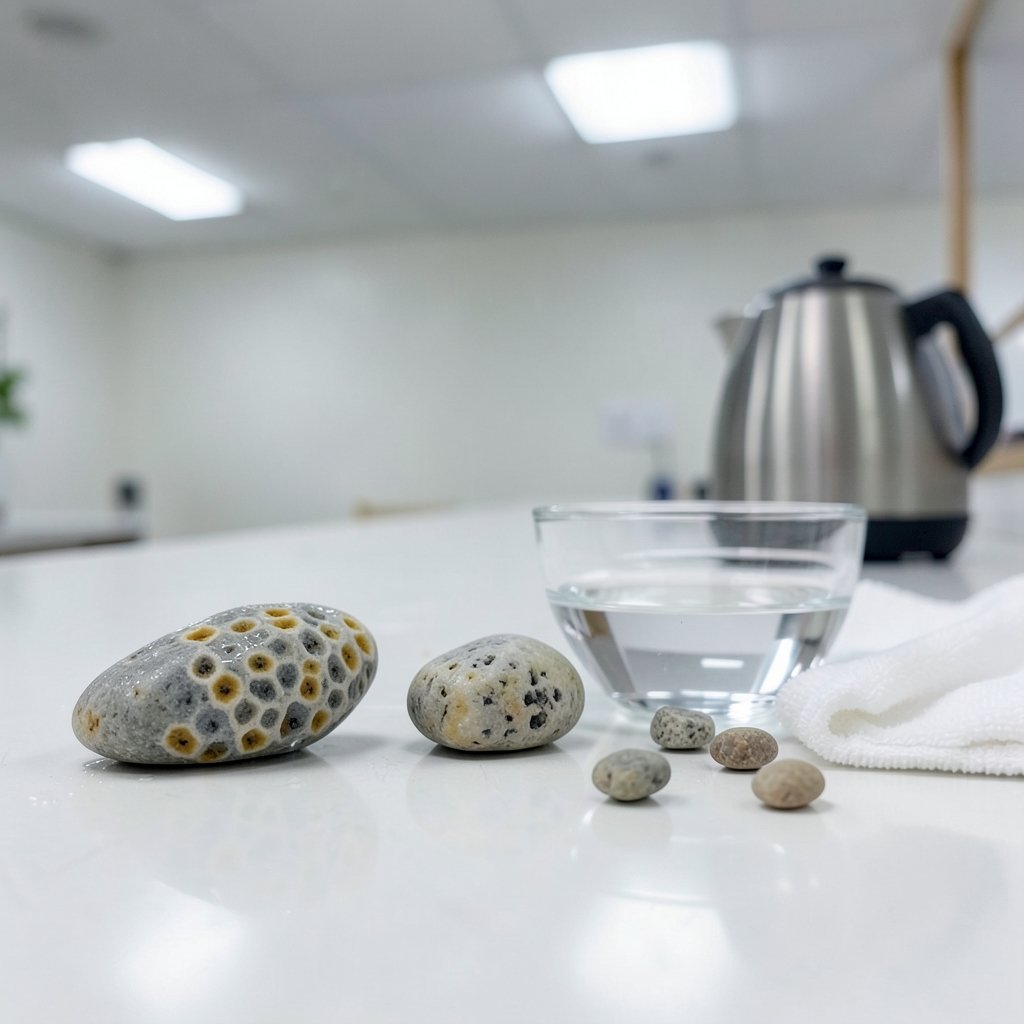
What if a rock you picked up on a Michigan beach turned out to be a 350-million-year-old coral reef, pressed into stone and polished by glaciers? That is exactly what a Petoskey stone is. It looks like an ordinary gray pebble until you wet it or hold it in the sun, and then a honeycomb pattern of tiny six-sided cups appears. Once you see that pattern, you never unsee it.
This guide explains what the stone actually is, where it comes from, how to identify one with confidence, and how to polish it without ruining it. It also covers the rules that matter, because the most common mistake people make is not knowing where collecting is allowed.
What Is a Petoskey Stone?
A Petoskey stone is a fossil colony of coral, commonly identified as Hexagonaria percarinata, embedded in rock that formed during the Devonian period. The coral lived in a shallow tropical sea that once covered what is now northern Michigan. When the coral died, minerals slowly replaced its skeleton, and the whole colony turned to stone.
The stone is the official state stone of Michigan, a designation made in 1965. That status says a lot about how deeply the stone is woven into the identity of the region. It shows up on jewelry, on souvenirs, in landscaping, and in the pockets of nearly every beachcomber along Lake Michigan and Lake Huron.
The name comes from Petoskey, a town in northern Michigan where the stones were found in abundance and where a local businessman, Ephraim Shay, popularized them in the late 1800s. That origin story is repeated widely and is worth treating as tradition rather than documented fact.
One point of confusion: a Petoskey stone is not a single coral animal. It is a colonial coral, meaning thousands of individual polyps lived side by side, each building its own cup-shaped skeleton. Those cups, called corallites, are what create the pattern you see today.
The Geology Behind the Honeycomb Pattern
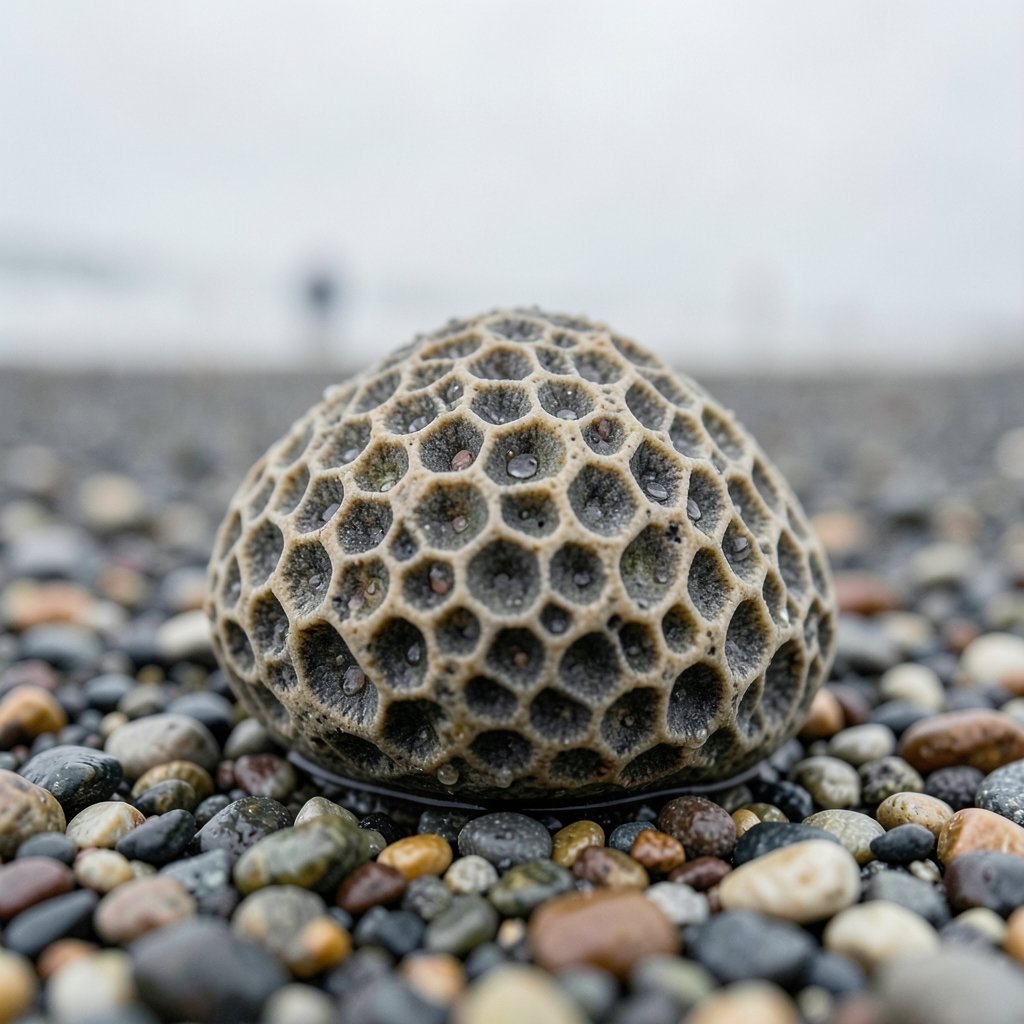
Roughly 350 million years ago, during the Devonian period, Michigan sat near the equator. Warm, clear, shallow water covered the region, and coral reefs thrived in it. The coral that became Petoskey stones grew in colonies, with each polyp secreting a hard calcium carbonate cup around itself.
When sea levels changed and the reefs died off, layers of sediment buried the coral. Over millions of years, minerals in groundwater seeped into the skeletons and crystallized, replacing the original material. The result is a fossil that preserves the shape of the coral in remarkable detail.
The fossil-bearing rock belongs to the Traverse Group, a set of limestones in northern Michigan. Glaciers later scraped across the landscape, breaking the limestone apart and dragging the pieces south and east. That is why the stones turn up on beaches far from any bedrock outcrop. They were carried there by ice, then tumbled and rounded by waves.
The honeycomb pattern itself is the key diagnostic feature. Each hexagon is a cross-section of a coral cup, and the dark center is the spot where the polyp’s internal structures once sat. The walls between cups are lighter, which creates the contrast. On an unpolished stone, the pattern is faint. On a wet or polished one, it is bold and unmistakable.
How to Identify a Petoskey Stone
Identification is easier than most people expect, but it takes a trained eye at first. The most common mistake is picking up any gray, rounded pebble with speckles and assuming it is a Petoskey stone. Granite and other speckled rocks fool a lot of beginners.
Here is a practical approach that works in the field:
- Wet the stone. Spit on it, dip it in the lake, or lick your thumb and rub it. Water fills the tiny surface pores and makes the pattern stand out. A dry, dull stone can look completely ordinary.
- Look for hexagons, not spots. The pattern should show six-sided shapes packed together like a honeycomb. Random speckles are usually mineral grains in granite.
- Check the “eyes.” Each hexagon typically has a darker center. If you see a grid of small circles with dark dots inside, you are on the right track.
- Turn it in the light. The pattern should be consistent across the whole surface rather than confined to one patch. A true Petoskey stone shows the coral structure throughout.
- Feel the texture. Polished stones are smooth. Raw ones are slightly rough and porous, which is why they absorb water and darken when wet.
Size matters less than pattern clarity. Small stones the size of a thumbnail can show a perfect honeycomb, while large ones may be weathered and faint. Collectors often favor stones with crisp, well-defined corallites, but a big, bold specimen has its own appeal.
Where Petoskey Stones Are Found
The stones are most common along the shores of Lake Michigan and Lake Huron, particularly near Petoskey, Charlevoix, and the Traverse City area. They also turn up in gravel pits, road cuts, and landscaping rock far inland, because glaciers scattered them widely.
Beach conditions change from year to year, and even week to week. Storms and wave action can expose fresh stones or bury them under sand. Spring and fall often bring better hunting because ice and storms churn the shoreline. After a big blow, walk the fresh gravel at the water’s edge and look for stones that are wet and dark.
A few practical tips from people who hunt regularly:
- Go early in the morning when the low sun rakes across the beach and highlights texture.
- Walk the wet zone just above the waves, where stones are already damp.
- Bring a spray bottle of water to check candidates without bending down twice.
- Look in gravel bars and rocky patches, not smooth sand.
- Carry a small bag, but leave the biggest, most beautiful stones for others to enjoy.
There is a real ethics question here. Popular beaches get picked over, and removing every good stone depletes the experience for the next person. Many collectors follow a simple rule: take a few, leave plenty, and never strip a spot.
Collecting Rules You Need to Know
This is where well-meaning collectors get into trouble. Rules vary by land ownership, and they are not always obvious from the beach.
| Land type | General rule | What to do |
|---|---|---|
| Private land | Permission required | Ask the owner before taking anything |
| State parks and recreation areas | Often restricted or prohibited | Check current park rules before collecting |
| National lakeshore (federal land) | Generally restricted | Confirm policy with park staff |
| Tribal land | Governed by tribal law | Obtain explicit permission |
| Ordinary public beaches | Often allowed in small amounts | Check local ordinances |
The safest approach is to check the rules for the specific place you plan to visit before you go. Michigan’s state geology and natural resources agencies publish guidance on fossil collecting, and national park units set their own policies. Rules can change, so a quick check on an official page is worth the two minutes.
The second rule is about scale. Casual collecting of a handful of stones for personal use is very different from hauling buckets away for resale. Commercial removal is typically regulated or banned, and it damages the resource for everyone.
Polishing a Petoskey Stone at Home
Raw stones are dull and gray. Polished ones glow, and the honeycomb pattern becomes the star. You can polish a Petoskey stone with hand tools, and it is a genuinely satisfying project.
The process is essentially the same as polishing any soft stone, but Petoskey stones are relatively soft, so gentleness matters. Here is a workable sequence:
- Clean the stone. Scrub off sand and dirt with water and a soft brush. Let it dry.
- Shape if needed. Use wet sandpaper or a lapidary wheel to smooth rough edges. Keep the stone wet to control dust.
- Work through grits. Start coarse and move progressively finer. Each step removes the scratches from the previous one.
- Check between grits. Dry the stone and look at it in good light. Any remaining scratches mean you need more time at the current grit.
- Polish. Use a fine polish and a soft cloth or buffing wheel until the surface shines.
- Seal if desired. Some collectors apply a stone sealer or a thin coat of mineral oil to deepen the color.
The biggest mistake is skipping grits. Jumping from coarse to fine leaves scratches that show up under polish, and you have to start over. Patience at each stage is what produces a glassy finish.
A second common mistake is overheating the stone on a mechanical buffing wheel. Petoskey stones can crack or chip if they get too hot. Keep the stone moving and use light pressure.
If you enjoy the finished look, the same skills transfer to other fossil and gem materials. Collectors who like the sparkle of a polished specimen often explore rhinestone nails for a completely different kind of shine, and the design principles of contrast and pattern carry over surprisingly well. For anyone drawn to bold color in their projects, this guide to green nail shades and skin tones shows how color choice changes the whole effect, much like polishing transforms a dull stone.
Petoskey Stone vs. Other Lookalikes
Not every fossil coral is a Petoskey stone, and not every hexagon is coral. Here is how the main lookalikes compare.
| Feature | Petoskey stone | Charlevoix stone | Granite pebble |
|---|---|---|---|
| Pattern shape | Six-sided honeycomb | Smaller, denser, often four- to six-sided | Random speckles |
| Pattern size | Larger corallites | Tiny, tightly packed | No regular pattern |
| Color when wet | Dark gray with light walls | Similar, often darker | Unchanged or slightly darker |
| Structure | Colonial coral cups | Colonial coral, different species | Interlocking mineral grains |
| Feel | Slightly porous when raw | Similar | Hard and smooth |
The Charlevoix stone is a close cousin, made of a different coral with much smaller cups. Both are fossils, both are found in the same region, and both polish well. Telling them apart comes down to the size and density of the pattern.
Granite is the most common false positive. Its speckles are irregular mineral crystals, not repeating cups. Once you have seen a few genuine Petoskey stones, the difference becomes obvious.
Why the Stone Matters Beyond the Beach
The Petoskey stone is a small object with an outsized story. It connects a modern beach walk to a tropical sea that existed before dinosaurs, before the Great Lakes, before the glaciers that scattered it. Holding one is a tangible link to deep time, and that is a rare thing to find in your pocket.
It also supports a local economy of rock shops, jewelers, and tourism. The stone appears in rings, pendants, cabochons, and carved figures. Some artisans set polished stones into silver, while others leave them raw and natural.
For people who love pattern and craft, the stone fits into a broader world of decorative design. The same instinct that draws someone to a honeycomb fossil shows up in diamond nail designs and rhinestone work, where small, repeating shapes create a larger visual effect. It is a reminder that pattern is one of the oldest forms of beauty, whether it grew in a coral reef or was placed by hand.
Conclusion
A Petoskey stone is a fossil coral from a Devonian sea, a Michigan state symbol, and one of the most satisfying things you can find on a beach. It rewards a little knowledge: wet the stone, look for hexagons, check the rules where you collect, and polish with patience. The pattern is the proof, and once you learn to read it, every gravel bar along Lake Michigan becomes a potential treasure hunt. Take a few stones, leave the rest, and enjoy the fact that you are holding a piece of a world that vanished 350 million years ago.
Frequently Asked Questions
What is a Petoskey stone made of?
It is a fossil colonial coral, commonly identified as Hexagonaria percarinata, preserved in limestone. Minerals replaced the coral skeleton over millions of years, leaving the six-sided coral cups visible as a honeycomb pattern.
Are Petoskey stones only found in Michigan?
They are most common in northern Michigan along Lake Michigan and Lake Huron, but glaciers carried them into surrounding areas, so they occasionally turn up in nearby states and in inland gravel deposits.
How can I tell a Petoskey stone from a regular rock?
Wet the stone and look for a repeating honeycomb of six-sided cups with darker centers. Random speckles usually mean granite, while a regular grid of cups means fossil coral. The pattern should appear across the whole surface.
Can you collect Petoskey stones on any beach?
No. Rules depend on who owns the land. Private land needs permission, state parks and federal lakeshore areas often restrict collecting, and tribal land has its own rules. Check the specific location’s policy before you go.
How do you polish a Petoskey stone?
Clean it, shape it if needed, then sand through progressively finer grits while keeping the stone wet. Finish with a fine polish and a soft buffing cloth. Skipping grits or overheating the stone are the most common causes of a poor finish.
Is the Petoskey stone rare?
The stone is not rare in its home region, but high-quality specimens with crisp, well-defined patterns are less common. Popular beaches are heavily picked over, so good stones often require patience and timing after storms.














