

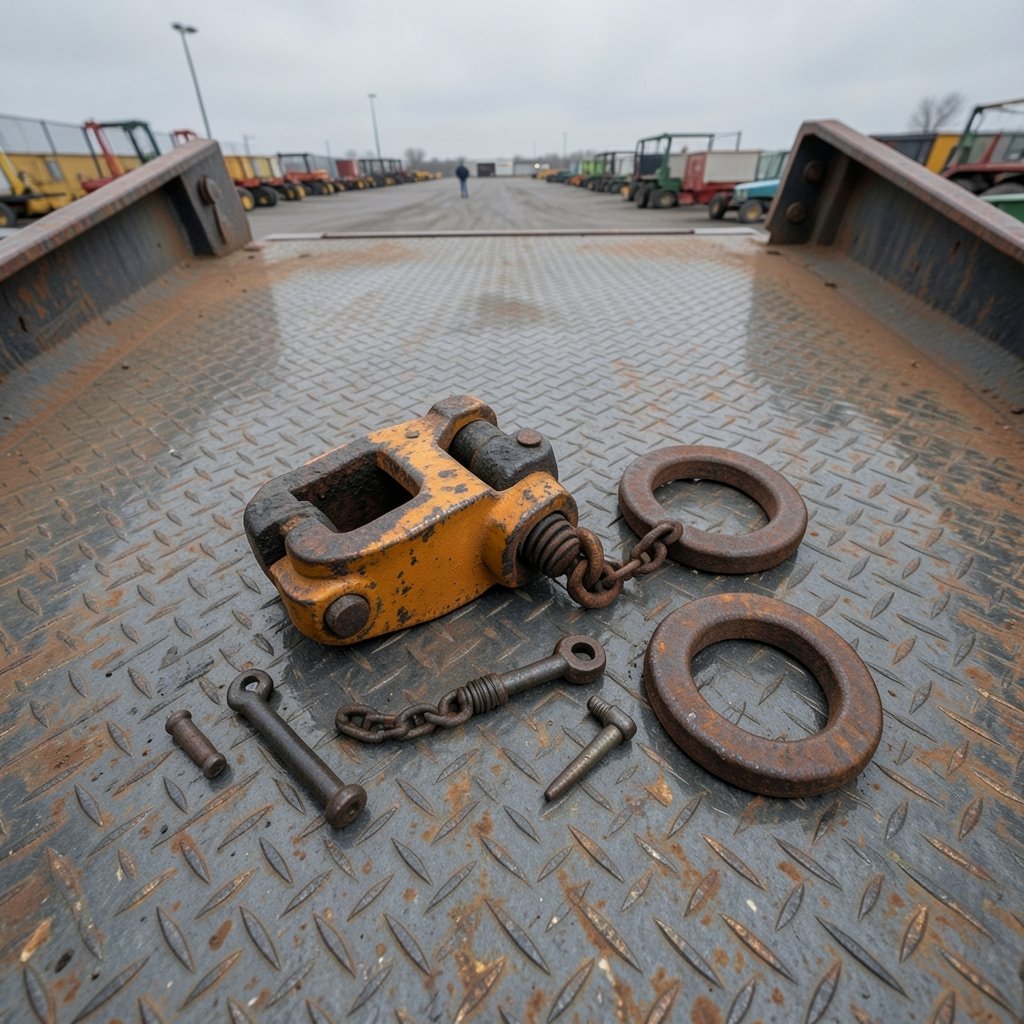
What do military convoys, dump trucks, and farm trailers have in common that a shiny pickup with a ball mount usually doesn’t? They all lean on a hook-and-ring connection that looks almost primitive next to a modern ball hitch, yet it survives conditions that would chew a ball mount to scrap. That connection is the pintle hitch, and understanding how it works, what it pairs with, and where it fails is the difference between a safe tow and a very expensive lesson.
What a Pintle Hitch Actually Is
A pintle hitch is a towing coupling built around two parts. On the towing vehicle sits a hook-shaped jaw called the pintle. On the trailer’s drawbar sits a ring called the lunette eye (sometimes just the lunette). The pintle jaw closes around the ring, and a latch or pin keeps it shut. That’s the whole system.
The design is old, and that’s part of its appeal. There are no ball bearings to seize, no coupler housing to fill with grease, and no precise alignment needed to hook up. A driver backs toward the ring, drops the jaw, and the trailer is attached. In mud, on gravel, or in the dark, that simplicity matters more than it sounds.
One quick note on terminology, because it trips people up. “Pintle” also describes the vertical pin in a hinge and the pivot pin on some gun mounts. In towing, it means the hook-and-eye coupling and nothing else. If someone starts talking about pintles on an aircraft, they’re in a different conversation.
How the Pintle and Lunette Pair Up
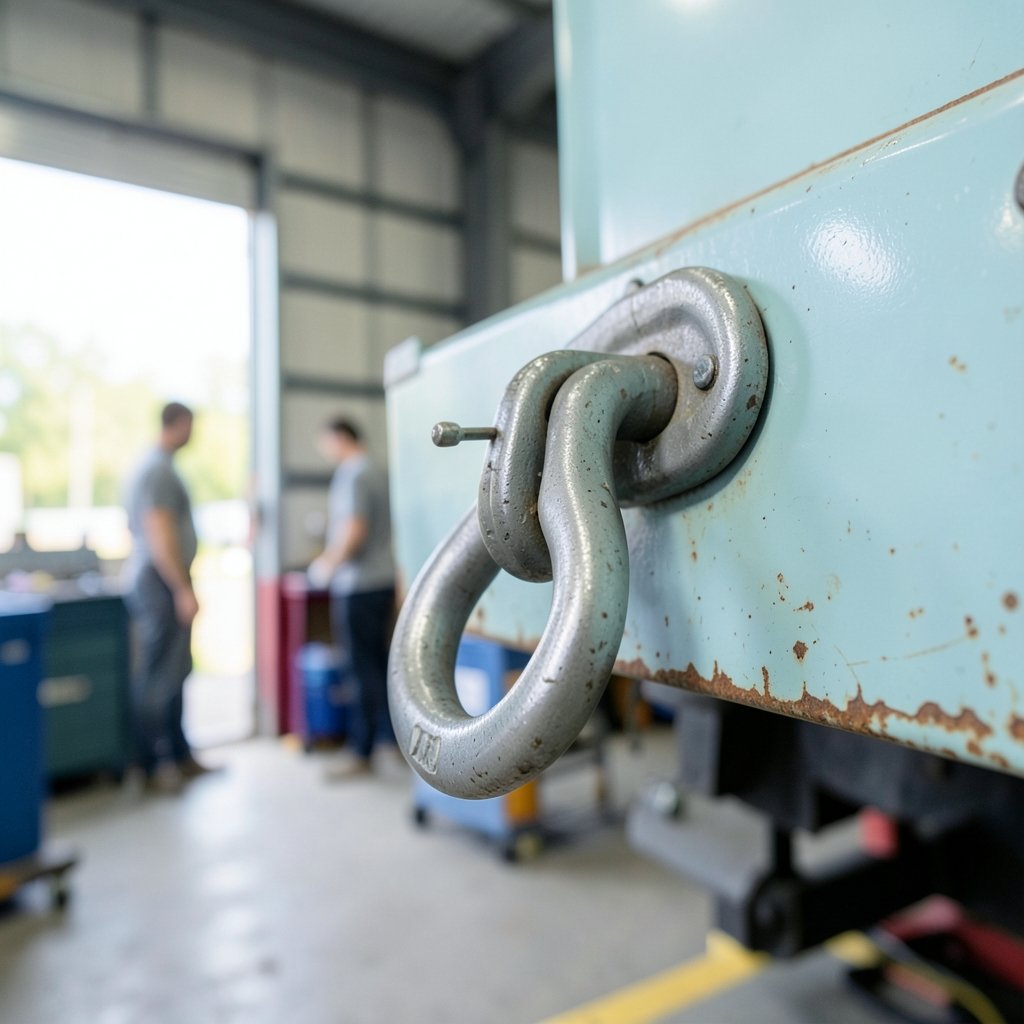
The pintle and lunette must match in size. This is not a suggestion. Lunette eyes come in several nominal sizes, and in North American practice the common ones run from about 2 inches up to roughly 3½ to 4 inches for the heaviest applications. A 3-inch ring in a 2-inch jaw will rattle, wear, and eventually slip free under load. A ring too large for the jaw simply won’t seat.
Experienced operators check three things before every hookup:
- Ring size against jaw rating. The lunette should sit fully in the throat of the hook with the latch closed.
- Latch function. The safety latch or pin must engage positively; it should not merely flop into place.
- Wear on both parts. A hook that has worn open, or a ring worn thin, loses its grip long before it looks broken.
That last point is where most failures begin. A pintle hook’s throat opening grows with use, and a lunette ring thins where it rubs against the jaw. Both changes are gradual, invisible day to day, and cumulative. Worn components can allow a trailer to detach under load. Manufacturers publish wear limits for their own hardware, and those limits vary, so the correct move is to check the specific maker’s spec rather than guess at a number.
Why Pintle Hitches Dominate Heavy and Off-Road Towing
The core advantage is articulation. A pintle and lunette connection allows movement across multiple axes at once: pitch as the trailer noses into a dip, yaw as the rig turns, and a degree of roll as the ground tilts underneath. A ball hitch handles some of this, but not with the same range, and not while carrying the same loads.
That multi-axis freedom is exactly why the coupling shows up on military trucks, tactical vehicles, agricultural trailers, and construction equipment. These machines spend their lives on surfaces that were never designed as roads. A coupling that binds or binds up when the trailer twists relative to the truck is a liability. A pintle hitch just keeps pivoting.
The trade-off is noise and play. There is a reason drivers describe the sound as a clunk. Pintle couplings run with more clearance than ball hitches by design, and that clearance shows up as slack you can hear and feel, especially at low speed or when starting and stopping. Some drivers find it annoying. On a jobsite, nobody cares.
Here’s a comparison that makes the trade-offs concrete:
| Feature | Pintle Hitch | Ball Hitch |
|---|---|---|
| Articulation range | Wide, multi-axis | Limited |
| Typical duty | Heavy, commercial, off-road | Light to medium, highway |
| Hookup ease | Very easy, forgiving | Needs alignment |
| Noise and slack | Noticeable clunk | Quiet and tight |
| Wear points | Hook throat, ring | Ball, coupler |
| Common users | Trucks, military, farm, construction | Utility trailers, boats, campers |
Neither is “better.” They solve different problems. A boat trailer behind a half-ton pickup wants a ball. A 14,000-pound equipment trailer behind a dump truck wants a pintle.
Standards and Rules That Govern the Coupling
Pintle hitches are not a free-for-all, even though they look it. In the United States, hitch assemblies for towing trailers are addressed by SAE J847, the commonly cited standard covering pintle-type and related couplings. In commercial vehicle operation, coupling devices fall under the federal regulations for parts and accessories on commercial motor vehicles, found in 49 CFR Part 393. Anyone specifying hardware for a commercial fleet should confirm the current revision and the exact applicable section rather than relying on secondhand summaries, since standards get revised and section numbering shifts.
In Europe, the picture looks different. Drawbar eyes and couplings are standardized under ISO 1102 and related international standards, and pintle-style hooks are less common there than ball couplings and fixed ring couplings. A driver importing equipment across regions needs to check the local standard, not assume the North American setup transfers.
The practical takeaway for anyone buying or maintaining this hardware: standards exist, they specify dimensions and performance, and mismatched or uncertified components are the weak link. A certified pintle hook bolted to an uncertified lunette is only as strong as the ring.
Where Pintle Hitches Show Up in Real Work
Walk through a working yard and the pattern becomes obvious. Pintle hitches appear on:
- Military and tactical vehicles, where rough terrain and articulation demands rule out fussier couplings.
- Dump trucks and heavy commercial rigs, hauling aggregate, equipment, and materials.
- Agricultural trailers, from grain wagons to livestock haulers.
- Construction equipment, including towable generators, compressors, and small plants.
- Recovery and utility trucks, where hooking up fast in bad conditions matters.
Notice what’s missing: light-duty consumer towing. You won’t find many pintle hitches on a family camper or a jet ski trailer. The coupling is overbuilt for those jobs, and the noise and slack would be a constant irritation. It earns its place where weight, terrain, and durability outweigh refinement.
Practical Tips, Common Mistakes, and What Actually Works
Most pintle hitch problems trace back to a handful of avoidable errors. Here’s what experienced operators do differently.
Match the ring to the hook, every time. The most common and most dangerous mistake is mixing sizes because “it fits well enough.” It doesn’t. Verify the nominal size on both sides and confirm the latch closes fully around the ring.
Inspect for wear, not damage alone. A hook doesn’t need to be cracked to be unsafe. Measure the throat opening and compare it to the manufacturer’s limit. Check the ring for thinning and flat spots. If either part is out of spec, replace it. This is cheap insurance compared with a detached trailer.
Keep the latch working. Safety latches and pins get bent, rusted, or removed by frustrated operators. A pintle without a functioning latch is a hook, and hooks let go. Free it up, replace the spring, or replace the assembly.
Grease the contact points, but not excessively. A light film on the jaw and ring reduces wear and quiets the clunk somewhat. Over-greasing attracts grit, which accelerates wear. A little, applied regularly, beats a lot applied once.
Expect the noise and plan for it. The clunk is normal. If it suddenly gets much louder or changes character, that’s a signal to inspect for wear or a loose mounting bolt, not a reason to turn up the radio.
Check the mounting hardware. The pintle bolts to a receiver or a fixed plate. Loose or corroded bolts are a failure point that has nothing to do with the hook itself and everything to do with how it was installed.
Don’t confuse hitch capacity with towing capacity. The pintle may be rated for far more than the truck can safely stop or control. The weakest link in the chain sets the limit.
There’s also a quiet advantage worth mentioning for anyone towing in bad weather or poor light: hookup is nearly alignment-free. Backing a ball under a coupler in the rain, with a spotter shouting, is a chore. Dropping a lunette into an open pintle jaw takes seconds. That ease is a safety feature in its own right, because people rush less when the task is simple.
Maintaining a Pintle Setup Over the Long Haul
Pintle hitches reward routine attention more than most towing hardware, because their wear is gradual and their failure mode is sudden. A sensible maintenance rhythm looks like this: inspect the hook throat, latch, ring, and mounting bolts before each heavy tow; measure wear against the maker’s limits at regular intervals; and replace rather than repair anything out of spec. Keep a record of when components were swapped, especially on a fleet, so nobody is guessing whether a hook has another season in it.
Storage matters too. A pintle left outdoors collects water in the jaw and rusts the latch mechanism. A cap or a dab of grease on the pivot keeps it functional. Small habits like these are why some couplings last a decade and others fail in three years.
For anyone working with textured or coarse hair alongside their towing work, the same principle applies: know the material, respect its limits, and maintain it. If you’re comparing hair types for a completely different kind of project, resources on 4c hair and 2b hair cover the spectrum from tight coils to loose waves. And if you’re reading up on row-by-row techniques for styling or planting, the row is a useful reference point. Different domain, same lesson: matching the tool to the job is what keeps things working.
Conclusion
The pintle hitch is not elegant, and it isn’t quiet. What it is, is dependable in the places where dependability is the whole point. Its hook-and-ring design delivers articulation that ball hitches can’t match, hookup that takes seconds, and durability that survives mud, gravel, and heavy loads year after year. The cost is slack, noise, and a genuine need for wear inspection, because the same clearance that makes it flexible is what lets a worn hook open up and let go.
Get the sizing right, keep the latch working, measure the wear, and tighten the bolts. Do those four things and a pintle setup will outlast most of what it’s asked to pull. Skip them, and the clunk you’ve been ignoring becomes the sound of a trailer heading somewhere without you.
Frequently Asked Questions
What is a pintle hitch used for?
A pintle hitch connects a towing vehicle to a trailer using a hook-shaped jaw on the truck and a ring, called a lunette eye, on the trailer. It’s used for heavy-duty towing on commercial trucks, military vehicles, farm trailers, and construction equipment, especially where rough terrain and wide articulation are normal.
Is a pintle hitch better than a ball hitch?
Neither is universally better. A pintle hitch offers wider multi-axis articulation, easier hookup, and greater durability for heavy and off-road work. A ball hitch is quieter, tighter, and better suited to light and medium highway towing like utility trailers and boats. The right choice depends on load, terrain, and how much noise you’re willing to tolerate.
Why does a pintle hitch clunk so much?
The clunk comes from built-in clearance between the hook and the ring. That slack is what allows the coupling to articulate freely across multiple axes. Some noise is normal. A sudden increase in noise or a change in how it sounds is a reason to inspect for wear or loose mounting hardware.
Can I use any lunette ring with any pintle hook?
No. Pintle hooks and lunette rings must match in nominal size and rating. A ring that is too small will rattle and wear; one that is too large won’t seat properly. Mismatched sizes are a known safety hazard and can lead to detachment under load.
How often should a pintle hitch be inspected?
Inspect the hook throat, latch, ring, and mounting bolts before every heavy tow. Measure wear against the manufacturer’s published limits at regular intervals and replace any component that’s out of spec. Worn hooks and rings can allow a trailer to detach, so measuring beats eyeballing.
Do I need to grease a pintle hitch?
A light film of grease on the jaw and ring reduces wear and can quiet the clunk slightly. Avoid over-greasing, since excess grease traps grit that accelerates wear. Apply a small amount regularly rather than a heavy coat occasionally, and keep the latch mechanism free of rust and debris.














