

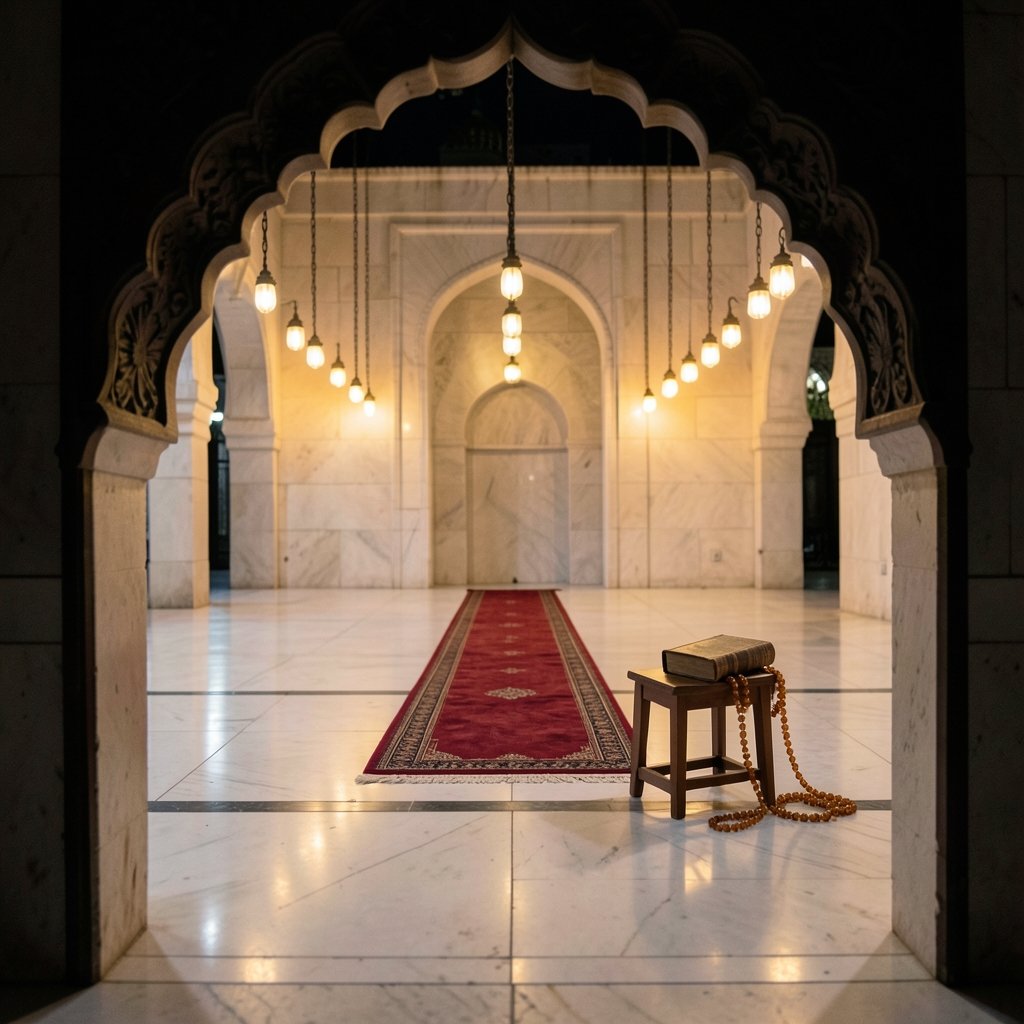
What do a declaration whispered by a new convert, a fast broken at sunset in Jakarta, and a walk around a black cube in Mecca have in common? They all belong to the same short list of obligations that shapes daily life for most of the world’s Muslims. The five pillars of Islam are the framework that holds the religion’s practice together: the shahada (declaration of faith), salah (ritual prayer), zakat (almsgiving), sawm (fasting in Ramadan), and hajj (pilgrimage to Mecca).
These five acts are not a complete summary of Islamic teaching. They are the load-bearing walls, the parts a practicing Muslim returns to every day, every year, or once in a lifetime. Here is what each one involves, where the details get complicated, and why the list looks slightly different depending on who you ask.
Where the Five Pillars Come From
The phrase itself is a convenient summary rather than a verse lifted straight from the Quran. The pillars are described in hadith literature, the recorded sayings and actions of the Prophet Muhammad, and they were formalized by scholars into the standard list taught today.
It is worth being precise about one thing early on: the five-pillar framework is primarily a Sunni framing. Shia Islam traditionally organizes its core obligations differently, often listing prayer, fasting, zakat, hajj, and wilayah (guardianship or allegiance) as its foundations, with some schools emphasizing jihad instead. The shared practices overlap heavily, but the numbering and emphasis do not. Presenting the five pillars as universal across all Muslims is a simplification, and a careful reader should know that going in.
The pillars also differ from the six articles of faith, which concern belief rather than action: belief in God, angels, revealed books, prophets, the Day of Judgment, and divine decree. One list covers what a Muslim does. The other covers what a Muslim holds to be true.
Pillar One: The Shahada, the Declaration of Faith

The shahada is a single sentence: “There is no god but God, and Muhammad is the messenger of God.” Reciting it sincerely, in front of witnesses, is the standard entry into Islam.
That brevity is deceptive. The first half is a statement of radical monotheism, a rejection of any partner or intermediary in divinity. The second half accepts Muhammad as the final prophet in a line that Muslims believe includes Abraham, Moses, and Jesus. Two clauses, and an entire worldview sits inside them.
In practice, the shahada is not only a conversion formula. It appears in the call to prayer, in the daily prayers themselves, and in the words spoken to a dying person. Many Muslims recite it as a quiet anchor throughout life. The common mistake outsiders make is treating it as a box ticked once and forgotten. It functions more like a compass needle, returned to constantly.
Pillar Two: Salah, the Five Daily Prayers
Salah is performed five times a day at set times: before sunrise, around midday, in the afternoon, just after sunset, and at night. Each prayer involves ritual washing, standing, bowing, prostration, and recitation, all performed facing Mecca.
The structure matters as much as the words. The ablution before prayer, called wudu, is a physical reset, and the movements are synchronized across the globe. At any given moment, someone somewhere is in the same posture.
Practical points that trip people up:
- Timing shifts. Prayer times follow the sun, not the clock, so they move through the year and vary by latitude. In high-latitude summers, some communities rely on calculated timetables or the nearest standard day.
- Missed prayers are made up. A missed obligatory prayer is generally performed later rather than simply dropped.
- Friday is different. The midday prayer on Friday, Jumu’ah, is a congregational service with a sermon, and it replaces the regular midday prayer for those who attend.
- Not every prayer is obligatory. The five daily prayers are required. The voluntary prayers around them are encouraged but optional.
Newcomers often assume the five prayers are long. Most take only a few minutes. The discipline is in the rhythm, not the duration.
Pillar Three: Zakat, the Obligatory Alms
Zakat is an annual obligatory payment on qualifying wealth, given to specified categories of recipients. It is not charity in the loose sense. It is a right that the poor hold over the wealth of those who have enough, and it is calculated rather than spontaneous.
The commonly cited figure is 2.5 percent of savings held for a full lunar year above a minimum threshold called the nisab. That 2.5 percent is the textbook norm for monetary savings and similar assets, not a universal rate. Rates differ for livestock, agricultural produce, and other categories, and the details are matters of jurisprudence that vary by school of law.
| Feature | How it works |
|---|---|
| Who pays | Muslims whose wealth exceeds the nisab threshold |
| Common rate | 2.5% on monetary savings held for one lunar year |
| Who receives | Specified categories, including the poor and the needy |
| When | Annually, on the zakat-eligible portion of wealth |
Two mistakes are common here. The first is treating 2.5 percent as a flat tax on everything a person owns, including their home and everyday possessions, which is not how it works. The second is confusing zakat with sadaqah, voluntary charity that has no fixed rate and can be given at any time, in any amount. Zakat is the obligation. Sadaqah is the open-ended generosity layered on top.
Pillar Four: Sawm, Fasting During Ramadan
Sawm means abstaining from food, drink, and other specified acts from dawn to sunset throughout Ramadan, the ninth month of the Islamic lunar calendar. Because that calendar is lunar, Ramadan moves about eleven days earlier each solar year, which means long summer fasts in some years and short winter ones in others.
The fast is more than hunger. It includes refraining from smoking, sexual activity, and angry or dishonest speech during daylight hours. The point is self-restraint, and the month is also marked by extra night prayers, Quran recitation, and a strong emphasis on generosity. Many Muslims pay zakat al-fitr, a smaller food-based donation, before the festival that ends the month.
Not everyone fasts. Exemptions include young children, people who are ill, travelers, pregnant and nursing women, and others for whom fasting would cause harm. Some make up missed days later; others provide food to those in need instead, depending on the circumstances. The common error is assuming the exemption is a free pass. It usually comes with a makeup obligation or a substitute act.
Practical advice that experienced fasters repeat: the pre-dawn meal matters more than the evening one, hydration through the night beats drinking at sunset, and the first three days are the hardest. Most people settle into a rhythm after that.
Pillar Five: Hajj, the Pilgrimage to Mecca
Hajj is the pilgrimage to Mecca, obligatory once in a lifetime for Muslims who are physically and financially able. It takes place during Dhu al-Hijjah, the final month of the Islamic calendar, and it draws roughly two million people in a typical year.
The rites unfold over several days and include entering a state of ritual purity called ihram, circling the Kaaba seven times, walking between the hills of Safa and Marwa, standing in prayer on the plain of Arafat, and stoning pillars that represent temptation. Pilgrims wear simple unstitched white garments, which erases markers of wealth and nationality. A billionaire and a laborer look identical.
The “once in a lifetime” clause carries real conditions. Debt, dependent family members, and health all factor in. Someone who cannot afford the pilgrimage without hardship is not obligated to go. Many Muslims save for years, and some never go at all, which is not a spiritual failure.
Logistics are the part people underestimate. Hajj is physically demanding, crowded, and tightly scheduled. Pilgrims who prepare with a licensed organizer, train their stamina in advance, and learn the rites beforehand consistently report a smoother experience than those who arrive cold. Saudi Arabia’s official Ministry of Hajj and Umrah portal publishes current procedures and requirements, and those change from year to year, so checking official guidance before booking is essential.
How the Pillars Fit Together
Look at the five side by side and a pattern emerges: one statement of belief, one daily discipline, one annual financial obligation, one annual physical test, and one lifetime pilgrimage. The frequency escalates. The commitment escalates with it.
| Pillar | Frequency | Core demand |
|---|---|---|
| Shahada | Once, and continually reaffirmed | Belief and witness |
| Salah | Five times daily | Time and attention |
| Zakat | Annually | Wealth and fairness |
| Sawm | One month yearly | Bodily restraint |
| Hajj | Once in a lifetime | Effort and resources |
The pillars also connect to the wider texture of Muslim life. Discussions of modesty and grooming, for instance, come up constantly in Muslim communities, and they connect to the same ethic of discipline that runs through the pillars. Anyone curious about the range of hair textures and care practices across Muslim and non-Muslim communities alike will find material on 4c hair and on looser patterns such as 2b hair useful background. Cultural coverage of Muslim life, from prayer-row etiquette to community customs, often touches on the row in discussions of congregational worship. These are side doors into the same conversation about practice, community, and daily habit.
Common Misconceptions Worth Correcting
A few errors show up again and again in explanations of the pillars, and correcting them makes the whole framework clearer.
Misconception one: the pillars are the whole religion. They are the obligatory core, not the entirety. Islamic practice also includes dietary rules, business ethics, family obligations, and a great deal of voluntary devotion.
Misconception two: the five pillars apply identically to all Muslims. As noted, Shia traditions organize their foundations differently while sharing the practices. Treat the five-pillar list as the Sunni standard.
Misconception three: zakat is a flat 2.5 percent of everything. It applies to qualifying wealth above a threshold, at rates that vary by asset type.
Misconception four: everyone must fast and everyone must perform hajj. Both obligations carry explicit exemptions for genuine hardship.
Misconception five: the pillars are purely private. Zakat and hajj are deeply communal. Salah is performed alone but is meritorious in congregation. The framework binds individual practice to a wider community.
Conclusion
The five pillars work because they are simple to state and demanding to live. A sentence of belief, five daily prayers, an annual payment, a month of fasting, and a once-in-a-lifetime pilgrimage cover the full arc of a life, from the moment of conviction to the final great effort. They also reveal something about how the religion is structured: belief is not left as an internal feeling but is tied to repeated, concrete action.
For anyone outside the tradition trying to understand it, the pillars are the right place to start precisely because they are observable. You can watch a fast break at sunset in any city with a Muslim community. You can see the direction of prayer in a hotel room’s ceiling arrow. You can read the numbers on a zakat calculator. The framework is public, and that is the point.
The nuance matters too. The pillars are a Sunni map, the details vary by school and circumstance, and the exemptions are as much a part of the system as the obligations. Understanding both the structure and its edges is what separates a real grasp of the topic from a list memorized off a poster.
What are the five pillars of Islam in order?
The standard order is shahada (declaration of faith), salah (prayer), zakat (almsgiving), sawm (fasting in Ramadan), and hajj (pilgrimage). The sequence runs from belief to daily practice to annual obligations to the pilgrimage made once in a lifetime, though Muslims do not treat the list as a strict ranking of importance.
Are the five pillars mentioned in the Quran?
The pillars as a numbered set are described in hadith literature rather than gathered into a single Quranic list. Each individual practice, including prayer, zakat, fasting, and pilgrimage, has clear Quranic grounding. The five-item framing was formalized by scholars drawing on both sources.
Do Shia Muslims follow the same five pillars?
Not exactly. Shia Islam traditionally lists different foundations, often prayer, fasting, zakat, hajj, and wilayah (guardianship), with some schools emphasizing jihad instead of wilayah. The shared practices overlap heavily with the Sunni list, but the framing and numbering differ.
How much is zakat, and who has to pay it?
The common norm is 2.5 percent of monetary savings held for a full lunar year above a minimum threshold called the nisab. Rates vary for livestock, crops, and other asset types. Muslims whose wealth falls below the threshold do not owe zakat, though they may still give voluntary charity.
Can someone be exempt from fasting or hajj?
Yes. Fasting exemptions include young children, the ill, travelers, pregnant and nursing women, and anyone for whom fasting would cause harm, with makeup days or substitute feeding required in many cases. Hajj is obligatory only once in a lifetime and only for those who are physically and financially able.
What is the difference between the five pillars and the six articles of faith?
The five pillars describe obligatory actions: what a Muslim does. The six articles of faith describe belief: God, angels, revealed books, prophets, the Day of Judgment, and divine decree. One is a framework for practice, the other for doctrine, and together they sketch the shape of the religion.














