

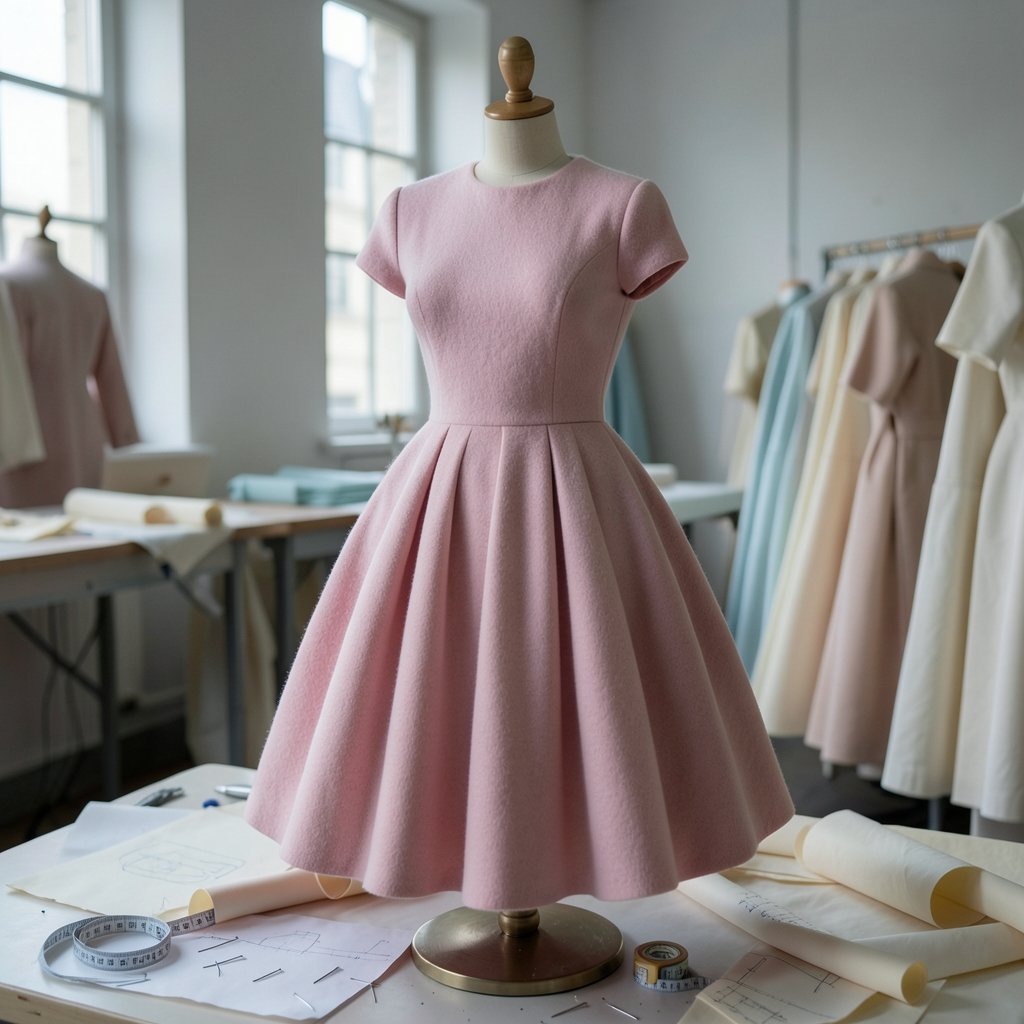
What if the most famous look of the 1950s was actually invented in 1947? That single twist explains almost everything about the decade’s style. The rounded shoulders, the tiny waist, the skirt that used yards of fabric: all of it flowed from a Paris show staged just after the war. By the time the 1950s arrived, that silhouette had spread from couture salons to department stores, sewing patterns, and small-town high schools. Understanding the decade means following one shape as it traveled from runway to real life, picking up teenage rebellion, Hollywood glamour, and a few questionable hairstyles along the way.
The New Look Set the Rules Before the Decade Began
On 12 February 1947, Christian Dior presented a collection that changed everything. His New Look featured rounded shoulders, a nipped waist, and full calf-length skirts. After years of wartime rationing and boxy uniforms, the excess fabric felt almost shocking. Some women protested in the streets; most of them quietly saved up for a version of their own.
The timing matters. Dior’s revolution landed in 1947, but its real reign was the 1950s. By 1950, the shape had softened and spread. Waists stayed cinched, but skirts narrowed slightly and daywear became more practical. If you want to see how the men’s side of this era evolved in parallel, the 1950s fashion trends for men followed their own path of draped jackets and slim trousers.
Dior himself died on 24 October 1957. Yves Saint Laurent, then around 21, took over and showed his first collection, the Trapèze line, in 1958. That loose, unbelted shape helped end the cinched-waist era and pushed fashion toward the 1960s.
The Women’s Wardrobe, Piece by Piece
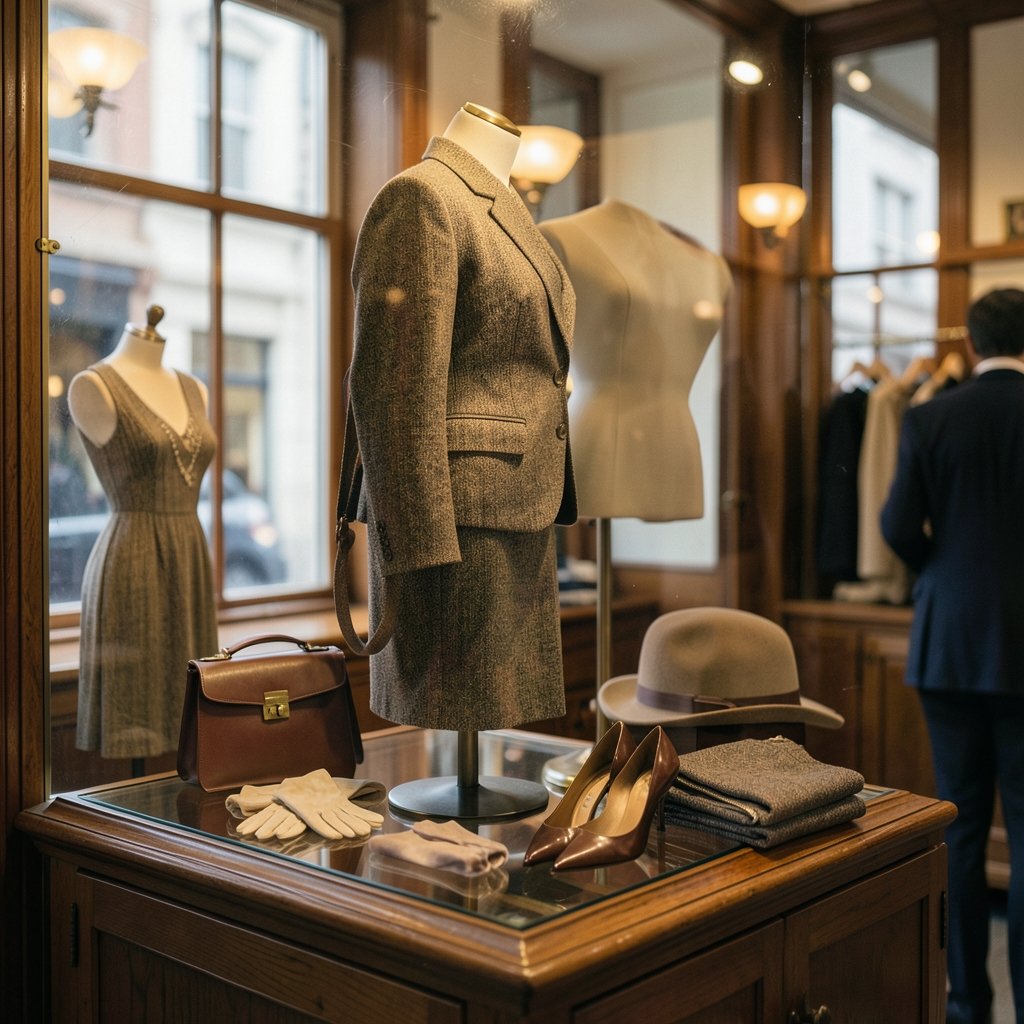
The 1950s woman did not own one look. She owned a system.
| Garment | Key Features | Where It Was Worn |
|---|---|---|
| Day dress | Fitted bodice, full skirt, shirtwaist buttons | Work, errands, housework |
| Wiggle dress | Narrow skirt, defined waist, often sheath-cut | Evenings, office, cocktails |
| Circle skirt | Full, circular cut, often felt or cotton | Casual days, dancing |
| Twin set | Matching cardigan and shell top | Layering, everyday |
| Tweed suit | Boxy jacket, matching skirt, chain-weighted hem | Town, travel, lunch |
| Shirtwaist dress | Button-front bodice, collar, full skirt | The all-purpose staple |
Coco Chanel relaunched her couture house in 1954 after closing it in 1939, and her tweed suit became a uniform for a certain kind of woman: practical, expensive, and quietly powerful. The suit’s boxy jacket freed the waist that Dior had bound tight, which is why the decade’s fashion was never as uniform as it looks in old photographs.
Accessories did heavy lifting. Gloves were worn outdoors, hats were expected in town, and a handbag matched the shoes. Nylon stockings were widely available by the 1950s after DuPont introduced nylon in 1939 and wartime rationing ended, which made hosiery cheaper and more accessible than silk had ever been. The zipper also became standard in men’s trousers and women’s dresses during the decade, replacing buttons on many garments.
Teenagers Invented a Market, and a Style
Here is the fact that reframes the whole decade: the teenager as a fashion customer barely existed before the 1950s. The post-war baby boom and rising disposable income created a group with money, time, and a fierce desire to look nothing like their parents.
The American uniform was specific: poodle skirts in felt with appliquéd animals, bobby socks, and saddle shoes. Boys wore letterman jackets and jeans. The look was cheap, widely copied, and endlessly customizable, which is exactly why it spread.
In Britain, the rebellion had a sharper edge. The Teddy Boy style emerged in the early 1950s, usually dated to around 1952 to 1954 in London. It revived Edwardian tailoring: long drape jackets, velvet collars, and drainpipe trousers. It was a working-class look that borrowed from upper-class dress and turned it into something slightly threatening. Sound familiar? That formula has powered youth fashion ever since, and it still shows up in how 2026 fashion trends recycle the past.
Menswear: Sharp, Draped, and Quietly Radical
Men’s 1950s fashion gets less attention than women’s, but it changed just as much. The standard was the drape suit: a jacket with soft shoulders, a longer line, and enough fabric to move. Think of the slim, dark-suited men in films of the era and you have the silhouette.
Three streams ran at once:
- The business uniform: grey or navy suit, white shirt, narrow tie, polished shoes. Conservative and near-universal in offices.
- The casual shift: polo shirts, short-sleeved knit shirts, and jeans worn outside work. Sportswear became everyday wear for the first time.
- The subcultural look: the Teddy Boy drape jacket in Britain, and the Beat and later beatnik look in the US from the mid-1950s, built on black turtlenecks, berets, and dark glasses.
The beatnik look matters because it was the first widely recognized style that rejected fashion rather than followed it. It was also, of course, carefully assembled.
Hollywood, Music, and the Power of a Single Image
Fashion in the 1950s was broadcast and sold. Film and music did the work that social media does now.
Brigitte Bardot appeared at Cannes in 1953 in a bikini, and the 1956 film And God Created Woman made the garment mainstream. The bikini had actually been introduced in 1946 by Louis Réard in Paris, but it took a decade and a movie star to make it acceptable.
Grace Kelly, Audrey Hepburn, and Marilyn Monroe each sold a different version of womanhood, and each version came with a wardrobe. Hepburn’s slim trousers and flat shoes were quietly revolutionary; Monroe’s fitted dresses were the opposite. Both sold.
Elvis Presley and rock and roll gave teenage boys a style to copy, and the leather jacket entered the permanent vocabulary. The decade’s real lesson is that a single photograph could move more product than any advertisement.
How Ordinary People Actually Wore It
Here is where the glossy version falls apart. Most people did not buy couture. They bought patterns.
Home sewing was enormous in the 1950s. Women’s magazines and pattern companies sold inexpensive designs that let a family copy a Paris look for a fraction of the price. If you want to understand the decade’s real style, look at sewing pattern envelopes, not runway photographs.
Three practical realities shaped everyday dress:
- Fabric was expensive. Clothes were mended, let out, and handed down. A single good coat lasted years.
- Care was labor. Washing, ironing, and pressing took hours. Easy-care cotton mattered more than glamour.
- Occasion ruled. There was a dress for church, one for town, one for the house. Mixing them up was a social error.
The most common mistake people make when recreating 1950s style today is buying the costume version: too much volume, too many accessories, and synthetic fabrics that hang wrong. What actually works is restraint. Pick one element, such as a full skirt or a twin set, and keep everything else modern and simple. The decade’s elegance came from fit, not decoration.
The Details That Made the Look
Certain details define the decade more than any single garment.
The waist was the center of everything. Belts, corsetry, and structured seams pulled the eye to a narrow middle. Dresses were cut to emphasize it, and even casual clothes were fitted.
The hair was architectural. Women set their hair in rollers, brushed it into waves, and slept on it. Men wore short, controlled cuts with a side part.
The makeup was deliberate: defined brows, red or coral lips, and a matte finish. It was a full routine, not a quick swipe.
The shoes were pointed or rounded with a modest heel for day and a stiletto for evening. The stiletto itself became a symbol of the decade, and it was genuinely new technology.
The cumulative effect was polish. A 1950s outfit was finished, not thrown together, and that finish is the hardest part to reproduce today.
Why the 1950s Still Shapes What We Wear
The decade’s influence did not stop in 1959. It keeps returning because its formula is so legible.
Designers return to the New Look silhouette constantly. The full skirt, the defined waist, and the ladylike finish reappear in almost every decade’s revival cycle. The current wave of Italian luxury fashion draws on the same mid-century tailoring traditions, and the broader 2026 fashion trends guide shows how often the 1950s silhouette gets reinterpreted for new audiences, including the 2026 fashion trends for women that lean on mid-century structure.
The teen market the decade invented is now the entire industry’s engine. The idea that young people set style rather than inherit it started here, and it never reversed.
And the visual language of the 1950s remains irresistible to storytellers. Fashion illustration and film still turn runway moments into lasting images, much as Angelica Hicks turns runway moments into drawings that distill a look into a few lines. The decade understood that power before anyone had a name for it, which is why a Barbie world tour book can still mine 1950s glamour for a modern audience. For anyone who wants to follow how these conversations develop, the best fashion substacks cover the revival cycle in detail.
What to Take From the Decade
The 1950s were not one look. They were a negotiation between couture and the sewing machine, between conformity and the teenager who wanted out. The cinched waist and the beatnik turtleneck existed at the same moment, and both were authentic.
If you are studying the era, start with the silhouette and work outward: the 1947 New Look, the 1954 Chanel comeback, the 1957 sack dress that ended the cinch. Then look at the sewing patterns and the department store catalogs, where most people actually lived. That is where the decade’s real style sits, and it is far more interesting than the nostalgic version.
Frequently Asked Questions
When did 1950s fashion actually begin?
The defining silhouette started earlier, on 12 February 1947, when Christian Dior showed the New Look. The 1950s inherited that shape, softened it, and made it mass-market. So the style’s origin is 1947, but its reign was the 1950s.
Who invented the bikini, and when did it become popular?
Louis Réard introduced the bikini in Paris on 5 July 1946. It only became mainstream in the 1950s, helped by Brigitte Bardot at Cannes in 1953 and the 1956 film And God Created Woman.
What did Teddy Boys wear?
Teddy Boy style emerged in early-1950s Britain, usually dated to around 1952 to 1954 in London. It revived Edwardian tailoring with long drape jackets, velvet collars, and drainpipe trousers, worn as a working-class statement.
What ended the cinched-waist look?
The loose, unbelted sack dress or chemise silhouette appeared in 1957 and replaced the fitted waist. Sources disagree on who showed it first, with Givenchy, Balenciaga, and Dior’s successor lines all credited. Yves Saint Laurent’s 1958 Trapèze line pushed the same idea further.
What did a typical 1950s woman wear day to day?
Most women wore a shirtwaist or day dress with a fitted bodice and full skirt, often home-sewn from a pattern. A twin set, a circle skirt, and a good coat covered most occasions. Couture was for a small minority.
Why does 1950s fashion keep coming back?
Because the formula is simple and flattering: a defined waist, a full or narrow skirt, and a polished finish. Designers return to it constantly, and the teen-driven market the decade created still rewards styles that look both new and familiar.














