You are standing in front of a wall of bourbon, and every bottle looks the same: amber liquid, a paper label, a name you half-recognise. Some cost $25 and some cost $250, and nobody is explaining why. Bourbon is simpler than that wall makes it look: once you know the rules, the bottles start to make sense.
So what is bourbon, exactly? It is an American whiskey made from a grain recipe that is at least 51% corn, distilled and aged in new charred oak barrels, and bottled at no less than 80 proof. This guide explains how bourbon is made, the rules that define it, the types to know, and how to drink it.
Key takeaways:
- Bourbon is an American whiskey: its grain recipe must be at least 51% corn, and it must be aged in new charred oak barrels.
- It must be distilled to no more than 160 proof, put into the barrel at no more than 125 proof, and bottled at no less than 80 proof.
- Straight bourbon is aged for at least two years with nothing added, while bottled-in-bond bourbon is 100 proof and aged at least four years.
- Kentucky makes about 95% of the world’s bourbon, and the flavour comes mostly from the corn and the new charred oak.
What is bourbon?
Bourbon is a type of American whiskey, and the name carries legal weight. Under the Federal Standards of Identity, a spirit can only be called bourbon if it meets a short list of rules: it must be made in the United States, its grain recipe must be at least 51% corn, it must be aged in new charred oak containers, and it must be bottled at no less than 80 proof, which is 40% alcohol by volume.
The name is often traced to Bourbon County, Kentucky, though the exact origin is debated and no single story is proven. What is certain is that bourbon became the defining American whiskey: in 1964, Congress declared it a distinctive product of the United States, the only spirit to hold that status.
How is bourbon made?
Bourbon starts with grain. The mash bill must be at least 51% corn, with the rest usually rye or wheat and a little malted barley. Corn gives bourbon its sweetness, rye adds spice, and wheat makes it softer. The grain is ground, cooked with water and fermented with yeast into a low-alcohol wash.
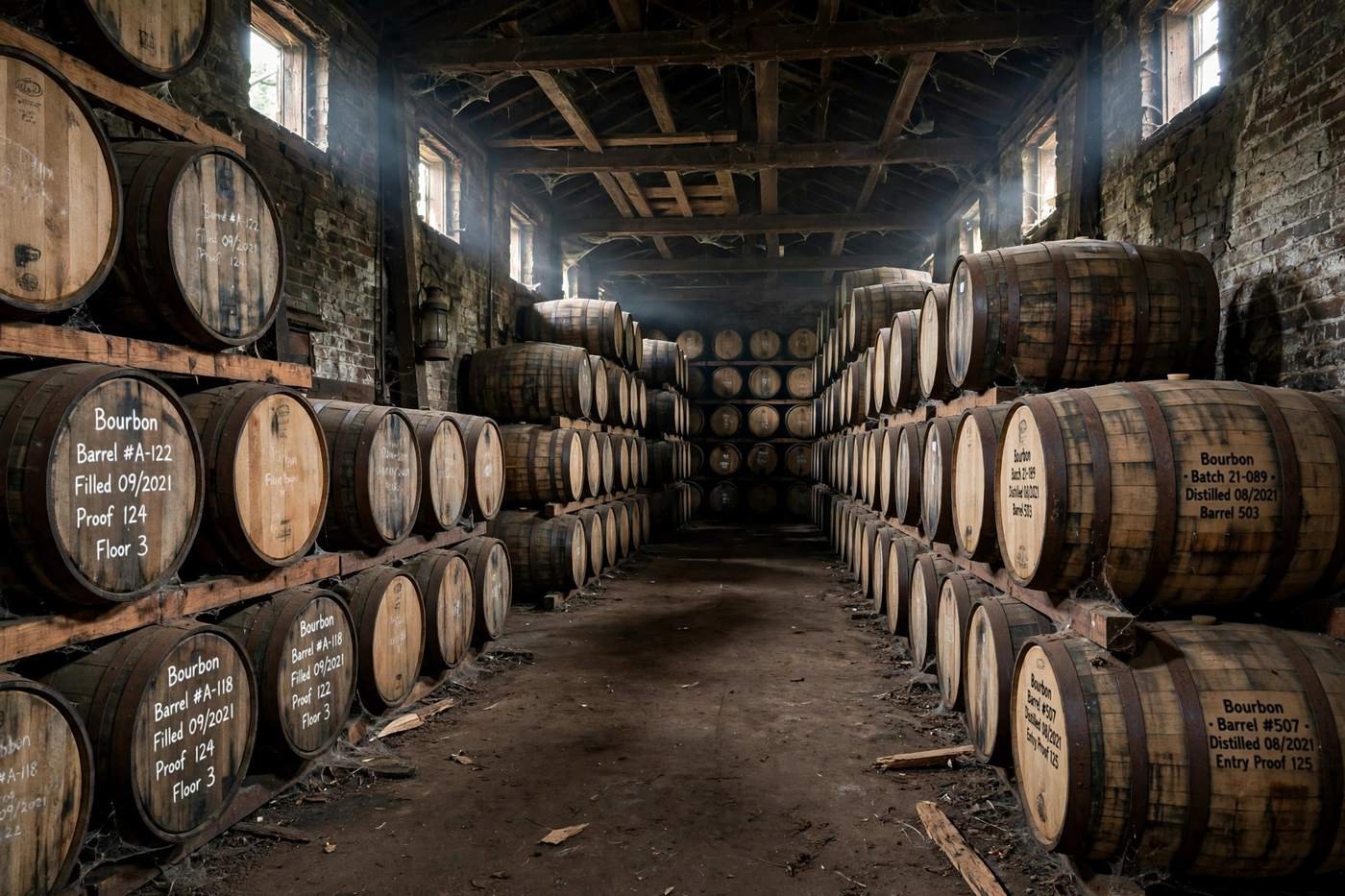
That wash is distilled, usually twice, in a column still or a pot still, to no more than 160 proof. The new spirit, clear as water and often called white dog, goes into new charred oak barrels at no more than 125 proof. The charring matters: the burnt inside of the barrel acts like a filter and a flavour factory, giving the spirit its amber colour and its notes of vanilla, caramel and oak.
Then comes the waiting. The barrels rest in a rickhouse, where the seasons do the work: in summer the wood expands and the spirit soaks in, in winter it contracts and pushes back out. A little evaporates each year, about 2% by one widely used estimate, in what distillers call the angel’s share. There is no minimum ageing time for bourbon itself, but straight bourbon must be aged for at least two years.
What are the rules for bourbon?
The rules for bourbon are short, and they explain what is in the bottle. First, bourbon must be made in the United States, and although it can legally be made anywhere in the country, Kentucky makes about 95% of it, according to the Kentucky Distillers’ Association.
Second, the grain recipe must be at least 51% corn. Third, it must be distilled to no more than 160 proof and put into the barrel at no more than 125 proof. Fourth, it must be aged in new charred oak containers, which is what separates bourbon from Scotch, where used barrels are the norm. Fifth, it must be bottled at no less than 80 proof.
Two more labels matter. Straight bourbon is aged for at least two years with no added colouring, flavouring or other spirits. Bottled-in-bond bourbon follows the Bottled-in-Bond Act of 1897: 100 proof, aged at least four years, made by one distiller at one distillery in a single season. Those words on a label are a legal guarantee, not marketing.
What types of bourbon are there?
Most bourbon falls into a few families, separated by the grain recipe. Traditional bourbon uses rye as the second grain, giving a spicier, drier character; Four Roses and Bulleit are well-known examples. Wheated bourbon swaps the rye for wheat, making a softer, sweeter spirit; Maker’s Mark and W.L. Weller are the classic examples.
High-rye bourbon pushes the rye share higher still, for a bolder, spicier drink. Beyond the recipe, the label tells you how the bourbon was handled: small batch means the bottling came from a small number of barrels, though the term has no legal definition; single barrel means the bottle came from one barrel alone; barrel proof means it was bottled at barrel strength, with no water added, so it is stronger, often well over 100 proof.
| Type | What defines it | Flavour | Try first |
|---|---|---|---|
| Traditional bourbon | Corn with rye as the second grain | Spicy, dry, oaky | Four Roses Small Batch |
| Wheated bourbon | Corn with wheat instead of rye | Soft, sweet, rounded | Maker’s Mark |
| High-rye bourbon | A higher share of rye | Bold, peppery, spicy | Bulleit Bourbon |
| Straight bourbon | Aged at least two years, nothing added | Varies by maker | Any straight bourbon |
| Bottled-in-bond | 100 proof, aged at least four years | Full, structured | Old Forester 100 Proof |
| Single barrel | One barrel per bottling | Varies barrel to barrel | Blanton’s |
| Barrel proof | Bottled at barrel strength | Intense, hot, rich | Booker’s |
The bottles named above are widely available examples of each style, not recommendations. For bottles worth seeking out, our guide to the best bourbon compares the leading picks.
How should you drink bourbon?
There is no wrong way to drink bourbon, but there is a good order to try it in. Start neat, at room temperature, in a small glass, and notice the vanilla and caramel from the oak and the sweetness from the corn. Then add a few drops of water, which opens up the aromas and softens the alcohol.
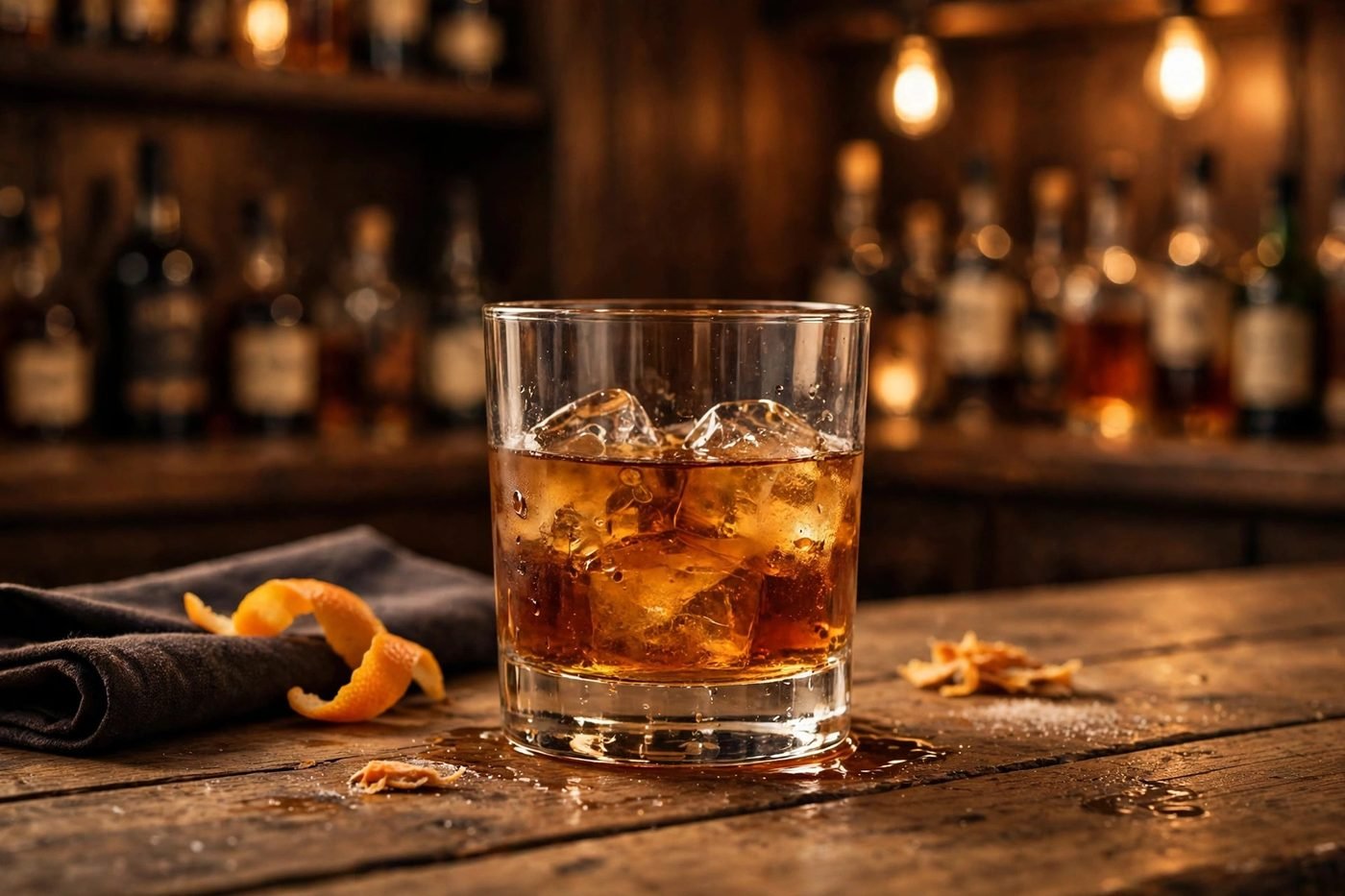
On the rocks is the next step. A large cube melts slowly, chilling the bourbon and diluting it gently, which suits a hot day or a stronger bottle. Cocktails are where bourbon earns its keep in a bar: an Old Fashioned, a Manhattan, a Whiskey Sour and a Mint Julep are all bourbon cocktails first, and each one shows a different side of the spirit.
What is the difference between bourbon and whisky?
All bourbon is whiskey, but not all whiskey is bourbon, and the difference is the rules. Scotch whisky must be made in Scotland, aged for at least three years in oak casks, and made mostly from malted barley; it is usually smoky from peat, which bourbon never is. Irish whiskey must be made in Ireland and is often triple-distilled, which makes it smoother and lighter.
Tennessee whiskey is the closest cousin: it follows the same rules as bourbon, then adds the Lincoln County Process, filtering the new spirit through maple charcoal before barrelling. Jack Daniel’s is the famous example, and that is why it is Tennessee whiskey rather than bourbon. Rye whiskey must be at least 51% rye instead of corn, which makes it drier and spicier. Our guide to cider covers another drink with its own strict traditions, and our guide to beer explains how grain, yeast and barrels shape a very different drink.
How do you store bourbon?
Bourbon is easier to store than wine. Once bottled, it stops ageing, because the ageing happens in the barrel, not the bottle, so a bottle will taste the same in ten years as it does today. Keep it upright, because the high-proof spirit can damage the cork if it sits in contact with it for years, and keep it somewhere cool and dark, away from direct sunlight.
An opened bottle slowly changes as air gets in, and a nearly empty bottle loses its edge faster than a full one. Finish a special bottle within a few months, or decant it into a smaller bottle so there is less air inside. There is no need to refrigerate bourbon, and the freezer will only dull its flavour.
Your bourbon checklist
Work through this list before you buy, and you will get the bottle right first time.
- Start with the style: wheated for soft and sweet, traditional for spicy, high-rye for bold.
- Check the proof: 80 to 90 proof is easy drinking; 100 proof and above is stronger and needs water or ice.
- Read the age: straight bourbon is at least two years old; older is not always better, but it is usually richer.
- Look for bottled-in-bond: 100 proof, four years, one distillery, and a legal guarantee of what is inside.
- Taste it neat first: a small sip before ice or water tells you what the bourbon actually tastes like.
- Add water slowly: a few drops at a time, and stop when the flavour opens up.
- Store it upright: cool, dark, away from sunlight, and finish nearly empty bottles within a few months.
Frequently asked questions
Does bourbon have to be made in Kentucky?
No. Bourbon must be made in the United States, but it can legally be made in any state. Kentucky makes about 95% of the world’s bourbon, which is why the two are linked, but good bourbon is also made in New York, Texas and Colorado.
What is the difference between bourbon and straight bourbon?
Straight bourbon is bourbon that has been aged for at least two years with no added colouring, flavouring or other spirits. All straight bourbon is bourbon, but bourbon without the word straight on the label may be younger than two years, in which case its age must be stated.
Why does bourbon taste sweet?
Two reasons: the grain recipe is at least 51% corn, which is a sweet grain, and the new charred oak barrel adds vanilla, caramel and toffee notes as the spirit ages. Nothing sweet is added to the bottle; the sweetness comes from the corn and the wood.
Can you drink bourbon with ice?
Yes, and a large cube is the best way: it chills the bourbon and dilutes it slowly, which suits stronger bottles. Purists drink it neat, but ice is a legitimate choice, especially for bourbons over 100 proof.
What is the angel’s share?
The angel’s share is the portion of bourbon that evaporates from the barrel during ageing, roughly 2% a year by one widely used estimate. It is why older bourbons cost more: less of the barrel is left to bottle.
Sources
The rules in this guide reflect the Federal Standards of Identity for Distilled Spirits, which define bourbon, straight bourbon and bottled-in-bond bourbon, and the Bottled-in-Bond Act of 1897. Production figures reflect the Kentucky Distillers’ Association, which reports that Kentucky makes about 95% of the world’s bourbon. For bottles worth seeking out, our guide to the best bourbon compares the leading picks, and our guide to cider covers another classic drink.
The bottom line
Bourbon is the most approachable of the world’s great whiskies: a short list of rules, a sweet and oaky flavour, and a bottle for every budget. The corn makes it sweet, the new charred oak makes it rich, and the rules make it honest, because what the label says is what the law requires.
Your next step is simple: pick a style that suits you, pour a small glass neat, add a few drops of water, and taste it properly before you decide what you like. The wall of bottles will look a lot less mysterious after that.
Please drink responsibly. Never drink and drive.