
Round vs Square Cufflinks 2027: 9 Comparisons That Matter
Cufflinks are small, but the shape you choose changes the whole look of a shirt cuff. A round cufflink softens the wrist, catches the light in a gentle curve, and reads as classic in the best sense. A square cufflink does the opposite, adding a clean edge and a sharper, more deliberate feel.
The choice matters because cufflinks sit where your shirt, your jacket, your watch and your hands all meet. Get it right and the cuff looks finished, even from across a room. The shape also affects how it sits, how comfortable it feels after eight hours, and how well it matches the rest of what you are wearing.
Below are nine comparisons between round and square cufflinks for 2027, from first impressions to comfort, care and price. Each one covers what it does well, what to watch for, and who it suits best.
Key takeaways
- Round cufflinks read softer and more classic, while square cufflinks read sharper and more modern, and that first impression sets the tone for the outfit.
- Round shapes suit traditional weddings, black tie and vintage-inspired looks, while square shapes suit contemporary suits and minimalist styling.
- Match the cufflink shape to your watch, belt buckle and other metal, so the wrist does not mix a soft curve with a sharp edge.
- Size and weight matter as much as shape, because a heavy cufflink can pull a light shirt cuff out of shape.
- No shape is universally better, and a cufflink that looks perfect in the box can feel wrong on the wrist, so check the fit and the weight before you commit.
What round and square cufflinks actually are
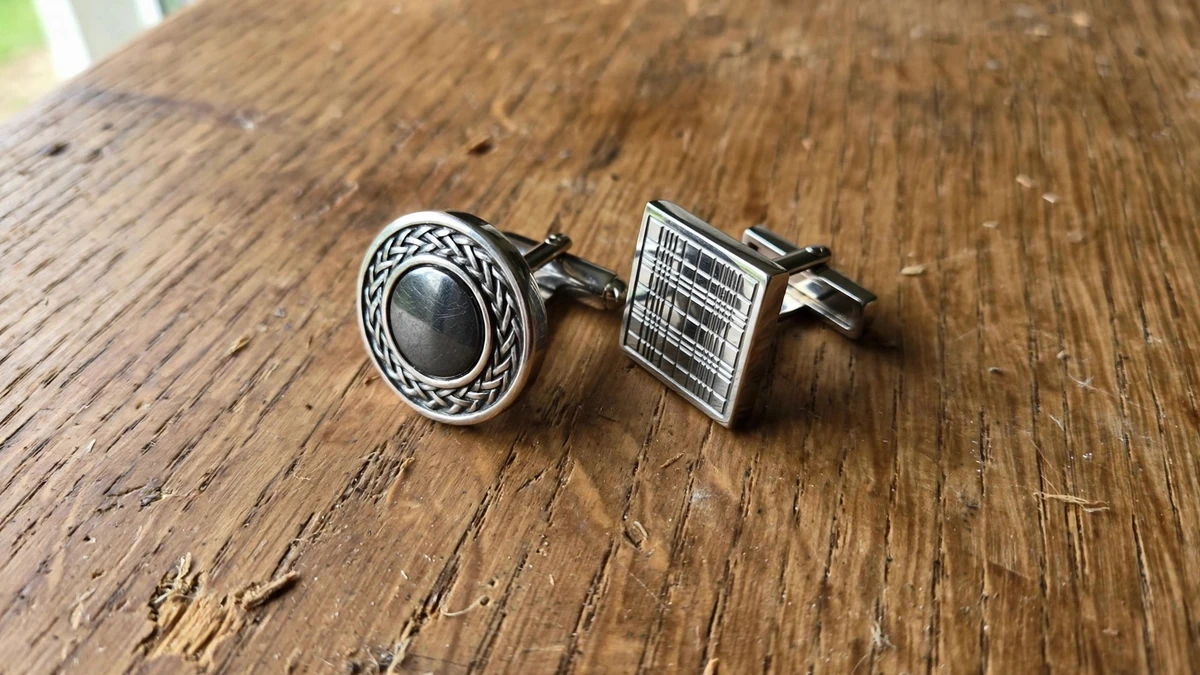
A round cufflink is a disc, a dome, a sphere or a rounded knot that presents a curved face to the world. The classics are mother-of-pearl discs, polished silver rounds, enamelled circles and silk knots, worn for more than a century without changing much. A curve never looks aggressive: it catches light softly, suits a rounded watch face, and reads as traditional without feeling old.
A square cufflink presents a flat, four-sided face, with softly rounded corners or a crisp, architectural edge. The classics are engraved silver squares, onyx panels, enamelled blocks and geometric designs in brushed or polished metal. Their appeal is precision: a square edge echoes a tailored lapel and a square watch case, giving the cuff a finished look a curve cannot quite match.
Both shapes use the same fittings: a toggle bar, a chain link, a fixed bar or a bullet back, and the shape of the face does not change how it fastens. What changes is the look, the feel, and the way the cufflink sits. A domed round cufflink can rock on a stiff cuff, while a flat square one sits flush but its corners can catch on a jacket lining.
How we chose these comparisons and what to look for
Look first at the face, because that is what people see: a round face should be smooth and even, with no rough edge where metal meets enamel or stone. A square face should have straight, clean edges and corners that are finished, not sharp enough to snag fabric. Hold it up to the light and turn it slowly: a good finish looks even from every angle, while a poor one shows scratches or uneven plating.

Look next at the weight and the fitting. A cufflink should feel solid but not heavy. If it pulls the cuff down when you lift your arm, it is too heavy for a standard cotton shirt. Check the toggle or bar moves freely and closes firmly, because a loose toggle is the most common reason a cufflink is lost. A silk tie in the same outfit is worth the same care, and our guide to the best silk ties for men explains how to match texture and colour across the whole outfit, not just the cuff.
Finally, look at the metal and the finish: sterling silver, gold, stainless steel and mother-of-pearl are the reliable choices, and they age well if looked after. Plated metal can look identical when new, but the plating wears thin at the edges first, which is where a square cufflink shows wear. Buy the best metal you can afford and keep the receipt.
The 9 comparisons that matter in 2027
First impressions: soft and classic vs sharp and modern
What we like: A round cufflink gives a soft, welcoming first impression, while a square cufflink gives a crisp, confident one. What to consider: The impression is set in seconds, so a round cufflink can look too gentle with a very sharp suit, and a square cufflink can look too severe with a soft, relaxed outfit. Best for: Round for classic and romantic occasions, square for modern and formal settings. Material: Mother-of-pearl or polished silver for round, onyx or brushed steel for square. Price range: About 30 to 300 pounds for a good pair in either shape. Standout feature: The curve catches light gently, while the edge holds it.
Formality and occasion
What we like: Round cufflinks suit black tie, traditional weddings and vintage-inspired evenings, while square cufflinks suit contemporary weddings, formal work events and minimalist evening wear. What to consider: A very ornate round cufflink can look out of place at a modern office, and a very plain square cufflink can look underdressed at a grand formal event. Best for: Round for black tie and classic ceremonies, square for modern formal occasions. Material: Enamel or mother-of-pearl for round, polished silver or gold for square. Price range: About 40 to 400 pounds depending on the metal and the maker. Standout feature: A round cufflink softens formal dress, while a square one sharpens it.
How each shape sits on the cuff
What we like: A flat square cufflink sits flush against the cuff and stays in place, while a domed round cufflink sits slightly proud and catches the light as you move. What to consider: A domed round cufflink can rock on a stiff cuff, and a square cufflink with sharp corners can catch on a jacket lining. Best for: Square for stiff or starched cuffs, round for soft, unstarched cuffs. Material: Flat enamel or onyx for square, domed silver or pearl for round. Price range: About 30 to 250 pounds for a well-made pair. Standout feature: The flat face of a square stays put, while the dome of a round one moves with the light.
Size and presence
What we like: Round cufflinks look balanced at a slightly larger size because a curve has no corners to dominate the cuff, while square cufflinks make a stronger statement at a smaller size because a straight edge reads clearly. What to consider: A large square cufflink can overpower a slim wrist, and a very small round cufflink can disappear against a wide cuff. Best for: Round for larger faces and wider cuffs, square for slimmer wrists and a bolder look. Material: Silver or gold in either shape, with enamel to add colour. Price range: About 35 to 350 pounds, with size adding little to the cost. Standout feature: A square cufflink reads larger than it is, a round one softer.
Matching your watch, belt buckle and other metal
What we like: A round cufflink pairs naturally with a round watch face and a curved buckle, while a square cufflink pairs naturally with a square or rectangular watch and a straight-edged buckle. What to consider: Mixing a round cufflink with a square watch, or a square cufflink with a round watch, is not a mistake, but it needs a reason, or the wrist looks accidental. Best for: Round for classic round watches, square for modern square or rectangular watches. Material: Match the metal first, silver with silver, gold with gold, and let the shape follow. Price range: About 40 to 300 pounds for a pair that matches a good watch. Standout feature: Matching the shape to the watch makes the whole wrist look intentional.
Material and finish
What we like: Round cufflinks show off mother-of-pearl, enamel and polished stone beautifully, because a curve suits a soft material, while square cufflinks show off onyx, brushed metal and engraved panels, because a flat face suits a hard, precise material. What to consider: A soft material in a square shape can look dull, and a hard, angular material in a round shape can look forced. Best for: Round for pearl, enamel and silk knots, square for onyx, brushed steel and engraved silver. Material: Mother-of-pearl, enamel, onyx, sterling silver, gold, stainless steel. Price range: About 25 to 500 pounds, with gold and onyx at the higher end. Standout feature: The right material makes the shape look inevitable.
Comfort and everyday wear
What we like: A round cufflink has no corners, so nothing digs into the wrist or catches on a sleeve, while a square cufflink with softly rounded corners is just as comfortable and stays in place better. What to consider: A square cufflink with sharp corners can press into the wrist during a long day, and a heavy round cufflink can feel tiring on a light shirt. Best for: Round for all-day comfort, square with rounded corners for a long formal day. Material: Lightweight silver or steel for everyday wear, heavier gold for occasional wear. Price range: About 30 to 200 pounds for a comfortable everyday pair. Standout feature: A cufflink you forget you are wearing is a cufflink that fits.
Care, cleaning and durability
What we like: A round cufflink has no corners to chip or wear, so enamel and stone survive longer, while a square cufflink has flat faces that are easy to polish and keep clean. What to consider: The corners of a square cufflink wear first, especially on plated metal, and a domed round cufflink can scratch more easily because it stands proud of the cuff. Best for: Round for enamel and stone, square for solid metal that can be polished. Material: Sterling silver and solid gold wear best in either shape, while plated metal shows wear at the edges. Price range: About 50 to 400 pounds for solid metal that lasts. Standout feature: Solid metal in either shape can be polished back to new, while plating cannot.
Price and value
What we like: Round and square cufflinks cost much the same at the same quality, because the price comes from the metal, the maker and the finish, not the shape. What to consider: A cheap square cufflink often shows its price at the corners, where plating wears first, while a cheap round cufflink often shows it in a dull or uneven dome. Best for: Round for a first pair on a modest budget, square for a second pair once you know your taste. Material: Stainless steel or sterling silver for the best value, gold for a lasting investment. Price range: About 25 to 100 pounds for a good starter pair, 150 to 500 pounds for solid silver or gold. Standout feature: Value comes from solid metal and good finishing, not from the shape.
Which cufflink is right for you
If your wardrobe is classic, your watch is round, and your occasions are traditional, round is the natural choice. It suits a black tie evening, a traditional wedding, and a shirt with a soft, unstarched cuff. Mother-of-pearl suits a wedding, polished silver suits work, and a silk knot suits a relaxed day.
If your wardrobe is modern, your watch is square or rectangular, and your occasions are contemporary, a square cufflink is the natural choice. It suits a sharp suit, a formal work event, a modern wedding, and a shirt with a crisp, structured cuff. Choose onyx for evening, brushed steel for work, and engraved silver for an occasion that deserves a little ceremony. A formal outfit is only as strong as its smallest details, and our guide to the best tuxedos for men shows how the cuff, the tie and the jacket should work together rather than compete.
If you wear both kinds of occasion, own one pair of each: a round pair in mother-of-pearl and a square pair in onyx cover almost every formal event, for less than a single pair in solid gold.
The caveats that matter
Shape is only one part of the decision. A cufflink that matches your watch and occasion looks right in either shape, and one that clashes with both looks wrong in either shape. The most common mistake is buying a shape because it looks good in a photograph, without checking how it sits on your own wrist.
| Detail | What is known |
|---|---|
| First impression | Round reads soft and classic, square reads sharp and modern |
| Best occasion | Round for black tie and traditional weddings, square for modern formal events |
| How it sits | Square sits flush and stays put, round sits proud and catches the light |
| Matching metal | Match the metal to your watch first, then let the shape follow the watch case |
| Comfort | Round has no corners to dig in, square needs softly rounded corners for long wear |
| Durability | Round has no corners to chip, square has flat faces that are easy to polish |
| Care | Wipe after wearing, store in a lined box, keep away from perfume and cologne |
| What shape does not do | It does not fix a poor fit, cheap plating, or a cufflink too heavy for the shirt |
Allergies matter too. Nickel is a common cause of skin irritation, and some plated cufflinks contain it, so if your skin reacts to cheap jewellery, choose sterling silver, solid gold or stainless steel. A cufflink that irritates your wrist will not be worn, whatever its shape.
Checklist: choosing between round and square cufflinks honestly
Use these checks before you buy, and again after a day of wearing the cufflinks.
- Check the occasion: traditional and black tie favour round, modern and business-formal favour square.
- Check the watch: match the metal first, then choose a shape close to the case.
- Check the fit: put it on, move your arm, and check it sits flat without rocking or catching.
- Check the corners: a square cufflink should have finished, softly rounded corners.
- Check the weight: if it pulls the cuff down when you lift your arm, it is too heavy for that shirt.
- Check the metal: choose sterling silver, solid gold or stainless steel, and avoid plated metal if your skin is sensitive.
Frequently asked questions
Are round or square cufflinks more formal?
Neither is more formal in itself. Round cufflinks suit traditional black tie and classic ceremonies, while square cufflinks suit modern formal events. The formality comes from the material and the occasion, not the shape.
Can I wear square cufflinks with a round watch?
Yes, but match the metal first and keep the rest of the outfit simple. It works best when both are the same metal and the outfit is modern rather than traditional.
Do square cufflinks catch on jacket sleeves?
They can, if the corners are sharp. Choose softly rounded corners and a flat face, and check it against your jacket lining first. A well-finished square cufflink should slide in and out of a sleeve without snagging.
Are round cufflinks old-fashioned?
No. Round cufflinks are classic, not old-fashioned, and mother-of-pearl rounds remain a standard choice for black tie, especially in polished silver or pearl.
Which shape is better for a first pair of cufflinks?
A round pair in sterling silver or mother-of-pearl is the safer first buy, because it suits the most occasions. Add a square pair in onyx or brushed steel later, once you know which occasions you dress for most. A good watch is the other half of the wrist, and our guide to the best luxury watches can help you match the cufflink to the watch you already own.
How much should I spend on cufflinks?
About 25 to 100 pounds buys a good starter pair in stainless steel or sterling silver, and 150 to 500 pounds buys solid silver or gold that lasts for decades. Spend on solid metal and good finishing, not on the shape.
The bottom line
The difference between round and square cufflinks is real, but smaller than the difference between a well-made pair and a cheap one. A round cufflink softens the wrist and suits traditional occasions, while a square cufflink sharpens it and suits modern ones. Choose the shape that matches your watch, your suit and the room you are walking into, and the cuff will look finished.
Buy solid metal, check the fit on your own wrist, and own one pair of each shape if you dress formally often.