A good work belt is the quietest part of an outfit, and the easiest to get wrong. It sits between a shirt and trousers, or cinches a dress at the waist, and when it is right nobody notices it at all. When it is wrong, a cracked edge, a peeling buckle, or a strap that curls at the tip, the whole outfit looks less considered, no matter how good the rest of it is.
The problem is that most belts sold for work look alike on a screen and behave very differently after six months. A thin bonded-leather strap can look smart on day one and split along the edge by spring. A full-grain strap costs more, but it ages the way good leather should, darkening slightly, softening at the waist, and holding its shape. The difference is in the material, the buckle, and the width, not in the label.
Below are nine leather belts worth considering for work in 2027, from a classic black strap for tailored trousers to a wide waist belt for dresses. Each one is described by what it does well, what to watch for, and who it suits best, so you can choose with your wardrobe in mind, not just a bestseller list. If you are starting from scratch, our guide to choosing the perfect leather belt covers width, fit, and buckle styles in more detail.
Key takeaways
- Full-grain leather is the most durable choice for a daily work belt, and it ages better than bonded or corrected-grain leather.
- A belt should match your shoes in tone, not necessarily in exact colour, and the buckle should match your other metal accessories.
- Width matters: a slim belt suits tailored trousers and a narrow waistband, while a wider belt works better with dresses and heavier fabrics.
- Buy for your true waist size, not your trouser size, and check the belt against your most-worn work outfit before committing.
- No belt lasts forever without care, and a cheap strap with a peeling finish will look worse, sooner, than a plain full-grain belt that is looked after.
What makes a leather belt right for work
A work belt has a narrower job than a casual belt. It needs to hold trousers in place without bunching, sit flat under a tucked-in shirt, and look tidy from a desk, a meeting room, and a commute. That means a strap that is firm but not stiff, edges that are finished rather than raw, and a buckle that is polished or brushed, not oversized or decorative.
Material is where most work belts succeed or fail. Full-grain leather uses the top layer of the hide, with its natural grain intact, so it resists scratches and develops a patina instead of peeling. Top-grain leather is lightly sanded and finished, so it looks more uniform but is slightly less hard-wearing. Bonded leather is made from leather fibres glued together, and it is the type most likely to crack and peel within a year. If a listing does not say which type it is, that is usually the answer.
Buckle and width are the other two decisions. A simple frame buckle in silver, gold, or gunmetal is the safest work choice, and it should echo the metal of your watch, rings, or bag hardware. A belt between 25 and 35 millimetres wide suits most work trousers, while a waist belt for dresses can be wider, up to 50 millimetres, without looking out of place. Our roundup of leather belts for women covers more styles if your wardrobe leans beyond the office.
How we chose these belts and what to look for
Look first at the leather. Full-grain or top-grain should be stated clearly, and the strap should feel firm with a smooth, even surface. Look next at the edges: they should be burnished or painted, not rough or fibrous, because raw edges fray first. Then look at the buckle. It should be solid metal, not hollow or plastic-coated, and it should sit flat against the strap without rattling.

Look at the holes, too. A good work belt has five or seven holes spaced about 25 millimetres apart, with the middle hole at your true waist size. That leaves room to adjust for heavier fabrics in winter or a lighter outfit in summer. Finally, look at the price against the cost per wear. A belt you wear four days a week for three years costs very little per wear, while a cheap belt replaced twice a year costs more and looks worse for most of that time.
The 9 best leather belts for work in 2027
Classic Black Full-Grain Belt with a Polished Buckle
What we like: A plain black full-grain strap with a simple polished frame buckle, the most versatile work belt there is, smart with a suit and tidy with dark trousers and a shirt. What to consider: Black shows scratches more than brown, so it needs an occasional wipe and condition. Best for: Formal offices and tailored trousers. Material: Full-grain leather. Price range: Mid to high. Standout feature: A clean, unbranded buckle that works with any outfit.
This is the belt to buy first if you only buy one. It does nothing flashy, and that is exactly why it works every day.
Tan Saddle-Stitched Belt
What we like: A warm tan strap with visible saddle stitching, which adds character without making the belt casual, and pairs well with navy, grey, and cream. What to consider: Tan darkens with wear and sun, so the colour will change slightly over time. Best for: Smart-casual offices and lighter work outfits. Material: Full-grain vegetable-tanned leather. Price range: Mid. Standout feature: Hand-finished stitching that holds up better than glued edges.
A good second belt once the black one is sorted. It softens a navy suit and looks right with chinos on a dress-down day.
Dark Brown Reversible Belt
What we like: One strap, two faces: dark brown on one side and black on the other, so it covers two outfits with one buckle. What to consider: The reversing mechanism adds a little bulk at the buckle, and the strap can feel slightly stiffer than a single-face belt. Best for: Small wardrobes and frequent travellers. Material: Top-grain leather, two-tone. Price range: Mid. Standout feature: A twist or snap buckle that flips the strap in seconds.
Useful if you travel light or want one belt to cover both brown shoes and black shoes. Keep the buckle mechanism clean and it will last.
Slim Black Belt with a Slim Buckle
What we like: A narrow 25-millimetre strap that sits neatly in the belt loops of tailored trousers and does not bulk up under a tucked-in shirt. What to consider: A slim strap can feel less supportive with heavier trousers, and the buckle is small, so it suits a quieter look. Best for: Tailored trousers and slim-fit work outfits. Material: Full-grain leather. Price range: Mid. Standout feature: A low-profile buckle that lies completely flat.
Choose this when your trousers have narrow loops or your shirts are fine and light.
Navy Leather Belt with a Matte Buckle
What we like: A deep navy strap with a matte buckle, a softer alternative to black that still reads as formal, and an easy match for navy suits and grey trousers. What to consider: Navy can look washed out against very dark shoes, so pair it with navy or brown footwear rather than black. Best for: Navy suits and grey work trousers. Material: Top-grain leather. Price range: Mid. Standout feature: A brushed matte buckle that does not catch the light.
Navy is the quiet way to add colour to a work outfit without breaking any dress code. It works best when the rest of the outfit stays neutral.
Oxblood Belt with a Brushed Buckle
What we like: A rich oxblood strap that adds warmth to black, navy, and charcoal outfits, with a brushed buckle that keeps it understated. What to consider: Oxblood is a statement colour, so it draws the eye, and it pairs best with shoes in a similar tone. Best for: Autumn and winter work wardrobes. Material: Full-grain leather. Price range: Mid to high. Standout feature: A deep, even dye that ages into a richer tone.
If black feels too severe and brown feels too casual, oxblood sits in between. It is the most interesting belt in this list, and the one most likely to be complimented.
Black Braided Leather Belt
What we like: A woven braided strap that flexes slightly as you move, with a texture that hides small scuffs, and a classic look that suits smart-casual offices. What to consider: Braided straps stretch a little over time, and the weave can catch on rough fabrics, so it is not the best choice for very formal tailoring. Best for: Smart-casual offices and textured fabrics. Material: Braided full-grain leather. Price range: Mid. Standout feature: A flexible weave that adjusts to your waist without fixed holes.
The braid gives the belt give, which makes it comfortable for long days at a desk. It is also the most forgiving of the belts here when it comes to small marks.
Wide Waist Belt for Work Dresses
What we like: A wide, structured waist belt that defines the waist of a shirt dress or a sheath dress, turning a simple dress into a finished work outfit. What to consider: A wide belt needs a dress with enough structure to hold it, and it can feel restrictive if it is too tight, so sizing matters more here than with a trouser belt. Best for: Shirt dresses and sheath dresses. Material: Full-grain leather with a firm core. Price range: Mid. Standout feature: A wide, flat buckle that sits smoothly against the waist.
Wear it at your natural waist, not at the hips, and keep the rest of the outfit simple so the belt does the shaping work.
Adjustable Ratchet Belt
What we like: A no-hole strap with a ratchet buckle that adjusts in small increments, so the fit is exact whether you have just eaten lunch or are wearing a heavier layer. What to consider: The buckle is larger than a frame buckle, and the strap end is cut to size, so it cannot be shortened twice. Best for: Long workdays and anyone between standard sizes. Material: Full-grain leather strap, metal ratchet buckle. Price range: Mid to high. Standout feature: Micro-adjustment in place of fixed holes.
The fit is the selling point. If standard holes always feel one too tight or one too loose, this solves the problem properly.
Which belt suits your work wardrobe
Start with your shoes. A black belt belongs with black shoes, a brown belt with brown shoes, and a navy belt with navy or grey shoes. That single rule settles most decisions, and it is why a black and a brown belt cover almost every work outfit. The debate over brown versus black belts is really a debate about which shoes you wear most, so count the shoes in your wardrobe before you buy the belt.
Then think about your trousers and dresses. Tailored trousers with narrow loops need a slim strap, while wider loops and heavier fabrics suit a standard 30 to 35 millimetre strap. Dresses usually suit a wider waist belt, and a belt worn over a blazer or a cardigan needs to be a little longer than one worn under it. Measure your waist over the clothes you will actually wear the belt with, not over a bare waist.
Finally, think about your office. A formal office rewards plain, polished buckles and dark, uniform leather. A smart-casual office gives you room for texture, stitching, and warmer colours such as tan and oxblood. In either case, one good belt worn well beats three cheap belts that peel, curl, and distract.
The caveats that matter
Leather belts are durable, but they are not indestructible. Water, heat, and harsh cleaners damage the surface, and a belt that is always pulled tight will stretch and crack at the holes. Bonded leather is the most common disappointment: it looks like real leather when new, then peels in flakes after a few months of daily wear. If the price seems too low for full-grain leather, it probably is not full-grain.
| Detail | What is known |
|---|---|
| Most durable leather | Full-grain, followed by top-grain; bonded leather peels and cracks early |
| Best width for trousers | 25 to 35 millimetres, matched to the width of your belt loops |
| How to size it | Measure your waist over work clothes, and buy so the middle hole is the right fit |
| Matching rule | Match the belt tone to your shoes, and the buckle metal to your other accessories |
| What to avoid | Raw unfinished edges, hollow buckles, and straps that feel papery or stiff |
| Care | Wipe clean, condition lightly twice a year, and keep away from water and direct heat |
| When to replace it | If the strap cracks at the holes, the edge peels, or the buckle no longer holds |
| What a belt does not do | It does not fix trousers that are the wrong size; fit the trousers first |
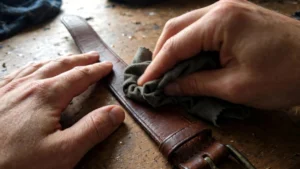
If you wear a belt every day, rotate two if you can. Leather needs a day to rest and dry out between wears, and a belt that is worn daily without a break will wear out faster at the holes and the buckle. Store belts hanging or loosely coiled, never folded tight, and keep them away from radiators and damp cupboards.
Checklist: choosing a leather belt for work honestly
Use these checks before you buy, and again after a month of wear.
- Check the leather type: full-grain or top-grain stated clearly, not just the word leather.
- Check the edges: burnished or painted, smooth to the touch, with no rough fibres.
- Check the buckle: solid metal, flat against the strap, and matching your other accessories.
- Check the fit: the middle hole should be the right one when worn over work clothes.
- Check the match: the belt tone should sit with your shoes, not fight them.
- Check the width: it should fill the belt loops without bunching or gaping.
Frequently asked questions
Should my belt match my shoes exactly?
It should match in tone, not necessarily in exact colour. A dark brown belt with dark brown shoes looks right even if the shades differ slightly. Black with black is the strictest pairing, while brown, tan, and oxblood have more room to vary.
How wide should a work belt be?
For trousers, 25 to 35 millimetres is the usual range. Slimmer straps suit tailored trousers with narrow loops, and wider straps suit heavier fabrics and casual work outfits. For dresses, a waist belt can be 40 to 50 millimetres wide.
How do I know if a belt is real leather?
Check the label for full-grain or top-grain leather, and feel the strap. Real leather has a slightly uneven grain, a firm but flexible feel, and finished edges. A strap that feels papery, plasticky, or perfectly uniform is often bonded leather or synthetic.
Can I wear a brown belt with a black suit?
It is better not to. A black suit calls for a black belt and black shoes. Brown works with navy, grey, and charcoal, where it softens the outfit, but black suiting is at its best with black accessories.
How long should a leather work belt last?
A full-grain belt worn most days should last three to five years with light care, and often longer if you rotate it with a second belt. A bonded leather belt often shows wear within a year.
Do I need a different belt for summer and winter?
Not necessarily, but it helps. Heavier winter fabrics and layers can need a slightly longer belt or a wider strap, while summer outfits suit slimmer, lighter belts. If you only buy one, choose a mid-width strap that works with both.
The bottom line
The best leather belt for work in 2027 is not the most expensive or the most fashionable. It is a full-grain strap in a colour that matches your shoes, with a simple buckle and finished edges, sized so the middle hole is the right one. Start with black for formal outfits, add brown or tan for everything else, and let the belt disappear into the outfit rather than compete with it.
Buy once, buy well, and look after it. A good belt worn four days a week for three years costs very little per wear, and it makes every outfit it sits in look more considered. That is the honest return on a piece of leather most people never think about until it lets them down.