A peridot bracelet is one of the easiest ways to wear August’s birthstone every day. Its fresh lime-to-olive green looks bright against the skin, pairs well with gold and silver, and costs far less than emerald. But not every green bracelet is worth your money: some stones are pale and glassy, some settings are too weak for a stone as soft as peridot, and some clasps will have you chasing your bracelet across a restaurant floor.
Peridot is the gem variety of olivine, coloured by iron built into the mineral itself, so every genuine peridot is green. The question is how good that green is.
This guide covers what matters before you buy: colour, clarity, cut, styles, metals, clasps, fakes, and fair prices in 2027.
Key takeaways
- Colour leads everything: look for a vivid, medium-toned green with no brown cast and only a little yellow warmth.
- Eye-clean stones are the goal, but tiny lily-pad inclusions are normal in peridot and harmless when they do not cloud the stone.
- Peridot scores 6.5 to 7 on the Mohs scale, so bezel settings and protective prongs matter more than for harder stones.
- Check the clasp in person: a secure box, lobster, or toggle clasp with a safety chain beats a pretty design that opens on its own.
- Buy from sellers who name the stone, the metal, and the total carat weight, and who accept returns.
Start with the colour
Colour carries most of a peridot bracelet’s value, so judge it first and in daylight. Shop lighting flatters jewellery, so step near a window: the stone should still glow green, not fade to a pale yellow wash.
The best colour is a medium-toned, vivid green. Too light and it looks washed out; too dark and the stones turn muddy. A slight yellow or olive cast is normal, but a brownish cast is the main thing that lowers quality, so walk away from stones that look tea-coloured or grey in the middle. White paper held behind the bracelet makes brown and grey undertones easier to see.
In a bracelet, matching matters as much as any single stone. A tennis bracelet should read as one continuous line of green, not a patchwork of pale and dark stones. Side by side, the bracelet with the more even colour is usually the better buy.
Clarity: what to accept and what to avoid
Peridot is a Type II coloured stone, so it commonly grows with some inclusions. The most characteristic are lily-pad inclusions, flat disc-like veils that look like tiny water lilies under magnification. A few small, scattered lily pads are normal and harmless.
What you want is an eye-clean appearance: no distracting inclusions visible to the naked eye at a normal viewing distance. If you can see black specks, cloudy patches, or cracks without a loupe, the clarity is poor for the price. Avoid any stone with a fracture that reaches the surface or runs near the girdle, the thin edge where the stone meets its setting: a surface-reaching crack is a future chip.
Cut: the difference between sparkle and a dull window
A good cut turns a nice green stone into a lively one. Peridot has strong double refraction, so light splits inside the stone, and a well-proportioned cut tames that into even colour and bright reflections. A poor cut leaves the stone flat, dark at the edges, or washed out in the centre.
The fault to look for is called windowing. Tilt the bracelet and look straight down through the top of a stone: if you can see straight through it, the cut is too shallow and light is leaking out of the bottom instead of bouncing back to your eye. A well-cut stone shows lively reflections and even colour, with no pale, see-through patch in the middle.
Bracelet styles and which suit peridot best
Peridot suits almost every bracelet style, but the stone’s softness means some designs protect it better than others. A bezel-set tennis bracelet is the safest fine-jewellery choice, while a beaded stretch bracelet is the most comfortable everyday option.
| Style | Best for | Peridot protection | Price range |
|---|---|---|---|
| Tennis bracelet | Evenings, weddings, gifting | Good in bezel settings | Higher |
| Beaded stretch | Daily wear, casual outfits | Fair; beads take knocks | Low to mid |
| Bangle | Stacking, statement looks | Good; stones set flush | Mid to high |
| Charm bracelet | Personal, collectable style | Fair; charms add weight | Mid |
| Cuff bracelet | Bold, modern styling | Good; centre stone protected | Mid to high |
| Link bracelet | Classic, office-friendly wear | Good with prong settings | Mid |
| Slider bracelet | Adjustable fit, gifting | Fair; check the slider | Low to mid |
| Beaded with gold accents | Everyday elegance | Fair; beads exposed | Low to mid |
For everyday wear, a beaded stretch bracelet or a bezel-set tennis bracelet is the sensible pick. For special occasions, a prong-set tennis bracelet or a cuff shows the stones off best.
Metal and setting: what keeps peridot safe
Yellow gold warms up peridot’s green and flatters warm skin tones, while white gold and platinum cool it down and suit cooler skin. Sterling silver is the most affordable option, but it is softer than gold, so check the prongs regularly.
Fourteen-karat gold is the practical sweet spot: harder and more scratch-resistant than 18-karat gold, and cheaper. Whatever metal you choose, the setting matters more than the karat. Bezel settings, where a rim of metal wraps around each stone, protect peridot’s edges from chips and suit daily wear best. Prong settings show off more of the stone, but check them every few months, because a loose stone can chip before you notice it is loose.
Fit and clasp: the part most buyers forget
A bracelet that does not fit will not be worn, however beautiful its stones are. Measure your wrist snugly, then add about one to two centimetres for comfort. A tennis bracelet should sit close to the wrist with just enough room to slide a finger underneath.
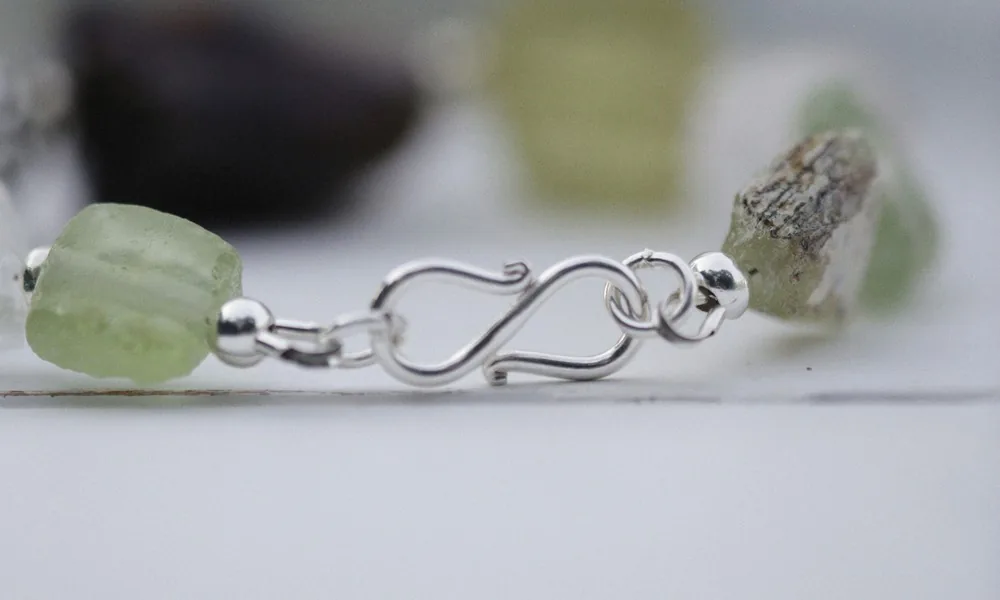
The clasp is the most common point of failure on any bracelet, so test it properly. A lobster clasp should snap shut firmly and need a deliberate press to open. A box clasp should click audibly and have a safety chain as backup. A toggle clasp should feel secure when the bar is through the ring, with no wobble. If the clasp feels flimsy, sticky, or vague, ask for a different piece, because a lost bracelet is a total loss.
How to spot a fake peridot bracelet
Peridot is almost always sold natural and untreated, but fakes still circulate, especially online. The most common substitutes are green glass, synthetic forsterite, and dyed quartz. Glass often contains round air bubbles and can look too perfect. Synthetic forsterite tends to be suspiciously flawless and cheap for its size. Dyed quartz gives itself away when colour gathers in cracks and along the edges of the stone, where dye pools.
Real peridot is strongly doubly refractive, so through a loupe you may see the back facet edges doubled, a detail glass does not show. It also feels cool to the touch and warms slowly, while glass warms quickly. For any bracelet over a modest budget, ask for a certificate from a recognised gemmological laboratory, and buy from a seller who states the stone, the metal, and the total carat weight in writing.
Your buying checklist
- Colour: vivid, medium-toned green in daylight, even across all stones, with no brown cast.
- Clarity: eye-clean at arm’s length, no surface-reaching cracks, no large black specks.
- Cut: no window in the centre of the stones, lively reflections, symmetrical beads or settings.
- Setting and metal: bezel or sturdy prongs, smooth finish, metal suited to your skin and budget.
- Clasp and fit: secure clasp with a safety chain, comfortable fit with a finger’s width of ease.
- Paperwork: stone, metal, and carat weight named in writing, plus a clear returns policy.
What a peridot bracelet should cost in 2027
Prices vary widely: a peridot bracelet can be a modest beaded piece or a four-figure fine-jewellery item. Small, commercial-quality beads in silver or on elastic cord are the most affordable entry point. Mid-range bracelets use better-coloured, eye-clean stones in 14-karat gold or solid silver, where most buyers find the best balance of beauty and durability. At the top end, large, vivid, eye-clean stones in 18-karat gold or platinum command serious prices, rising steeply with size because fine peridot over three carats is genuinely scarce.
Expect to pay more for even colour, eye-clean clarity, and a secure, well-finished setting than for size alone. A smaller bracelet with excellent colour will always outshine a larger one with muddy stones. Compare like with like: a bracelet listed as “peridot” with no carat weight, no metal purity, and no stone count is not comparable to one that lists all three. A good returns policy is part of the price.
How to care for your peridot bracelet
Clean it with warm water, a drop of mild washing-up liquid, and a soft brush, then rinse and pat dry with a lint-free cloth. Avoid ultrasonic and steam cleaners, which can shake loose stones in older settings, and never use harsh chemicals or abrasive polishes. Put your bracelet on last when you get dressed and take it off first when you come home, so it avoids perfume, hairspray, and hand cream. Store it separately from harder jewellery, and have the prongs and clasp checked by a jeweller once a year.
If you are still deciding between styles, our round-up of the best peridot bracelets shows the designs side by side, and the wider peridot jewellery guide covers rings, earrings, and necklaces in the same stone.
Frequently asked questions
Is peridot durable enough for everyday wear?
Yes, with sensible care. Peridot scores 6.5 to 7 on the Mohs hardness scale, softer than sapphire or diamond but hard enough for daily wear in a protective setting. Choose a bezel setting or sturdy prongs, and take it off for heavy work and the gym.
What colour peridot is best in a bracelet?
A vivid, medium-toned green with little yellow and no brown is the most desirable, bright and lively in daylight rather than pale or muddy. In a bracelet, even colour across all the stones matters as much as the colour of any single stone.
How much should I spend on a peridot bracelet?
It depends on the stones and the metal. Simple beaded bracelets in silver are affordable, mid-range gold bracelets with eye-clean stones offer the best value, and large, vivid stones in 18-karat gold cost considerably more. Judge value by colour, clarity, and setting quality rather than by size alone.
How can I tell if a peridot bracelet is real?
Look for natural variation in colour, tiny lily-pad inclusions under a loupe, and a cool feel that warms slowly in your hand. Round air bubbles, a too-perfect colour, or dye pooling in cracks all suggest glass or dyed quartz.
Which metal looks best with peridot?
Yellow gold warms peridot’s green and suits warm skin tones, while white gold, platinum, and silver cool it down and suit cooler skin. Fourteen-karat gold is the practical choice for daily wear. Try the bracelet on in daylight, since shop lighting flatters every metal.
What is the best clasp for a peridot bracelet?
A box clasp with a safety chain is the most secure choice for a fine tennis bracelet, followed by a firm lobster clasp. Toggle clasps look elegant and fasten easily one-handed, but they should fit snugly with no wobble. Test any clasp several times in the shop: it should close with a firm click and stay shut when you tug it gently. Our guide to what to look for in a peridot ring covers the same quality checks for stones.
The bottom line
A great peridot bracelet comes down to four checks: vivid, even green in daylight; eye-clean stones with no surface cracks; no window in the centre of the cut; and a clasp that clicks shut and stays shut. Get those four right and you will have a bracelet you reach for constantly.
Note: Prices and availability change, and every stone is unique, so treat the price ranges here as a guide rather than a promise. If a deal looks far cheaper than comparable pieces, check the stone, the metal, and the returns policy first.