



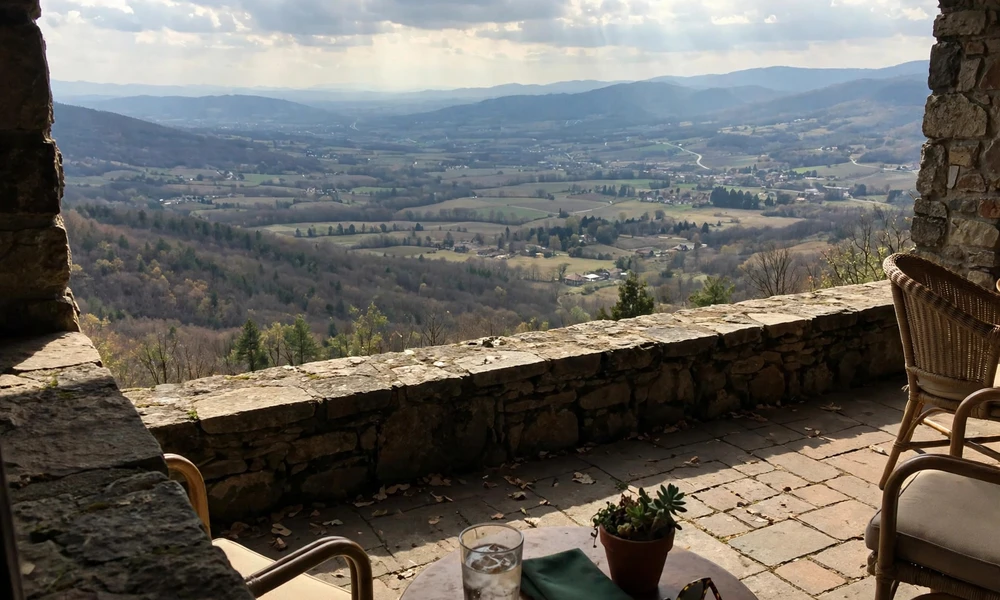
A hilltop retreat is the simplest luxury there is: a room above everything, with the valley, the sea or the vineyards spread out below you and nothing between you and the horizon. There is no lobby scene to join, no beach club to fight for, and no view that depends on the floor you booked. The view is the point of the place, and every room is built around it.
The appeal is not only the scenery. Hilltops are quieter than towns, cooler than valleys in summer, and calmer at night, when the lights below switch on one by one. For a short stay, that feeling of being above the everyday is hard to beat.
Below are nine luxury hilltop retreats worth considering in 2027, from a restored Tuscan castle to a palace on a hill above Hyderabad and a mountain lodge in the Dolomites. Each one is described by what it does well, what to watch for, and who it suits best, so you can choose with your trip in mind, not just a photograph.
Key takeaways
- A true hilltop retreat sits at the summit or on the highest ground, with views in more than one direction and real quiet at night.
- Pick the hill and the season together: hilltops are cooler and windier than valleys, and the best views come with changeable weather.
- Check the transfer before you book, because many hilltop stays are reached by a winding road, a funicular or a private driver.
- Rooms facing the view cost more and sell first, so book early if the outlook matters to you, and ask exactly which direction the room faces.
- No hilltop stay suits everyone, and steep paths, thin air at altitude and long drives can make a beautiful retreat the wrong choice for some travellers.
What a luxury hilltop retreat actually is
A hilltop retreat is a stay built on high ground, where the elevation is the main attraction. It is not simply a hotel with a nice view from the top floor. The whole property is placed to use the height: terraces face the sunset, pools sit at the edge of the slope, dining rooms look across the valley, and the best rooms are the ones that sit highest. The difference is easy to feel. Down in a town, a view is something you look at. Up on a hill, you live inside it.
The best hilltop retreats share three things. First, they are genuinely high, with open views rather than a glimpse between buildings. Second, they are calm, because the height puts distance between you and traffic, crowds and noise. Third, they make the outdoors easy to enjoy, with terraces, gardens, walking paths or a pool that faces the right way.
Hilltops also come with honest trade-offs. The road up is often narrow and winding, and a stay that feels remote and romantic in daylight can feel a long way from a restaurant or a pharmacy after dark. Wind is stronger up high, mornings can be misty, and in the mountains the air is thinner, so walking uphill takes more effort than you expect. A hillside retreat sits lower on the slope and is often easier to reach, while a hilltop stay trades that convenience for the full panorama.
How we chose these retreats and what to look for
Look first at the position. A genuine hilltop retreat sits at or near the summit, with views that open out rather than up. Ask which direction the rooms face, because a west-facing terrace gives you sunsets while an east-facing one gives you sunrise, and the difference matters more than the room size. Check whether the pool, the restaurant and the spa also face the view, or whether only a few premium rooms do.
Look next at how you get there and how you get around once you arrive. Some hilltop stays are a short drive from a town, others need a private transfer and a winding climb. If you plan to explore, check whether the hotel runs a shuttle, whether a car is worth hiring, and whether walking into town is realistic or a steep climb back. A retreat that feels peaceful for two days can feel cut off by day four if you have no easy way down.
Finally, look at what the height gives you in practice. A spa with a view, a restaurant that uses the terrace at dusk, and walking paths that start at the door are all signs the property was designed for its position. Our guide to luxury cliff retreats covers the coastal alternative, where the drop is to the sea rather than to the valley.
The 9 best luxury hilltop retreats of 2027
Castello di Casole, Tuscany, Italy
What we like: A restored tenth-century castle on a hill above the Tuscan countryside, with an infinity pool facing the valley, a spa in the old castle walls, and rooms that feel like a private estate rather than a hotel. What to consider: It is a drive from Siena and Florence, and a car is useful for exploring. Best for: Couples and slow, wine-country weeks. Style: Restored castle, warm stone and linen. Price range: From around $800 a night. Standout feature: The pool terrace at sunset, with the whole valley below.
Rosewood Castiglion del Bosco, Tuscany, Italy
What we like: A working wine estate on a hill above the Val d’Orcia, with a private golf course, a spa in a restored farmhouse, and suites spread across the village so the stay feels like a small town of your own. What to consider: The estate is large and spread out, so allow time to move between the village, the spa and the restaurants. Best for: Wine lovers and longer stays. Style: Rustic luxury, stone farmhouses and cypress trees. Price range: From around $1,000 a night. Standout feature: The estate winery and the views across the Val d’Orcia.
Anantara Al Jabal Al Akhdar, Oman
What we like: A resort on the edge of a canyon on Oman’s Green Mountain, 2,000 metres up, with a clifftop infinity pool, a spa built into the rock, and some of the clearest night skies in the Middle East. What to consider: The altitude and the mountain road are real factors, and the resort is a two-hour drive from Muscat. Best for: Stargazers and travellers who want real altitude. Style: Mountain fortress, stone and warm wood. Price range: From around $600 a night. Standout feature: The Diana’s Point platform, with a view across the canyon at sunset.
Wildflower Hall, Shimla, India
What we like: A former residence of Lord Kitchener on a hilltop above Shimla, surrounded by cedar forest, with an outdoor pool, a spa, and views across the Himalayan foothills. What to consider: The mountain roads are slow, and the altitude takes a day to adjust to. Best for: Families and first-time Himalayan travellers. Style: Colonial manor, wood panelling and open fires. Price range: From around $500 a night. Standout feature: The cedar forest walks that start at the door.
Six Senses Douro Valley, Portugal
What we like: A renovated nineteenth-century manor on a hill above the Douro River, with terraced vineyards below, an outdoor pool facing the valley, and a spa with a large indoor pool. What to consider: The Douro is a wine region, so the best months are spring and autumn, and summer can be very hot. Best for: Wine lovers and slow river-valley weeks. Style: Contemporary manor, light wood and stone. Price range: From around $700 a night. Standout feature: The pool deck above the terraced vineyards at dusk.
Taj Falaknuma Palace, Hyderabad, India
What we like: A palace on a hill above Hyderabad, with marble halls, a large pool, horse-drawn carriage arrivals, and views across the old city from the terraces. What to consider: It is a grand, formal hotel, so it suits travellers who enjoy ceremony and service rather than a casual stay. Best for: Special occasions and first-time visitors to Hyderabad. Style: Restored palace, marble and chandeliers. Price range: From around $700 a night. Standout feature: The palace itself, and the view across the city from the hill.
Belmond Hotel Splendido, Portofino, Italy
What we like: A former monastery on a hill above Portofino harbour, with a pool and terraces looking down over the boats, a spa, and gardens that feel a world away from the busy harbour below. What to consider: Portofino is small and expensive in high season, and the hill means a climb or a shuttle back up. Best for: Couples and classic Riviera weekends. Style: Riviera monastery, pale stone and shaded terraces. Price range: From around $1,200 a night. Standout feature: The pool terrace above the harbour at golden hour.
Adler Lodge Ritten, South Tyrol, Italy
What we like: A small lodge on a sunny plateau above Bolzano, with a spa, an outdoor pool, and views across the Dolomites, reached by cable car from the valley. What to consider: It is a quiet, small property, so it suits travellers who want walking and wellness rather than nightlife. Best for: Walkers and spa lovers. Style: Alpine lodge, wood, glass and stone. Price range: From around $600 a night. Standout feature: The plateau walks with the Dolomites on the horizon.
Monastero Santa Rosa, Amalfi Coast, Italy
What we like: A seventeenth-century monastery on a hill above the Amalfi Coast, with terraced gardens, an infinity pool, and a spa in the old monastery cells. What to consider: The coast road is slow and busy in summer, and the hotel is a drive from the nearest town. Best for: Couples and quiet coastal weeks. Style: Restored monastery, white walls and lemon trees. Price range: From around $900 a night. Standout feature: The terraced gardens above the sea.
Which hilltop retreat is right for you
Start with what you want the height to give you. If you want vineyards and slow food, a Tuscan or Douro hilltop is the right call, with wine, walking and long dinners built in. If you want drama and altitude, the Omani mountains or the Himalayan foothills will give you thin air, big skies and a real sense of being far away. If you want the sea as well as the height, the Riviera and the Amalfi Coast offer both, with a harbour or a coastline below.
Think next about how much effort you are happy with. A hilltop stay in Tuscany or the Douro is an easy drive from an airport and a town, with a car and a map. A mountain lodge in Oman or a plateau in the Dolomites needs more planning, a transfer, and a day to adjust to the altitude.
Finally, match the stay to the season. Hilltops are at their best in late spring and early autumn, when the air is clear, the light is soft, and the temperature is comfortable. Winter is quiet and atmospheric, but some terraces and pools close, and the roads can be slow. A cliff escape plan uses the same seasonal logic, because height and weather are always linked.
The caveats that matter
Hilltop stays are beautiful, but they are not always easy. The road up is often narrow, steep or winding, and driving it at night or in rain is harder than it looks on a map. Altitude affects some people more than others, with headaches, tiredness and poor sleep on the first night, especially above 2,000 metres. Wind and mist can hide the view for a day, and a hilltop that is magical in sunshine can feel exposed in a storm.
| Detail | What is known |
|---|---|
| What makes a true hilltop stay | Built at or near the summit, with open views and real quiet at night |
| Best seasons | Late spring and early autumn, when the air is clear and the light is soft |
| Who should take care | Travellers with mobility issues, vertigo, or sensitivity to altitude |
| Getting there | Often a winding road, a funicular or a private transfer; arrive in daylight |
| Weather up high | Cooler and windier than the valley, with mist and fast-changing conditions |
| What to book first | A view-facing room, which sells first and costs more |
| What to pack | Layers, flat shoes, a light waterproof, and sun protection |
| What it does not suit | Trips that need easy town access, nightlife, or flat, step-free walking |
If you have a heart condition, breathing problems, or you are pregnant, check with your doctor before booking a stay at real altitude, and tell the hotel when you arrive. Most hilltop stays are happy to help with a slower first day, a room close to the main building, or a driver for the steepest sections. Asking in advance is always better than struggling on the hill.
Checklist: booking a hilltop retreat honestly
Use these checks before you book, and again before you travel.
- Check the position: ask which direction the room faces and whether the pool and restaurant face the view too.
- Check the transfer: confirm how you get up the hill, how long it takes, and what it costs.
- Check the season: ask what the weather is usually like in your month, and what is open.
- Check the walking: ask about steps, slopes and distances between the room, the spa and the restaurant.
- Check the room: confirm the view is from the room itself, not just from a shared terrace.
- Check the plan: keep the first day light, arrive in daylight, and pack layers for the wind and the evening chill.
Frequently asked questions
What is the difference between a hilltop and a hillside retreat?
A hilltop retreat sits at or near the summit, with views in several directions and the valley below. A hillside retreat sits on the slope, usually lower down, with a view in one direction and easier access to the town. Hilltops trade convenience for the full panorama.
Are hilltop retreats suitable for older travellers?
Often yes, if the property has a shuttle, a lift and flat paths between the main areas. Ask the hotel directly about steps and slopes, and choose a room close to the restaurant and spa. Avoid stays that need a long, steep walk to reach the rooms.
Do I need a car at a hilltop retreat?
It depends on the stay. A car is useful in Tuscany, the Douro and the Amalfi Coast, where villages and vineyards are spread out. In the mountains and on small plateaus, a hotel shuttle and a cable car are often easier. Check before you book, and ask about parking if you drive.
What is the best time of year for a hilltop stay?
Late spring and early autumn are usually best, with clear air, soft light and comfortable temperatures. Summer can be hot in the Mediterranean, and winter is quiet but can be misty, with some terraces and pools closed. Check what is open in your month.
Is altitude a problem at hilltop retreats?
Most hilltop stays are below 1,500 metres, where altitude is rarely an issue. Above 2,000 metres, as in Oman, some people notice headaches, tiredness or poor sleep on the first night. Drink water, keep the first day light, and ask your doctor if you have a heart or breathing condition.
How far in advance should I book a hilltop retreat?
Three to six months ahead for the best rooms in spring and autumn, and earlier for a view-facing room or a special occasion. Hilltop stays are often small, with few rooms, so the best ones sell out first. Book the transfer at the same time as the room.
The bottom line
The best luxury hilltop retreat in 2027 is not the highest or the most expensive. It is the one whose hill, season and setting match the trip you actually want, with a room that faces the view, a transfer that is already sorted, and a first day kept light enough to enjoy the height rather than recover from it. For vineyards and slow food, Tuscany and the Douro are hard to beat. For drama and altitude, Oman and the Himalayan foothills offer something no valley stay can.
Choose one hill, book the view-facing room early, arrive in daylight, and give yourself a day to settle into the height.


