


What do a kitchen sink shutoff, a city water main, and a chemical plant reactor line have in common? Each one probably depends on a ball valve, a small piece of hardware that has quietly become one of the most common valves on earth. The idea behind it is almost laughably simple: a metal ball with a hole through the middle sits inside the pipe. Turn the handle a quarter turn, and the hole either lines up with the flow or turns away from it. That is the whole trick.
But simple does not mean trivial. The details of how that ball is held, what the seats are made of, and how the bore is sized decide whether a valve lasts thirty years or fails in a month. This guide walks through the design, the trade-offs, the standards, and the mistakes that trip people up in practice.
What Is a Ball Valve, Exactly?
A ball valve is a quarter-turn rotary valve. A spherical, ported ball inside the body controls the flow. When the port faces the pipe, fluid passes through. Rotate the handle 90 degrees and the solid side of the ball blocks the line.
That quarter-turn action is the headline feature. A gate valve or globe valve may need many turns of the handwheel to open or close. A ball valve goes from fully open to fully closed with one quick motion. In an emergency, that speed matters. In everyday use, it saves time and wrist strain.
The design is generally credited to Henry Kennedy, who patented a metal-seated ball valve in the United States in 1877. Details of the patent record vary across secondary sources, so treat the exact attribution with a little caution. What is not in doubt is that the modern soft-seated version, with polymer seats, became dominant in the twentieth century as PTFE and similar materials became available.
How the Quarter-Turn Mechanism Works
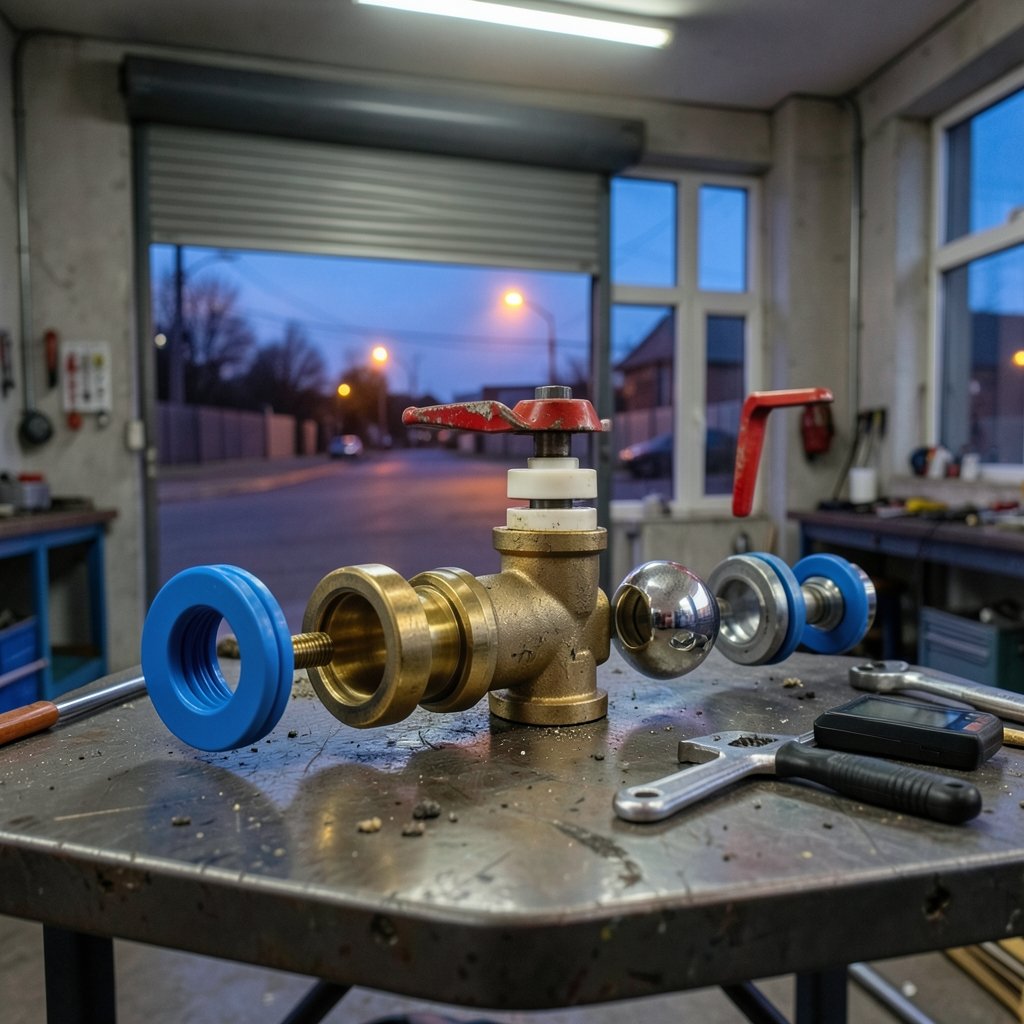
Picture the inside of the valve body. The ball sits between two seats, which are ring-shaped seals that press against the sphere. The stem connects the ball to the handle outside. Packing around the stem stops leaks to the outside world.
Three things happen when the handle turns:
- The stem rotates the ball 90 degrees.
- The port swings from aligned to blocked, or the reverse.
- The seats keep contact with the ball throughout, so the seal is maintained even mid-turn.
In most designs, the handle stops at two positions, fully open and fully closed. That physical stop is a safety feature. It prevents someone from leaving the valve half open by accident, which is exactly the condition soft-seated ball valves handle worst.
Floating Ball vs. Trunnion-Mounted Ball
Not all balls are supported the same way, and this is one of the most important design splits in the category.
| Feature | Floating ball | Trunnion-mounted ball |
|---|---|---|
| How the ball is held | Restrained only by the seats | Anchored top and bottom on bearings |
| Typical sizes | Small to medium | Large and high-pressure lines |
| Sealing force | Line pressure pushes ball into downstream seat | Seats are pushed against a fixed ball |
| Operating torque | Rises with size and pressure | Lower and more predictable |
| Common use | Residential and light industrial | Pipelines, large process lines |
With a floating ball, line pressure actually helps the seal. The pressure pushes the sphere into the downstream seat, tightening the shutoff. That works beautifully on small valves. On large ones, the same force makes the handle brutally hard to turn, so engineers switch to a trunnion mount. The ball stays put, and the seats do the moving. If you have ever strained to turn a big valve handle, you have met a floating ball that should have been trunnion-mounted.
Port Configurations: Full Port, Reduced Port, and Multi-Port
The bore through the ball is not always the same size as the pipe. That choice has real consequences.
A full-port valve has a bore equal to the pipe’s internal diameter. Flow passes with very little pressure drop, and you can often run a pig or cleaning tool through it. It costs more and takes up more space.
A reduced-port valve has a smaller bore. It is cheaper, lighter, and needs less torque to operate, but it throttles the flow slightly even when fully open. On a long line with several reduced-port valves, those small losses add up.
Then there are three-way and multi-port versions. These divert or mix flow between two or more lines. They are common in switching applications, like alternating between two supply tanks. Note that a three-way ball valve is a routing device, not a precision mixing valve.
Seat Materials and Temperature Limits
The seats are the heart of the seal, and their material sets the valve’s practical limits.
PTFE (often called Teflon) and similar polymers give extremely tight shutoff at moderate temperatures. They are the default for water, air, and many chemicals. Above a certain temperature, though, the polymer softens and deforms, and the seal degrades. Manufacturers publish their own limits, and those limits vary widely, so always check the datasheet rather than assuming a generic number.
Metal seats handle high temperatures and abrasive service. The trade-off is that a metal-to-metal seal is rarely bubble-tight in the way a soft seat is. It leaks a little, by design, and that is acceptable in many hot or dirty applications.
A practical rule: match the seat to the worst condition the valve will see, not the average one. A steam line that occasionally spikes hot will punish a soft seat that was specified for normal operation.
Where Ball Valves Shine, and Where They Don’t
Ball valves are everywhere: water distribution, oil and gas, chemical processing, and residential plumbing. The shutoff valve under your sink is very likely a ball valve, and so is the main valve where water enters a house. Low torque, tight shutoff, and fast operation make them the default choice for on/off service.
They are less suited to throttling. Partially open a soft-seated ball valve and the flow rushes past the edge of the port at high velocity, which can erode the seat over time. If you need to control flow rate, a globe valve or a control valve is usually the better tool. Ball valves are switches, not dimmers.
Slurry service and cavitation also demand special designs. Standard valves can clog or wear quickly in those conditions. If your line carries grit or flashes to vapor, talk to a specialist rather than reaching for the catalog default. (The row)
Standards That Matter
Industrial ball valves are not sold on a handshake. Several standards govern how they are built and tested.
API 6D covers pipeline valves, including ball valves used in transmission lines. ASME B16.34 sets pressure-temperature ratings for valves with flanged, threaded, and welding ends. Fire-safe claims should reference a recognized test procedure, either API 607 or ISO 10497, which simulate a fire and check that the valve still seals afterward.
One caution: standards get revised. When you cite a standard on a specification sheet, cite the edition rather than only the number. A valve built to an old edition may not meet the current one, and that gap can matter in an audit.
Practical Tips and Common Mistakes
Experience with these valves surfaces a handful of recurring errors. None are exotic, and all are avoidable.
Matching the valve to the pipe size but not the flow. A reduced-port valve on a line sized for full flow will quietly rob capacity. Check the port as well as the end connections.
Ignoring the dead volume. In hygienic service, such as food or pharma lines, the cavity around the ball can trap product. Cavity-filling designs exist for exactly this reason. Specifying a standard valve in a cleanable line is a classic mistake.
Over-tightening threaded ends. Pipe dope and too much torque crack bodies. Follow the maker’s instructions and use the right sealant.
Assuming the handle position tells the truth. On some valves, the handle can be removed and refitted in the wrong orientation. Verify open and closed against flow rather than relying only on the lever.
Skipping the actuator question. If the valve will be automated, check the mounting interface early. Getting an actuator to fit a valve that was never designed for one is a needless headache.
Forgetting the stem packing. The packing is a wear item. On critical isolation valves, a planned repacking schedule beats an unplanned leak.
For anyone deep in textured-hair content, the word “ball” might bring to mind something else entirely, like the tight coils of 4c hair or the loose waves of 2b hair. Different world, same principle of matching the tool to the job.
Ball Valve vs. Gate Valve: A Quick Comparison
These two are often pitted against each other for isolation duty. Both are on/off valves, but they behave differently.
| Factor | Ball valve | Gate valve |
|---|---|---|
| Operation | Quarter turn | Multi-turn |
| Speed | Fast | Slow |
| Shutoff tightness | Excellent with soft seats | Good, but can weep |
| Pressure drop (full port) | Very low | Very low |
| Throttling | Poor | Poor |
| Size range | Small to very large | Small to very large |
| Maintenance | Seat and packing replacement | Stem and seat wear |
The short version: ball valves win on speed and tight shutoff, gate valves win on cost at very large sizes and on tolerance for debris in some services. Neither is a good throttling valve.
Installation and Maintenance in Practice
A few habits keep ball valves healthy for decades.
Install with the handle accessible. It sounds obvious, but valves get buried behind insulation or piping all the time. Leave room to turn the lever and to reach the packing nut.
Exercise the valve periodically. A valve that sits untouched for years can seize or develop a stiff seat. Turning it open and closed a few times a year keeps it free. This is especially true for emergency isolation valves, which are useless if they will not move when needed.
Watch for stem leaks. A drip at the packing gland usually means the packing needs tightening or replacing. Do not crank the nut down hard; a gentle adjustment is enough.
Replace seats rather than the whole valve when possible. Many industrial ball valves are designed for seat and seal replacement, which saves money and downtime.
And respect the temperature limit. A soft-seated valve pushed past its rated temperature will deform its seats and start to leak. That failure is gradual and easy to miss until it becomes a problem.
Conclusion
The ball valve earns its place through simplicity: one sphere, one hole, one quarter turn. That basic idea scales from a garden hose to a transcontinental pipeline, with the details of ball support, port size, and seat material doing the heavy lifting. Choose full port when flow matters, trunnion-mounted when size and pressure climb, and soft seats only within their temperature comfort zone. Keep the valve accessible, exercise it now and then, and cite the right standard edition when it counts. Get those things right, and the humble quarter-turn will keep doing its quiet, reliable job for a very long time.
Frequently Asked Questions
What is a ball valve used for?
A ball valve is used to start and stop flow in a pipe. It is common in residential plumbing, water distribution, oil and gas, and chemical processing. It is a quarter-turn valve, so it opens and closes fast and seals tightly. It is not designed for precise flow control.
How many turns does a ball valve need to open?
Just one quarter turn, or 90 degrees. The handle moves from fully closed to fully open in a single motion, which is one reason ball valves are favored for emergency shutoff. Most designs have physical stops at both positions so the valve cannot be left partly open by accident.
What is the difference between full port and reduced port?
A full-port ball valve has a bore the same size as the pipe inside diameter, so it causes very little pressure drop. A reduced-port valve has a smaller bore, which makes it cheaper and easier to turn but slightly restricts flow even when fully open.
Are ball valves good for throttling flow?
Generally no. Partially opening a soft-seated ball valve sends flow rushing past the port edge at high speed, which can erode the seat over time. For flow control, a globe valve or a dedicated control valve is the better choice. Ball valves are best treated as on/off switches.
What does fire-safe mean on a ball valve?
A fire-safe rating means the valve has passed a recognized fire test, such as API 607 or ISO 10497. These tests simulate a fire and check that the valve still limits leakage afterward. If a supplier claims fire safety, ask which test and which edition of the standard the valve was evaluated against.
How long does a ball valve last?
It depends on the service. A residential shutoff valve in clean water can last decades. In abrasive, hot, or chemically aggressive service, seats and packing wear faster and need replacement. Exercising the valve periodically and staying within its rated temperature and pressure helps it last much longer.









