

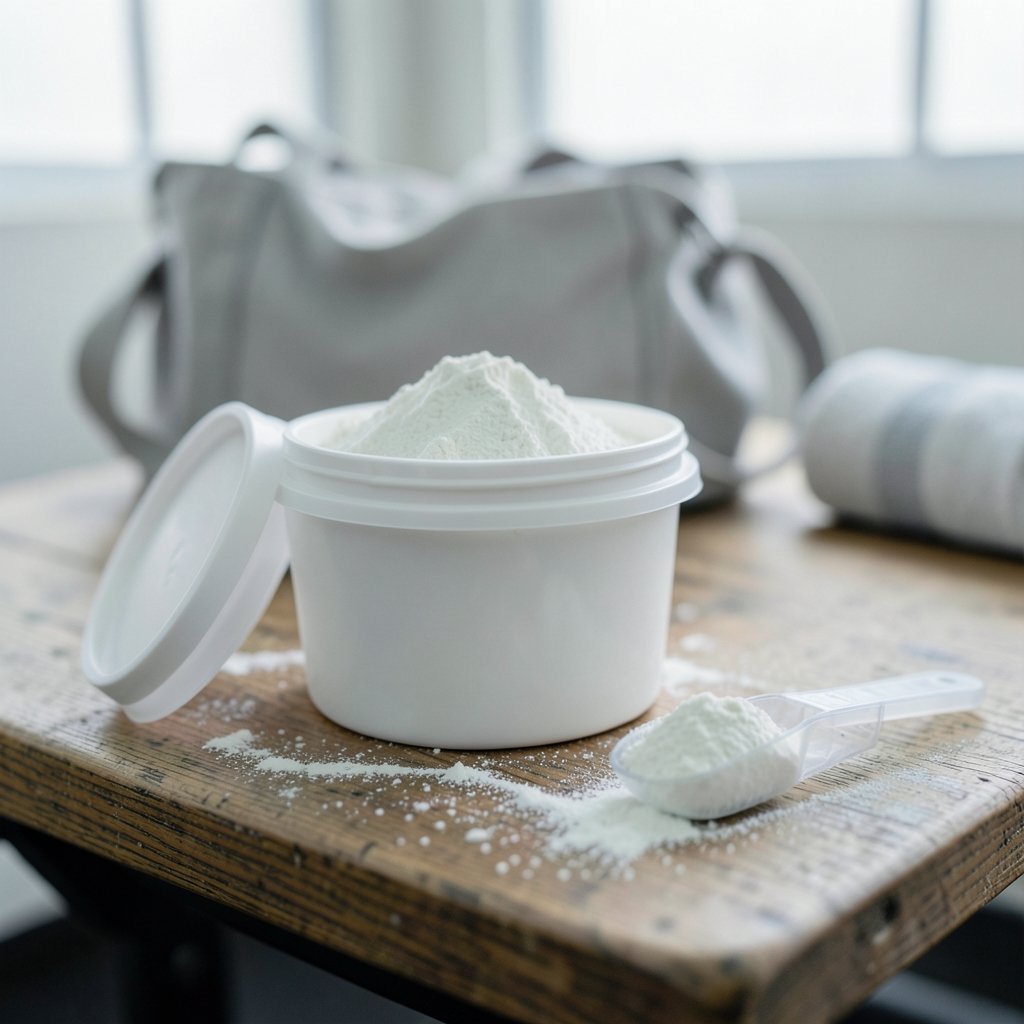
What if the most effective supplement in your gym bag costs less than a sandwich and has been studied for decades? That’s creatine. Yet walk into any supplement store and you’ll face a wall of tubs claiming to be the “best creatine” — gummies, liquids, HCl, buffered blends, fancy fruit punches. Most of it is marketing. A small amount of it is genuinely good.
This guide cuts through the noise. It explains which form has the evidence behind it, how to read a label like someone who knows what they’re doing, and which practical details separate a smart purchase from an expensive mistake.
Why Creatine Earns the “Best” Label at All
Creatine is a nitrogenous compound the body makes from arginine, glycine and methionine, and it also comes from meat and fish. In muscle it’s stored largely as phosphocreatine, which helps regenerate ATP during short, intense effort — the kind that lasts seconds, not hours.
That mechanism is why creatine shows up in sprinting, lifting, and repeated high-intensity work. A 2017 meta-analysis in the British Journal of Sports Medicine found small-to-moderate gains in strength and lean mass when creatine was paired with resistance training versus training alone. And the International Society of Sports Nutrition’s 2017 position stand calls creatine monohydrate the most effective ergogenic supplement for raising high-intensity exercise capacity and lean mass.
In other words, the “best” question isn’t really about whether creatine works. It’s about which product delivers it cleanly, at a fair price, without nonsense.
The Form Question: Monohydrate Wins by Default

Here’s the short version: creatine monohydrate is the most studied form, and reviews have found no reliable evidence that HCl, ethyl ester, buffered, nitrate, or liquid versions outperform it for strength or muscle outcomes.
That doesn’t mean other forms are harmful. It means you’re paying extra for a story. The premium forms often cost two to four times more per gram while offering no proven edge.
| Form | Evidence for superiority | Typical price per gram | Practical verdict |
|---|---|---|---|
| Monohydrate (powder) | None shown over monohydrate | Lowest | Best default choice |
| HCl | Not established | High | Skip unless you tolerate monohydrate poorly |
| Ethyl ester | Not established | High | Skip |
| Buffered (“Kre-Alkalyn”) | Not established | High | Skip |
| Nitrate | Not established for strength | High | Niche, not a baseline pick |
| Liquid | Not established; stability concerns | High | Skip |
| Gummies | Not established; dosing accuracy varies | Very high | Convenient, not optimal |
One practical note from real-world use: some people report bloating or stomach discomfort with monohydrate powder. Taking it with a meal, splitting the dose, or choosing a finer-milled powder usually solves it. Switching to an expensive form rarely does — and it costs a lot more to find out.
How to Judge a Creatine Product in 60 Seconds
Forget the front label. Flip the tub over and look for four things.
1. The ingredient line
It should say creatine monohydrate and basically nothing else. Flavored versions add sweeteners, acids and colors, which is fine if you want a flavored drink — but plain monohydrate plus your own juice or water is cheaper and more flexible. If the label lists a “proprietary blend” with creatine somewhere inside, put it back.
2. Third-party testing
This is the single most useful quality signal. Independent programs like NSF Certified for Sport and Informed Sport verify label claims and screen for contaminants. Because dietary supplements in the US are regulated under the Dietary Supplement Health and Education Act of 1994 — which puts pre-market responsibility on manufacturers rather than requiring FDA approval — a certification mark does real work. It’s not a guarantee of purity, but it’s the closest thing to one on a shelf.
3. Dose per serving
A serving should be around 3 to 5 grams. Watch for products that list “5 g creatine blend” where only part of that is actual creatine. Also watch gummies: a “3 g serving” might mean three gummies, and the bottle might hold only 20.
4. Price per gram, not price per tub
Divide the total price by the total grams in the container. A big tub that looks like a bargain can be worse value than a smaller, tested product. This one calculation kills most bad purchases.
Loading or No Loading? Both Work
Common protocols are about 3 to 5 grams per day for maintenance, or a loading phase of roughly 20 grams per day split into four doses for 5 to 7 days.
Loading saturates muscles faster — useful if you have a competition or a short training block coming up. Skipping the load just means it takes a few weeks to reach the same level. Neither approach is “better” in the long run; they’re different timelines.
A practical tip: take it with a meal or a carb-containing drink. Insulin helps drive creatine into muscle, and food also reduces the chance of stomach upset. Consistency matters far more than timing — the people who get results are the ones who take it most days, not the ones who nail a perfect pre-workout window.
The Mistakes That Cost People Money
A few patterns show up again and again.
Buying based on the front label. Words like “micronized,” “ultra-pure” and “advanced absorption” are not regulated claims. Micronized powder does dissolve more easily, which is a real convenience — but it isn’t a different supplement.
Chasing a new form every few months. If monohydrate is working, switching to HCl or a liquid is a lateral move at best. The research hasn’t moved; the marketing has.
Ignoring the scoop. A heaping scoop can be 7 or 8 grams. That’s not dangerous, but it burns through a tub fast and can cause GI discomfort. Level scoops, or a cheap kitchen scale, keep dosing honest.
Expecting creatine to fix a bad program. Creatine supports training. It doesn’t replace progressive overload, sleep, or enough protein. The 2017 meta-analysis measured creatine plus resistance training — the training was part of the package.
Storing it badly. Powder is stable, but keep it dry and sealed. A tub left open in a humid bathroom turns into a brick.
Who Should Be Careful
Creatine is well tolerated in healthy people, and long-term use has been studied for up to about five years without evidence of harm in that group. That’s a strong safety record.
The picture is less clear for people with pre-existing kidney disease. Evidence there is limited and some case reports exist, and the standard guidance notes caution in that group. Anyone with kidney concerns, or who is pregnant, nursing, or taking medication, should talk to a clinician before starting — not because creatine is uniquely risky, but because “generally safe” isn’t the same as “safe for everyone.”
One more unresolved question: whether caffeine blunts creatine’s effects. Early work suggested it might; later studies are mixed. Treat it as an open question rather than a reason to panic about your pre-workout.
What About Hair and Texture Content?
If you landed here from a beauty or grooming search, a quick clarification: creatine has nothing to do with curl patterns. Hair typing — whether you’re caring for 4c hair, working with looser 2b hair, or following a styling routine like the row method — is a separate topic entirely. Supplement choices and hair care routines don’t overlap. The only shared principle is the same one that applies everywhere: buy based on evidence, not packaging.
A Simple Buying Checklist
If you want a decision you can make in the aisle, run this list:
- Creatine monohydrate on the ingredient line, ideally as the only ingredient.
- A third-party certification mark, or a manufacturer that publishes testing results.
- Roughly 3 to 5 grams per serving.
- A price per gram that beats the flavored and “advanced” alternatives.
- A container size you’ll actually finish in a few months.
That’s it. Everything else is preference — flavor, micronized texture, capsule versus powder. Capsules are convenient for travel but usually cost more per gram and require swallowing several pills per dose.
Conclusion
The best creatine isn’t a secret formula or a premium blend. It’s plain creatine monohydrate, third-party tested, dosed at 3 to 5 grams a day, bought at a sensible price per gram. The evidence for that approach is deep, the safety record in healthy people is strong, and the cost is low enough that consistency becomes easy.
The supplement industry rewards novelty, but your muscles don’t. Pick the boring option, take it most days, and put the money you save toward food that actually feeds the training.
Frequently Asked Questions
Is creatine monohydrate really better than other forms?
For strength and muscle outcomes, reviews have found no reliable evidence that HCl, ethyl ester, buffered, nitrate or liquid forms outperform monohydrate. Monohydrate is also the most studied and usually the cheapest. Other forms aren’t necessarily harmful, but you’re paying a premium for an unproven advantage.
How much creatine should I take each day?
Maintenance is typically about 3 to 5 grams per day. A loading phase of roughly 20 grams per day, split into four doses for 5 to 7 days, saturates muscles faster but isn’t required. Both routes get you to the same place; loading just gets there sooner.
Do I need to cycle off creatine?
No cycling is needed for healthy adults. Long-term use has been studied for up to about five years without evidence of harm in healthy people. Taking it continuously is standard practice and keeps muscle stores saturated, which is the whole point.
Does creatine damage your kidneys?
In healthy people, the evidence doesn’t show kidney harm from recommended doses. The picture is less clear for people with pre-existing kidney disease, where evidence is limited and some case reports exist. Anyone with kidney concerns should check with a clinician first.
Can I take creatine with caffeine?
Probably, but the science isn’t settled. Some early work suggested caffeine might blunt creatine’s effects, while later studies are mixed. There’s no strong reason to avoid combining them, but treat claims in either direction with skepticism.
What’s the fastest way to tell if a creatine product is good?
Check three things: the ingredient line says creatine monohydrate, there’s a third-party testing mark such as NSF Certified for Sport or Informed Sport, and the price per gram is reasonable. If a product hides creatine inside a proprietary blend or leans on unregulated front-label claims, look elsewhere.
What to do with the tub you already bought. If it’s monohydrate, keep it and finish it. If it’s a premium form, finish it too — the cost is already sunk, and it won’t hurt you. Just don’t reorder on autopilot. Set a calendar reminder for when the tub runs out and decide then, with the checklist above in hand, rather than re-buying from habit or from a recommendation that arrived in your feed.
One last calibration on expectations. Creatine is one of the few supplements with a genuinely strong evidence base, but “strong” is relative. The gains are real and modest — a few percent on strength and lean mass over months of consistent training, not a transformation. That’s exactly why the boring pick makes sense: you want the cheapest, most reliable version of a small, dependable edge, not an expensive version of a claim that doesn’t hold up. Buy the plain tub, take it most days, and spend your attention on the parts of training that move the needle more.














