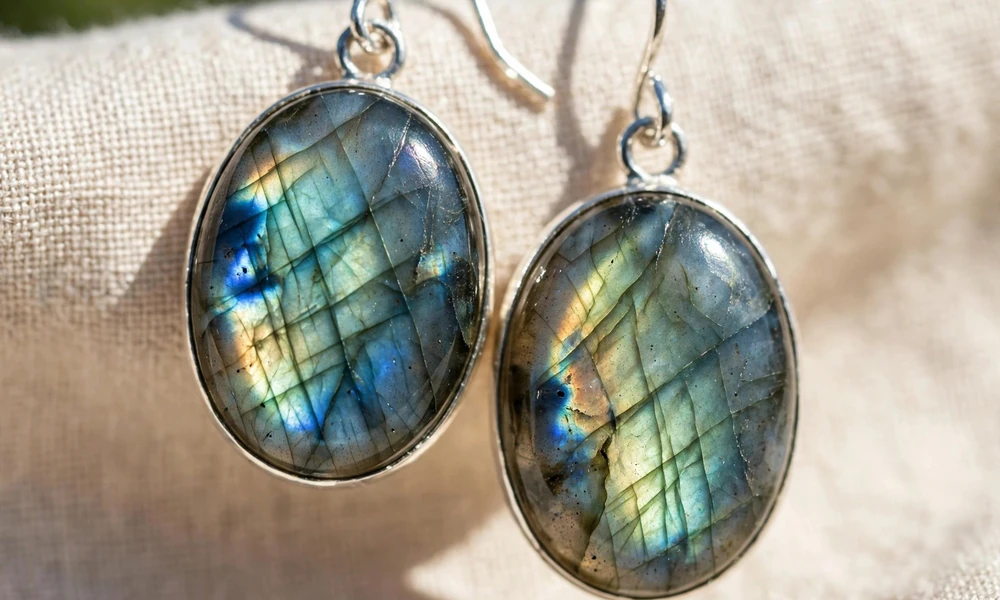
Labradorite is the stone that refuses to sit still. Turn it one way and it looks like a quiet grey-green gem. Tilt it slightly and a flash of blue, green or gold sweeps across the surface, a phenomenon called labradorescence. It is that shifting colour that makes labradorite earrings so appealing, and also what makes them tricky to buy well. A pair that looks magical in a photograph can look flat in daylight, and a stone that flashes brilliantly under shop lights can go dull on a cloudy day.
That is why this guide is organised around the stone itself, not just the setting. A good pair of labradorite earrings starts with a stone cut to show its flash, set in a way that lets light reach it, and sized to suit the way you actually wear earrings. A small stud is a daily piece. A drop earring is an evening piece. Both can be labradorite, but they are not interchangeable, and the price range between them is wide.
Below are nine labradorite earrings worth considering in 2027, from classic studs to statement drops. Each one is described by what it is good at, what to watch for, and who it suits best, so you can choose with the stone in mind, not just the brand name.
Key takeaways
- Labradorite is a feldspar mineral known for labradorescence, a shifting flash of blue, green or gold that appears as the stone moves in the light.
- The best earrings use stones cut and set to show that flash face-up, in settings that let light reach the stone rather than hiding it.
- Studs suit daily wear and sensitive ears, while drops and hoops suit evenings and occasions, and each needs a different kind of setting.
- Check the stone in daylight, not just under shop lights, and ask about the setting, the metal, and the return policy before you buy.
- No labradorite flashes the same way in every light, and a stone that looks dull in one setting may simply need a different angle, but a heavily included or poorly cut stone will not improve with wear.
What labradorite actually does in the light
Labradorite belongs to the feldspar family, and its colour play comes from thin layers inside the stone that scatter light. When light hits those layers at the right angle, you see a flash of blue, green, gold or violet. When the angle is wrong, the stone looks grey or greenish-brown. That is not a flaw. It is the nature of the stone, and it is why two pieces of labradorite from the same batch can look quite different.
What matters for earrings is how the stone is cut. A good cut angles the flash so it shows face-up, toward the person looking at you, rather than sideways. A cabochon cut, with a smooth domed top, is the most common choice for labradorite, because it shows the flash well and suits the stone’s softness. A faceted cut can look sharper, but it can also split the flash into smaller pieces, so it is less common in fine jewellery.
Labradorite is also softer than sapphire or diamond, at around 6 to 6.5 on the Mohs scale. That does not make it fragile for earrings, which take far less wear than rings, but avoid knocking drops against hard surfaces, and store them separately so harder stones do not scratch them.
How we chose these earrings and what to look for
Look first at the flash. Hold the earring in daylight and tilt it slowly. A good stone shows a clear, even flash across most of its face. A stone that only flashes in one small corner, or only under a strong shop light, will disappoint in everyday wear. The colour of the flash is a matter of taste. Blue is the most sought after, green and gold are also common, and a stone that shows more than one colour is usually the most interesting.
Look next at the setting and the metal. A bezel setting protects the stone’s edges and suits daily wear. A prong setting lets in more light and suits a stone you want to show off, but it leaves the edges more exposed. For the metal, 14k or 18k gold is a sensible choice for earrings you will wear often, and sterling silver is a good option if you want the same look at a lower price. Our guide to labradorite jewellery explains how the stone behaves across rings, necklaces and earrings, which is useful if you are building a small set rather than buying one piece.
Finally, look at the size and the weight. A stud should sit comfortably on the earlobe without pulling. A drop should move when you move, but not swing so far that it catches on a scarf or a collar. If you have sensitive ears, check the post material. Surgical steel, titanium or solid gold posts are the safest choices, and a pair that uses them is worth a small premium.
The 9 best labradorite earrings of 2027
Tiffany & Co. Labradorite Studs
What we like: A clean, classic stud in a polished setting, with a well-cut stone that shows a clear blue flash in daylight, and a secure, comfortable post.
What to consider: Premium price, and the flash is subtle rather than dramatic, which suits daily wear but may disappoint if you want a statement. Stone: Cabochon labradorite, blue flash. Setting: Bezel, 18k gold. Best for: Daily wear, understated elegance. Price range: Premium.
A reliable first pair of labradorite earrings. The setting is simple, the stone is well chosen, and the result is a stud you can wear every day without thinking about it.
Cartier Labradorite Earrings
What we like: A refined drop design with a smooth cabochon stone, excellent finishing, and a setting that lets light reach the stone from the front and the sides.
What to consider: High price, and the drop length suits evenings and occasions more than everyday wear. Stone: Cabochon labradorite, blue-green flash. Setting: Prong, 18k gold. Best for: Evenings, formal occasions. Price range: Luxury.
For a special occasion, this is a strong choice. The stone is generous, the flash is visible across the room, and the setting is made to last.
Bulgari Labradorite Drop Earrings
What we like: A bold, architectural drop with a large stone and a distinctive silhouette, showing a strong green and gold flash in natural light.
What to consider: A statement piece, so it suits occasions rather than the office, and the larger stone needs more care in storage. Stone: Cabochon labradorite, green-gold flash. Setting: Bezel, 18k gold. Best for: Statement evenings, special events. Price range: Luxury.
If you want labradorite to be the centre of attention, this is the pair. The stone is large enough to show its full range of colour.
Van Cleef & Arpels Labradorite Earrings
What we like: A delicate, floral-inspired design with a softly glowing stone, beautiful finishing, and a light, comfortable feel on the ear.
What to consider: The stone is smaller, so the flash is gentle rather than bold, and the price reflects the craftsmanship as much as the stone. Stone: Cabochon labradorite, blue flash. Setting: Bezel, 18k gold. Best for: Elegant daytime wear, gifts. Price range: Luxury.
A graceful pair for someone who wants labradorite without a large stone. It reads as jewellery first and gemstone second, which suits a quieter style.
Harry Winston Labradorite Stud Earrings
What we like: Exceptionally well-matched stones with a strong, even blue flash, set in a clean, secure mounting that shows the stone to its best advantage.
What to consider: Very high price, and the classic stud design is deliberately simple, so it suits a traditional taste. Stone: Cabochon labradorite, blue flash. Setting: Prong, platinum. Best for: Heirloom pieces, classic style. Price range: Luxury.
The matching matters here. Both stones flash the same way, at the same angle, which is harder to achieve than it looks.
Monica Vinader Labradorite Earrings
What we like: A modern, wearable design at a mid-range price, with a good-sized stone and a setting that works for both day and evening.
What to consider: The flash is softer than in the finest stones, and the gold vermeil finish needs more care than solid gold. Stone: Cabochon labradorite, blue-green flash. Setting: Bezel, 18k gold vermeil on sterling silver. Best for: Everyday luxury, gifts. Price range: Mid-range.
A sensible middle ground. You get a real labradorite with a visible flash, in a design that is easy to wear, without a luxury price.
Mejuri Labradorite Stud Earrings
What we like: A simple, affordable stud with a clean setting, a solid gold post, and a stone that shows a pleasant blue flash in daylight.
What to consider: The stone is small, so the flash is subtle, and the design is minimal, which suits a quiet style but not a statement look. Stone: Cabochon labradorite, blue flash. Setting: Bezel, 14k solid gold. Best for: Daily wear, first labradorite piece. Price range: Affordable.
For a first pair of labradorite earrings, this is an easy place to start. It is well made, comfortable, and priced so that you can learn what you like about the stone before spending more.
Brilliant Earth Labradorite Earrings
What we like: Ethically sourced stones with clear provenance, a well-cut cabochon, and a choice of settings and metals to suit different tastes.
What to consider: Made to order, so delivery takes longer, and the stone’s flash varies, so ask to see the exact pair before it ships. Stone: Cabochon labradorite, blue flash. Setting: Bezel or prong, 14k gold or platinum. Best for: Ethical sourcing, custom choices. Price range: Mid-range to premium.
A good choice if provenance matters to you. The ability to choose the setting and the metal makes it easier to get a pair that fits the way you actually wear earrings.
Missoma Labradorite Earrings
What we like: A fashionable, lightweight drop with a good-sized stone, a visible flash, and a price that makes it easy to try the stone without a large commitment.
What to consider: The gold vermeil finish will wear with heavy use, and the drop is better for evenings than for all-day wear. Stone: Cabochon labradorite, blue-green flash. Setting: Bezel, 18k gold vermeil on sterling silver. Best for: Trend-led styling, evenings out. Price range: Affordable.
A fun, accessible way into labradorite. The drop moves nicely, the flash is easy to see, and the price leaves room to try the stone before investing in a finer pair.
Which labradorite earrings are right for you
Start with how you will wear them. If you want a daily pair, choose a stud in a bezel setting, with a stone that flashes clearly in daylight. A small to medium stone is enough, and a secure post matters more than size. If you want an evening pair, choose a drop, and accept that a larger stone needs more care in storage and handling.
Consider your skin tone and hair colour too. A blue flash suits cool skin tones and dark hair, while a green or gold flash warms up fair skin and lighter hair. That is a guide, not a rule. The best test is to try the earrings on in daylight and see whether the flash works with you. A guide to diamond earrings is a useful comparison here, because it shows how a different stone behaves in the same settings, and why labradorite’s shifting colour suits a different kind of outfit.
Finally, think about the rest of your jewellery. Labradorite pairs well with silver, white gold and platinum, which keep the cool tones of the flash. Yellow gold warms it up and can make the flash look greener. If you already own a labradorite necklace or ring, match the metal and the flash colour, and the pieces will read as a set even if they were bought separately.
The caveats that matter
Labradorite is a beautiful stone, but it is not a hard stone, and it is not a stone that looks the same in every light. Both of those facts matter before you buy, because they are the two reasons people are disappointed with a pair they loved in the shop.
| Detail | What is known |
|---|---|
| What makes it special | Labradorescence, a shifting flash of blue, green or gold as the stone moves |
| Best cut for earrings | Cabochon, smooth and domed, which shows the flash face-up |
| Hardness | 6 to 6.5 on the Mohs scale, softer than sapphire or diamond |
| Best setting for daily wear | Bezel, which protects the stone’s edges |
| Best setting for display | Prong, which lets in more light but leaves edges exposed |
| Check before buying | View the stone in daylight, tilt it, and check the post material |
| Care | Store separately, clean with mild soap and water, avoid hard knocks |
| What it does not do | It does not flash the same way in every light, and a dull stone will not improve with wear |
If you have sensitive ears, check the post material before you buy, and avoid plated posts that can wear through to a base metal. If you are buying as a gift, check the return policy, because labradorite is a personal stone, and the flash that one person loves may not be the flash another person wants.
Checklist: choosing labradorite earrings honestly
Use these checks before you buy, and again when the earrings arrive.
- Check the flash in daylight: tilt the stone slowly and look for a clear, even flash across most of its face.
- Check the cut: a smooth cabochon that shows the flash face-up is usually better than a faceted cut for this stone.
- Check the setting: a bezel protects the stone for daily wear, a prong shows it off but leaves the edges exposed.
- Check the post: solid gold, titanium or surgical steel is safest for sensitive ears.
- Check the weight: the earring should sit comfortably without pulling, especially for drops.
- Check the return policy: labradorite is personal, and you should be able to return a pair whose flash does not suit you.
Frequently asked questions
What is labradorescence?
It is the shifting flash of blue, green or gold that labradorite shows as it moves in the light. It comes from thin layers inside the stone that scatter light, and it is what makes labradorite different from a plain grey stone.
Is labradorite durable enough for earrings?
Yes, for earrings. At 6 to 6.5 on the Mohs scale it is softer than sapphire or diamond, but earrings take far less wear than rings. Store them separately and avoid hard knocks, and they will last well.
Why does my labradorite look dull sometimes?
Because the flash depends on the angle of the light. In flat light the stone can look grey or greenish-brown. Tilt it toward a light source and the flash returns. A stone that never flashes is poorly cut or heavily included.
Can I wear labradorite earrings every day?
Yes, if they are studs in a bezel setting with a secure post. Drops are better for occasions, because they move more and catch on scarves and collars. Check the weight first, because a heavy drop can become uncomfortable over a full day.
How do I clean labradorite earrings?
Use lukewarm water and a mild soap, with a soft cloth or a soft brush. Rinse well and dry gently. Avoid ultrasonic cleaners and harsh chemicals, which can damage the stone and the setting. A diamond buying guide covers cleaning and care in more detail, and much of the same advice applies to softer stones like labradorite.
Is labradorite a good gift?
Often yes, because it is unusual and personal, and it suits people who like jewellery with a story. Check the return policy first, because the flash is a matter of taste, and the recipient may prefer a different colour of flash or a different size.
The bottom line
The best labradorite earrings in 2027 are not the most expensive or the largest. They are the pair whose stone flashes clearly in daylight, whose setting protects it, and whose size and weight suit the way you actually wear earrings. For daily wear, a well-cut stud in a bezel setting is the honest choice. For evenings, a drop with a larger stone shows the flash at its best.
Choose one pair, check it in daylight before you commit, and judge it on how it looks on your ear, not on how it looked under a shop light. That is the straightforward way to buy a stone that is genuinely different from anything else in your jewellery box, without paying for a flash you will rarely see.