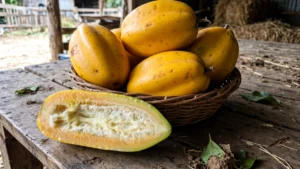
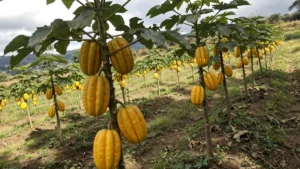
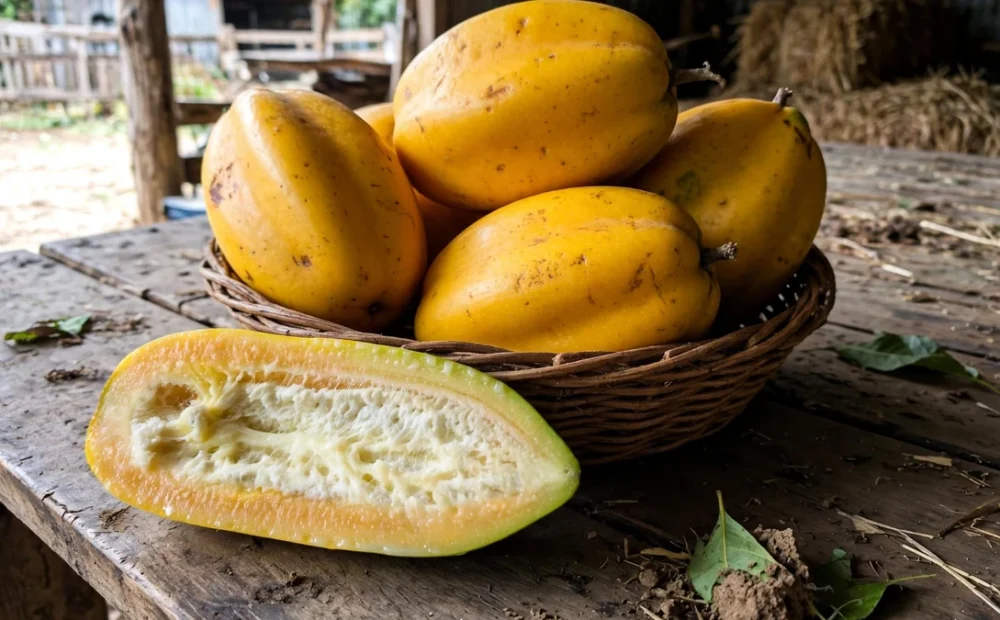
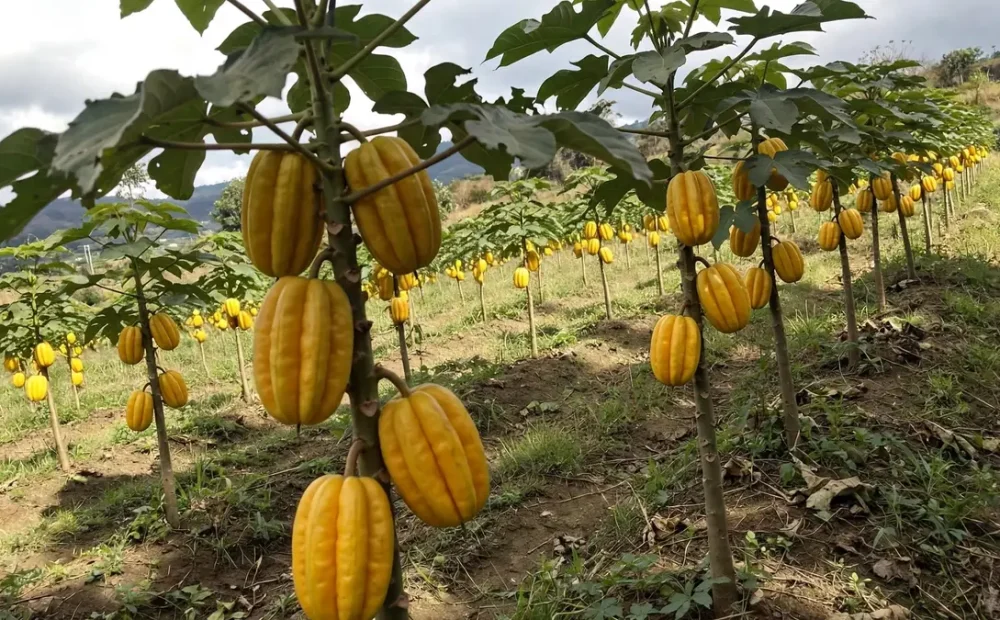
Babaco is the fruit most travellers have never heard of, and the one they remember longest after a trip through the Andes. It grows on a small, soft-stemmed tree in the cool highlands of Ecuador, a five-sided yellow fruit with no seeds inside, fragrant enough to scent a kitchen and juicy enough to drink straight from the glass. It is often called mountain papaya, but that name misleads more than it helps. Babaco comes from a different plant, grows at a different altitude, and tastes sharper and cleaner than the lowland papaya most people know.
A babaco farm stay is not a resort with a fruit bowl on the side. The farms are small and usually family-run, set between 1,500 and 2,500 metres where the air is cool and the mornings are misty. Guests walk the rows in the morning, watch the fruit being picked by hand, and eat it the same day: sliced at breakfast, pressed into juice at lunch, sometimes cooked into a light dessert after dinner. The luxury is in the setting and the food, not in marble bathrooms or infinity pools.
Below are nine farm retreats across Ecuador, Peru, Colombia and Chile that put babaco at the centre of the stay. For each place you will find its strongest point, its weak point, the traveller it fits best, the style of the stay, a price range, and one feature that sets it apart. Prices are per night for two people, including breakfast, unless the entry says otherwise.
Key takeaways
- Babaco is a five-sided, seedless yellow fruit from the Andean highlands, best eaten fresh or as juice on the day it is picked.
- The best farm stays are small and family-run, between 1,500 and 2,500 metres, with the harvest worked into meals and walks.
- Babaco is not papaya: it comes from a different species, grows in cool mountains rather than hot lowlands, and tastes tart and clean.
- Book for the dry months when the fruit is at its best, and give yourself a day to adjust to the altitude before walking the rows.
- Ask the farm about gluten before you book, because bread, pasta and sauces are part of most farm menus and are not always labelled.
What babaco is, and why it grows where it does
Babaco, Vasconcellea × heilbornii, is a natural hybrid of two Andean relatives, and it is almost entirely a highland plant. It fruits best where nights are cool and days are mild, which is why the commercial groves sit on the slopes around Quito, Cuenca and Loja rather than on the coast. The plant is frost-sensitive and short-lived, usually productive for three to five years, so farmers replant in rotation and keep the groves small. That is part of why the fruit rarely travels far: it is picked ripe, it bruises easily, and it is at its best within a day or two of the tree.
The fruit itself is hard to mistake for anything else. It is pentagonal in cross-section, with five clear ridges running its length, and it turns from green to a warm yellow as it ripens. Cut it open and there is no seed cavity to scoop out, only pale, juicy flesh with a fragrance somewhere between pineapple and passion fruit. The flavour is tart and clean, less sweet than papaya and more refreshing, which is why farms serve it as juice at breakfast and as a chilled dessert after a hot walk.
For a traveller, the difference that matters most is the altitude. Babaco country is mountain country, and the farms sit high enough that a first day of steep walking can leave you breathless if you arrive straight from the coast. The farms in this guide all build the stay around that fact: slow mornings, a short walk on the first day, and the harvest tasting saved for when you have settled in. Our guide to ulluco farm retreats follows the same highland logic, because the Andean tuber farms sit at similar heights and ask the same patience of their guests.
How we picked these nine retreats
We looked for farms where babaco is the main crop rather than a side planting, where guests can join the morning picking, and where the kitchen uses the fruit in more than one way. A place that grows babaco but serves it only as juice at breakfast did not make the list. A place that cooks with it, ferments it, or turns it into dessert did. We also checked that the stay is genuinely on the farm, not in a town hotel with a farm visit tacked on, and that the farm is reachable by a road a normal car can use.
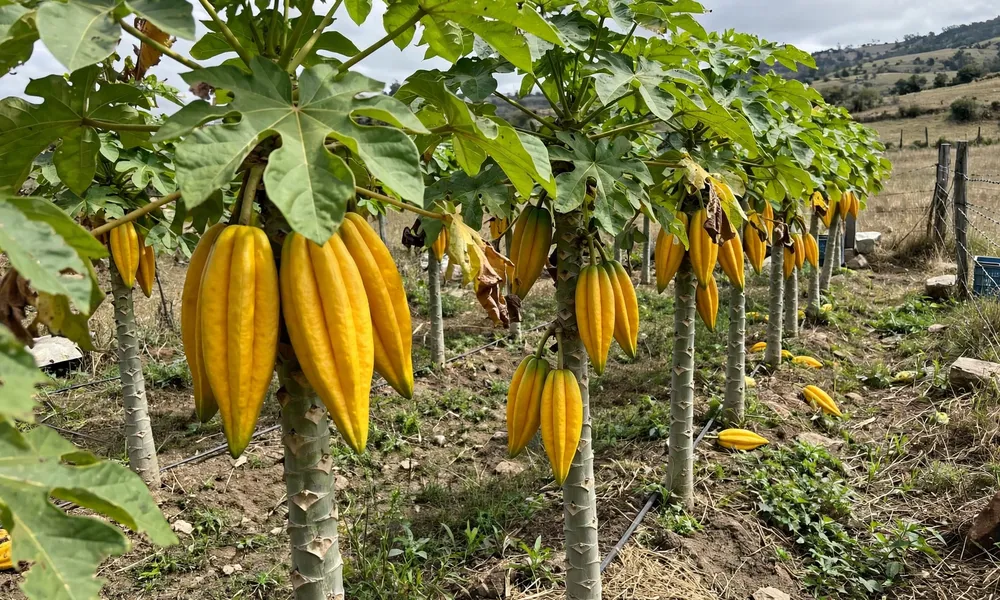
Price ranges below are for two people per night with breakfast, based on the rates farms were quoting for 2027 stays. They move with the season, and the dry months cost more than the wet ones. Every entry names the style of the stay, because a working farm with shared bathrooms and a boutique lodge with a private terrace are different holidays even when the fruit is the same. If you are comparing highland farm stays more broadly, our arracacha farm retreats cover a root crop grown on the same slopes, with stays that share the same rhythm of early mornings and long lunches.
The 9 best luxury babaco farm retreats of 2027
Quito
What we like: The closest babaco groves to a major airport, with terraces that look down over the valley and a kitchen that presses juice to order. What to consider: Quito sits at 2,850 metres, so the first day should be slow. Best for: Short stays and first-time highland travellers. Style: Boutique lodge with a farm garden. Price range: $150–$230. Standout feature: A sunrise picking walk followed by a juice tasting on the terrace.
Cuenca
What we like: Cooler, quieter groves with old stone farmhouses and a slower pace than the capital. What to consider: Evenings are chilly and the farms are spread out, so a car helps. Best for: Travellers who want a calm base for several days. Style: Restored farmhouse with a walled garden. Price range: $120–$190. Standout feature: A wood-fired oven used for babaco and honey desserts.
Loja
What we like: The warmest of the Ecuadorian groves, with fruit that ripens early and a lively small-town market nearby. What to consider: Loja is a longer drive from Quito, so plan it as a destination in itself. Best for: Market lovers and travellers pairing the farm with a southern loop. Style: Family farm with guest cottages. Price range: $95–$160. Standout feature: A Saturday market stall where the farm sells its own babaco juice.
Ambato
What we like: A fruit-growing valley with several babaco farms close together, so you can compare groves in one stay. What to consider: Ambato is a working agricultural town, not a resort town, and the farms are plain. Best for: Serious fruit lovers who want to see how babaco is really grown. Style: Working farm with simple guest rooms. Price range: $70–$115. Standout feature: A grafting and replanting demonstration in the nursery rows.
Lima
What we like: Coastal access to the highland groves, with a Lima base and a farm day in the hills above the city. What to consider: The babaco farms are a drive inland, so this is a day-trip model rather than a sleep-on-the-farm stay. Best for: Travellers who want a city base with a farm day out. Style: City hotel plus guided farm day. Price range: $140–$220. Standout feature: A chef-led tasting that pairs babaco with coastal ceviche.
Arequipa
What we like: High desert light, white-stone farm buildings, and babaco grown in irrigated terraces below the volcanoes. What to consider: The air is very dry and the sun is strong, so carry water on every walk. Best for: Photographers and travellers who like dry, bright mountain air. Style: Terraced farm lodge with a courtyard. Price range: $110–$175. Standout feature: A terrace breakfast with babaco juice and a view of the volcanoes.
Medellín
What we like: Mild weather year-round, flower-filled groves, and farms that pair babaco with coffee tastings. What to consider: The babaco here is a smaller planting, so the harvest is seasonal and short. Best for: Coffee lovers and travellers combining fruit and flowers. Style: Hillside finca with a coffee terrace. Price range: $130–$200. Standout feature: A combined babaco juice and coffee tasting in the afternoon.
Bogotá
What we like: Cool highland groves a short drive from the capital, with serious farm kitchens and a strong juice culture. What to consider: Bogotá is at 2,640 metres and the farms are higher still, so altitude matters here too. Best for: Food-focused travellers who want a farm kitchen done properly. Style: Highland farmhouse with a large kitchen. Price range: $125–$195. Standout feature: A full babaco menu, from juice to dessert, cooked in one kitchen.
Santiago
What we like: Greenhouse-grown babaco in the foothills, with a modern lodge and a clear view of the Andes. What to consider: The fruit is grown under cover here, so the grove walk is a greenhouse tour rather than an open-field walk. Best for: Travellers who want comfort and a reliable harvest. Style: Modern lodge with a greenhouse grove. Price range: $180–$280. Standout feature: A greenhouse dinner served among the babaco trees.
Babaco on the plate: juice, breakfast, and the kitchen garden
On the farms, babaco is eaten the way it is picked: fresh, ripe, and the same day. Breakfast is the main event, with the fruit sliced into wedges, pressed into juice, or folded into yoghurt. The juice is the simplest preparation and the one most guests ask for again, because it is tart, fragrant and cold, and it suits a morning at altitude better than coffee on an empty stomach. Lunch is lighter, often a salad with babaco ribbons, and dinner is where the kitchens show off, with the fruit cooked into sauces for pork or chicken, or baked into a simple dessert with honey.
The fruit’s seedless flesh is what makes it so easy to cook with. There is nothing to scoop out and nothing to spit, so a cook can slice it straight into a pan or a blender. Farms also use the peel and the core less often than visitors expect; the flesh is the point, and the rest goes to the compost. If you are offered a babaco sorbet, a babaco jam, or a babaco and herb salad, say yes to all three. They are the dishes the farms are proudest of, and they are hard to find anywhere else. For a sense of how another highland fruit is cooked on the farm, our camu camu farm retreats cover an Amazon berry that is also served mostly as juice and sorbet, with a very different flavour.
The caveats that matter
Enjoying babaco is simple; visiting the farms that grow it takes a little more care. The groves sit high in the mountains, the fruit marks easily when it is knocked about, and the milky sap from a cut stem can sting the skin, which is why pickers wear gloves and guests are handed a pair too. Soap and water take the sap off, but it is better to know about it before you touch a fruit than after. Then there is the calendar: the crop comes in waves, not all year, so a farm overflowing in June may have little to show in September, and the ripening weeks matter more than the nightly rate.
| Detail | What is known |
|---|---|
| Best time to visit | Dry months, when the fruit is ripening in flushes and the roads are firm |
| Altitude of the farms | Mostly 1,500 to 2,500 metres; Quito and Bogotá stays are higher still |
| How babaco is eaten | Fresh, as juice, in salads, sauces and desserts; never eat it unripe |
| Seeds | None; the fruit is seedless, with pale juicy flesh throughout |
| Skin and sap | The milky sap can irritate skin; wear gloves to pick and wash hands after |
| Who should take care | Anyone new to altitude, and anyone with a latex or fruit allergy |
| Gluten on the farm | Bread, pasta and sauces are common; ask ahead and bring your own snacks if needed |
| What babaco is not | It is not papaya; it is a different species, grown in cool mountains, with a tart flavour |
Anyone with a latex allergy or a fruit allergy should mention it to the farm ahead of arrival. Babaco shares a family with papaya, so a reaction to papaya latex can sometimes mean a reaction to babaco sap as well, and the farms are happy to change the tasks they offer once they know. Expecting a baby, breastfeeding, or on medicine that changes how altitude affects you? Speak to your clinician first before reserving a stay above 2,000 metres.
Checklist: booking a babaco farm stay honestly
Use these checks before you book, and again the week before you travel.
- Check the harvest dates: ask which weeks the fruit is actually ripening, not just when rooms are free.
- Check the altitude: confirm the farm’s height and plan a slow first day if you are coming from sea level.
- Check the food: tell the farm about gluten and any allergy before you book, and ask what bread and sauces are served.
- Check the room: confirm hot water, heating for cold nights, and whether the bathroom is shared or private.
- Check the road: ask whether a normal car can reach the farm, or whether you need a 4×4 or a farm pickup.
- Check the picking rules: ask whether guests pick with gloves, how much fruit you can take, and what the farm charges for extra juice.
Frequently asked questions
How is babaco different from papaya?
They are cousins, not twins. Babaco, Vasconcellea × heilbornii, is a highland hybrid that grows in cool mountains; papaya, Carica papaya, is a lowland tropical fruit. A babaco has five clear ridges, no seeds and a tart bite, while a papaya is smooth and round or oval, packed with seeds, and much sweeter.
When is babaco in season?
It depends on the farm and the altitude, but the main flushes fall in the dry months. Ecuadorian groves are usually generous from June to September, while the Chilean greenhouse harvest is steadier through the year. Ask the farm for its exact weeks.
Can I eat babaco raw?
Yes, when it is ripe. A ripe babaco is yellow, gives slightly when pressed, and smells fragrant. Unripe fruit is green, hard and astringent, so wait for the colour to change and ask the farmer if you are unsure.
Do I need to worry about altitude?
Yes, a little. Most babaco farms sit between 1,500 and 2,500 metres, and the Quito and Bogotá stays are higher. Arrive a day early if you can, drink water, walk slowly on the first day, and tell the farm if you feel unwell.
What do I tell a babaco farm if I cannot eat gluten?
Ask what is served at breakfast and dinner, whether bread and pasta can be swapped, and whether sauces are thickened with flour. Most farms can adapt with a day’s notice, but the change is easier if you ask at booking rather than at the table.
Is babaco safe for children?
Ripe babaco is fine for children as a fruit or a juice, and most farms welcome families. Keep children away from the sap when fruit is being cut, and make sure they wear gloves if they join the picking.
The bottom line
The best babaco farm retreat in 2027 is the one that matches your appetite for altitude, farm work and cooking. Quito is the easiest first stop, Cuenca the calmest base, Loja the most hands-on, and Santiago the most comfortable. The fruit is the same everywhere, tart and fragrant, but the stay around it changes completely from one valley to the next.
Pick a farm that grows babaco as its main crop, book for a ripening flush, and give yourself a slow first day. The juice at breakfast and the walk through the rows will do the rest.