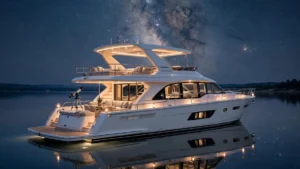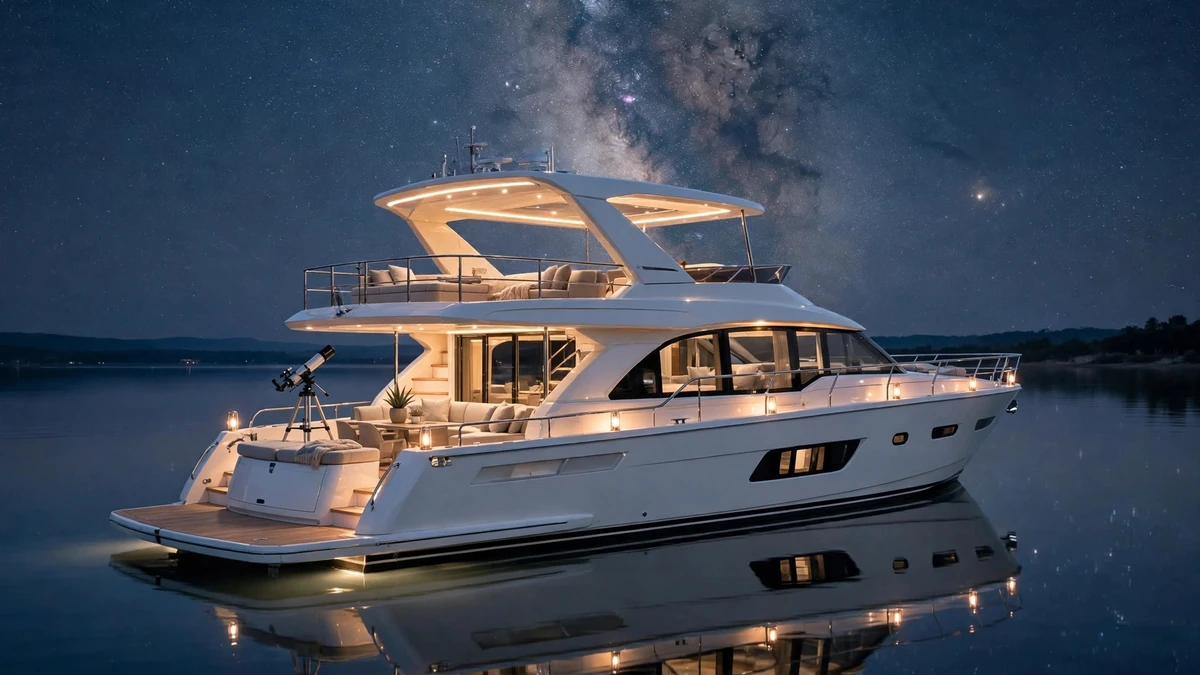

There is a particular kind of quiet you only find at sea, far from shore, when the last town lights fade behind you and the sky opens up. On a clear night in open water, with no street lamps and no glow on the horizon, the Milky Way is not a faint smear. It is a bright band overhead, and the stars are sharp enough to count. A luxury yacht built for stargazing is designed around that moment: a dark-sky anchorage, a clear upper deck, and nothing between you and the night but warm air.
Not every yacht does this well. A brightly lit deck, a noisy generator, a route that keeps you near a lit coastline, or a sky full of haze can all take the edge off the night. The best stargazing yachts are chosen for what they remove as much as for what they offer: minimal light pollution, open deck space to lie back and look up, a stable platform at anchor, and a crew who know when to dim the lights and when to leave you alone with the sky.
Below are nine yachts worth considering for a stargazing trip in 2027, from expedition yachts that reach genuinely dark water to large charter yachts with observatory-style decks and telescopes on board. Each one is described by what it is good at, what to watch for, and who it suits best, so you can choose with the night sky in mind, not just the size of the yacht.
Key takeaways
- The best stargazing happens far from shore, in dark-sky water with no coastal glow, clear air, and a moonless or near-moonless night.
- Look for open upper decks, dimmable deck lighting, a stable anchorage, and a crew willing to run a lights-out evening.
- Expedition yachts reach the darkest water; large charter yachts add telescopes, an astronomer guest, and comfortable deck lounging.
- Plan around the moon calendar and the season: the Milky Way core is best in summer, while winter skies are often clearer and sharper.
- No yacht can guarantee a clear sky, and cloud, haze, moonlight, and rough seas can all hide the stars, whatever the charter costs.
What makes a yacht good for stargazing
Stargazing from a yacht starts with darkness. Light pollution is the single biggest factor, and it is measured by how much glow sits on the horizon. Near a busy port or a lit coastline, the sky washes out and only the brightest stars show. Ten or twenty miles offshore, in open water, the sky deepens and faint stars, the Milky Way, and even distant galaxies become visible to the naked eye. That is why the route matters as much as the yacht: a good stargazing trip plans anchorages away from towns, resorts, and shipping lanes.
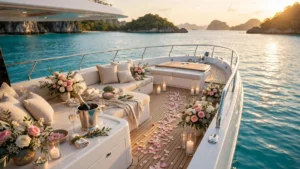
The deck matters too. You need somewhere flat and open to lie back, with a clear view overhead and no bright lights in your line of sight. A sun deck with loungers, a clear foredeck, or an open bridge deck all work, as long as the crew can dim the deck lights and the interior lights do not spill out through glass doors. Some yachts carry a small telescope, binoculars, and a star chart, which turn a good night into a guided one.
Stability and weather complete the picture. A yacht at anchor in a sheltered bay moves gently, which is fine for looking up, but a rolling sea makes a telescope almost useless. Clear, dry air beats humid haze every time, and a moonless night beats a full moon by a wide margin. The best trips build in two or three nights at anchor, so one cloudy evening does not end the whole experience.
How we chose these yachts and what to look for
Look first at the route and the anchorage. Ask where the yacht will anchor at night, how far that is from the nearest town, and whether the crew plan a lights-out evening. A yacht that cruises a dark-sky coast, such as the open water off the Maldives, the far Aegean, or the South Pacific, has a natural advantage over one that stays in a busy bay. Our guide to chartering a luxury yacht explains how itineraries are planned, and a stargazing trip is one where the night plan deserves as much attention as the day plan.

Look next at the deck and the light. A clear upper deck with loungers, dimmable lighting, and a spot to set up a telescope matters more than the size of the cinema room. Ask whether the yacht carries a telescope or good binoculars, and whether a crew member or a guest astronomer can point out constellations, planets, and the Milky Way.
Finally, look at the practical side. A stable hull at anchor, a sheltered bay, and a calm forecast make the difference between a comfortable night on deck and an evening spent below. Check what happens if the sky clouds over: a good trip has a plan B, rather than a single night that has to be perfect. Charter prices below are indicative weekly rates before tax, fuel, food, drinks, and tips, and they vary with season and itinerary.
The 9 best luxury yachts for stargazing trips of 2027
M/Y Eclipse
What we like: At 162 metres, Eclipse has vast open decks, a huge sun deck for lying back under the sky, and the range to reach genuinely dark water far from shore. What to consider: Very large and very expensive, and its size means it anchors further out, so tender trips to shore take longer. Length: 162 m. Guests: 24. Best for: Large groups who want the darkest sky and the most deck space. Charter price range: From about $1.5 million per week.
M/Y Flying Fox
What we like: A 136-metre yacht with a large sun deck, a two-deck beach club, and a crew used to running themed evenings, including astronomy nights with a telescope on deck. What to consider: Premium weekly rate, and the most popular weeks book far ahead. Length: 136 m. Guests: 25. Best for: Groups who want a guided stargazing evening with proper equipment. Charter price range: From about $1.1 million per week.
M/Y Serene
What we like: A 134-metre yacht with a calm, open upper deck, a large swimming pool that doubles as a reflecting surface at night, and long range for remote anchorages. What to consider: Its size and rate put it firmly at the top end, and it needs deep anchorages. Length: 134 m. Guests: 24. Best for: Families and groups who want space, calm, and a slow itinerary. Charter price range: From about $1 million per week.
M/Y Dilbar
What we like: At 156 metres, Dilbar has one of the largest deck areas afloat, a huge sun deck, and room for a full telescope set-up, loungers, and a dinner under the stars. What to consider: Very large, very formal, and best for guests who are comfortable with a big yacht and a large crew. Length: 156 m. Guests: 36. Best for: Very large groups and celebrations under the stars. Charter price range: From about $1.2 million per week.
M/Y Kismet
What we like: A 122-metre yacht with a striking open deck, a large beach club, and a crew known for thoughtful evening programming, including deck dinners and stargazing nights. What to consider: High demand in summer, so the best weeks go early. Length: 122 m. Guests: 12. Best for: Smaller groups who want a polished, well-run evening on deck. Charter price range: From about $900,000 per week.
M/Y Amadea
What we like: A 106-metre yacht with a clear upper deck, a large sun deck, and a calm, classic layout that works well for evenings on deck. What to consider: An older yacht than some on this list, so check the deck lighting and telescope set-up with the broker. Length: 106 m. Guests: 16. Best for: Groups who want a classic large yacht with generous deck space. Charter price range: From about $700,000 per week.
M/Y Here Comes The Sun
What we like: An 83-metre yacht with a large sun deck, a spa and a beach club, and a crew who are used to remote anchorages in the Mediterranean and the Caribbean. What to consider: Smaller than the largest yachts here, so deck space is shared and needs a little planning. Length: 83 m. Guests: 12. Best for: Couples and families who want a warm, well-run trip with dark-sky nights. Charter price range: From about $550,000 per week.
M/Y Loon
What we like: A 67-metre yacht with a large sun deck, a beach club, and a reputation for active, well-organised charters, including evening activities on deck. What to consider: Its sun deck fills up quickly with twelve guests, so agree the stargazing set-up in advance. Length: 67 m. Guests: 12. Best for: Active groups who want days on the water and nights under the stars. Charter price range: From about $400,000 per week.
M/Y Legend
What we like: A 77-metre expedition yacht built for remote water, with an ice-class hull, long range, and a clear upper deck, ideal for reaching the darkest anchorages. What to consider: An expedition layout, so the styling is more practical than glamorous, and the pace is slower. Length: 77 m. Guests: 26. Best for: Adventurous groups who want the darkest skies, far from any town. Charter price range: From about $450,000 per week.
Which stargazing yacht is right for you
Large groups should look at the biggest yachts, such as Eclipse, Dilbar, and Legend, because they have the deck space for everyone to lie out at once and the range to reach dark water. Smaller groups of twelve or fewer have more choice: Kismet, Here Comes The Sun, and Loon all offer a good balance of deck space, comfort, and price, and their crews are used to setting up a telescope and a quiet evening on deck.
Couples and honeymooners often prefer a smaller yacht with a private sun deck, where the night can be just the two of them. A dark-sky anchorage off the Maldives is a classic choice for this kind of trip, and our guide to luxury hotels in the Maldives is a useful companion if you want a few nights ashore before or after the charter, since the same dark skies and clear air apply on land too.
Families with children should ask about a telescope, binoculars, and a simple star chart, because children engage far more with a guided night than with an open sky alone. Adventurous travellers who want the darkest possible sky should choose an expedition yacht such as Legend and a remote itinerary, and accept a slower trip in exchange for a sky with no glow at all.
The caveats that matter
Stargazing from a yacht is honest and rewarding, but it depends on conditions no one controls. Cloud, haze, moonlight, and rough seas can all hide the stars, and a single cloudy week can leave you with no clear night at all. That is why the best trips build in several nights at anchor, choose the moon phase carefully, and treat a clear night as a gift rather than a guarantee.
| Detail | What is known |
|---|---|
| Best sky conditions | Dark water far from shore, clear dry air, and a moonless or near-moonless night |
| Best season for the Milky Way | Summer, when the galactic core is highest; winter skies are often clearer and sharper |
| What to ask the crew | Where you will anchor at night, whether they run a lights-out evening, and what telescope or binoculars are on board |
| Deck lighting | Deck lights should dim or switch off; red-light torches protect night vision |
| What can spoil the night | Cloud, haze, a full moon, coastal glow, rough seas, and bright deck lights |
| Who should plan carefully | Anyone prone to seasickness, and families with small children who need an early night |
| What is not included in the rate | Tax, fuel, food, drinks, tips, licences, and a guest astronomer, which is usually an extra |
| What no yacht can promise | A clear sky, a shooting star, or a particular constellation on a particular night |
If you are prone to seasickness, take advice from your doctor before the trip, because even a gentle swell feels bigger when you are lying still and looking up. Keep warm layers and a blanket on deck, and use a red-light torch rather than a phone screen, which ruins night vision for everyone on deck.
Checklist: choosing a stargazing yacht honestly
Use these checks before you book, and again when the itinerary arrives.
- Check the moon calendar: book a moonless or near-moonless week, and avoid a full moon if the stars are the point.
- Check the anchorage: ask how far it is from the nearest town and whether the crew plan a lights-out evening.
- Check the deck: confirm there is a clear, flat upper deck with loungers and dimmable lighting.
- Check the equipment: ask whether a telescope, binoculars, and a star chart or app are on board.
- Check the weather plan: ask what happens if the sky clouds over, and build in two or three nights at anchor.
- Check the extras: confirm what is included in the rate and what a guest astronomer, fuel, and tips will add.
Frequently asked questions
When is the best time of year for stargazing from a yacht?
Summer is best for the Milky Way core, which sits high in the sky on warm, clear nights. Winter often brings clearer, sharper air and better visibility of stars and planets, so both seasons work. The moon phase matters more than the month, so book around a new moon if you can.
Do I need a telescope, or is the naked eye enough?
The naked eye is enough for the Milky Way, constellations, and the brightest planets. A telescope adds the Moon in detail, the rings of Saturn, and deep-sky objects, and good binoculars are a useful middle ground. Ask the broker what is on board before you book, rather than assuming.
Will the yacht’s lights ruin the night sky?
They can, if they stay on. A good crew will dim or switch off deck lights for a stargazing evening, keep interior lights from spilling out, and use red-light torches. Navigation lights stay on, as the rules require, but they are small and low compared with deck lighting.
Is stargazing better from a yacht than from land?
Often yes, because a yacht can move away from town lights and find dark water, and there is no glow on the horizon at all. Land has the advantage of a fixed observatory and a telescope that does not move, so the best choice depends on whether you want darkness or equipment.
Can children enjoy a stargazing yacht trip?
Yes, and they often enjoy it more than adults, especially with a telescope and a guide who can point out planets and constellations. Keep the evening short for younger children, bring warm layers and a blanket, and plan an early night, since the best stars appear after bedtime for small children. A romantic trip, such as one of our honeymoon destinations, is a different kind of night, so match the itinerary to who is travelling.
What if it is cloudy all week?
That is a real risk, and no yacht can change the weather. Build in several nights, choose a region and season with a good record for clear skies, and ask the crew for a plan B, such as a night sail, a late swim, or an evening ashore. A good trip is still a good trip without a perfect sky.
The bottom line
The best luxury yacht for a stargazing trip in 2027 is not the biggest or the most expensive. It is the one with a clear upper deck, a crew who will dim the lights, and an itinerary that takes you far enough from shore for the sky to go properly dark. For large groups, Eclipse and Dilbar offer the most space. For smaller groups, Kismet, Here Comes The Sun, and Loon offer a better balance of comfort and price. For the darkest sky of all, an expedition yacht such as Legend, in remote water, is hard to beat.
Book around the new moon, ask about the anchorage and the telescope before you pay, and give yourself two or three nights at anchor. If the sky clears, you will see the Milky Way as it actually looks, bright and overhead, with no town glow on the horizon. That is the whole point of the trip, and it is worth planning the charter around.