

Mixed metal nose studs are for people who refuse to choose. Gold and silver, rose gold and steel, copper and silver, three tones twisted together: these studs combine two or more metals in a single piece, so they match whatever else you are wearing. That flexibility is their whole appeal. A mixed metal stud sits happily next to a gold necklace, a silver ring, or a watch in either metal, and it never looks like a mistake, because the mixing is the design.
The idea is not new. Jewellers have combined metals for centuries, from two-tone rings to mixed-metal bracelets, but nose studs took longer to catch up. A nose stud is small, and mixing metals in a few millimetres of jewellery takes care. Done well, the result is a stud with more visual interest than a single metal, and more forgiving about what you pair it with. Done badly, it looks muddled, or one metal dominates and the other looks like an afterthought.
Below are nine mixed metal nose studs worth considering in 2027, from a classic gold and silver twist to a three-tone design that wears like a tiny piece of sculpture. Each one is described by what it is good at, what to watch for, and who it suits best, so you can choose with your piercing and your jewellery box in mind.
Key takeaways
- Mixed metal nose studs combine two or more metals in one piece, so they match gold and silver jewellery alike.
- The best designs give each metal a clear role, such as a gold twist against a silver base, rather than blending them into a muddle.
- Check the gauge, post length and backing before you buy, and make sure the join between metals is smooth.
- Different metals tarnish at different rates, so clean the stud as a whole and dry it thoroughly.
- Mixed metal studs are not the best choice for a fresh piercing, and anyone with a metal sensitivity should check every metal in the mix before wearing one.
What mixed metal nose studs actually are
A mixed metal nose stud is a small piece of nose jewellery made from two or more metals, worn through a nostril piercing. The metals are joined in the visible end of the stud, as a twist, a two-tone ball, a banded design, or a stone setting in one metal with a post in another, and the stud is held in place by a post with a backing, an L-shaped bend, or a screw thread. Common combinations are gold and silver, gold and rose gold, copper and steel, and silver with a gold accent, but any pairing that holds together can work.
The practical appeal is simple. Most people own jewellery in more than one metal, and a single-metal nose stud forces a choice every morning: wear gold and leave the silver at home, or the other way round. A mixed metal stud removes that choice. It bridges the metals you already wear, which is why it is often the most-worn stud in a collection, even when it is not the most expensive one.
The thing to understand is how the metals are joined. In a good mixed metal stud, the join is smooth, the metals are securely bonded, and each metal is present in enough quantity to be seen. In a poor one, the join is rough, one metal is only a thin plating that wears away, or the design is so small that the second metal is invisible. That is why it pays to look closely at the stud, and to buy from a listing that names every metal in the piece rather than just calling it “mixed metal”.
How we chose these mixed metal nose studs and what to look for
Look first at the balance of the metals. A good mixed metal stud gives each metal a clear job: one metal forms the base or the twist, the other forms the accent or the stone setting, and the two are visible in roughly equal measure, or in a deliberate ratio such as two parts gold to one part silver. If you cannot tell at a glance that two metals are present, the mixing is not doing any work. If one metal is only a faint line, it will disappear on the face.
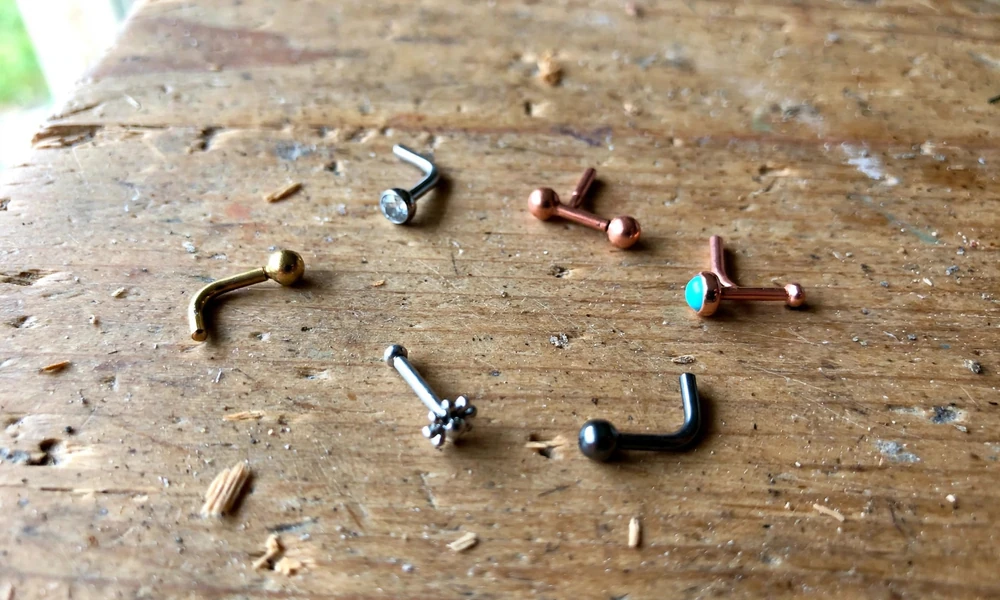
Look next at the gauge, the post length and the backing, because a mixed metal stud is still a nose stud, and the same rules apply. Most nostril piercings are 20 gauge, about 0.8 millimetres, or 18 gauge, about 1 millimetre, and a stud in the wrong gauge will slip or feel tight. L-shaped studs are easy to put in and take out, screw studs stay put better, and flat-back labret studs are the most comfortable for sleeping. Our guide to the best nose studs for women covers gauge and backing choices in more detail, and it is worth reading before you settle on a shape.
Finally, look at the join and the finish. Run a fingertip over the stud and check that the join between metals is smooth, with no rough edge, no gap, and no sharp point. Check whether either metal is only a plating, because plating wears away with time and leaves the base metal showing. And check that the metals are named, not just described as “mixed”, so you know exactly what will touch your skin.
The 9 best mixed metal nose studs of 2027
The Classic Gold and Silver Twist Stud
What we like: Two fine wires, one gold and one silver, twisted together into a small spiral that reads clearly as two metals from any distance. What to consider: The twist can catch on fabric if it is not polished smooth. Best for: Everyday wear and anyone who owns both gold and silver jewellery. Material: Gold and sterling silver twist. Price range: Mid. Standout feature: The clearest, most readable two-metal design in this list.
This is the mixed metal stud to start with. It is simple, honest about what it is, and it matches almost everything, which is why it tends to become the stud people wear most often.
The Gold and Rose Gold Twisted Stud
What we like: A warm twist of gold and rose gold that feels softer and more romantic than gold and silver. What to consider: The two warm metals can look similar in dim light, so the twist needs to be bold enough to read. Best for: Warm skin tones and romantic or vintage styling. Material: Gold and rose gold twist. Price range: Mid. Standout feature: The warmest combination in this roundup.
The Three-Tone Stud
What we like: Gold, silver and rose gold twisted together in a single small stud, giving you every metal at once. What to consider: Three metals in a tiny stud can look busy, so the design needs to be clean and simple. Best for: People who wear all three metals and want one stud to match them all. Material: Gold, silver and rose gold. Price range: Mid to high. Standout feature: The only three-metal design in this roundup.
The Copper and Steel Stud
What we like: Warm copper paired with cool steel, a high-contrast combination that looks modern and slightly industrial. What to consider: Copper tarnishes faster than steel, so the two metals will age differently. Best for: Modern styling and people who like contrast. Material: Copper and stainless steel. Price range: Low to mid. Standout feature: The strongest colour contrast in this list.
The Two-Tone Clicker with a Crystal
What we like: A two-tone clicker, gold on one side and silver on the other, with a small crystal set in the centre. What to consider: Check that the clicker closes firmly and the crystal is prong-set, not glued. Best for: Evenings out and special occasions. Material: Gold and silver, cubic zirconia. Price range: Mid to high. Standout feature: The only clicker design in this roundup, and the most secure closure here.
The Slim Two-Tone Seamless Stud
What we like: A very slim seamless ring, half gold and half silver, with no visible join and no stone. What to consider: The seamless design can be fiddly to open and close, so handle it gently. Best for: Minimalist styling and very subtle wear. Material: Gold and silver, seamless. Price range: Mid. Standout feature: The most understated mixed metal stud here.
The Gold and Black Two-Tone Stud
What we like: Polished gold paired with blackened metal, a bold contrast that reads as jewellery with an edge. What to consider: The black finish will lighten with wear unless it is sealed, so check the coating. Best for: Evening wear and bolder styling. Material: Gold and blackened steel. Price range: Mid. Standout feature: The boldest contrast in this roundup.
The Rose Gold and Silver Stud
What we like: Soft rose gold paired with bright silver, a gentle contrast that flatters fair and cool skin tones. What to consider: Rose gold can fade in tone over time, so a sealed finish lasts longer. Best for: Fair skin and soft, romantic styling. Material: Rose gold and sterling silver. Price range: Mid. Standout feature: The softest contrast in this list.
The Tiny Two-Tone Stud
What we like: A very small two-tone ball, about two millimetres, half gold and half silver, that reads as a warm dot of light. What to consider: Small studs are easy to lose, so keep a spare and check the backing. Best for: Delicate styling and multiple piercings. Material: Gold and silver, polished finish. Price range: Low to mid. Standout feature: The smallest stud in this roundup, and the easiest to wear daily.
Which mixed metal nose stud is right for you
Start with the metals you already wear. If your jewellery box is mostly gold, a gold and silver twist will bridge it to the silver pieces you own. If it is mostly silver, the same stud works in reverse. If you wear rose gold, the gold and rose gold twist or the rose gold and silver stud will sit more naturally with your collection. The point of a mixed metal stud is not to add a new metal to your life, but to connect the ones you already have, and a stud that echoes your existing jewellery will get worn far more than one that fights it. A mixed metal nose pin in the same metals can extend the idea across your nose jewellery, if you wear more than one piece.
Then think about your skin. Warm skin tones suit the gold and rose gold combinations, where the metals pick up the warmth in the skin. Cool and fair skin suits gold and silver or rose gold and silver, where the silver brightens the look. The high-contrast designs, copper and steel, or gold and black, suit people who like their jewellery to be noticed, while the slim seamless stud and the tiny two-tone stud suit people who want the mixing to be a quiet detail rather than a feature.
Finally, think about your piercing. A healed piercing can wear any of these studs, but a piercing that is still settling should stick to a simple, smooth design with a flat-back post, and avoid clickers, twists and textured finishes until it is calm. Mixed metal studs are no harder on a piercing than single-metal ones, as long as every metal in the mix is named and none of them is one you react to.
The caveats that matter
Mixed metal studs are safe for most people in healed piercings, but they ask a little more of you than a single-metal stud. Different metals tarnish at different rates, so a stud that starts out evenly balanced can look uneven after a few months if one metal darkens faster than the other. Cleaning the whole stud gently and drying it thoroughly keeps the metals ageing together, and a sealed finish slows the process further. Plated metals deserve extra care, because plating wears away with time and exposes the base metal underneath.
| Detail | What is known |
|---|---|
| Best for most people | Gold and silver twist, 20 or 18 gauge, in a healed piercing |
| Main drawback | Metals tarnish at different rates, so the balance can shift over time |
| When to avoid mixed metal | Fresh or irritated piercings, and sensitivity to any metal in the mix |
| Cleaning | Warm water and mild soap, dry thoroughly, polish gently as a whole |
| Storage | Dry, in a small pouch or box, away from humidity |
| Gauge | Usually 20 or 18 gauge; match your piercing, do not force a fit |
| Plating | Check whether any metal is only a plating, because plating wears away |
| What mixed metal does not do | It does not remove the need to match gauge, backing and skin sensitivity |
Check every metal in the mix before you buy. A stud can be mostly gold and still contain a metal you react to, and a reaction to one metal in the mix is a reaction to the stud. If you are unsure, wear it for a few hours first and check your skin, or choose a stud whose metals you have already worn without trouble.
Checklist: buying a mixed metal nose stud honestly
Use these checks before you buy, and again when the stud arrives.
- Check the metals: the listing should name every metal in the piece, not just say “mixed metal”.
- Check the balance: both metals should be visible, with a clear role for each, not one faint line.
- Check the gauge and post length against your piercing, usually 20 or 18 gauge.
- Check the join: it should be smooth, with no rough edge, gap or sharp point.
- Check the backing: L-shape, screw, clicker or flat-back, and choose the one you find easiest to wear and sleep in.
- Check your skin: wear it for a few hours first, and stop if you see redness, itching or swelling.
Frequently asked questions
Do mixed metal nose studs look messy?
Not when they are designed well. A good mixed metal stud gives each metal a clear role, such as a twist or a two-tone ball, so the combination reads as deliberate. Avoid designs where one metal is only a faint line, because those are the ones that look muddled.
Can I wear a mixed metal nose stud with gold jewellery?
Yes, that is the point. A mixed metal stud bridges gold and silver, so it sits happily next to a gold necklace or a silver ring. Choose a stud that contains the metals you already wear, and the whole look will feel coherent.
How do I clean a mixed metal nose stud?
Use warm water and mild soap, rinse well, and dry it completely. Clean the stud as a whole rather than trying to polish one metal at a time, and avoid harsh chemical dips, which can damage plating and loosen stones.
Will the metals tarnish at different rates?
Usually yes. Copper darkens faster than steel, and silver tarnishes faster than gold, so the balance of a stud can shift over time. Regular gentle cleaning and a sealed finish slow the process, and the shift is usually gradual rather than sudden.
Can I wear a mixed metal nose stud in a new piercing?
It is better not to. New piercings heal best in implant-grade titanium or solid gold, which are less reactive. Wait until the piercing is fully healed before switching to a mixed metal design.
Are mixed metal nose studs more expensive?
Sometimes, because joining two metals takes more work, but the difference is usually small. Many mixed metal studs cost about the same as a single-metal stud of similar quality, and a mixed metal toe ring in the same metals can complete the set without doubling the cost.
The bottom line
The best mixed metal nose stud in 2027 is the one that connects the metals you already wear, in a design where each metal has a clear role. For most people, that is a gold and silver twist in the right gauge, worn in a healed piercing. It is versatile enough to wear every day, and it never clashes with the rest of your jewellery.
If you wear mostly warm metals, choose the gold and rose gold twist instead, and if you like contrast, try copper and steel or gold and black. Whatever you choose, buy from a listing that names every metal, check the join is smooth, and wear it for a few hours first. A mixed metal stud chosen that way is one you will reach for again and again, because it goes with everything you own.