A titanium nose stud is the piece most piercers reach for first, and for good reason. Implant-grade titanium, the same metal used in surgical implants, is light, strong, and one of the least reactive metals you can put through skin. It does not tarnish, it does not flake, and it rarely causes the itching or redness that cheaper mystery metals can. For a fresh piercing, for sensitive skin, or for a stud you plan to wear every day without thinking about it, titanium is the sensible starting point.
The catch is that not every stud labelled titanium is the same. Some are implant-grade titanium, usually marked ASTM F136 or Grade 23, with a smooth, polished finish. Others are commercial titanium, or titanium-coated steel, which can behave very differently on sensitive skin.
Below are nine titanium nose studs worth considering in 2027, from a classic polished ball to a black anodised piece and a flat-back labret for sleeping. Each one is described by what it is good at, what to watch for, and who it suits best, so you can choose with your piercing in mind, not just a product photo.
Key takeaways
- Implant-grade titanium (ASTM F136 or Grade 23) is the least reactive common nose-stud metal, and the safest choice for fresh piercings and sensitive skin.
- Check the grade and the finish before you buy: polished implant-grade titanium, not titanium-coated steel, and a smooth post with no rough edges.
- Flat-back labret studs are the most comfortable for sleeping and for fresh piercings; L-shaped and screw studs suit healed piercings and need a little more care to insert.
- Titanium is light and strong, so it works well for everyday wear, but coloured anodised finishes can fade with time and harsh cleaning.
- No metal suits everyone, and a stud that irritates a fresh piercing should be checked by your piercer rather than worn through the discomfort.
What titanium nose studs actually are
A nose stud is a small piece of jewellery with a decorative front, a ball, a gem, or a flat disc, and a post that sits inside the nostril. Titanium studs use titanium for the post and usually for the front as well. The metal is valued because the body tolerates it well: it is nickel-free in its implant-grade form, it resists corrosion from skin oils and saline, and it is about half the weight of steel, so a stud feels almost weightless once it is in.
The grade is what separates a good titanium stud from a disappointing one. Implant-grade titanium, sold as ASTM F136 or Grade 23, is the standard piercers trust. Commercially pure titanium, Grades 1 to 4, is also used and is generally fine. What you want to avoid is a stud that only says titanium with no grade, or one described as titanium-coated, which usually means a steel core with a thin titanium layer that can wear away.
Titanium can also be anodised, which is how the blue, purple, gold and black studs in this guide get their colour. Anodising changes the surface of the metal with electricity rather than adding a coating, so the colour is part of the metal itself. It can still fade over years of wear and cleaning, especially the darker shades, but it does not peel the way a plated finish can.
How we chose these titanium nose studs and what to look for
Look first at the grade and the threading. Implant-grade titanium with a smooth, polished post is the baseline. Threadless push-pin ends are easier to change than screw-on ends and are less likely to work loose, while internally threaded posts are gentler on a healing piercing than externally threaded ones, which can drag rough threads through the piercing on the way in.
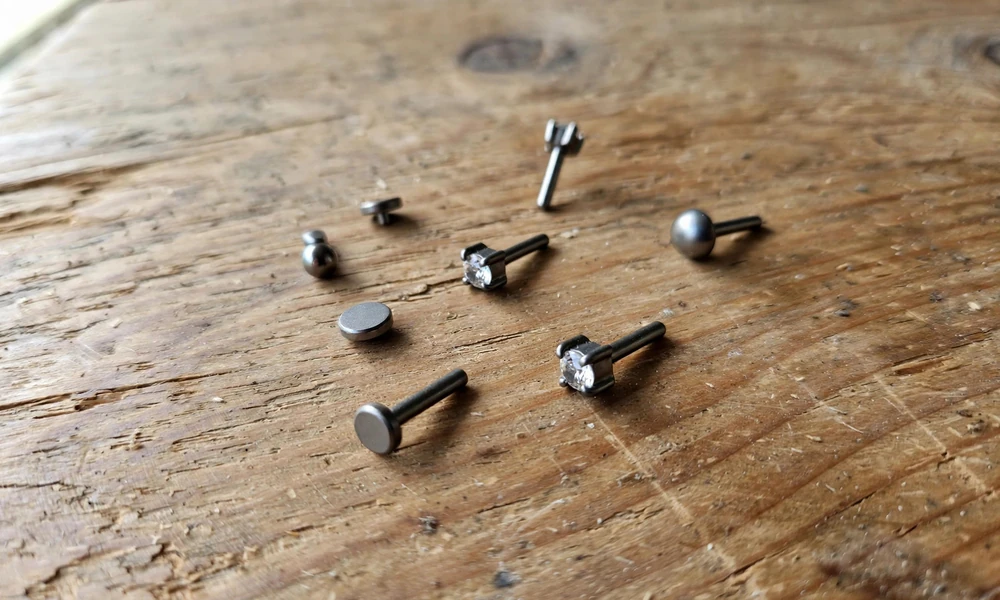
Look next at the back. A flat-back labret sits flush inside the nostril and is the most comfortable option for sleeping, for glasses wearers, and for fresh piercings. An L-shaped stud bends inside the nostril and holds well once healed, but it can be fiddly to insert. A screw stud twists into place and stays put, but it needs a confident hand. Our guide to the best nose studs for women explains how the different backs compare, so you can match the back to your piercing rather than guessing.
Finally, look at the size. Most nostril piercings take an 18-gauge post, about 1 mm thick, with a 6 mm or 7 mm length. A post that is too short presses into the skin; one that is too long catches on towels and masks. The decorative front should suit your nostril too. A 2 mm ball is subtle, a 3 mm ball is visible without being loud, and a gem larger than 3 mm starts to dominate a small nose.
The 9 best titanium nose studs of 2027
The Classic Polished Titanium Stud
What we like: A smooth 3 mm polished ball on an implant-grade titanium post, the most versatile stud in this guide. It suits a fresh piercing, a healed piercing, and almost any outfit. Best for: Everyday wear and first piercings. Material: Implant-grade titanium (ASTM F136). Price range: £10 to £20. Standout feature: A mirror-polished ball that catches the light without a gem.
What to consider: It is plain by design, so if you want sparkle, a crystal or gem end is a better pick.
The Brushed Titanium Ball Stud
What we like: A soft matte finish on the same implant-grade post, for a quieter look that never looks flashy. The brushed surface hides fine scratches and fingerprints well. Best for: People who want a low-shine, understated stud. Material: Brushed implant-grade titanium. Price range: £10 to £18. Standout feature: A matte finish that stays looking new for longer.
What to consider: The matte finish can look dull in photographs, and the ball can be harder to grip when changing the stud.
The Titanium Stud with a Tiny Crystal
What we like: A 2 mm cubic zirconia set into a titanium end, giving a small sparkle without a large gem. It reads like a diamond at a glance and suits daily wear. Best for: Everyday sparkle and special occasions alike. Material: Implant-grade titanium, cubic zirconia. Price range: £12 to £25. Standout feature: A prong-set crystal that catches the light from every angle.
What to consider: Prongs can catch on fabric, and a crystal can loosen over time.
The Black Titanium Stud
What we like: A deep black anodised finish on implant-grade titanium, modern and low-key. The colour is part of the metal, not a plating, so there is nothing to peel. Best for: A bold, dark look and for people who wear mostly black or silver. Material: Anodised implant-grade titanium. Price range: £12 to £22. Standout feature: A rich black finish with no coating to flake.
What to consider: Anodised black can fade to a grey-brown after a year or two of daily wear, and harsh cleaners speed that up.
The Anodised Blue Titanium Stud
What we like: A vivid blue finish, created by anodising rather than paint, so the colour sits in the metal itself. It is a pop of colour that is still metal, not a gem. Best for: Anyone who wants colour without a stone. Material: Anodised implant-grade titanium. Price range: £12 to £22. Standout feature: A bright, even blue that changes slightly in different light.
What to consider: The shade varies between batches, and blue can look purple in warm light, so buy from a seller with clear photographs.
The Titanium L-Shaped Stud
What we like: A simple L bend on an implant-grade titanium post, easy to insert once you know the angle, and reliable once it is in. It is the classic nostril stud shape. Best for: Healed piercings and people who change studs often. Material: Implant-grade titanium. Price range: £8 to £16. Standout feature: A clean L bend that holds its shape through many changes.
What to consider: It is not ideal for a fresh piercing, and it can fall out during sleep if the bend is too short for your nostril.
The Titanium Flat-Back Labret Stud
What we like: A flat disc inside the nostril that sits flush against the skin, so nothing pokes or presses. It is the most comfortable stud in this guide for sleeping. Best for: Sleeping, fresh piercings, and glasses wearers. Material: Implant-grade titanium. Price range: £12 to £24. Standout feature: A flat back that never catches on a pillow or a mask.
What to consider: The disc can feel strange at first if you are used to a screw stud.
The Titanium Stud with a Pearl End
What we like: A small freshwater pearl on a titanium post, softening the metal look into something elegant and gentle. It works for weddings and for quiet everyday wear. Best for: Weddings, soft everyday elegance, and gifts. Material: Implant-grade titanium, freshwater pearl. Price range: £15 to £30. Standout feature: A real pearl end that glows rather than sparkles.
What to consider: Pearls are delicate and should not be soaked in saline or harsh cleaner, and a pearl can chip if it is knocked.
The Tiny Titanium Stud
What we like: A 1.5 mm polished ball, barely there at a glance, just a glint on the nostril. It is the most discreet stud in this guide. Best for: Minimal looks, workplaces, and second nostril piercings. Material: Implant-grade titanium. Price range: £8 to £15. Standout feature: Almost invisible, with just enough shine to catch the eye.
What to consider: It is very easy to lose when changing, and the tiny ball needs tweezers or a steady hand.
Which titanium nose stud is right for you
Start with the age of your piercing. A fresh nostril piercing needs a flat-back labret in implant-grade titanium, fitted by your piercer, and it should stay in place until the piercing has healed, usually two to four months. A healed piercing gives you the full choice: L-shaped, screw, flat-back, ball, crystal, or pearl, in any finish you like.
Think next about your skin and your style. If your skin reacts to most jewellery, stick to polished implant-grade titanium and skip coloured or coated pieces until you know how your skin behaves. If you like a visible piece, a 3 mm ball or a small crystal reads clearly; if you want something quiet, a 2 mm ball or a brushed finish disappears into your look. If you love the line of a nose stud but are not pierced, a titanium nose cuff gives a similar look without a hole in your nostril.
Finally, think about your daily life. If you sleep on your side, a flat-back is the kindest option. If you wear glasses, a low-profile front sits better under a frame. If you play sport or work with your hands near your face, a small, smooth stud with no prongs is the least likely to catch. The best stud is the one you forget you are wearing.
The caveats that matter
Titanium is the safest common choice, but it is not a guarantee. A piercing can still become irritated if the stud is changed too soon, if the post is the wrong length, or if cleaning is skipped. The most common problems are not the metal at all, but a stud that is too tight, a thread that drags through a healing piercing, or an anodised colour that fades faster than expected. Buy from a seller who states the grade clearly, and ask your piercer if you are unsure.
| Detail | What is known |
|---|---|
| Best grade to buy | Implant-grade titanium, ASTM F136 or Grade 23; avoid ungraded or titanium-coated steel |
| Who should start gently | Anyone with a fresh piercing or a history of metal sensitivity; ask your piercer first |
| When to change a stud | Not before the piercing has healed, usually 2 to 4 months for a nostril |
| Cleaning | Sterile saline only; no alcohol, hydrogen peroxide, or harsh soaps |
| Anodised colours | Colour is part of the metal but can fade over time, especially black and blue |
| What to avoid | Externally threaded posts in a fresh piercing, and studs with no stated grade |
| Signs of trouble | Persistent redness, swelling, pain, or discharge after the first few days; see your piercer |
| What it does not do | Titanium does not guarantee a piercing will heal without care; aftercare still matters |
If you are pregnant, breastfeeding, or taking medication that affects healing, check with your clinician or piercer before a new piercing or a stud change. That is not a formality. Healing is slower when the body is under strain, and a simple check avoids weeks of irritation.
Checklist: buying a titanium nose stud honestly
Use these checks before you buy, and again after a week of wear.
- Check the grade: ASTM F136 or Grade 23, implant-grade, not titanium-coated steel.
- Check the threading: threadless or internally threaded; avoid external threads in a fresh piercing.
- Check the back: flat-back for sleeping and fresh piercings, L-shaped or screw for healed ones.
- Check the size: 18 gauge is standard, with a 6 mm or 7 mm post length for most nostrils.
- Check the finish: polished for shine, brushed for a matte look, anodised for colour, and expect colour to fade slowly.
- Check the fit after a week: no pressing, no redness, and no catching on towels or masks.
Frequently asked questions
Is titanium good for a new nose piercing?
Yes. Implant-grade titanium is the metal most piercers recommend for fresh nostril piercings, because it is nickel-free, resists corrosion, and rarely causes a reaction. Ask your piercer to fit a flat-back labret in implant-grade titanium, and leave it alone until the piercing has healed.
Can I wear a titanium nose stud if I am allergic to nickel?
Usually yes, because implant-grade titanium contains no nickel. The important word is implant-grade. Cheap ungraded studs sold as titanium can contain nickel or a steel core, so check the grade on the listing and buy from a seller who states it clearly. If you have a severe nickel allergy, ask your piercer to confirm the grade before you wear it.
How long should I wait before changing my nose stud?
Until the piercing has healed, usually two to four months for a nostril. Changing a stud too early can tear the healing tissue and set the piercing back by weeks. If the stud is causing pain or pressing, see your piercer rather than swapping it yourself.
Will a black or blue titanium stud keep its colour?
Not forever. Anodised colour is part of the metal, so it does not peel, but it fades gradually with wear, cleaning, and sun. Black and blue fade fastest. If the colour matters to you, a polished or brushed stud will look the same in a year as it does on day one.
Flat-back or L-shaped: which is better?
Flat-back is better for a fresh piercing and for sleeping, because the disc sits flush and nothing pokes. L-shaped is better for a healed piercing if you like to change studs often, because it is quick to insert and remove. Neither is better in general; the right one depends on your piercing and your habits. Our guide to how to wear a nose stud walks through inserting each type step by step.
How do I clean a titanium nose stud?
Use sterile saline, the same spray your piercer recommends, and rinse the stud in it. Pat it dry with clean gauze or paper, and do not use alcohol, hydrogen peroxide, or harsh soap, which dry out the skin and slow healing. Clean the stud before it goes in, not just the piercing around it.
The bottom line
The best titanium nose stud in 2027 is not the most decorative or the most expensive. It is the one in implant-grade titanium, in the right size and back for your piercing, that you can wear every day without irritation. For a fresh piercing, that means a flat-back labret fitted by your piercer. For a healed piercing, it means whichever front and finish you love, from a polished ball to a black anodised stud.
Choose one stud, check the grade, wear it for a few weeks, and judge it on how your piercing feels, not on how it looks in a product photo. That is the honest way to get the benefit titanium is known for, without the irritation that makes people give up on a piercing they actually love.