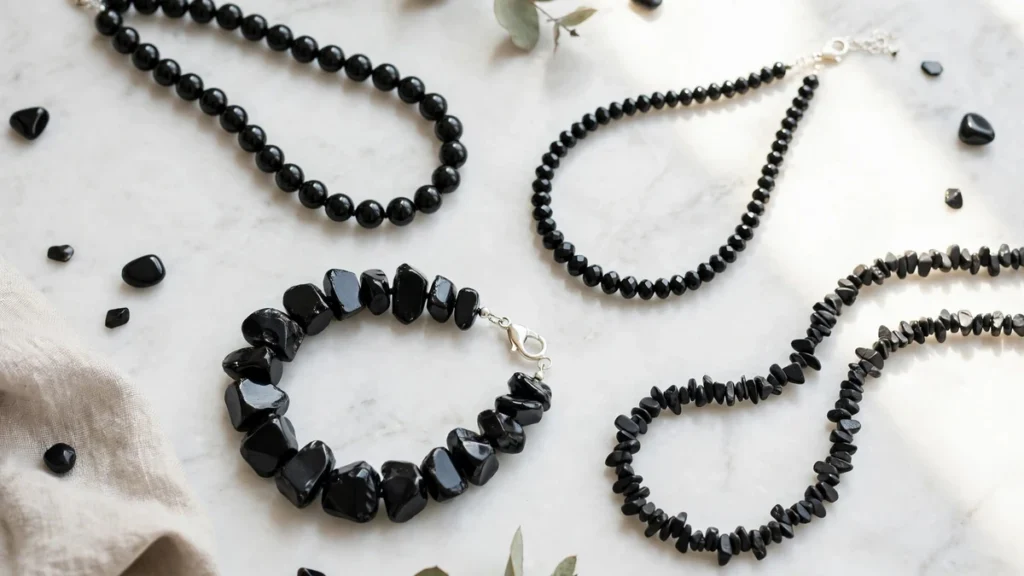
Obsidian is the most dramatic stone in a jewellery box. It is black glass made by a volcano, polished to a shine that looks almost wet, and it turns a simple chain into something with presence. The problem is that obsidian is also one of the easiest stones to get wrong. It is soft for a gemstone, it chips if it is knocked, and a great deal of what is sold as obsidian is ordinary black glass, which is not the same thing at all.
That is why this guide looks at the stone itself before the necklace. A well-made obsidian necklace uses a protected setting or a beaded strand, honest disclosure about the variety, and a price that matches the material. A pendant in a thin claw setting, or a strand strung on weak thread, will not survive everyday wear, however beautiful it looks in the box.
Below are nine obsidian necklaces worth considering in 2027, from a classic black bead strand to gold sheen, rainbow and snowflake varieties. Each one is described by what it does well, what to watch for, and who it suits best, so you can choose with the stone in mind, not just the photograph.
Key takeaways
- Obsidian is natural volcanic glass, usually black, with a Mohs hardness of 5 to 5.5, which makes it softer and more chip-prone than quartz or sapphire.
- Gold sheen, rainbow and snowflake obsidian are natural varieties, while most plain black “obsidian” beads are either genuine or black glass, so ask what you are buying.
- Beaded strands, bezel settings and cabochon cuts suit obsidian best, because they protect its edges from knocks.
- Keep obsidian away from hard surfaces, ultrasonic cleaners and steam cleaners, and store it separately so it is not scratched by harder stones.
- Obsidian has no proven healing properties and is not an investment stone, and a very cheap, perfectly uniform black bead is more likely glass than volcanic glass.
What obsidian actually is
Obsidian forms when lava cools so quickly that crystals have no time to grow, leaving a natural glass. That is why a broken piece has a sharp, shell-like edge and a shine that looks almost liquid. Most obsidian is black, but iron and magnesium give it brown and green tints, and tiny crystals inside the glass create the varieties collectors look for: gold sheen obsidian has a golden shimmer, rainbow obsidian shows bands of colour in strong light, and snowflake obsidian has white, flower-like patterns.
Its hardness is the fact that matters most for a necklace. At Mohs 5 to 5.5, obsidian is softer than quartz at 7 and far softer than sapphire at 9. That means it can be scratched by keys, coins and other jewellery, and it can chip if it hits a hard surface. It is not fragile in the way amber is, but it is not a stone to wear while moving furniture or at the gym. A necklace that sits close to the collarbone, rather than swinging freely, is a safer everyday choice.
The other fact is the imitation problem. Black glass looks very like obsidian, costs almost nothing, and is widely sold as obsidian. The two are genuinely hard to tell apart by eye, which is why the seller matters more than the stone. Buy from a brand or jeweller who names the variety and the origin, and be suspicious of a very cheap strand that is perfectly uniform in colour, because natural obsidian usually has some variation, bubbles or flow lines.
How we chose these necklaces and what to look for
Look first at the cut and the setting. A cabochon, a smooth bead or a polished slice suits obsidian far better than a faceted cut, because facets create thin edges that chip. A bezel setting, which wraps the metal around the stone, protects those edges and is the safest choice for a pendant. A beaded strand avoids the problem altogether, since there are no claws to catch and no thin edges to break. Our guide to obsidian bracelets uses the same logic, because the stone behaves the same way whatever it is set in.

Look next at the variety and the disclosure. Gold sheen, rainbow and snowflake obsidian should be named as such, and a seller should be able to say whether the stone is natural or glass. Rainbow obsidian is the variety most often misrepresented, because its colours only show in strong light, and a dull bead can be sold as rainbow without anyone checking. Hold the stone up to a bright light and turn it slowly before you buy, if you can.
Finally, look at the chain and the clasp. Obsidian pendants are often heavier than they look, especially in larger beads, so a fine chain can stretch or snap. A 1.2 mm cable chain or a beaded strand on a strong cord is a practical minimum for a pendant over 10 mm. Check the clasp too. A lobster clasp is more secure than a spring ring for a necklace you plan to wear daily, and it is worth paying a little more for a chain that will not need replacing in six months.
The 9 best obsidian necklaces of 2027
Tiffany & Co. Obsidian Bead Pendant
What we like: A smooth black obsidian bead on a fine silver chain, cleanly finished, with the brand’s hallmark and a secure lobster clasp. What to consider: Premium price for a simple design, and the bead is unprotected, so it needs careful storage. Stone: Black obsidian, polished bead. Setting: Silver bail on a silver cable chain. Best for: Everyday wear and a first obsidian piece. Price range: $275–$350.
Cartier Obsidian Bead Necklace
What we like: Graduated black obsidian beads with a gold clasp, evenly matched in colour, and a strand that sits flat on the collarbone. What to consider: The strand is strung on silk, so it needs restringing every year or two with regular wear. Stone: Black obsidian, graduated beads. Setting: Silk strand with an 18k gold clasp. Best for: Evening wear and formal occasions. Price range: $1,400–$1,800.
David Yurman Obsidian Pendant
What we like: A black obsidian cabochon in the brand’s signature cable setting, with a substantial chain that suits the weight of the stone. What to consider: The cabochon is set high, so it can catch on knitwear if you are not careful. Stone: Black obsidian cabochon. Setting: Sterling silver cable bezel. Best for: A statement pendant with a designer finish. Price range: $450–$600.
Mejuri Obsidian Bead Necklace
What we like: Small, evenly polished obsidian beads on a delicate gold vermeil chain, light enough for daily wear and easy to layer. What to consider: The chain is fine, so it is best for smaller pendants and gentle wear. Stone: Black obsidian, small beads. Setting: Gold vermeil chain with a lobster clasp. Best for: Layering and everyday minimal styling. Price range: $95–$140.
Monica Vinader Obsidian Pendant
What we like: A bezel-set obsidian pendant in gold vermeil, with the stone sitting low and protected, and a chain that can be adjusted to two lengths. What to consider: Gold vermeil wears over time and will need replating after a few years of daily use. Stone: Black obsidian, bezel-set cabochon. Setting: Gold vermeil bezel on an adjustable chain. Best for: A protected everyday pendant. Price range: $150–$200.
Missoma Gold Sheen Obsidian Necklace
What we like: Gold sheen obsidian with a visible golden shimmer in daylight, set simply so the stone is the focus. What to consider: The sheen only shows in bright light, so indoors it reads as plain black. Stone: Gold sheen obsidian, polished bead. Setting: Gold vermeil bail on a gold vermeil chain. Best for: Anyone who wants the most interesting variety of obsidian. Price range: $120–$165.
Maria Black Obsidian Sculptural Pendant
What we like: A sculptural silver setting that holds a rough-cut obsidian piece, with an architectural feel that suits the stone’s volcanic origin. What to consider: The rough edges are more exposed than a polished bead, so it needs more care. Stone: Black obsidian, rough-cut. Setting: Sterling silver sculptural setting. Best for: Bold, design-led styling. Price range: $200–$280.
Astrid & Miyu Obsidian Bead Necklace
What we like: An affordable beaded strand with a gold-plated clasp, even bead sizes, and a length that works well layered with a shorter gold chain. What to consider: The beads are small and the strand is light, so it suits layering more than a solo statement. Stone: Black obsidian, small beads. Setting: Beaded strand with a gold-plated clasp. Best for: Layering and a first obsidian necklace on a budget. Price range: $65–$95.
Thomas Sabo Rainbow Obsidian Pendant
What we like: Rainbow obsidian with bands of colour visible in strong light, set in a sturdy silver bezel that protects the stone. What to consider: The rainbow effect is subtle and needs bright light to show, so check it in daylight before buying. Stone: Rainbow obsidian cabochon. Setting: Sterling silver bezel on a silver chain. Best for: Collectors and anyone who likes a stone with a secret. Price range: $140–$190.
Which obsidian necklace is right for you
If you want a necklace you can wear every day, choose a beaded strand or a bezel-set pendant. Both protect the stone, both sit close to the body, and neither has thin edges waiting to chip. A strand is the safer choice if you are hard on jewellery, because there is no setting to catch on clothing, while a bezel pendant is the better choice if you want a single focal stone with a clean, finished look. Length matters too. A 16-inch strand sits at the collarbone and shows the beads clearly, while an 18-inch chain with a pendant gives a little more movement and suits a lower neckline.
If you want the most interesting stone, choose gold sheen or rainbow obsidian, but buy it in person if you can, or from a seller with a clear returns policy. The sheen and the colour bands are the whole point of these varieties, and a photograph will not tell you how strong they are. A dull gold sheen bead is not worth a premium over plain black obsidian, and a rainbow bead that shows no colour in daylight is not rainbow obsidian at all. Our obsidian earrings guide makes the same point, because the varieties behave the same way at any size.
For evening wear, a graduated strand or a larger pendant has more presence than a fine beaded necklace, but it also carries more weight, so check the chain. A pendant over 12 mm needs a chain of at least 1.2 mm, and a strand of large beads needs a clasp you can trust. If the chain feels flimsy when you hold it, it will not feel better after a month of wear.
The caveats that matter
Obsidian is a genuine natural material, but it is not a hard stone, and it is not rare. That combination is what trips people up. They assume a black stone is tough because it looks solid, and they assume it is valuable because it is sold as a gemstone. Neither is true. Treat it as a beautiful, affordable glass with character, handle it gently, and you will enjoy it for years. It also pairs well with silver, which suits its cool black tone, and with gold, which warms it up, so the metal is a matter of taste rather than a rule.
| Detail | What is known |
|---|---|
| What it is | Natural volcanic glass, formed when lava cools too fast for crystals to grow |
| Hardness | Mohs 5 to 5.5, softer than quartz and sapphire, so it can scratch and chip |
| Common varieties | Black, gold sheen, rainbow and snowflake obsidian |
| Best settings | Bezel settings, cabochons and beaded strands, which protect the edges |
| Main imitation | Black glass, which looks very similar and is widely sold as obsidian |
| What to avoid | Knocks on hard surfaces, ultrasonic and steam cleaners, and storage with harder stones |
| Care | Wipe with a soft cloth, wash with mild soap and water, store separately in a pouch |
| What it is not | It has no proven healing properties and is not an investment stone |
If you are buying obsidian as a gift, keep the receipt and the seller’s description of the variety. A gift that turns out to be glass is disappointing, but a gift with a clear, honest description is easy to enjoy, whatever the stone is. And if you have a nickel allergy, check the metal, not just the stone. Many affordable obsidian necklaces use plated base metal, and the clasp is the part that touches your skin most.
Checklist: choosing an obsidian necklace honestly
Use these checks before you buy, and again when the necklace arrives.
- Check the variety: black, gold sheen, rainbow or snowflake, named by the seller, not just “obsidian”.
- Check the setting: a bezel, a cabochon or a beaded strand protects the stone better than a claw setting.
- Check the chain: at least 1.2 mm for a pendant over 10 mm, with a secure lobster clasp.
- Check the light: hold gold sheen and rainbow obsidian in bright light and turn it slowly before you commit.
- Check the price: a very cheap, perfectly uniform black bead is more likely glass than volcanic glass.
- Check the care: no ultrasonic or steam cleaning, store separately, and wipe with a soft cloth after wear.
Frequently asked questions
Is obsidian a real gemstone?
Yes, in the sense that it is a natural material formed by a volcano, but it is glass rather than a crystal, and it is not rare or expensive. Its value is in its colour, shine and variety, not in scarcity.
Can I wear an obsidian necklace every day?
Yes, if it is a beaded strand or a bezel-set pendant, and you take it off for the gym, housework and swimming. A claw-set pendant or a very large bead is better kept for occasional wear, because it is more likely to chip.
How can I tell obsidian from black glass?
It is hard by eye alone. Natural obsidian often has tiny bubbles, flow lines or slight colour variation, while glass is usually perfectly uniform. The most reliable check is buying from a seller who names the variety and origin and offers returns.
Does obsidian need special cleaning?
No, but it needs gentle cleaning. Warm water, mild soap and a soft cloth are enough. Never use an ultrasonic or steam cleaner, and never soak it with other jewellery, because harder stones will scratch it.
What is gold sheen obsidian?
It is a natural variety with tiny bubbles that reflect light as a golden shimmer. The effect only shows in bright light, so indoors it looks like plain black obsidian. It is worth a small premium, but not a large one, over black obsidian.
Is obsidian good for sensitive skin?
The stone itself is inert and rarely causes a reaction, but the metal matters more. If you have a nickel allergy, choose sterling silver or solid gold settings and check the clasp, which sits against your skin. A gold jewellery guide for everyday wear is a useful place to check which metals suit sensitive skin, because the chain and clasp are the parts that matter most.
The bottom line
The best obsidian necklace in 2027 is not the most expensive or the darkest. It is the one with a protected setting, an honestly named variety, and a chain strong enough for the stone it carries. A beaded strand or a bezel-set pendant will outlast a claw-set stone by years, and a gold sheen or rainbow piece bought from a seller you trust is worth more than a flawless-looking bead with no description at all.
Choose the variety you like, check it in bright light, store it separately from harder stones, and wear it with the knowledge that obsidian is volcanic glass with a dramatic past, not a hard gemstone. Treated gently, it is one of the most striking black stones you can wear, at a price that leaves room for the rest of your jewellery box.