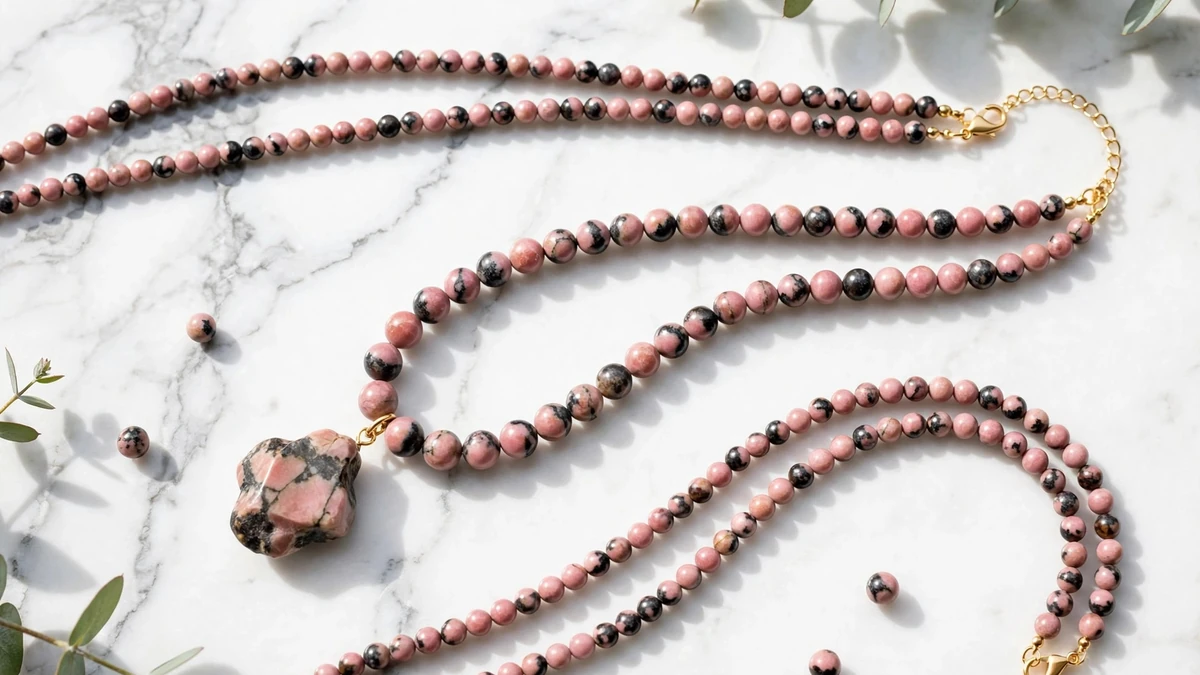
Rhodonite is the pink stone that stops people mid-sentence. Its soft rose colour is cut through with black veins of manganese oxide, so every bead and pendant looks like a small piece of marble, and no two are ever alike. It is warm, romantic and easy to wear, which is why it turns up in so many pendant necklaces. The problem is not finding a pretty rhodonite necklace. It is finding one that is set well enough to survive daily wear, because rhodonite is a soft stone, and a careless setting will scratch and chip it far sooner than you expect.
That is why this guide is organised by setting and colour, not just by price. A rhodonite pendant in a protective bezel can be worn most days with a little care, while the same stone in an open prong setting is better saved for occasions. A deep pink stone with strong black veining suits a simple chain, where the pattern does the talking, while a pale pink stone looks best against silver or white gold that keeps its cool, soft tone. Price is a poor guide on its own. Rhodonite itself is affordable, so most of what you pay for is the metal, the chain, and the quality of the setting.
Below are nine rhodonite necklaces worth considering in 2027, from a classic bezel pendant to beaded strands and sculptural designs. Each one is described by what it is good at, what to watch for, and who it suits best, so you can choose with the stone’s softness in mind, not just its colour.
Key takeaways
- Rhodonite is a pink manganese silicate at Mohs 5.5 to 6.5, with natural black manganese-oxide veins that make every stone unique.
- Bezel and channel settings protect rhodonite best, while open prongs and exposed points scratch and chip more easily.
- Deep pink with strong black veining is the most valued look, while pale, evenly pink stones are usually the least expensive.
- Clean rhodonite only with lukewarm water, mild soap and a soft cloth, and never use an ultrasonic or steam cleaner, heat, or harsh chemicals.
- Rhodonite is affordable and decorative rather than rare, dyed howlite and pink glass imitations are common, and it has no proven healing properties and is not an investment stone.
What rhodonite actually is
Rhodonite is a manganese silicate, and its name comes from the Greek word for rose, which is exactly what it looks like. The pink ranges from a pale, almost milky blush to a deep, saturated rose, and the black veins are manganese oxide, the same mineral that gives the stone its colour. Those veins are not a flaw. They are the signature of genuine rhodonite, and a stone with bold, branching black lines is usually more prized than one with barely any marking at all.
The finest rhodonite comes from Russia and Australia, and it has been used in jewellery and ornamental carving for well over a century. It cuts well into cabochons, which suit its opaque, patterned character far better than faceting does, because a smooth dome shows off the pink and black pattern while a faceted cut can look muddy in a stone with no transparency to play with.
What matters most for a necklace is hardness. Rhodonite sits at Mohs 5.5 to 6.5, which is harder than fluorite but still softer than quartz, and softer than the steel of a zip or a key. It can scratch, and a sharp knock can chip an exposed edge. That is why rhodonite is rarely used in rings, which take knocks all day, and why a necklace, which hangs away from hard surfaces, is one of the kindest places to wear it.
How we chose these necklaces and what to look for
Look first at the setting. A bezel, where a rim of metal wraps around the edge of the stone, protects rhodonite from side knocks and is the safest choice for a pendant you plan to wear often. A channel setting, where the stone sits in a groove, offers similar protection for beaded and bar designs. Open prongs look lighter and show more of the stone, but they leave the edges exposed, so save prong-set rhodonite for occasions rather than everyday wear.

Look next at the colour and the pattern. Deep pink with strong black veining is the classic rhodonite look, and it suits a simple pendant or a beaded strand, where the pattern is the whole point. A pale pink stone looks softer and more delicate, and it pairs well with silver and white gold. Be wary of stones that are an even, saturated hot pink with no veins at all, because those are often dyed howlite or pink glass rather than rhodonite. Our guide to rhodonite bracelets covers the same setting logic for the wrist, where the stone takes even more knocks than it does on a necklace.
Finally, look at the chain and the clasp. A fine chain suits a small pendant, while a beaded rhodonite strand needs a sturdy clasp and a silk or wire thread that is knotted between beads, so a break does not scatter the strand. Check that the bail, the loop that joins pendant to chain, is solid rather than a thin wire, and that the clasp closes with a firm click. A necklace is only as reliable as its weakest link, and with a soft stone, a dropped pendant is the most common accident.
The 9 best rhodonite necklaces of 2027
Tiffany & Co. Pendant
What we like: A polished rhodonite pendant in a clean bezel setting, with a fine chain that lets the pink stone and its black veins take centre stage. The setting protects the stone’s edges, and the colour is a deep, natural rose.
What to consider: Premium price for a soft stone, and the bezel hides the back of the stone, so you see less of the veining from behind. Stone: Rhodonite, cabochon. Setting: Bezel, sterling silver. Best for: Everyday wear with care. Price range: £250–£400.
Cartier Pendant
What we like: A deep pink rhodonite pendant in 18k gold with a refined, minimal design, and a chain length that sits well with both crew necks and open collars.
What to consider: The gold price dominates the cost, and the black veining varies from stone to stone, so ask to see the exact piece. Stone: Rhodonite, cabochon. Setting: Bezel, 18k yellow gold. Best for: Dressier days and evenings. Price range: £900–£1,400.
David Yurman Pendant
What we like: A rhodonite pendant with the brand’s signature cable detail, in a sturdy bezel that suits regular wear, with a chain that feels substantial rather than flimsy.
What to consider: The cable motif adds weight, and the pink can look darker indoors than it does in daylight. Stone: Rhodonite, cabochon. Setting: Bezel, sterling silver. Best for: Daily wear and layering. Price range: £400–£650.
Mejuri Pendant
What we like: A small rhodonite pendant in vermeil, at a fair price, with a delicate chain that layers easily with other necklaces.
What to consider: Vermeil wears over time and needs gentle care, and the pendant is small, so the veining is subtle rather than dramatic. Stone: Rhodonite, cabochon. Setting: Bezel, gold vermeil. Best for: Layering and first rhodonite pieces. Price range: £90–£160.
Monica Vinader Pendant
What we like: A rhodonite pendant with a clean, modern shape, on an adjustable chain that works at two lengths, and a setting that shows the stone from the front and the side.
What to consider: The adjustable chain is fine rather than heavy, so avoid layering it with chunky pieces that could tug it. Stone: Rhodonite, cabochon. Setting: Bezel, 18k gold vermeil. Best for: Everyday wear and gifting. Price range: £130–£220.
Missoma Pendant
What we like: A rhodonite pendant with a soft, organic shape, in gold vermeil, that reads as a design piece rather than a plain stone on a chain.
What to consider: The organic shape means each stone looks different, and vermeil needs to stay away from perfume and water. Stone: Rhodonite, freeform cabochon. Setting: Bezel, gold vermeil. Best for: Casual and creative looks. Price range: £110–£190.
Maria Black Pendant
What we like: A sculptural rhodonite pendant with an architectural setting, in sterling silver, that suits people who want their jewellery to look designed rather than traditional.
What to consider: The sculptural setting leaves more of the stone exposed, so this is an occasions piece rather than a daily one. Stone: Rhodonite, cabochon. Setting: Semi-bezel, sterling silver. Best for: Evenings and statement looks. Price range: £180–£300.
Astrid & Miyu Pendant
What we like: A beaded rhodonite strand necklace with knotted beads in mixed pink shades, at an accessible price, with a secure clasp.
What to consider: Beads are more exposed than a bezel pendant, so the strand needs careful storage, and bead sizes vary slightly. Stone: Rhodonite beads. Setting: Knotted strand, gold-filled clasp. Best for: Colourful, relaxed outfits. Price range: £85–£150.
Thomas Sabo Pendant
What we like: A rhodonite pendant with a detailed bail and a longer chain option, good for layering over knitwear, with a setting that holds the stone firmly.
What to consider: The longer chain swings more, so the pendant can knock against hard surfaces if you lean forward. Stone: Rhodonite, cabochon. Setting: Bezel, sterling silver. Best for: Layering over jumpers and dresses. Price range: £120–£210.
Which rhodonite necklace is right for you
If you want a necklace to wear most days, choose a bezel-set cabochon in deep pink rhodonite, on a medium chain. It is the most forgiving combination: the bezel protects the edges, the cabochon has no corners to chip, and the pink and black pattern works with both cool and warm outfits. A shorter chain keeps the pendant close and out of harm’s way, while a longer one suits layering but swings more.
If you want a dressier piece, a rhodonite pendant in yellow gold is the most striking choice, because the warm gold picks up the pink while the black veins add contrast that reads as deliberate rather than accidental. Keep it for evenings and occasions, store it in its own pouch, and put it on after perfume and hairspray. Our guide to pearl necklaces is a useful contrast here, because pearls and rhodonite both need the same gentle habits, and a routine that protects one will protect the other.
If you love colour above all, a beaded rhodonite strand is the best value, because you get many stones for the price of one pendant, and the mixed pink shades suit plain tops and denim. Accept that beads will pick up small marks over time, and treat the strand as a favourite to enjoy rather than a piece to keep flawless.
The caveats that matter
Rhodonite’s softness is the whole story. At Mohs 5.5 to 6.5, it scratches more easily than quartz, and a sharp knock can chip an exposed edge. That does not make it unwearable, but it does make it a necklace for someone who will take it off before the gym, before gardening, and before any job that involves hard surfaces. It should also stay out of ultrasonic and steam cleaners, which can crack it, and away from heat and harsh chemicals, which can dull the polish.
| Detail | What is known |
|---|---|
| What it is | A pink manganese silicate, named from the Greek word for rose |
| Hardness | Mohs 5.5 to 6.5, softer than quartz and easy to scratch |
| Colours | Pale blush to deep rose pink, with black manganese-oxide veins |
| Best setting | Bezel or channel, which protect the edges; prongs leave the stone exposed |
| Cleaning | Lukewarm water, mild soap, soft cloth; never ultrasonic, steam, heat or harsh chemicals |
| Best cut | Cabochon, which shows off the pattern and has no corners to chip |
| Imitations | Dyed howlite, dyed quartz and pink glass are common; even hot pink with no veins is a warning sign |
| What it is not | It has no proven healing properties and is not a rare or investment stone |
Imitations are worth knowing about, because rhodonite is inexpensive and pink copies are easy to make. Real rhodonite shows natural black veining, colour that varies across the stone, and small inclusions, while dyed howlite has a greyish, veined look that is too even, and pink glass is usually uniformly coloured and may hold tiny round bubbles. A seller who discloses the stone as rhodonite and prices it modestly is usually honest; a seller who charges a premium for a supposedly rare colour is a warning sign.
Checklist: choosing a rhodonite necklace honestly
Use these checks before you buy, and again after a month of wear.
- Check the setting: a bezel or channel protects the stone best, especially for daily wear.
- Check the cut: a smooth cabochon has no corners to chip, and it shows the veining better than a faceted cut.
- Check the colour: look for natural black veining and variation, and be wary of perfectly even, very saturated hot pink.
- Check the chain and clasp: the bail should be solid, the clasp should click shut firmly, and a beaded strand should be knotted between beads.
- Check the care routine: lukewarm water and mild soap only, and store the necklace in its own pouch away from harder jewellery.
- Check the price: rhodonite is affordable, so most of the cost should be the metal and the workmanship, not the stone.
Frequently asked questions
Can I wear a rhodonite necklace every day?
Yes, with care, if it is bezel-set and you take it off for the gym, gardening, cleaning and any work near hard surfaces. A necklace takes fewer knocks than a ring or bracelet, which is why rhodonite works better here than on the hand or wrist.
What are the black veins in rhodonite?
The black veins are manganese oxide, the same mineral family that gives rhodonite its pink colour. They are a natural part of the stone and the clearest sign of genuine rhodonite, not a flaw, and a stone with bold, branching veins is usually more prized than one with barely any marking.
How do I clean a rhodonite necklace?
Use lukewarm water, a drop of mild soap, and a soft cloth, then rinse and dry gently. Never use an ultrasonic or steam cleaner, hot water, or harsh chemicals, and never scrub with a brush, because the stone is soft enough to scratch.
Does rhodonite fade in sunlight?
Rhodonite is fairly stable in normal light, but like most coloured stones it is best stored out of long, direct sunlight, so keep it in a pouch or a drawer rather than on a sunny windowsill. Normal indoor wear is not a problem.
Is my rhodonite necklace real or dyed howlite?
Real rhodonite has natural black manganese veins and colour that varies across the stone, while dyed howlite often looks greyish-pink with veins that are too even, and pink glass is uniformly coloured and may hold tiny bubbles. If you are unsure, ask a jeweller to check it, and buy from sellers who name the stone plainly. Our guide to rhodonite earrings for spring covers the same checks for smaller rhodonite pieces.
What chain length suits a rhodonite pendant?
A 40 to 45 centimetre chain sits at the collarbone and keeps the pendant protected, while a 50 to 60 centimetre chain suits layering and lower necklines. Shorter is safer for a soft stone, because the pendant swings less and is less likely to knock against a table or a zip.
The bottom line
The best rhodonite necklace in 2027 is not the biggest stone or the most expensive setting. It is a well-protected stone in a setting that suits how you actually live: a bezel-set cabochon for daily wear, a deep pink pendant in gold for evenings, or a beaded strand for colour. Choose the setting first, the colour second, and the price last, and the necklace will last far longer than a pretty stone in a careless mount.
Enjoy rhodonite for what it is, a warm, romantic, naturally patterned stone with no two pieces alike, and care for it as a soft stone. Keep it clean with soap and water, keep it away from knocks and cleaners, and it will repay a little attention with years of wear.