Best Sapphire Septum Rings 2027
A sapphire septum ring is a small piece of jewellery with an outsized effect. The deep blue of a sapphire sits right at the centre of the face, so even a tiny stone changes how a whole look reads. It can feel classic and quietly expensive, or bold and modern, depending on the setting, the metal, and the size of the stone. That range is exactly why sapphire septum rings have become a favourite for people who want colour in a piercing without the flash of a diamond.
The difficulty is choosing well. Sapphires vary enormously in colour, from a pale, almost grey blue to a rich cornflower or a deep royal blue, and a stone that looks vivid in a photograph can look flat in daylight. Settings matter too. A clicker is easy to open and close, a horseshoe suits a bolder look, and a seamless ring is the most discreet of all. Then there is the metal, the gauge, and the question of whether the stone is natural or lab-grown.
Below are nine sapphire septum rings worth considering in 2027, from a classic blue clicker to a tiny everyday ring and a lab-grown option that keeps the price sensible. Each one is described by what it does well, what to watch for, and who it suits best, so you can choose with your piercing in mind, not just a photograph.
Key takeaways
- Sapphire is the second-hardest gemstone used in jewellery after diamond, so it holds up well in a septum ring worn daily.
- Colour matters more than size: a small, vivid blue stone reads better than a large, greyish one.
- Clickers are the easiest to open and close; horseshoes suit a bolder look; seamless rings are the most discreet.
- Check the gauge, the diameter, and the metal before buying — a ring that does not fit your piercing will not sit comfortably.
- No septum ring suits a fresh or irritated piercing, and a stone that is glued rather than set can loosen with daily wear.
What sapphire septum rings actually are
A septum ring sits through the thin tissue at the base of the nose, between the nostrils. In a sapphire septum ring, the stone is set into the visible part of the piece, usually at the front centre of a clicker, along the curve of a horseshoe, or as a single stone on a seamless ring. The stone is the point of the design. Everything else — the metal, the closure, the size — exists to show it off and to keep it comfortable.
Sapphire is the mineral corundum, coloured blue by traces of iron and titanium. The same mineral in other colours is still sapphire, except for red, which is ruby. That is why a sapphire septum ring can be blue, pink, yellow, white, or teal, and still honestly be called sapphire. Blue remains the classic choice, and it is the colour most people picture first. Sapphire scores 9 on the Mohs hardness scale, second only to diamond, which means it resists scratches from everyday wear far better than softer stones such as opal or pearl.
People choose sapphire septum rings for three reasons: colour, durability, and versatility. A deep blue reads as rich and deliberate with warm gold, cool silver, and darkened metals alike. A hard stone in a secure setting can be worn every day, and the same blue can look understated in a tiny seamless ring or striking in a larger clicker.
How we chose these sapphire septum rings and what to look for
Look first at the stone. A good blue sapphire is vivid and even in colour, without grey or brown undertones and without a dark, almost black centre. A small stone with strong colour beats a larger washed-out one, and a vivid lab-grown sapphire beats a dull natural one.
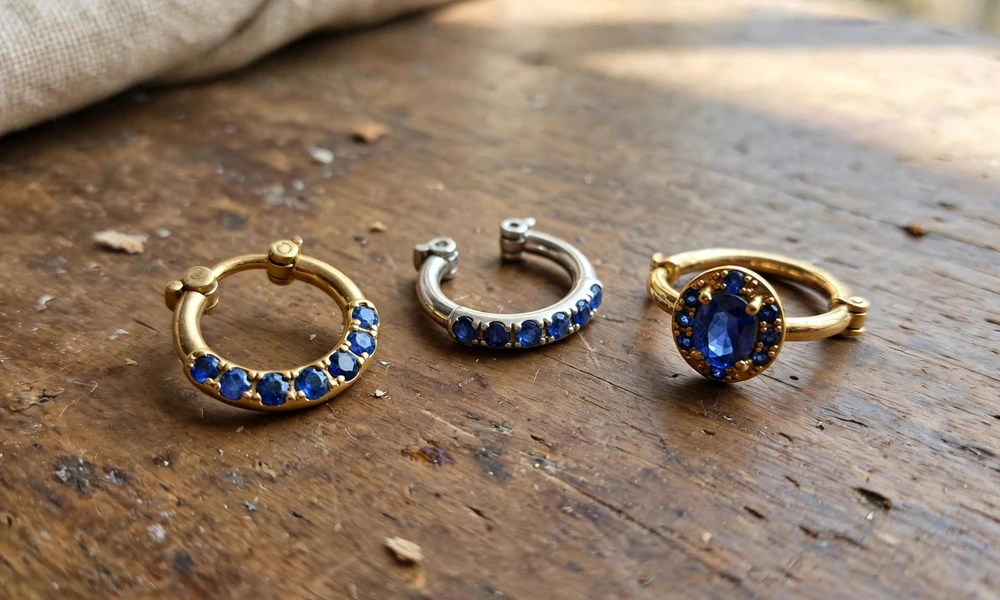
Look next at the setting and the metal. The stone should be held by prongs or a bezel, not glued in place, because glue loosens with heat, water, and daily handling. Solid gold, implant-grade titanium, and solid sterling silver are the usual safe choices for a healed piercing. Our guide to gold jewellery for everyday wear explains why solid gold holds up better than plated pieces, and the same logic applies here: a septum ring is worn every day, so the metal needs to survive that.
Finally, check the fit. Most septum piercings are done at 16 gauge, with some at 14 gauge, and the ring diameter is usually 8 to 10 millimetres. A ring that is too small will press against the nose, and a ring that is too large will hang low and catch on things. If you do not know your gauge or diameter, measure your current ring or ask your piercer before ordering, because a beautiful ring in the wrong size is unwearable.
The 9 best sapphire septum rings of 2027
The Classic Blue Sapphire Clicker
What we like: A vivid oval blue sapphire in a hinged clicker that opens and closes with a soft snap, easy to put in and take out without tools. What to consider: The hinge needs a firm click to stay shut, so check it after the first few wears. Best for: Everyday wear and first-time sapphire buyers. Material: 14k solid gold with a natural blue sapphire. Price range: $180 to $320. Standout feature: The colour — a strong cornflower blue that reads clearly even in a small stone.
This is the ring the rest of the list is measured against: not the cheapest, but the one most people will reach for every morning.
The Bezel-Set Sapphire Horseshoe
What we like: A round blue sapphire held in a smooth bezel at the base of a horseshoe, with ball ends that keep the shape balanced. What to consider: A horseshoe sits lower than a clicker, so it reads as a bolder look. Best for: People who want their septum ring to be noticed. Material: Implant-grade titanium with a natural blue sapphire. Price range: $90 to $160. Standout feature: The bezel setting, which protects the stone edges from knocks.
A horseshoe is the classic septum shape, and the bezel keeps the stone safe in a clean, finished outline.
The Pink Sapphire Clicker
What we like: A soft pink sapphire in a slim gold clicker, warm and gentle where blue sapphire is cool and bold. What to consider: Pink sapphires vary from pale blush to strong rose, so check the exact shade before buying. Best for: Warm skin tones and anyone who finds blue too stark. Material: 14k rose gold with a natural pink sapphire. Price range: $160 to $290. Standout feature: The rose gold and pink stone together, which feels softer than a blue-and-yellow-gold pairing.
Pink sapphire is the same stone as blue, coloured by chromium, so it is just as hard and durable.
The White Sapphire Seamless Ring
What we like: A single white sapphire set into a thin seamless ring, with a quiet sparkle that reads as understated rather than showy. What to consider: White sapphire is less brilliant than diamond, so do not buy it expecting a diamond look. Best for: Minimal looks and workplaces where a bold piercing feels too much. Material: Solid sterling silver with a white sapphire. Price range: $60 to $120. Standout feature: The seamless closure, which has no hinge or gap to catch on clothing.
This is the most discreet ring on the list: the stone catches the light quietly, and there is nothing to snag.
The Yellow Sapphire Hinged Hoop
What we like: A warm golden-yellow sapphire in a hinged hoop, sunny and unusual without being loud. What to consider: Yellow sapphires can look pale in dim light, so a deeper golden shade is worth seeking out. Best for: People who wear gold jewellery daily and want a stone to match. Material: 14k yellow gold with a natural yellow sapphire. Price range: $150 to $280. Standout feature: The golden tone, which pairs naturally with yellow gold in a way blue sapphire does not.
Yellow sapphire is less common than blue, which is part of its appeal, and it looks warm and intentional in yellow gold.
The Lab-Grown Sapphire Clicker
What we like: A lab-grown blue sapphire with strong, even colour at a fraction of the price of a comparable natural stone. What to consider: Lab-grown stones do not hold resale value the way fine natural sapphires can, but that rarely matters in a septum ring. Best for: Anyone who wants vivid colour on a sensible budget. Material: 14k solid gold with a lab-grown blue sapphire. Price range: $110 to $200. Standout feature: The colour consistency — lab-grown stones are reliably vivid, without the grey patches common in cheaper natural stones.
A lab-grown sapphire is chemically the same stone as a natural one. In a small septum ring, the difference is invisible and the saving is real.
The Sapphire and Diamond Accent Ring
What we like: A central blue sapphire flanked by two tiny diamonds, adding sparkle without taking attention from the sapphire. What to consider: The diamonds are small, so they add light rather than size, and the price reflects that. Best for: Special occasions and people who want one dressier septum ring. Material: 14k white gold with a blue sapphire and two small diamonds. Price range: $260 to $450. Standout feature: The three-stone layout, which makes the ring look considered rather than plain.
This is the most formal ring in the roundup, earning its place when you want the piercing to look deliberate and finished.
The Teal Sapphire Horseshoe
What we like: A teal sapphire, blue with a green undertone, set in a darkened silver horseshoe for a modern, slightly edgy feel. What to consider: Teal is a matter of taste — in some lights it reads blue, in others green, so be sure you like both. Best for: Cool skin tones and anyone who wants a colour that is not quite blue. Material: Oxidised sterling silver with a natural teal sapphire. Price range: $100 to $190. Standout feature: The colour shift, which makes the ring look different indoors and out.
Teal sits between blue and green, and that in-between quality is what makes it interesting.
The Tiny Sapphire Clicker
What we like: A 2-millimetre blue sapphire in a slim clicker, small enough to read as a dot of colour rather than a statement. What to consider: The stone is tiny, so its colour needs to be strong to show up at all — avoid pale stones at this size. Best for: First septum rings, subtle styles, and stacking with other nose jewellery. Material: Implant-grade titanium with a natural blue sapphire. Price range: $70 to $130. Standout feature: The size — it is the smallest ring here, and the easiest to wear every day without thinking about it.
Small does not mean forgettable: a vivid 2-millimetre sapphire is visible from conversation distance.
Which sapphire septum ring is right for you
Start with the closure. If you change your jewellery often, a clicker is the easiest option — it opens and closes with your fingers and needs no tools. If you rarely change it, a seamless ring is smoother and less likely to catch, and a horseshoe gives the boldest look of the three.
Then think about colour and metal together. Blue sapphire with yellow gold is the classic pairing, warm and rich. Blue sapphire with white gold or silver is cooler and more modern. Pink sapphire suits rose gold, yellow sapphire suits yellow gold, and white sapphire works with any metal because it is effectively colourless. A roundup of the best septum rings for women shows the same principle across styles: the metal sets the tone, and the stone follows it.
Finally, be honest about how much attention you want. A tiny clicker is a private pleasure, visible only up close. A horseshoe with a bezel-set stone is a public one, visible across a room. Neither is better, but they suit different days and different moods, and many people end up owning one of each.
The caveats that matter
Sapphire is hard and durable, but a septum ring is still worn through a piercing, and piercings have their own rules. A new piercing needs time to heal before any stone-set ring goes in, and a ring that is too heavy, too tight, or made from a metal your skin dislikes will irritate it. The stone itself is rarely the problem — the fit and the metal are.
| Detail | What is known |
|---|---|
| Hardness | Sapphire scores 9 on the Mohs scale, second only to diamond |
| Best colour for most people | Vivid, even blue without grey or brown undertones |
| Most common gauge | 16 gauge, with some piercings at 14 gauge |
| Usual diameter | 8 to 10 millimetres for most septum piercings |
| Safest metals | Solid gold, implant-grade titanium, and solid sterling silver |
| What to avoid | Glued-in stones, plated metals, and unknown alloys |
| When to wait | Until a new piercing is fully healed, usually several months |
| What it does not do | A septum ring does not suit an unhealed piercing, whatever the stone |
Lab-grown sapphire is real sapphire, with the same hardness and chemistry as a mined stone — not a fake or a substitute. The difference is origin and price, not quality. If a seller describes a lab-grown stone as natural, walk away.
Checklist: buying a sapphire septum ring honestly
Use these checks before you buy, and again when the ring arrives.
- Check the stone: vivid, even colour in daylight, with no grey patches or dark centre.
- Check the setting: prongs or a bezel holding the stone, not glue.
- Check the metal: solid gold, implant-grade titanium, or solid sterling silver, not plated.
- Check the fit: confirm your gauge and diameter before ordering, and measure your current ring if unsure.
- Check the closure: a clicker should snap shut firmly, and a seamless ring should close without a visible gap.
- Check the return policy: a reputable seller accepts returns if the size or colour is wrong.
Frequently asked questions
Can I wear a sapphire septum ring every day?
Yes, if your piercing is fully healed. Sapphire is hard enough to handle daily wear, and a secure setting keeps the stone in place. Clean the ring gently with warm water and mild soap, and check the setting now and then for looseness.
Is a lab-grown sapphire as good as a natural one?
For a septum ring, yes. A lab-grown sapphire has the same hardness and chemistry as a natural stone, and its colour is often more even. It costs less, and at the small sizes used in septum rings, the difference is not visible.
What gauge is a septum ring?
Most septum piercings are 16 gauge, with some done at 14 gauge. Check your current jewellery or ask your piercer before buying, because a ring in the wrong gauge will not fit comfortably.
Will a sapphire septum ring irritate my piercing?
The stone itself should not. Irritation usually comes from the metal, the fit, or a piercing that has not finished healing. If your piercing is sore, switch to a simple implant-grade titanium ring and let it settle before wearing a stone-set piece.
How do I clean a sapphire septum ring?
Remove it, wash it in warm water with a drop of mild soap, and dry it with a soft cloth. Avoid ultrasonic cleaners for rings with small pavé stones, and avoid harsh chemicals, which can dull the metal over time.
Can I wear a sapphire septum ring with other nose jewellery?
Yes. A small sapphire clicker pairs well with a nostril stud, and the same colour logic applies: match the metals, and keep one piece as the focus. Our roundup of the best sapphire nose rings is a useful place to find a matching stud in the same stone and metal.
The bottom line
The best sapphire septum ring in 2027 is the one that fits your piercing, suits your colouring, and feels comfortable enough to forget you are wearing it. For most people, that is a small blue sapphire in a gold or titanium clicker. Lab-grown sapphire is a sensible way to get that colour for less, and pink, yellow, or teal sapphire is worth considering if blue feels too expected.
Choose one ring, check the gauge and the diameter before you order, and wear it for a few weeks before deciding whether it is right. A septum ring is a small thing, but you see it every time you look in a mirror, so it is worth choosing slowly and well.