
A ruby septum ring is a small piece of jewellery with a strong personality. Where a diamond glints, a ruby glows: a deep red that stands out against every skin tone and reads clearly even at a small size. A ruby at the centre of the face adds warmth and colour to a look that might otherwise be all metal and skin.
The problem is that rubies vary more than most people expect. A fine ruby is a rich, slightly pinkish red with good clarity. A poor one is dark, almost black in low light, or cloudy enough to look dull. Lab-created rubies are widely available and look very close to natural stones, while natural rubies of good quality are expensive, especially above a tenth of a carat.
Below are nine ruby septum rings worth considering in 2027, from a classic solitaire clicker to a pavé horseshoe and a lab-created option that keeps the cost down. Each one is described by what it does well, what to watch for, and who it suits best, so you can choose with your face and your budget in mind, not just a colour.
Key takeaways
- A ruby septum ring works because the deep red stone reads clearly at a small size, adding colour where a diamond only adds light.
- Clickers are the easiest to open and close daily, while horseshoes and captive rings suit people who like a simpler, more adjustable fit.
- Lab-created rubies look very close to natural stones and cost far less, which makes a larger or cleaner stone affordable.
- Gauge and diameter matter more than carat weight: a ring that is too wide or too heavy will feel wrong within a day.
- No septum ring suits a fresh or unhealed piercing, and a ruby does not make a poorly fitting ring comfortable, so fit comes before colour.
What ruby septum rings actually are
A ruby septum ring is a ring worn through the septum, the thin wall of tissue between the nostrils, with a ruby set into it. Most designs are clickers, horseshoes, or seamless rings. A clicker has a hinged segment that opens and closes with a click, and the ruby is usually set into the segment itself. A horseshoe, also called a circular barbell, is an open ring with a small ball or stone at each end. A seamless ring is a plain circle that closes with a small gap, with a ruby set into the front curve.
The ruby is usually small, often between 0.05 and 0.25 carats for a single stone, and pavé designs use several tiny stones along the front of the ring instead. The metal is usually 14k or 18k gold, or implant-grade titanium with a gold finish. Gold is the classic choice for a ruby, because the warm metal flatters the red stone, while titanium is lighter and a good option for sensitive skin. The stone is normally a round or oval cut, because those shapes show off the colour best at a small size, though cushion cuts appear in larger settings.
Septum piercings are usually done at 16 gauge, and most ruby septum rings are made in 16 gauge, with 14 gauge for people who have stretched slightly. Diameter is typically 8 to 10 millimetres. The right size sits close to the nose, moves freely when you smile, and does not need adjusting during the day.
How we chose these ruby septum rings and what to look for
Look first at the colour. A good ruby is a rich, medium red, neither too dark nor too pink, with an even colour across the stone. Hold it in daylight if you can: a stone that looks black in shade will look black on your face, and a stone that looks orange in bright light will look orange too. Lab-created rubies are usually a clean, even red, which is one reason they are so popular in small jewellery. Our roundup of the best nose rings for women covers the wider range of coloured-stone nose jewellery, which is a useful comparison if you are choosing between a ruby and another gemstone.
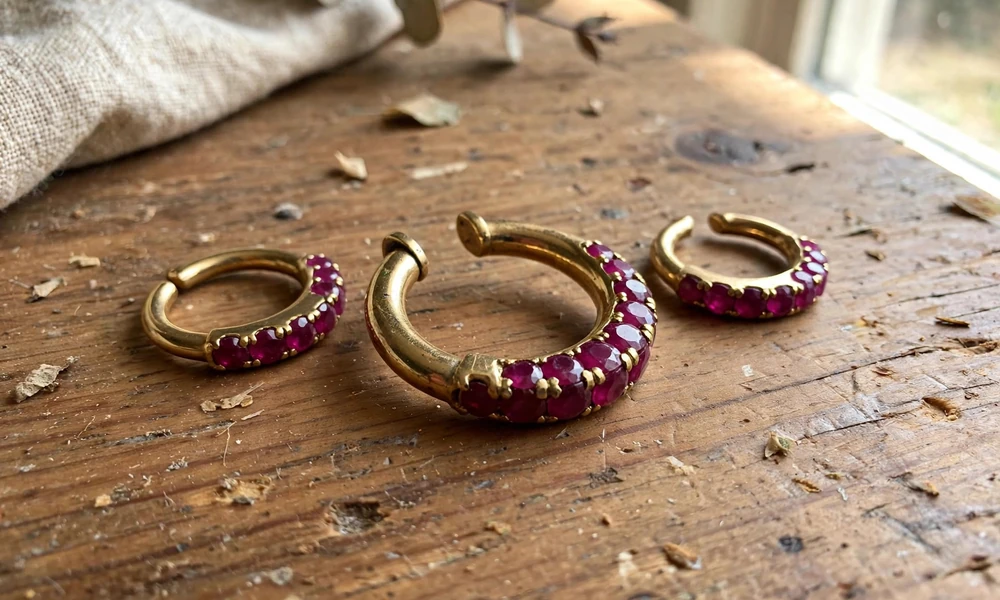
Look next at the setting and the closure. A clicker with a smooth hinge is the most practical daily choice, because you can open and close it without tools and without bending the metal. Check that the hinge closes flush, with no gap and no sharp edge. A bezel setting, where the metal wraps around the edge of the stone, protects a ruby better than prongs, because ruby is softer than diamond and chips more easily. A prong setting lets in more light and makes the stone look brighter, but it leaves the edges exposed.
Finally, look at the gauge, the diameter, and the weight. Match the gauge to your piercing, and choose a diameter that sits close to your nose without pressing on it. A pavé ring will be heavier than a single-stone ring, and a heavy ring can slowly stretch a piercing or feel uncomfortable by the end of the day.
The 9 best ruby septum rings of 2027
The Classic Ruby Clicker
What we like: A single round ruby in a slim 14k gold clicker, easy to open and close, with a deep red stone that reads clearly at a glance. What to consider: The stone is small, so the colour is a note rather than a statement. Best For: Everyday wear and first ruby septum rings. Material: 14k yellow gold, 0.10 ct round ruby. Price Range: £90 to £180. Standout Feature: A smooth hinge that closes flush with no gap.
The Pavé Ruby Horseshoe
What we like: A row of tiny rubies set along the front curve of a horseshoe, giving a band of colour that is far more visible than a single stone of the same weight. What to consider: Slightly heavier, and the open ends need checking so the balls do not loosen. Best For: Evenings and occasions when you want the colour to show. Material: 14k white gold, pavé rubies totalling 0.15 ct. Price Range: £140 to £260. Standout Feature: A continuous line of red across the front of the ring.
The Solitaire Ruby Septum Ring
What we like: One well-chosen ruby held high in four prongs, with nothing else competing for attention. What to consider: Prongs leave the stone edges exposed, so it needs a little care around scarves and jumpers. Best For: Minimal looks and people who want a single, clear focal point. Material: 18k white gold, 0.20 ct oval ruby. Price Range: £200 to £380. Standout Feature: A high prong setting that lets light through the stone from below.
The Lab-Created Ruby Clicker
What we like: A lab-created ruby that looks very close to a natural stone, in a slim clicker, at a fraction of the price of a natural ruby of the same size and clarity. What to consider: Resale value is lower, and some buyers still prefer a natural stone. Best For: A larger, cleaner stone on a sensible budget. Material: 14k yellow gold, 0.25 ct lab-created round ruby. Price Range: £70 to £150. Standout Feature: A visibly larger stone for the same money as a small natural ruby.
The White Gold Ruby Septum Ring
What we like: Cool white gold with a deep red ruby, a combination that looks sharp against most skin tones and suits silver jewellery worn elsewhere. What to consider: White gold needs re-plating every year or two to stay bright. Best For: Cool skin tones and mixed-metal jewellery wardrobes. Material: 14k white gold, 0.12 ct round ruby. Price Range: £110 to £220. Standout Feature: A cool, clean finish that makes the red look deeper.
The Rose Gold Ruby Septum Ring
What we like: Warm rose gold that flatters warm skin tones and gives a soft, romantic frame to a bright red stone. What to consider: The pink tone is not for everyone, and it can clash with cool-toned jewellery. Best For: Warm skin tones and softer, romantic styling. Material: 14k rose gold, 0.10 ct round ruby. Price Range: £100 to £200. Standout Feature: A warm blush tone that softens the red.
The Tiny Ruby Septum Ring
What we like: A very small ruby on a fine band, barely there at a glance, with a quiet flash of red that rewards a closer look. What to consider: The stone is easy to lose sight of, so it will not satisfy anyone who wants the colour to show. Best For: Work, discreet wear, and people who prefer subtle jewellery. Material: 14k yellow gold, 0.05 ct round ruby. Price Range: £60 to £120. Standout Feature: A fine, lightweight band that feels like nothing on.
The Ruby Septum Ring with a Hidden Hinge
What we like: A clicker with the hinge concealed inside the band, so the ring looks like a seamless circle from the front. What to consider: The hidden mechanism costs more, and it needs gentle handling to keep the hinge smooth. Best For: People who love the seamless look but want the convenience of a clicker. Material: 18k yellow gold, 0.15 ct round ruby. Price Range: £180 to £340. Standout Feature: A hinge you cannot see, with the ease of a clicker.
The Vintage-Inspired Ruby Septum Ring
What we like: Milgrain edging and a cushion-cut ruby in a warm gold setting, with a hand-finished feel that suits vintage and bohemian styling. What to consider: The detailing can trap dirt, and the stone needs regular cleaning to stay bright. Best For: Vintage lovers and layered, bohemian looks. Material: 14k yellow gold, 0.12 ct cushion-cut ruby. Price Range: £130 to £250. Standout Feature: Milgrain edging and a softly glowing cushion-cut stone.
Which ruby septum ring is right for you
Start with your piercing. If your septum is fully healed and you wear a ring daily, a clicker is the most practical choice, because you can take it out and put it back without tools. If your piercing is newer, wait until it is fully healed before switching to a ruby ring, and ask your piercer to help with the first change.
Then think about how much colour you want. A single small ruby is discreet and suits work and everyday wear. A pavé ring is noticeably redder and suits evenings, while a solitaire sits in between: one clear stone that reads well without shouting. If you already wear a lot of jewellery, a simpler ring will balance the look. If the septum ring is your only piece, you can afford to go bolder. Our guide to gold jewellery for everyday wear is a useful frame here, because the metal you choose changes how red the ruby looks: yellow gold warms it, white gold cools it, and rose gold softens it.
Metal colour is the last big decision, and it is worth matching to the jewellery you already wear. Yellow gold is warm and classic, white gold is cool and modern, and rose gold is soft and romantic. All three hold a ruby well, though a bezel setting protects the stone better than prongs. If you wear silver elsewhere, white gold will sit most comfortably alongside it. If you wear gold, match the tone, because a mixed finish is noticeable at the centre of the face.
The caveats that matter
Ruby septum rings are low-risk jewellery, but they are not risk-free. A new piercing needs months to heal, and a ruby ring should not go into a fresh piercing. The stone and setting add weight, and a heavy ring can irritate a piercing that is still settling. Cheap plated rings can flake and irritate the skin, so solid gold or implant-grade titanium is worth the extra cost.
| Detail | What is known |
|---|---|
| Best closure for daily wear | A clicker with a smooth, flush hinge, easy to open and close without tools |
| Typical stone size | 0.05 to 0.25 carats for a single stone; pavé designs use several tiny stones |
| Best metal | 14k or 18k gold for most people; implant-grade titanium for sensitive skin |
| Usual gauge | 16 gauge, with 14 gauge for slightly stretched piercings |
| Usual diameter | 8 to 10 millimetres; smaller sits neater, larger hangs lower |
| Who should wait | Anyone with a fresh or unhealed piercing, or an irritated septum |
| Care needed | Clean with warm soapy water, check prongs and hinges regularly, avoid hard knocks |
| What it does not do | A ruby does not fix a poor fit, and a heavy ring will not feel comfortable just because the colour is good |
If you have a nickel allergy, check the metal composition before buying, because some gold alloys contain nickel, and a reaction in a piercing is painful and slow to settle. If your piercing is irritated, sore, or producing discharge, take the ring out, clean the area gently, and speak to your piercer before putting a ruby ring back in.
Checklist: buying a ruby septum ring honestly
Use these checks before you buy, and again when the ring arrives.
- Check the colour in daylight: it should be a rich, even red, not dark, cloudy, or orange.
- Check the closure: the hinge should close flush, with no gap, no sharp edge, and no stiffness.
- Check the setting: a bezel protects the stone best, while prongs show more of the colour.
- Check the metal: solid 14k or 18k gold, or implant-grade titanium, not plated base metal.
- Check the weight: a ring that feels heavy in your hand will feel heavier in your nose by evening.
- Check the return policy: you need to be able to return it if the fit is wrong, because size is hard to judge online.
Frequently asked questions
How much should a ruby septum ring cost?
Most good options fall between £60 and £380. A tiny ruby in 14k gold starts around £60, a classic clicker or solitaire sits between £90 and £260, and larger stones, 18k gold, or hidden-hinge designs push towards £340. Lab-created rubies usually cost far less than the equivalent natural stone.
Can I wear a ruby septum ring every day?
Yes, if your piercing is fully healed and the ring fits well. A clicker in solid gold is the easiest daily option. Clean it weekly with warm soapy water, check the hinge and prongs monthly, and take it out if the piercing becomes sore or irritated.
Are lab-created rubies a good choice for septum rings?
Yes. They are chemically the same as natural rubies, and in a small septum ring the difference is very hard to see. They cost far less, which means you can afford a larger or cleaner stone. The only real difference is resale value, which is lower.
What gauge is a ruby septum ring?
Most are 16 gauge, which is the standard size for a septum piercing. Some are made in 14 gauge for people who have stretched slightly. Always match the ring to your piercing, and do not force a thicker ring through a smaller hole.
Will a ruby septum ring irritate my piercing?
It should not, if the piercing is healed and the ring is solid gold or implant-grade titanium. Plated rings and nickel-containing alloys are the usual cause of irritation. If your piercing becomes red, sore, or swollen after changing rings, remove the ring, clean gently, and speak to your piercer. Our guide to the best ruby nose hoops covers similar care advice for ruby nose jewellery, including how to spot a setting that is likely to irritate.
How do I clean a ruby septum ring?
Remove it, soak it in warm water with a drop of mild soap, and brush gently with a soft toothbrush to clear the setting. Rinse well, dry it, and check the prongs before putting it back.
The bottom line
The best ruby septum ring in 2027 is not the largest or the most expensive. It is the one that fits your piercing, closes cleanly, and shows a rich, even red in daylight. For most people, that is a classic 14k gold clicker with a single well-chosen ruby, or a lab-created version of the same ring if you want a bigger stone for the same money.
Choose one ring, check the colour in daylight and the gauge and diameter before you buy, and wear it for a week before deciding whether the fit is right. A ruby earns its place at the centre of your face by being comfortable as well as colourful, and the ring you forget you are wearing is usually the right one.