

Best Opal Septum Rings 2027
An opal septum ring is a small piece of jewellery with an outsized personality. The stone itself does the talking: a white opal flashes green and blue as it catches the light, a black opal glows with deep reds and teals, and a fire opal burns orange and gold. Worn through the septum, that play of colour sits right at the centre of the face.
The appeal is easy to understand, but the buying is less simple than it looks. Opal is a soft, water-bearing stone, far more delicate than a diamond or a sapphire, and a septum ring is worn in a place that gets bumped, cleaned and changed more often than most jewellery. The difference between a ring you wear every day and a ring that chips in a month usually comes down to the setting, the metal, and whether the opal was chosen for wear rather than for a photograph.
Below are nine opal septum rings worth considering in 2027, from a classic white opal clicker to a bold black opal horseshoe, each described by what it does well and who it suits best.
Key takeaways
- Opal septum rings suit most septum piercings, but the stone is soft, so a protective bezel setting matters more than the size of the stone.
- White opal is the most versatile choice, black opal is the most dramatic, and fire opal is the warmest and most unusual.
- Choose 14k gold, implant-grade titanium or solid sterling silver for the metal, and check the gauge and diameter against your own piercing before ordering.
- A hinged clicker is the easiest style to open and close daily, while a horseshoe or seamless ring gives a simpler, more minimal look.
- Opal can crack if it dries out, gets knocked hard, or is cleaned with harsh chemicals, so it needs gentler care than a diamond or a plain metal ring.
What opal septum rings actually are
A septum ring passes through the thin wall of tissue between the nostrils, and an opal septum ring sets an opal into that ring so the stone sits at the front of the nose. Most designs are clickers, horseshoes, or seamless rings, and the opal is usually held in a small bezel, a prong setting, or a pavé row along the curve of the ring. The stone is the star, but the setting is what keeps it safe.
Opal is not one stone but a family. White opal is the classic, milky stone with flashes of green, blue and pink. Black opal has a dark body that makes its colours look deeper and brighter. Fire opal is transparent orange or red, with little or no play of colour, but a warm glow of its own. Ethiopian opal is usually white or crystal-clear with vivid flashes, while Australian opal is often denser and more stable.
The other thing to know is that opal contains water, usually between three and ten percent of its weight, and it is soft, ranking around 5.5 to 6.5 on the Mohs hardness scale. That makes it far more vulnerable than a diamond, which ranks at 10, or a sapphire at 9. A hard knock, a drop onto a bathroom tile, or a soak in an ultrasonic cleaner can crack it. None of that means you cannot wear opal every day. It means you should choose a setting that protects the stone and treat the ring with a little more care than a plain gold hoop.
How we chose these opal septum rings and what to look for
Look first at the setting. A bezel setting, where a rim of metal wraps around the edge of the stone, protects opal far better than tall prongs, which leave the edges exposed. For a stone this soft, that protection is worth more than a slightly larger stone. Check the photos closely: the opal should sit snugly in its setting with no visible gap, and the metal should look smooth rather than rough or pitted.
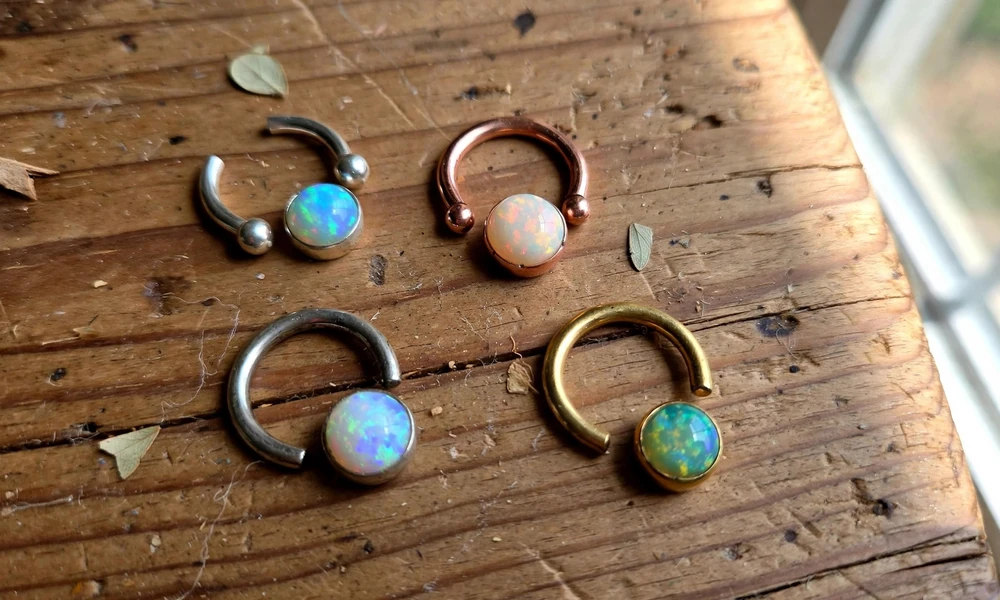
Look next at the metal and the measurements. Implant-grade titanium and 14k gold are the safest choices for a healed septum, and solid sterling silver is a good budget option if your skin tolerates it. Nickel-heavy mystery metals are the ones to avoid, especially if your piercing is still settling. Gauge matters too: most septum piercings are 16 gauge, with 14 gauge common for a bolder look, and the diameter, usually 8 to 10 millimetres, decides whether the ring sits snugly or hangs low. Our guide to gold jewellery for everyday wear explains why solid gold holds up better than plated metal for jewellery you never take off.
Finally, look at the opal itself. A good opal shows colour from several angles, not just one, and the colour should look lively in ordinary daylight rather than only under a bright shop light. A stone that looks flat or chalky in a natural-light photo will look flat on your face too. Lab-created opal is a legitimate, cheaper alternative to natural opal, and for a septum ring it has a real advantage: it is more consistent in colour and slightly tougher than some natural opals, which makes it a sensible choice if this is your first opal ring.
The 9 best opal septum rings of 2027
The Classic White Opal Clicker
What we like: A white opal in a smooth gold bezel on a hinged clicker, easy to open and close, with soft green and blue flashes that work with any outfit. What to consider: The opal is small, so the colour play is subtle rather than dramatic. Best for: Everyday wear and first-time opal buyers. Material: 14k gold with natural white opal. Price range: 60 to 110 pounds. Standout feature: The hinged clicker closes with a clean, secure snap.
The Ethiopian Opal Clicker
What we like: A bright Ethiopian opal with vivid flashes of green, orange and pink, set in a slim gold bezel that lets the stone take centre stage. What to consider: Ethiopian opal is more porous than Australian opal, so it needs to be kept dry and away from oils and perfumes. Best for: Colour lovers who want the brightest opal available. Material: 14k gold with Ethiopian opal. Price range: 70 to 130 pounds. Standout feature: The opal flashes a different colour with every small movement.
The Black Opal Horseshoe
What we like: A dark-bodied black opal with deep red and teal flashes, set at the centre of a slim horseshoe in blackened titanium. What to consider: Black opal is the most expensive opal type, and the dark stone can look almost plain in very dim light. Best for: Evening wear and bold, dramatic styling. Material: Implant-grade titanium with black opal. Price range: 120 to 220 pounds. Standout feature: The dark body makes the colour flashes look deeper and richer.
The Pink Opal Septum Ring
What we like: A soft pink opal with a gentle, milky glow, set in rose gold for a warm, romantic look that suits fair and medium skin tones. What to consider: Pink opal has little play of colour, so it reads as a pretty pink stone rather than a flashing opal. Best for: Soft, feminine styling and rose gold lovers. Material: 14k rose gold with pink opal. Price range: 55 to 100 pounds. Standout feature: The rose gold and pink stone tone together beautifully.
The Fire Opal Clicker
What we like: A transparent orange fire opal that glows like amber in sunlight, set in yellow gold with a low-profile bezel. What to consider: Fire opal has almost no play of colour, so buyers expecting rainbow flashes may be disappointed. Best for: Warm skin tones and autumn styling. Material: 14k gold with Mexican fire opal. Price range: 65 to 120 pounds. Standout feature: The warm orange glow is unlike any other stone on this list.
The Lab-Created Opal Septum Ring
What we like: A lab-created white opal with consistent, vivid colour, set in implant-grade titanium at a fraction of the price of natural opal. What to consider: It is not a natural stone, which matters to some buyers, and the colour can look slightly more uniform than natural opal. Best for: Budget buyers and anyone who wants a tough, low-maintenance opal. Material: Implant-grade titanium with lab-created opal. Price range: 25 to 55 pounds. Standout feature: The best value on this list, with reliable colour in every piece.
The Opal and Diamond Accent Clicker
What we like: A white opal flanked by two tiny diamonds, adding sparkle without overwhelming the opal, in a polished 14k gold clicker. What to consider: The diamonds add cost, and the extra stones mean more places for dirt to collect, so it needs regular gentle cleaning. Best for: Special occasions and fine jewellery lovers. Material: 14k gold with white opal and small diamonds. Price range: 150 to 280 pounds. Standout feature: The diamonds frame the opal and make its colours look brighter by contrast.
The Bezel-Set Opal Seamless Ring
What we like: A small white opal set into a seamless ring with no visible hinge, giving the cleanest, most minimal look of any ring here. What to consider: Seamless rings are harder to open and close than clickers, so changing it takes patience and clean hands. Best for: Minimalists who want the stone to speak quietly. Material: 14k gold with white opal. Price range: 50 to 95 pounds. Standout feature: No hinge, no clasp, just a smooth circle with a single opal.
The Tiny Opal Septum Ring
What we like: A small three-millimetre opal in a slim silver bezel, subtle enough for a first septum ring and easy to wear with other facial jewellery. What to consider: The stone is tiny, so the colour play is faint, and it can be hard to find in a larger diameter. Best for: First piercings, subtle styling, and layering with other jewellery. Material: Solid sterling silver with white opal. Price range: 20 to 45 pounds. Standout feature: The smallest, most discreet opal on this list.
Which opal septum ring is right for you
Start with your piercing. If your septum is fully healed and you change jewellery often, a hinged clicker is the most practical choice, because it opens and closes cleanly without tools. If you rarely change your ring, a seamless ring or a horseshoe gives a cleaner look and fewer moving parts. Check your gauge and diameter before ordering: most septums are 16 gauge, and an 8 millimetre diameter sits snugly while a 10 millimetre diameter hangs a little lower.
Then think about your skin tone and your wardrobe. White opal and Ethiopian opal suit almost everyone, which is why they lead this list. Black opal suits deeper skin tones and dramatic styling, and it looks especially good against dark hair. Fire opal and pink opal suit warm and fair skin respectively, and rose gold flatters both. Our roundup of the best septum rings for women is a useful next read, because it covers the plain metal styles that pair well with an opal ring when you want to rotate your look.
Finally, be honest about how you will treat it. If you are active, swim often, or tend to knock your jewellery, choose a bezel-set lab-created opal in titanium, which is the toughest combination here. If you are careful with jewellery and want the most beautiful stone, a natural Australian or Ethiopian opal in a gold bezel is worth the extra cost and the extra care.
The caveats that matter
Opal is a beautiful stone, but it is not a hard stone, and the caveats matter more here than with most septum jewellery. The most common mistake is treating an opal ring like a plain metal ring: wearing it in the shower with harsh soaps, dropping it on a hard floor, or cleaning it with an ultrasonic cleaner. Any of those can crack or dull the stone, and a cracked opal cannot be repaired.
| Detail | What is known |
|---|---|
| Hardness of opal | Around 5.5 to 6.5 on the Mohs scale, much softer than diamond or sapphire |
| Best setting for opal | A bezel setting, which wraps metal around the stone and protects its edges |
| Safest metals | 14k gold and implant-grade titanium; solid sterling silver is a good budget option |
| Common gauge | 16 gauge for most septum piercings, 14 gauge for a bolder look |
| Common diameter | 8 to 10 millimetres, with 8 sitting snugly and 10 hanging slightly lower |
| Cleaning | Lukewarm water and mild soap only, with a soft cloth; never an ultrasonic cleaner |
| What to avoid | Harsh chemicals, perfumes, oils, long soaks, and hard knocks or drops |
| What it does not do | It does not stay bright if neglected, and a cracked opal cannot be repaired |
If your septum piercing is still healing, wait before switching to an opal ring. A fresh piercing needs a simple, implant-grade piece while it heals, and the extra weight and movement of a stone-set ring can slow that process. Once healed, opal is fine for daily wear, but give it the same respect you would give any delicate piece of jewellery.
Checklist: buying an opal septum ring honestly
Use these checks before you buy, and again when the ring arrives.
- Check your gauge and diameter: confirm whether your piercing is 16 or 14 gauge, and whether 8 or 10 millimetres suits you.
- Check the setting: choose a bezel setting over tall prongs, and look for a smooth, snug fit around the stone.
- Check the metal: pick 14k gold, implant-grade titanium or solid sterling silver, and avoid mystery alloys.
- Check the opal in daylight: look for colour from several angles, not just under a bright shop light.
- Check the closure: test the clicker or hinge before first wear, and make sure it snaps shut cleanly.
- Check the care routine: plan on lukewarm water and mild soap only, and keep it away from perfumes and harsh chemicals.
Frequently asked questions
Can I wear an opal septum ring every day?
Yes, once your piercing is fully healed. Choose a bezel setting and a sturdy metal, and take the ring out before swimming in chlorinated water or using harsh hair products near your face. With gentle care, an opal ring can be an everyday piece.
Is opal too soft for a septum ring?
It is softer than diamond or sapphire, but it is not too soft to wear. The key is the setting: a bezel protects the edges, which are the most vulnerable part of the stone. Lab-created opal is also a tougher, more consistent option if you worry about durability.
What gauge should I choose for a septum ring?
Most septum piercings are 16 gauge, and that is the safest default if you are unsure. Some people stretch to 14 gauge for a bolder look. Measure your current jewellery or ask your piercer before ordering, because the wrong gauge will not sit properly.
How do I clean an opal septum ring?
Use lukewarm water and a drop of mild soap, then rinse and pat dry with a soft cloth. Never use an ultrasonic cleaner, steam cleaner or abrasive polish, and keep the ring away from perfumes, hairspray and strong household cleaners. Our guide to the best opal nose rings covers the same gentle cleaning routine for opal worn elsewhere on the nose.
Does opal lose its colour over time?
It can fade or crack if it dries out, which is why opal should not be stored in very dry places or left in strong heat. Wearing it regularly helps, because moisture in the air and on your skin keeps the stone hydrated, and a gentle clean often restores a dull opal.
Is lab-created opal a good choice for a septum ring?
Yes. Lab-created opal has the same structure and appearance as natural opal, with more consistent colour and often slightly better toughness. It costs much less, which makes it a sensible first opal ring.
The bottom line
The best opal septum ring in 2027 is not the biggest or the most expensive. It is the one with a protective bezel setting, a safe metal, and an opal that shows colour in ordinary daylight. For most people, that means a white or Ethiopian opal clicker in 14k gold, or lab-created opal in titanium if budget matters.
Choose one ring, check your gauge and diameter before ordering, and treat the stone gently once it arrives. Opal rewards a little care with colour that no other stone can match, and a well-chosen septum ring will look just as good in a year as it does on the day it arrives.