A turquoise nose screw is a small piece of jewellery that does a lot of work for its size. The blue-green stone is easy to spot, even at 2 mm across, and the corkscrew post keeps it in place through a full day of moving, changing clothes and sleeping. It is a practical shape for a stone that deserves to be seen, because the screw holds the stone flat against the nostril while the curved tail stays hidden inside.
Turquoise has a colour that no other common stone quite matches. It ranges from a soft sky blue to a deeper green-blue, often with fine brown or black veining called matrix running through it. That colour suits warm weather and casual outfits especially well, and it pairs naturally with silver, gold and bohemian styling. It is also one of the most affordable stones for nose jewellery, which makes it an easy first step into coloured stones.
Below are nine turquoise nose screws worth considering in 2027, from a classic silver setting to a tiny everyday screw and a bohemian piece with matrix veining. Each one is described by what it does well, what to watch for, and who it suits best, so you can choose with your piercing and your budget in mind.
Key takeaways
- Turquoise nose screws combine a bright blue-green stone with a corkscrew post that holds securely through the day.
- Silver is the classic setting for turquoise, while gold gives it a warmer, dressier look.
- Small stones of 1.5 to 2.5 mm suit everyday wear, while larger stones are better kept for occasions.
- Check the gauge, usually 20 or 18, and whether the stone is natural, stabilised or imitation before you buy.
- Turquoise is a soft stone, so it scratches and fades more easily than garnet or sapphire, and it should be kept away from perfume, lotions and harsh cleaning.
What turquoise nose screws actually are
A nose screw is a piece of nose jewellery with a curved, corkscrew-shaped post. The stone sits on the outside of the nostril, and the curved tail sits inside, which stops the piece from sliding out during the day. It is different from a flat-back stud, which uses a straight post and a disc, and from a nose ring, which is a hoop that passes through the piercing. The screw shape is discreet, comfortable once it is in, and well suited to a healed piercing.
Turquoise is a blue-green mineral that has been used in jewellery for thousands of years. Its colour comes from copper, and the finest stones are a clear, even sky blue. Many turquoise stones show matrix, the dark veining of the host rock, which some wearers love for its character and others prefer to avoid. Most turquoise used in jewellery is stabilised, meaning it has been treated with a resin to make it harder and less likely to change colour, and a seller should say so plainly.
Most turquoise nose screws are sold in 20 gauge, which is about 0.8 mm thick, or 18 gauge, about 1 mm thick. The thinner gauge suits a newer or smaller piercing, while the thicker gauge feels more secure for many wearers. The stone is usually 1.5 to 3 mm across. A smaller stone looks neat and understated, while a larger one makes the blue-green colour the point of the piece.
How we chose these turquoise nose screws and what to look for
Look first at the stone. A good turquoise should be a clear, even blue or green-blue without a chalky or grey cast, and the surface should look smooth and slightly waxy rather than dull. Matrix veining is a matter of taste, not quality, but a stone with very heavy veining can look muddy at a small size. Be wary of a stone that is an unnaturally bright, uniform blue, which can be a sign of dyed howlite or plastic rather than real turquoise.
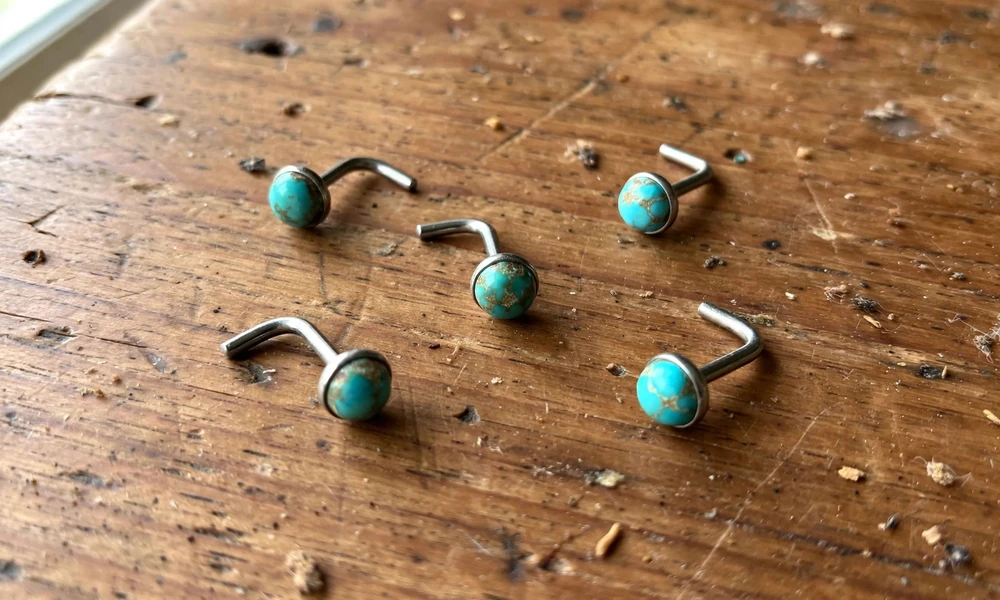
Look next at the metal and the gauge. Sterling silver is the classic partner for turquoise, and it keeps the price down, while gold gives the stone a warmer, more formal feel. Solid gold and implant-grade titanium are the safest choices for sensitive skin. Check that the gauge matches your piercing, because a post that is too thick will not go in, and one that is too thin will move around and irritate the skin. Everyday gold jewellery, like the pieces in our guide to gold jewellery for everyday wear, follows the same rule: the metal matters as much as the stone.
Finally, look at the finish of the screw itself. The tail should be smooth, with no sharp edge or rough join, because a rough tail can scratch the inside of the piercing. A screw that is too tightly curled is hard to insert, while one that is too loose will not hold. If you are new to nose screws, ask the seller for the post length as well as the gauge, since a short post can press against the inside of the nostril.
The 9 best turquoise nose screws of 2027
The Classic Silver Turquoise Screw
What we like: A 2 mm sky-blue turquoise in a simple sterling silver setting, with a smooth corkscrew tail that is easy to insert and comfortable all day. What to consider: Silver tarnishes and needs occasional polishing, and it is not the best choice for very sensitive skin. Best for: Everyday wear and first-time turquoise buyers. Material: Sterling silver. Price range: Affordable. Standout feature: The classic silver and sky-blue pairing.
The Gold Turquoise Screw
What we like: A 2 mm turquoise in 14k gold, where the warm metal softens the cool blue stone and gives the piece a dressier, more polished feel. What to consider: The gold setting costs more than silver, and the contrast is subtler, so the stone reads as quieter. Best for: Evenings and warmer skin tones. Material: 14k gold. Price range: Mid-range. Standout feature: The warm gold against the cool stone.
The Tiny Turquoise Screw
What we like: A 1.5 mm turquoise on a fine 20 gauge post, so discreet that it reads as a small blue sparkle rather than a piece of jewellery. What to consider: The stone is easy to lose sight of if it loosens, and the fine post needs careful handling when you insert it. Best for: Work, minimal styling, and smaller piercings. Material: Implant-grade titanium. Price range: Affordable. Standout feature: How little of it there is.
The Bohemian Turquoise Screw
What we like: A 2.5 mm turquoise with natural matrix veining, set in a slightly textured silver setting that suits layered, bohemian styling. What to consider: The veining makes every stone different, so the piece you receive will not match a photo exactly, and the textured setting is harder to clean. Best for: Festivals, holidays and relaxed styling. Material: Sterling silver. Price range: Affordable to mid-range. Standout feature: The natural matrix veining.
The Turquoise Bezel Screw
What we like: A 2.5 mm turquoise held in a full bezel setting, which protects the edges of the soft stone and gives the piece a smooth, modern outline. What to consider: The bezel hides the sides of the stone, so slightly less light reaches it, and the setting looks best on a straight, well-healed piercing. Best for: Active lifestyles and anyone who wants a secure setting. Material: 14k gold. Price range: Mid-range. Standout feature: The protective bezel setting.
The Turquoise and Gold Accent Screw
What we like: A 2 mm turquoise with a small gold bead accent beside it, which warms up the cool stone and makes the piece feel more finished. What to consider: The accent adds a second element to keep clean, and the piece costs more than a plain turquoise screw. Best for: Special occasions and gifts. Material: 14k gold. Price range: Mid-range. Standout feature: The gold bead accent beside the turquoise.
The Oval Turquoise Screw
What we like: An oval-cut turquoise, about 2 by 3 mm, which shows more of the stone than a round cut of the same size and gives the piece a slightly longer, more elegant shape. What to consider: The oval shape needs to sit straight on the nostril, and it can look uneven if the screw turns during the day. Best for: Anyone who wants a larger-looking stone without a larger price. Material: Gold-filled. Price range: Affordable to mid-range. Standout feature: The oval cut that makes the stone look bigger.
The Green-Blue Turquoise Screw
What we like: A 2 mm turquoise chosen for a deeper green-blue tone, which looks richer than a pale sky blue and suits olive and deeper skin tones well. What to consider: The greener tone can look dark in dim light, and it suits a slightly bolder style than a pale blue stone. Best for: Olive and deeper skin tones, and autumn styling. Material: Sterling silver. Price range: Affordable. Standout feature: The deep green-blue colour.
The Turquoise Screw with Matrix Veining
What we like: A 2.5 mm turquoise with fine, even matrix veining, set low so the stone sits close to the nostril and the veining reads as a natural pattern rather than a flaw. What to consider: No two stones match, so buy from a seller who shows the actual stone, and the veining can make the colour look less even. Best for: Anyone who wants a one-of-a-kind stone. Material: Sterling silver. Price range: Affordable to mid-range. Standout feature: The fine, even matrix pattern.
Which turquoise nose screw is right for you
Start with your piercing, not the stone. If your piercing is fully healed and you know your gauge, choose a screw in that gauge with a post length that matches your nostril thickness. If you are unsure, a 20 gauge screw with a standard post is the safest starting point, and a piercer can check the fit in a few minutes. Our guide to the best nose rings for women covers the wider range of nose jewellery, including how a screw compares with a stud and a ring, if you are still deciding on the shape.
Then think about how you will wear it. A tiny 1.5 mm screw in titanium is the easiest daily choice, especially if you work in a setting where jewellery should stay discreet. A 2 to 2.5 mm stone in silver suits most days and most outfits, while a gold-accent or bohemian screw is better saved for holidays, festivals and occasions, when you want the piece to be noticed.
Finally, match the metal to the rest of your jewellery and to your skin. Silver is the classic partner for turquoise and suits cool skin tones. Gold warms it up and suits warm skin tones. If your skin is sensitive, choose solid gold or implant-grade titanium, and avoid plated metals for a piercing that is still settling.
The caveats that matter
Turquoise is a soft stone, and a nose screw lives in a busy place. It gets knocked when you wash your face, change clothes and sleep on your side, and it is exposed to perfume, lotion and sunscreen every day. That is why the setting matters as much as the stone, and why a bezel or a low setting is often a better choice than a high, exposed one for daily wear.
| Detail | What is known |
|---|---|
| Stone hardness | Turquoise measures 5 to 6 on the Mohs scale, softer than garnet, sapphire or diamond |
| Usual gauge | 20 gauge, about 0.8 mm, or 18 gauge, about 1 mm |
| Common stone size | 1.5 to 3 mm across, with 2 mm the most popular everyday size |
| Best metals for sensitive skin | Solid gold and implant-grade titanium are the safest choices |
| What to avoid | Perfume, lotions and harsh cleaners on the stone, and stones sold without a clear description |
| Cleaning | Warm water and mild soap only, with a soft cloth; never use ultrasonic cleaners or chemicals |
| When to replace it | If the stone loosens, fades, or the setting feels rough inside the piercing |
| What it does not do | It does not suit a fresh piercing, and it will not stay bright if it is soaked in chemicals |
If your piercing is new, healing, or irritated, do not switch to a decorative screw yet. Wait until it is fully healed, keep it clean with saline, and ask your piercer before changing jewellery. A screw that is forced into a piercing that is not ready can set healing back by weeks.
Checklist: buying a turquoise nose screw honestly
Use these checks before you buy, and again after a week of wear.
- Check the stone: a clear, even blue or green-blue, with no chalky or grey cast, and a seller who states whether it is natural or stabilised.
- Check the gauge: 20 or 18, matching your piercing, with a post length that suits your nostril.
- Check the metal: solid gold or implant-grade titanium for sensitive skin, and no plating on a healing piercing.
- Check the tail: smooth, with no sharp edge or rough join that could scratch the piercing.
- Wear it for a week: it should feel comfortable, stay in place, and not catch on clothing or bedding.
- Keep it dry of chemicals: put perfume and lotion on first, then the screw, and clean it with warm water only.
Frequently asked questions
Can I wear a turquoise nose screw every day?
Yes, if your piercing is fully healed. A 1.5 to 2 mm stone in silver or titanium is comfortable for daily wear, as long as you keep it away from perfume and lotions. Larger stones and decorative settings are better kept for shorter wear, because they catch more easily and the stone is more exposed.
How do I insert a nose screw?
Clean your hands and the jewellery first, then guide the curved tail into the piercing and turn it gently until the stone sits flat on the outside of the nostril. Do not force it. If it will not go in easily, the gauge may be wrong, or the piercing may not be ready, so ask a piercer for help.
Is turquoise a good stone for a nose screw?
Yes, for most wearers. It is affordable, its blue-green colour is easy to spot, and it suits casual styling well. It is softer than most stones, so it needs a secure setting and gentle care, but with those it holds up well for everyday wear.
Will a turquoise nose screw suit my skin tone?
Usually yes. Cool skin tones suit turquoise in silver, while warm skin tones suit it in gold. The deeper green-blue stones suit olive and deeper skin tones especially well, while pale sky-blue stones suit fair skin.
How does a turquoise nose screw compare with a turquoise nose ring?
A screw sits flat against the nostril and stays put, while a ring is a hoop that moves more and draws more attention. A screw is the quieter, more practical choice for everyday wear, and a ring suits a bolder look. Our guide to the best turquoise nose rings covers the ring styles in the same detail if you want to compare them side by side.
How do I clean a turquoise nose screw?
Use warm water and a drop of mild soap, rinse well, and dry with a soft cloth. Never use ultrasonic cleaners, steam cleaners or harsh chemicals, which can damage the stone. If the stone looks dull, a gentle clean is usually enough to bring the colour back.
The bottom line
The best turquoise nose screw in 2027 is not the biggest stone or the most expensive setting. It is the one that fits your piercing, suits your skin tone, and stays comfortable from morning to night. For most wearers, that means a 2 mm stone in silver or titanium, with a smooth corkscrew tail and a secure setting. For holidays and occasions, a larger stone or a gold accent adds something special without changing what makes the screw work.
Choose one screw, wear it for a week, and judge it on comfort first. If it stays in place, does not irritate the piercing, and the colour still pleases you after a few days, you have found the right one. That is the honest way to buy nose jewellery, and it is how a small blue-green stone becomes a piece you reach for every day.