Turquoise Toe Rings 2027: 9 Picks Worth Wearing
A turquoise toe ring is summer in a single piece of jewellery. The bright blue-green stone looks like shallow sea water, it pairs with everything from white linen to denim, and it has been worn on the toes for centuries, from Native American silverwork to Mediterranean beach jewellery. In 2027, the best turquoise toe rings mix that bohemian history with clean, modern settings that work far beyond the beach.
The problem is not finding a turquoise toe ring. It is finding one that is actually turquoise, not dyed howlite or plastic, and set well enough to survive a summer of sand, salt water, and bare feet. Turquoise is a soft stone, softer than garnet or sapphire, and a badly set or fake stone will chip, fade, or crack long before the season is over. The difference between a turquoise toe ring you wear every day and one you regret is usually the stone itself.
Below are nine turquoise toe rings worth considering in 2027, from a classic single-stone stud to a matrix turquoise clicker and a titanium option for sensitive skin. Each one is described by what it is good at, what to watch for, and who it suits best, so you can choose with your feet in mind, not just a photograph.
Key takeaways
- Real turquoise is a bright blue-green stone, often with a brown or black matrix veining, and it is softer than most jewellery stones.
- Look for a secure bezel setting, because turquoise chips easily and a prong setting leaves the edges exposed.
- Stabilised turquoise is common and perfectly fine for a toe ring, but dyed howlite and plastic are not the same stone.
- Silver is the classic metal for turquoise, and it suits the stone better than yellow gold for most people.
- No turquoise toe ring is completely hard-wearing, and the stone will fade or crack if it is soaked in chemicals or left in strong sun for long periods.
What turquoise toe rings actually are
A turquoise toe ring is a small ring worn on a toe, usually the second toe, with a turquoise as its main stone. Turquoise is a phosphate mineral, coloured blue-green by copper, and its colour ranges from a pale sky blue to a deep green-blue. Many stones have a matrix, a web of brown or black veining running through the blue, which is part of the stone’s natural character and is often the sign of a genuine piece. Turquoise has been used in jewellery for thousands of years, from Egyptian tombs to Native American silverwork, and it remains one of the most recognisable stones in the world.
Toe rings are a natural home for turquoise. The stone is associated with summer, the sea, and holidays, and a turquoise toe ring works with sandals, bare feet, and open-toe shoes in a way that a more formal stone does not. The blue-green colour also pairs well with tanned skin, white linen, and denim, which is why it shows up so often in beach and festival styling.
Turquoise rates around 5 to 6 on the Mohs hardness scale, which makes it one of the softer stones used in jewellery. That means it can scratch and chip if it is knocked against hard surfaces, and it is porous, so it can absorb oils, creams, and chemicals, which can change its colour over time. For normal daily wear in summer, a well-set turquoise toe ring holds up well, but it needs more care than a garnet or a sapphire.
How we chose these turquoise toe rings and what to look for
Look first at the stone. Real turquoise has a slightly waxy lustre, a colour that is never perfectly uniform, and often a matrix veining. A stone that is a flat, even, bright blue with no variation at all is more likely to be dyed howlite or plastic. Stabilised turquoise, which has been treated with resin to make it harder and less porous, is common and perfectly acceptable for a toe ring, and it is much more durable than untreated turquoise. Ask whether the stone is natural, stabilised, or reconstituted, and be wary of any seller who will not say.
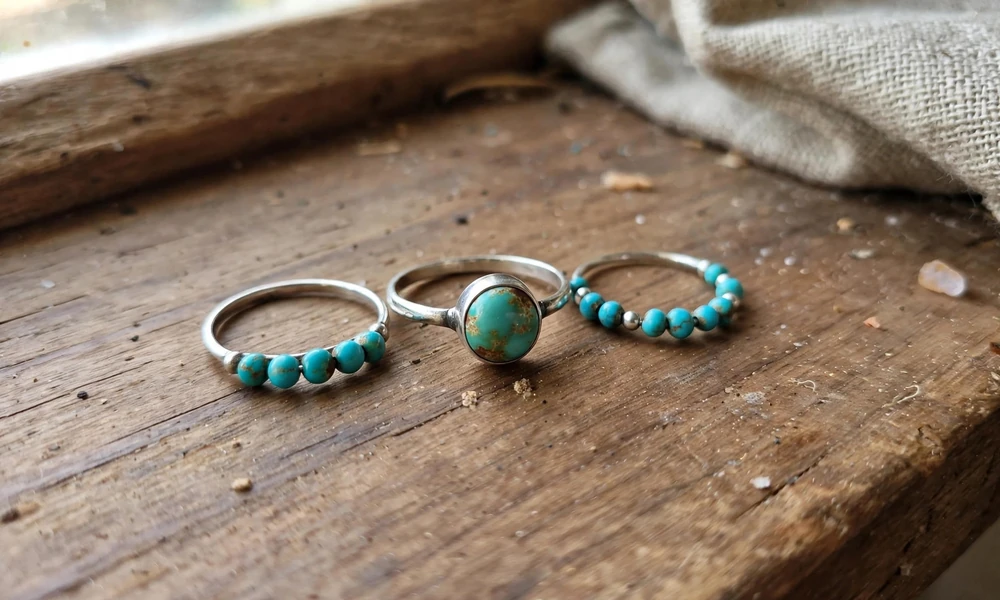
Look next at the setting and the metal. A bezel setting, where the metal wraps around the edge of the stone, is the best choice for turquoise, because it protects the soft edges from knocks and keeps water and sand out of the sides of the stone. Silver is the classic metal for turquoise, and the cool grey of sterling silver suits the blue-green stone better than yellow gold for most people, though gold can work well with a greener turquoise. If your skin reacts to mixed metals, titanium or solid sterling silver is the safest bet. Our guide to gold jewellery for everyday wear explains how to judge metal quality before you buy, which is worth reading even for a silver piece, because the same checks apply.
Finally, look at the fit and the size of the stone. A stone of 4 to 6 millimetres is a good balance for a toe ring, large enough to show the colour and the matrix, small enough not to catch on shoes. An adjustable band is the safest choice if you are between sizes, because toe sizes change with heat, and a band that is too tight will be uncomfortable by the end of the day.
The 9 best turquoise toe rings of 2027
The Classic Turquoise Stud
What we like: A single round turquoise in a simple silver band, clean, classic, and easy to wear every day. What to consider: The stone is soft, so a bezel setting is essential, and it should not be worn for rough activities. Best for: Everyday wear and first-time toe ring buyers. Material: Sterling silver, stabilised turquoise. Price range: £35 to £65. Standout feature: A 5 mm stone with a clear sky-blue colour.
The Turquoise Hoop
What we like: A slim hoop with a small turquoise set at the front, light, comfortable, and modern. What to consider: The hoop is thin, so it is not the best choice for very active days. Best for: Minimalist styling and warm-weather outfits. Material: Sterling silver, turquoise. Price range: £30 to £55. Standout feature: A seamless hoop with a flush-set stone.
The Turquoise Clicker
What we like: A clicker-style band with a turquoise centre stone, secure hinged closure, and a slightly bolder look. What to consider: The clicker mechanism should be checked regularly, and the stone needs a bezel. Best for: People who want a toe ring that stays exactly where they put it. Material: Sterling silver, stabilised turquoise. Price range: £45 to £80. Standout feature: A hinged closure that clicks shut securely.
The Matrix Turquoise Stud
What we like: A turquoise with a strong brown matrix veining, which gives the stone character and proves it is genuine. What to consider: Matrix turquoise is often more expensive, and the veining means no two stones look alike. Best for: People who love the natural, earthy look of turquoise. Material: Sterling silver, natural matrix turquoise. Price range: £60 to £110. Standout feature: A web of brown matrix across a bright blue stone.
The Turquoise and Diamond Accent Stud
What we like: A central turquoise flanked by two small diamonds, which lift the blue-green and add sparkle. What to consider: The most expensive style here, and the diamonds are small enough to need a loupe to appreciate. Best for: Special occasions and gifts. Material: 14k white gold, turquoise, diamond accents. Price range: £120 to £200. Standout feature: Two diamond accents that frame the turquoise.
The Titanium Turquoise Stud
What we like: A lightweight titanium band with a bezel-set turquoise, hypoallergenic and very comfortable. What to consider: Titanium cannot be resized, so the size has to be right from the start. Best for: Sensitive skin and all-day wear. Material: Titanium, stabilised turquoise. Price range: £35 to £60. Standout feature: A feather-light band that never tarnishes.
The Vintage-Style Turquoise Stud
What we like: A milgrain-edged setting with a round turquoise, romantic and a little different from the modern styles. What to consider: The vintage detailing can trap sand and dirt, so it needs a soft brush clean now and then. Best for: Vintage lovers and anyone who wants a toe ring with character. Material: Sterling silver, stabilised turquoise. Price range: £50 to £90. Standout feature: Milgrain edging and a soft, old-style finish.
The Turquoise Seamless Hoop
What we like: A continuous hoop with a turquoise set into the band itself, no hinge, no clasp, nothing to catch. What to consider: It has to be slipped on, so it is not adjustable, and the size must be exact. Best for: People who want a toe ring they can forget about. Material: Sterling silver, turquoise. Price range: £30 to £50. Standout feature: A smooth, continuous band with a flush stone.
The Tiny Turquoise Stud
What we like: A small 3 mm turquoise on a delicate band, subtle, understated, and easy to stack. What to consider: The stone is small, so the colour and matrix are less visible from a distance. Best for: Stacking with other toe rings and very subtle styling. Material: Sterling silver, stabilised turquoise. Price range: £25 to £45. Standout feature: A 3 mm stone that is barely there.
Which turquoise toe ring is right for you
Start with how you will wear it. If the toe ring is for the beach and everyday summer wear, a bezel-set stud in silver or titanium is the most practical choice, because it protects the stone and stays comfortable in water. If it is for evenings and special occasions, the turquoise and diamond accent stud will give you more presence. If you want to stack, the tiny stud and the seamless hoop are the best partners, because they sit flat and do not compete with each other.
Think about your skin next. If you react to mixed metals, choose titanium or solid sterling silver, and avoid plated bands, which can wear through and expose the base metal underneath. If your toes swell in heat, an adjustable band is worth it, because a fixed band that fits in the morning can feel tight by the afternoon. A guide to the best nose rings for women is a useful companion here, because it covers the same questions of stone, metal, and fit in a different piece of jewellery, and the advice transfers directly to toe rings.
Finally, think about the colour of turquoise you actually like. A bright sky blue looks fresh and summery, a deeper green-blue looks richer and more unusual, and a strong matrix gives the stone an earthy, natural character. There is no wrong answer, but it is worth looking at the stone in natural light before you commit, because turquoise can look very different indoors and in sunlight.
The caveats that matter
Turquoise is a soft, porous stone, and it needs more care than most. It can scratch, it can chip if it is knocked hard, and it can absorb oils, creams, and chemicals, which can change its colour over time. Suncream, perfume, and household cleaners should be kept away from the stone, and the ring should not be soaked in water for long periods. A quick rinse after swimming is fine, but a long soak in a hot tub is not. Take the ring off for heavy manual work, and store it in a soft pouch rather than loose in a bag with keys.
| Detail | What is known |
|---|---|
| Stone hardness | Turquoise rates 5 to 6 on the Mohs scale, softer than garnet or sapphire, and it can scratch and chip |
| Best setting | A bezel setting protects the soft edges best; prong settings leave the stone exposed |
| Best metal for sensitive skin | Titanium or solid sterling silver; avoid plated bands if your skin reacts to nickel |
| Stone size | 4 to 6 mm is a good balance for a toe ring; 3 mm is subtle, larger stones catch more easily |
| Water | A quick rinse after swimming is fine; avoid long soaks, hot tubs, and harsh chemicals |
| Colour range | Pale sky blue to deep green-blue, often with a brown or black matrix veining |
| Who should avoid it | Anyone doing heavy manual work while wearing it, and anyone who will not take it off for cleaning products |
| What it does not do | It does not stay scratch-free forever, and it can fade or change colour if it absorbs oils or chemicals |
If you are pregnant, your feet and toes may swell, and a fixed toe ring can become uncomfortable or difficult to remove. An adjustable band is the safer choice during pregnancy, and any ring that feels tight should come off rather than be forced. If a toe becomes red, sore, or swollen around a ring, remove the ring and let the skin settle before wearing it again.
Checklist: buying a turquoise toe ring honestly
Use these checks before you buy, and again after a week of wear.
- Check the stone: a slightly uneven colour and a waxy lustre suggest real turquoise, while a flat, perfect blue suggests dyed howlite or plastic.
- Check the setting: a bezel that wraps around the stone, not prongs alone, and never glue alone.
- Check the metal: solid silver, gold, or titanium, and avoid plated bands if your skin is sensitive.
- Check the fit: it should slide on easily and stay put without pinching, even at the end of a warm day.
- Check the size of the stone: 4 to 6 mm is a good balance, and larger stones catch on shoes and socks.
- Check the return policy: a toe ring that does not fit or irritates your skin should be returnable.
Frequently asked questions
Can I wear a turquoise toe ring every day?
Yes, a well-set turquoise toe ring is fine for daily wear in summer. Choose a bezel setting, take it off for heavy manual work and cleaning, and clean it with a soft, dry cloth rather than soapy water, which the stone can absorb.
How can I tell if turquoise is real?
Real turquoise has a slightly waxy lustre, a colour that is never perfectly even, and often a matrix veining. A stone that is a flat, uniform, bright blue with a glassy shine is more likely to be dyed howlite or plastic, so ask the seller whether the stone is natural, stabilised, or reconstituted.
Can I wear a turquoise toe ring in the sea or a swimming pool?
A quick swim is fine for a well-set ring, but rinse it in fresh water afterwards and dry it properly. Avoid long soaks, hot tubs, and chlorinated water for extended periods, because turquoise is porous and can absorb chemicals.
What size turquoise toe ring should I buy?
Measure your second toe at the end of the day, when it is at its largest, and if you are between sizes, choose an adjustable band. A toe ring should feel snug but not tight, and you should be able to slide it off without forcing it.
Does turquoise fade in sunlight?
Turquoise can fade or change colour if it is left in strong sun for very long periods, or if it absorbs oils and chemicals. Normal summer wear is fine, but do not leave the ring on a sunny windowsill or in a hot car.
Is a turquoise toe ring a good gift?
Yes, especially for a December birthday, because turquoise is the December birthstone. An adjustable band makes a safer gift than a fixed size, and a simple stud suits almost everyone. Our guide to turquoise nose rings covers the same stone in a different piece, if you are building a matching set.
The bottom line
The best turquoise toe ring in 2027 is not the most expensive or the flashiest. It is the one with a real stone, a secure bezel setting, a metal that suits your skin, and a fit that stays comfortable all day. A classic bezel-set stud in silver is the safest first choice, a titanium stud is the best option for sensitive skin, and the matrix turquoise stud is the one to choose when you want something genuinely one of a kind.
Choose one ring, wear it for a week before deciding whether the size and style are right, and look after it with a soft, dry cloth and a little care around chemicals. That is the honest way to get the bright blue-green colour turquoise is known for, without the chipped stone or faded colour that makes people give up on toe rings altogether.