What makes one bouquet look effortless and another look like a grocery-store afterthought? The answer is rarely the budget. It is almost always the structure, the condition of the stems, and a handful of decisions made before the flowers ever reach the vase.
A bouquet is a small piece of design engineering disguised as romance. Behind every good one sits a form, a color plan, a mechanics method, and a care routine. Get those four things right and even supermarket carnations can look expensive. Get them wrong and a 60-dollar armload of peonies will collapse by Thursday. This guide walks through how bouquets are actually built, what flowers have meant across cultures, how to keep them alive, and where the modern cut-flower trade runs into trouble.
What Actually Defines a Bouquet
The word gets used loosely, but florists treat a bouquet as a specific object: a group of cut stems arranged to be held or displayed as a single unit. That distinguishes it from a vase arrangement anchored in foam, a corsage, or a single stem in a bud vase.
Three structural families cover most of what people buy and make:
| Form | Shape | Typical use |
|---|---|---|
| Round or dome | Even, ball-like profile | Gifts, centerpieces, bridesmaid bouquets |
| Hand-tied spiral | Stems crossed in one direction, fanning at the top | Market bunches, bridal bouquets, casual gifts |
| Cascade or linear | Flowing or tall, asymmetric line | Formal weddings, statement pieces |
The spiral hand-tie is the workhorse technique. Stems are added one at a time, each rotated slightly in the same direction, so the bunch stays balanced and the stems form a neat spiral at the binding point. It looks simple. It is not, which is why the first attempt usually ends up as a lopsided bunch that refuses to stand up in a vase.
A second distinction matters for buyers: bouquet versus arrangement. A bouquet is designed to be held or dropped into a vase with its stems intact. An arrangement is built in place, often in floral foam, and cannot be lifted out and held. If someone plans to carry the flowers, ask for a bouquet. If the flowers need to survive a three-hour reception on a table, an arrangement is often the sturdier choice.
Why Flower Choices Signal Meaning, Even When the Meanings Conflict
Long before anyone texted a heart emoji, flowers carried messages. Floriography, the language of flowers, peaked in the 19th century. Charlotte de Latour’s Le Langage des Fleurs, published in French in 1819, helped codify a system that Victorian readers then devoured through popular flower dictionaries.
Here is the catch that most modern guides skip: the meanings were never standardized. A red rose meant passionate love in one book and something quite different in another. Meanings shifted between countries, between publishers, and between decades. A gift that read as devotion in London could read as a polite brush-off in another tradition. Anyone who claims a single authoritative meaning for every bloom is overselling.
What survived is a looser, more practical vocabulary that most people still recognize:
- Roses for love, with color doing the fine-tuning
- Lilies for purity and grief, which is why they appear at both weddings and funerals
- Chrysanthemums for remembrance in much of Europe, and for longevity in parts of East Asia
- Sunflowers for warmth and loyalty
- Rosemary for memory
The older tradition behind the modern bouquet is the tussie-mussie, also called a nosegay: a small, tight posy of herbs and flowers. These were documented in medieval and Renaissance Europe, and the Victorian era gave them the twee name. The popular story that they were carried to ward off plague is repeated constantly and poorly sourced, so it is best treated as legend rather than fact. What is certain is that fragrant herbs had practical value in an era of strong smells.
Wedding bouquets as we know them are usually traced to Victorian England, with roots in older customs of carrying fragrant plants. The white bridal bouquet is a much later styling convention, not an ancient rule.
The Practical Rules of Building a Bouquet That Looks Designed
Good bouquets follow a few rules that are easy to learn and hard to fake.
Start with odd numbers. Three, five, seven, or nine focal flowers read as natural. Even numbers tend to look arranged, and not in a good way.
Work in three layers. Focal flowers carry the eye. Secondary flowers bridge between them. Filler and foliage give volume and texture. A bouquet of only focals looks stiff; a bouquet of only filler looks like weeds.
Pick a color plan before you pick flowers. Monochrome, analogous (neighbors on the color wheel), or complementary (opposites). A tight palette with varied textures almost always beats a rainbow of the same flower.
Vary the shapes. Round blooms, spiky accents, and trailing elements together create rhythm. All-round blooms create a dome that photographs flat.
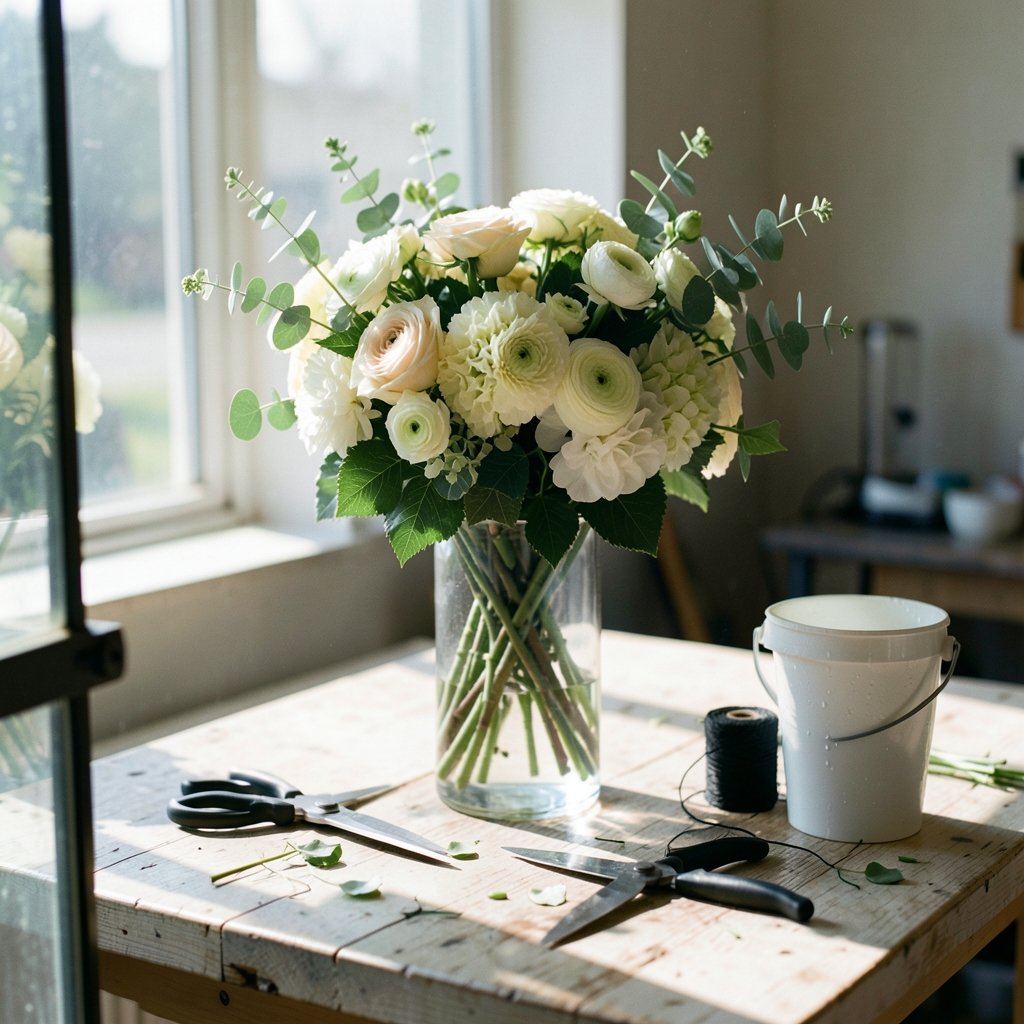
Cut and condition as you go. Strip every leaf that would sit below the waterline, recut each stem at an angle, and get stems into water within minutes.
Common mistakes recur. People buy too many of one flower. They leave leaves submerged, which rots and clouds the water. They cram stems into a narrow vase so tightly that the stems bruise. They arrange in a hot room and wonder why everything droops. And they skip the most effective step: a clean vase, scrubbed rather than merely rinsed.
For anyone building a home or rental portfolio and thinking about curb appeal, the same logic applies as with rental property cash flow: small, consistent investments in presentation compound. A fresh, well-conditioned bouquet in a staged entryway costs little and reads as care.
How to Keep Cut Flowers Alive Longer
Cut flowers die for predictable reasons. Stems senesce partly because of ethylene gas, partly because bacteria block the xylem (the water-conducting tissue), and partly because of simple water loss. Every care tip below attacks one of those three problems.
- Recut stems at an angle with a sharp knife or snips. An angled cut exposes more surface and keeps the stem from sitting flat on the vase bottom. A blunt cut crushes tissue.
- Use a clean vase. Scrub it with hot soapy water. Bacteria are the number one cause of short vase life.
- Remove all submerged foliage. Leaves underwater decay fast.
- Change the water every two days and recut stems each time.
- Keep flowers cool and out of direct sun, away from radiators, fruit bowls, and ripening produce, all of which raise ethylene exposure.
- Use flower food properly. Commercial food typically contains a sugar for energy, an acidifier to lower pH, and a biocide to slow bacterial growth. Mix it at the stated ratio, not stronger.
A homemade pinch of sugar and a drop of bleach is a common substitute, but the ratio is easy to get wrong, and too much bleach damages stems. Commercial food is cheap and calibrated.
Some flowers need extra handling. Poppies and poinsettias bleed a milky sap that seals the stem, so they are usually seared or dipped in boiling water briefly. Daffodils release sap that harms other flowers, so they should be conditioned in their own water for several hours before joining a mixed bunch. Woody stems like lilac and hydrangea benefit from a vertical slit at the base to improve uptake.
Safety: What to Know Before Giving Certain Flowers
Not every beautiful flower belongs in a home with small children or pets. Lily of the valley, oleander, and foxglove are toxic if ingested. Lilies in particular are dangerous to cats, and even pollen or vase water can cause serious harm. Public-health and veterinary poison-control resources maintain plant lists worth checking before a gift goes out.
Practical safeguards are simple. Keep bouquets out of reach of toddlers and chewers. Do not leave vase water where pets can drink it. Warn recipients when a bouquet contains a known irritant or allergen, and remember that heavily scented flowers like lilies and freesia can trigger reactions in sensitive people.
The Cut-Flower Trade and Its Sustainability Problem
Most cut flowers travel a long way. The Netherlands dominates global auction and distribution, while Kenya, Colombia, and Ecuador are major producers. Exact market shares shift every year, so current trade data is the only reliable source.
That global supply chain raises real concerns: air-freighted imports, water use in producing regions, plastic sleeves and wrap, and floral foam, which is a microplastic and has been restricted or phased out by some retailers and jurisdictions. The direction of travel is clear, but the details vary by country and change often enough that buyers should check current rules rather than rely on a blog post.
For consumers, the practical levers are straightforward. Buy in season and locally where possible. Choose bouquets without foam. Reuse or refuse plastic wrap. Compost spent flowers. None of these is a complete solution, but each is a real reduction.
There is also a design argument for buying what is in season: seasonal stems are cheaper, fresher, and conditioned for the local climate. A bunch of locally grown dahlias in August will outlast and outshine imported roses every time.
Bouquets for Different Occasions and Hair, Oddly Enough
Occasion shapes the brief more than most people realize.
For a wedding, the bouquet must survive being held, photographed, and hugged. Sturdy focals, well-conditioned stems, and a hidden water source matter more than trend. For a birthday, color and scent carry the message. For sympathy, white and green with lilies or chrysanthemums is conventional in many traditions, and a card matters as much as the flowers. For a hospital visit, choose low-scent, low-allergen blooms and skip the lilies.
The same structural thinking applies well beyond the vase. Ask anyone who has built a wedding look around 4c hair: volume, shape, and balance are design problems, and the principles of proportion and texture transfer directly. A bouquet and a hairstyle both live or die on silhouette.
Gifting etiquette is worth a note too. Send flowers to a workplace and choose something with a low scent and no loose pollen. Send to a home and consider the recipient’s pets first. The most thoughtful bouquet is the one that fits the room it lands in. (The row)
Conclusion
A bouquet is not a random bunch of pretty stems. It is a structure, a color decision, a conditioning routine, and a set of cultural signals, all working at once. The spiral hand-tie, the three-layer build, the clean vase, and the angled recut are not secrets. They are just steps most people skip.
The next time flowers arrive, treat them like what they are: a perishable design object with a short window. Recut, clean, cool, and change the water. Do that, and a modest bunch will outperform an expensive one that gets dropped in tap water and forgotten. And if the meanings behind the flowers are murky and contradictory, that is fine. The gesture still lands.
What is the difference between a bouquet and an arrangement?
A bouquet is a group of cut stems designed to be held or placed in a vase with stems intact, often built with a spiral hand-tie. An arrangement is constructed in place, frequently in floral foam, and usually cannot be lifted out and carried. For anything that needs to travel, ask for a bouquet.
Do flower meanings actually have a standard?
No. Floriography, the language of flowers, became popular in the 19th century through works like Charlotte de Latour’s Le Langage des Fleurs (1819), but meanings varied between books, publishers, and countries. A single bloom could carry different messages depending on the source. Modern meanings are a loose shared vocabulary, not a fixed code.
How often should I change the water in a bouquet?
Every two days is the practical standard, with a fresh angled recut each time. Change it daily in hot weather or if the water turns cloudy. Clean water and clean stems are the two biggest factors in vase life, because bacteria blocking the xylem is a leading cause of early collapse.
Which common bouquet flowers are dangerous to pets?
Lilies are notably dangerous to cats, and even pollen or vase water can cause serious harm. Lily of the valley, oleander, and foxglove are toxic if ingested. Veterinary poison-control plant lists are the right reference before gifting flowers to a household with pets or small children.
Is floral foam bad for the environment?
Floral foam is a microplastic, which is why some retailers and jurisdictions have restricted or phased it out. The specifics vary by place and change over time, so check current local rules. For home arranging, a spiral hand-tie or a chicken-wire support in the vase avoids foam entirely.
Can I make cut flowers last longer without commercial flower food?
Yes, but results vary. A clean vase, an angled recut, cool placement away from fruit and radiators, and daily water changes do most of the work. Homemade sugar-and-bleach mixes can help, but the ratio is easy to get wrong and excess bleach damages stems. Commercial food is calibrated and inexpensive.