



Ever flipped over a cereal box and wondered what those black-and-white stripes and twelve little numbers are really doing there? That strip on the bottom of the carton is a box UPC code, and it is the reason a cashier can ring up a product in a fraction of a second. It is also one of the most misunderstood pieces of packaging in retail.
This guide explains what a box UPC code is, how the digits break down, why it differs from the code on a shipping case, and the mistakes that trip up small brands when they print their first one.
What Is a Box UPC Code?
A UPC (Universal Product Code) is a 12-digit barcode used mainly for retail point-of-sale in North America. The standard is maintained by GS1 US, formerly the Uniform Code Council. The 12-digit UPC-A format was standardized in the early 1970s, and the first UPC-marked product was scanned at a Marsh supermarket in Troy, Ohio, on June 26, 1974.
“Box UPC code” is not an official standards term. It is retail shorthand for the UPC printed on a product’s own retail carton or box, as opposed to the code on an outer shipping case, an inner pack, or a pallet label. No standards body defines “box UPC” as a separate code type. It is simply the consumer-facing barcode on the unit a shopper picks off the shelf.
That distinction sounds small, but it matters enormously. A box UPC identifies one sellable unit. A case code identifies a carton of those units. Mix them up, and a retailer’s inventory system will count your product wrong from day one.
How the 12 Digits Break Down
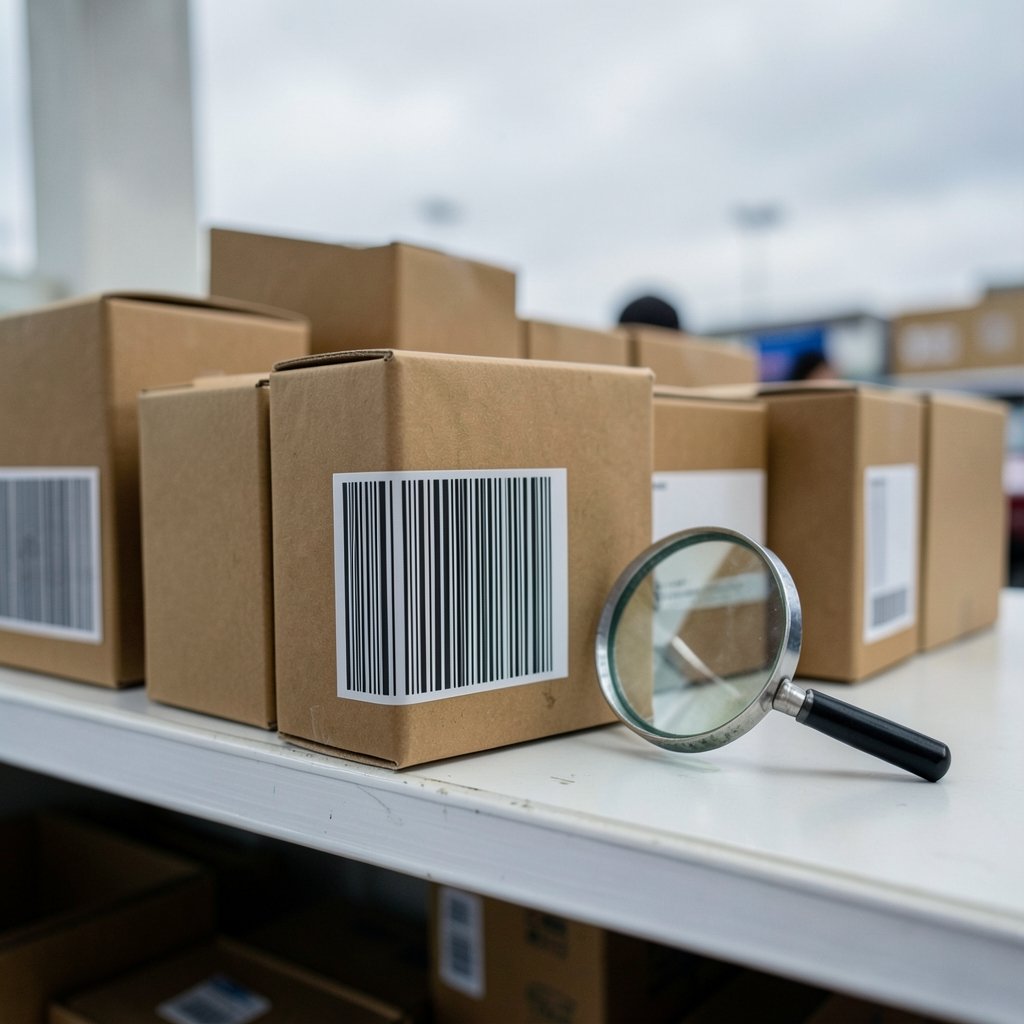
A UPC-A symbol encodes exactly 12 digits, and every one has a job. From left to right:
| Position | Digits | What It Means |
|---|---|---|
| 1 | 1 digit | Number system character |
| 2-6 | 5 digits | Manufacturer (company) prefix |
| 7-11 | 5 digits | Item number |
| 12 | 1 digit | Check digit |
The number system character is the leading digit, and it signals how the code is used. Digits 0, 1, 6, 7, and 8 are for regular retail products. A 2 marks variable-weight items like meat or produce. A 3 covers drugs and health items. A 4 is reserved for in-store use, such as loyalty or internal codes. A 5 is for coupons.
The company prefix is licensed, not free. A brand obtains a GS1 Company Prefix from GS1 US through a membership arrangement, then assigns item numbers to its own products. That is why the middle digits on a box UPC tend to stay the same across every product a single company makes.
The check digit is the last number, and it is not random. It is calculated from the other eleven digits so a scanner can instantly tell whether a barcode was read correctly.
The Check Digit: The Box UPC Code’s Built-In Proofreader
Here is the math in plain terms. Take the eleven digits before the check digit. Multiply the digits in odd positions by 3, add the digits in even positions, then find the amount needed to reach the next multiple of 10. That amount is the check digit.
Walk through a simple example. Suppose the first eleven digits are 0 3 6 0 0 0 2 9 1 4 5. Multiply the odd-position digits (0, 6, 0, 2, 1, 5) by 3 to get 0 + 18 + 0 + 6 + 3 + 15 = 42. Add the even-position digits (3, 0, 0, 9, 4) for 16. The total is 58. The next multiple of 10 is 60, so the check digit is 2.
Why care? Because a barcode printed with a wrong check digit will fail at the register. A scanner reads the bars, runs the math, and rejects the symbol. The cashier types the number by hand, the line stalls, and the shopper notices. Getting this right before you print thousands of boxes is far cheaper than fixing it after.
Box UPC vs. Case Code vs. Pallet Code
This is where many new brands get into trouble. The barcode on the box is only one layer of a whole family of codes, and each layer has a different job.
| Code | Typical Digits | Where It Goes | Who Scans It |
|---|---|---|---|
| UPC-A | 12 | Retail box or unit | Cashier, self-checkout |
| EAN-13 | 13 | Retail unit outside North America | Retail POS |
| ITF-14 | 14 | Shipping case | Warehouse, distribution center |
| SSCC | 18 | Pallet or logistics unit | Freight, receiving dock |
Retail boxes usually carry a GTIN-12, which is the formal name for a UPC-A. Shipping cases often carry a GTIN-14 in the ITF-14 format, and pallets carry an SSCC (Serial Shipping Container Code). These are defined separately in GS1 standards, and they are not interchangeable.
A practical tip from the packaging floor: print the case code on the outside of the corrugated shipper, never on the retail box, and keep the two artwork files completely separate. Designers who reuse a single template for both are the single most common source of mixed-up codes. If a warehouse scanner picks up a retail UPC on a case, the receiving system logs the wrong unit count, and the error can take weeks to trace.
UPC, EAN, and GTIN: How They Fit Together
UPC-A is a 12-digit subset of the broader GTIN (Global Trade Item Number) system. EAN-13 is the 13-digit European counterpart used outside North America. A UPC-A can be represented as a GTIN-13 simply by adding a leading zero.
That leading zero is why a store in the United States and a store in Germany can both read the same product. The underlying number is the same; the barcode symbology differs. If a brand plans to sell internationally, it pays to plan the numbering from the start rather than reprinting packaging later. Hair and beauty brands that sell across markets, for instance, often deal with a tangle of codes on every carton and label, much like the styling distinctions between 4c hair and looser curl patterns: the categories look similar until you need the exact one.
The Scanning Standard Behind the Stripes
UPC-A is read by both laser and imager scanners at retail point-of-sale. The symbology itself is defined in ISO/IEC 15420, the EAN/UPC bar code symbology specification. That standard governs bar widths, quiet zones, and print tolerances, which is why a barcode that looks fine on screen can still fail on a cheap thermal printer.
How to Get a Box UPC Code for Your Product
The process is more straightforward than most first-time sellers expect. Here is the sequence that works in practice.
- Obtain a GS1 Company Prefix through GS1 US membership. Do not buy a resold barcode from a third party; retailers increasingly reject them.
- Assign a unique item number to each product variant. A new size, scent, or color is a new code.
- Calculate and verify the check digit before sending artwork to the printer.
- Size the barcode to the required magnification for your package dimensions, and leave a clear quiet zone on both sides.
- Test-scan the printed proof with the same type of scanner your retailer uses.
- Keep a master spreadsheet mapping every code to its exact product, so nobody assigns the same number twice.
That last step is unglamorous and saves enormous headaches. Brands that grow fast tend to outgrow their numbering discipline, and duplicate codes surface months later when a retailer’s system flags two products as one.
Common Mistakes With Box UPC Codes
A few errors show up again and again, and each one is avoidable.
Buying resold barcodes. Cheap codes from resale sites often carry a prefix the seller does not own. Retailers can and do reject them, and the brand has no recourse.
Printing too small. A barcode squeezed onto a tiny carton panel may look sharp but scan poorly. The standard sets minimum sizes for a reason.
Placing the code on a curved or reflective surface. Glossy foil and tight curves distort the read. Flat, matte, high-contrast areas work best.
Forgetting the quiet zone. The blank margin around the bars is part of the symbol. Artwork that crowds it will fail.
Reusing a code for a reformulated product. If the change matters to the retailer or the shopper, it usually needs a new code.
Skipping the proof scan. A five-second test with a real scanner catches most of the problems above.
There is a broader lesson in packaging design here. Consistency across a product line is what makes a shelf read cleanly, whether the category is hair care or cereal. A brand that gets its the row of products aligned visually, from carton to carton, tends to get its barcodes aligned too, because the same discipline drives both. The same logic applies to finer distinctions in curl typing, where a 2b hair product and a coily-texture product may sit side by side but still need separate, correctly assigned codes.
Who Actually Enforces UPC Rules?
In the United States, UPC use is voluntary and industry-driven rather than federally mandated. GS1 US administers the system and licenses prefixes, but no government agency requires every product to carry a barcode. Retailers enforce the standard in practice: if a product’s code does not scan or does not match the retailer’s item file, it does not get shelf space.
That is the real pressure point. A box UPC code is not a legal requirement so much as a commercial passport. It is the thing that lets a product move from a warehouse to a shelf to a shopper’s basket without a human typing numbers.
Conclusion
A box UPC code is a small rectangle of ink with a surprisingly large job. It identifies one sellable unit, carries a licensed company prefix, proves itself with a check digit, and connects a physical carton to a retailer’s entire inventory system. Get the number right, size the symbol correctly, keep it separate from your case and pallet codes, and the barcode disappears into the background where it belongs. Get it wrong, and it becomes the most expensive square inch on the package.
Frequently Asked Questions
What is the difference between a box UPC code and a case code?
A box UPC code identifies a single retail unit and typically uses a 12-digit GTIN-12 in UPC-A format. A case code identifies an outer shipping carton and usually uses a 14-digit GTIN-14 in ITF-14 format. They serve different scanning points and should never be swapped.
Can I just buy a barcode online instead of joining GS1 US?
Resold barcodes are risky. The seller may not own the prefix, and major retailers can reject codes that do not trace back to the brand. Obtaining a GS1 Company Prefix directly avoids that problem entirely.
Do I need a new UPC for every size and flavor?
Yes, in most cases. Each distinct variant that a retailer stocks and sells as a separate item needs its own unique code. A new scent, size, or color is generally a new product from the scanner’s point of view.
Is a UPC the same as an EAN?
They are closely related but not identical. UPC-A uses 12 digits and is standard in North America, while EAN-13 uses 13 digits and is used elsewhere. A UPC-A can be expressed as a GTIN-13 by adding a leading zero.
Why did my barcode fail to scan at the register?
The most common causes are a wrong check digit, a symbol printed below the minimum size, a missing quiet zone, or placement on a curved or glossy surface. A quick test scan with a retail-grade scanner before mass printing catches nearly all of these.
Is a UPC code legally required in the United States?
No. UPC use in the US is voluntary and industry-driven, with GS1 US administering the system. Retailers enforce it commercially, though, because their point-of-sale and inventory systems depend on scannable codes.









