A cashmere skirt is one of the quietest luxuries a wardrobe can hold. It works softly: warmth without weight, drape without stiffness, and a finish that looks polished with boots and a coat or with a sweater and loafers.
The problem is that two skirts labelled “cashmere” can be entirely different garments. One is spun from long, fine fibres that stay soft for years. The other is made from short, coarse fibres that pill within a fortnight and sag at the waistband. Neither the swing tag nor the price will always tell you which one you are holding.
This guide is strictly about buying. It walks through fibre grade, ply, weight, silhouette, fit, length, price, and care, in the order you should check them.
Key takeaways
- Look for Grade A cashmere: fibres of 14 to 15.5 microns and at least 34 mm long, with no guard hairs.
- Choose two-ply or more for a skirt you will wear weekly; single-ply pills and stretches faster.
- Pick the silhouette by your day: a straight column for work, an A-line for ease, a ribbed knit for softness.
- Check the fit sitting down as well as standing, and confirm the waistband recovers after a gentle pull.
- Expect to pay more for long-fibre Mongolian cashmere, and treat a suspiciously cheap “100% cashmere” label as a warning sign.
Start With the Fibre, Not the Label
Cashmere comes from the fine undercoat of cashmere goats, not from sheep. The fibres are far finer than ordinary wool, usually between 14 and 19 microns across, which is why cashmere feels feather-light yet warm and drapes softly. That fineness is the whole point of the fibre, and the first thing a poor skirt loses.
The words “100% cashmere” are legally meaningful but practically limited. They confirm the garment contains only cashmere fibre, yet say nothing about its grade, origin, or processing. A skirt made from short, coarse Grade C fibres can carry the same label as one made from long, fine Grade A fibres. The first pills quickly; the second keeps its hand feel for years.
So read past the headline claim. Check the fibre composition on the inner care label, where percentages must be accurate, and look for the details good makers disclose: micron count, fibre length, origin, and ply. If a brand cannot or will not tell you any of these, that silence is information. Our round-up of the best cashmere sweaters for 2027 shows the same markers at work in a different garment.
Grades, Microns and Fibre Length
Two measurements decide most of a cashmere skirt’s fate: fineness and length. Fineness is measured in microns, and lower numbers mean softer fibres. Length, or staple length, decides strength: longer fibres lock together during spinning, so the yarn pills less and holds its shape.
The trade grades cashmere as A, B, or C, a convention rather than a law, so ask for the numbers behind the grade. Grade A is the finest commercially available cashmere: 14 to 15.5 microns and a staple of 34 mm or longer. Grade B is the standard most shops carry, at 16 to 19 microns and 28 to 34 mm. Grade C uses short fibres below 30 mm, often with guard hairs mixed in. It feels soft in the shop, then deteriorates quickly as softening treatments wash out.
Climate shapes the fibre. The finest cashmere comes from Mongolia and Inner Mongolia, where extreme temperature swings stimulate a dense, fine undercoat. A maker that names its origin and micron count has the fibre to back it up.
| Grade | Micron count | Fibre length | Hand feel | What to expect |
|---|---|---|---|---|
| Grade A | 14–15.5 | 34 mm or longer | Cloud-soft, smooth | Minimal pilling, lasts years |
| Grade B | 16–19 | 28–34 mm | Soft, pleasant | Some pilling, lasts seasons |
| Grade C | 19 or above | Below 30 mm | Soft at first, then coarse | Fast pilling, sags |
| Cashmere-silk blend | 14–16 | 34 mm or longer | Smooth, with sheen | Better drape, less warm |
| Cashmere-wool blend | 16–19 | 28–34 mm | Warm, springy | Sturdier, cheaper, less soft |
| Cashmere-cotton blend | 15–17 | 30–34 mm | Light, breathable | Transitional weather |
| “Cashmere feel” acrylic | Not cashmere | Not applicable | Slippery, cool | Not cashmere; avoid |
Ply, Gauge and Weight: How the Knit Is Built
Ply is the number of yarn strands twisted together. Two-ply cashmere twists two strands into one yarn, making a stronger, warmer fabric that resists pilling better than single-ply. Single-ply is lighter and softer at first touch, but it stretches and pills faster with frequent wear. For a skirt you plan to wear weekly, two-ply or more is the safer buy.
Gauge describes how finely the knit is worked. A fine-gauge knit, such as a 12-gauge, looks smooth and layers neatly under a coat; a chunky low-gauge knit looks cosy but adds bulk at the waist and hips. Fine gauges suit straight shapes, chunkier gauges suit relaxed A-line shapes.
Weight is measured in grams per square metre (GSM). Lightweight cashmere of 100 to 150 GSM suits layering and mild days. Midweight cloth of 150 to 200 GSM covers most of autumn and spring. Heavyweight cashmere above 200 GSM is the choice for deep winter. Hold the skirt up and let it fall: good cashmere feels substantial yet fluid, never stiff or flimsy. For more on knit weight and gauge, see our guide to the best knitwear for 2027.
Silhouette and Fit: Choose by Your Day
The silhouette decides how often you will reach for the skirt, so choose by your real days rather than by a photograph. A straight column or pencil skirt is the most polished for work and travel: it skims rather than clings and sits smoothly under a coat. Look for a back vent or kick pleat, because a straight knit skirt without one restricts your stride.
An A-line skirt is the easiest shape to live in. It flares gently from the waist, gives the hips room, and suits almost every body, making it the best first cashmere skirt if you are unsure. A ribbed knit skirt offers softness and stretch but shows every lump beneath it, so wear it with smooth underlayers.
Fit matters more in knit than in woven cloth because knit moves with you and remembers where it has been. Try the skirt sitting down, not just standing: the waistband should stay put, the hem should not ride up sharply, and there should be no horizontal pulling across the hips, which means you need a larger size. Gently pull the waistband and let go; it should spring back at once. The same skim-not-grip rule governs a cashmere dress, and our guide to how to wear a cashmere dress explains the fit checks.
Length, Colour and When to Wear It
Length is a practical decision before it is a style one. A midi, falling below the knee and above the ankle, is the most versatile for 2027: warm enough for winter, easy to walk in, and right with boots, loafers, and heels. A knee-length skirt is neater for the office but colder, while a maxi is the warmest, though it needs a shorter top or a belt.
What a Cashmere Skirt Should Cost in 2027
Price is a clue, not a guarantee. A genuinely good cashmere skirt costs more to make than a wool one, because a single goat yields only a small amount of usable undercoat each year, and the fibres must be combed, sorted, and de-haired before spinning.
Be wary of the extremes. A skirt sold for the price of a sandwich and labelled “100% cashmere” is almost certainly short-fibre or blended fibre. At the other end, a very high price does not guarantee Grade A fibre either, especially when the brand discloses nothing. Ask what the money is for. If the answer is a logo rather than a fibre, walk away.
Pilling, Care and Making It Last
All cashmere pills at first. Loose surface fibres rub together at friction points, the seat, the inner thighs, the waistband under a belt, and form small balls. The difference between good and bad cashmere is how much, and how easily the pills come off. Premium grades pill minimally, forming tiny, soft balls that brush away with a cashmere comb. Aggressive, hard, or clustered pilling within days signals short fibres or guard-hair contamination, and it will not improve.
Care is simple but unforgiving of shortcuts. Hand-wash sparingly in cool water with a gentle detergent, or use a delicate machine cycle inside a mesh bag if the care label allows it. Never wring the skirt; press the water out gently, reshape it, and dry it flat, away from direct heat. Fold rather than hang, and rest it between wears.
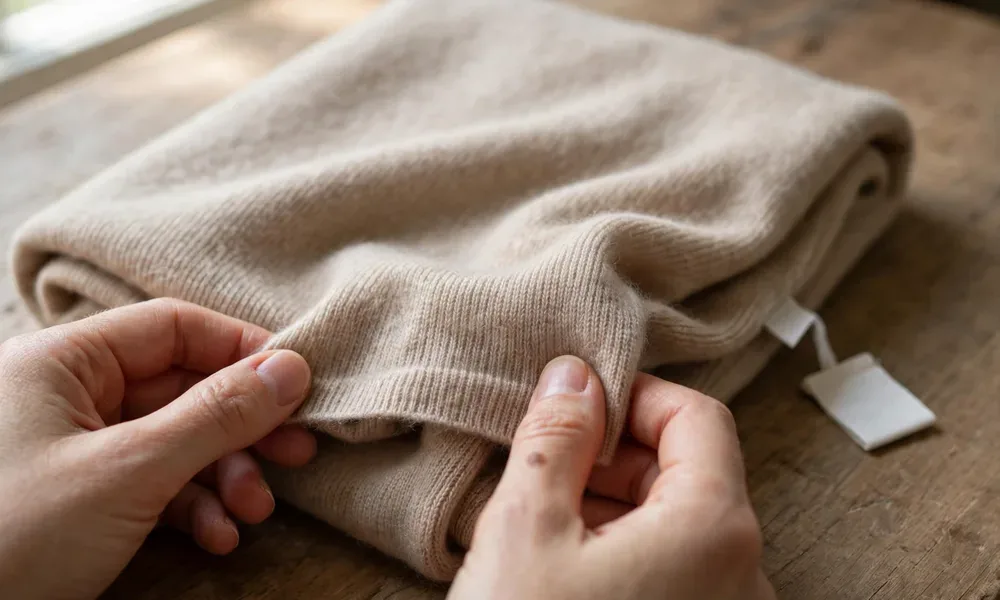
Before you buy, run three quick tests. First, the touch test: rub the fabric lightly against your wrist or cheek. It should feel smooth, never prickly. Second, the stretch test: gently pull a small section sideways. Good cashmere stretches a little and rebounds within a couple of seconds; poor cashmere sags or stays wrinkled. Third, the light test: hold the knit up to a light; the stitches should be even and tight, with no thin patches.
Your Cashmere Skirt Checklist
- Label says 100% cashmere, or a named blend with exact percentages.
- Grade A fibre: 14 to 15.5 microns, staple 34 mm or longer, with no guard hairs.
- Two-ply or more, with an even, tight knit and no thin patches.
- Silhouette matched to your day, with a vent or pleat on straight shapes.
- Fit checked sitting down: no pulling across the hips, waistband springs back.
- Care label allows hand-washing or a delicate cycle, and the shop offers fair returns.
Frequently asked questions
How can I tell if a cashmere skirt is good quality?
Check the fibre first: Grade A measures 14 to 15.5 microns with a staple of 34 mm or longer, and the maker should disclose both. Then use your hands: the fabric should feel smooth against your wrist, stretch slightly and spring back, and show an even, tight knit. Minimal, soft pilling is normal; hard pilling within days signals short fibres.
Is a cashmere skirt worth the money?
A good one is, because it replaces several cheaper skirts. Long-fibre cashmere stays soft, holds its shape, and resists pilling for years. Worn weekly for five winters, it costs less per outing than a bargain skirt abandoned after a month.
What ply should a cashmere skirt be?
Two-ply is the best balance: stronger, warmer, and more resistant to pilling than single-ply, while still draping softly. Single-ply is lighter and softer at first touch but stretches and pills faster, which matters in a skirt that takes friction every time you sit.
Will a cashmere skirt pill?
Yes, all cashmere pills at first, especially at the seat and inner thighs. Premium long-fibre cashmere pills lightly, and the soft pills come off easily with a cashmere comb. Heavy pilling within days that resists removal points to short fibres or guard-hair contamination, and it is a reason to return the skirt.
How should I wash a cashmere skirt?
Hand-wash sparingly in cool water with a gentle detergent, or use a delicate cycle in a mesh bag if the care label allows it. Never wring it; press the water out, reshape it, and dry it flat. Fold it rather than hanging it, and rest it between wears.
What should I wear with a cashmere skirt?
Keep the top simple and let the skirt lead. A fine-knit sweater or a silk blouse works for most days, with knee-high boots in cold weather and loafers or heels when it is milder. Add a structured coat on top, and keep jewellery understated.
The bottom line
Choosing the perfect cashmere skirt comes down to a short list of checks: long, fine fibres with a disclosed micron count and origin; two-ply or more; an even, tight knit; a silhouette that suits your real days; and a fit you have tested sitting down. Get those right and the skirt will serve you for many winters.
Buy the fibre, not the label. Touch it, stretch it, hold it to the light. The skirt that passes those tests is the one worth taking home.
Note: Prices and availability change, and cashmere grades are a trade convention rather than a legal standard, so treat the figures here as a way to compare garments, not a guarantee about any single brand. Always check the care label and the returns policy before you buy.