A wedding ring is the one piece of jewellery most people wear every single day, for decades, through work, travel, workouts and holidays. It also carries real emotional weight: it marks a promise and sits on your hand in every part of daily life. That mix of meaning and everyday use is why choosing one deserves more thought than a quick browse in a single shop.
The good news is that the decision is simpler than it looks. It comes down to a handful of choices — metal, style, width, fit and budget — and once you understand what each one does, the right ring usually becomes obvious. You do not need to be a jewellery expert or spend a fortune. You need to know how you live, what feels comfortable, and what will still look right in ten or twenty years.
This guide walks through every decision in order: the practical questions first, then the finishing details, the costs, and the mistakes to avoid.
Key takeaways
- Start with your lifestyle, then choose metal, style and width around daily wear.
- Yellow gold, white gold, rose gold and platinum wear and age differently, and some metals cannot be resized.
- Width and profile affect comfort more than most people expect, so try rings on in person.
- Try your wedding ring with your engagement ring to check the fit and the gap between them.
- Allow three to four months before the wedding for sizing and engraving.
Start With How You Will Wear It
Before you look at a metal or a style, think about how the ring will live on your hand. A ring worn next to an engagement ring must sit comfortably beside it, without rubbing or leaving an awkward gap. A ring worn on its own can be wider or more detailed, because it does not share space. Someone who works with their hands, lifts weights or swims needs a tougher, lower-profile design than someone whose ring will spend most days at a desk.
Your routine also shapes the finish. A polished band shows fine scratches more readily, while a brushed or matte finish hides everyday wear. Stones set high or delicate pavé work can catch on clothing, while a smooth plain band is the easiest thing in the world to live with.
Choose Your Metal
The metal is the most important decision: it decides how the ring looks, wears, ages, and whether it can be resized. Most couples choose between yellow gold, white gold, rose gold and platinum.

Yellow gold is the traditional choice, warm and instantly recognisable, commonly available in 14k and 18k. Higher-carat gold has a richer colour but is softer and picks up scratches more easily; lower-carat gold is harder and more affordable. White gold offers a bright, silvery look and usually costs less than platinum, although it is typically plated with rhodium and may need re-plating. Rose gold, made by mixing gold with copper, has a warm pink tone that flatters many skin tones.
Platinum is naturally white, dense and durable, and it does not need plating. It develops a soft, satin-like patina over time rather than staying mirror-bright, and it is usually the most expensive of the main options. Titanium and tungsten are extremely hard and scratch-resistant with a modern look, but they usually cannot be resized in the conventional way, so the fit has to be exactly right from the start. Always ask whether a metal can be resized before you buy.
Pick a Style That Suits You
Once the metal is settled, the style is where your personality comes in. A classic plain band is timeless, low-maintenance and easy to resize, and its look is defined entirely by its width, profile and finish. A minimalist slim band is delicate and understated and stacks easily, although a band that is too thin can bend or wear faster, so do not go thinner than your jeweller recommends.
Diamond bands add sparkle across part or all of the ring. A pavé band has small stones set along its surface. A half-eternity band carries stones across the top half and plain metal underneath, giving everyday sparkle while staying comfortable and resizable. A full-eternity band has stones all the way around for a luxurious look, but it cannot usually be resized. Our comparison of diamond versus moissanite explains how the two differ in sparkle, durability and cost.
Shaped bands are one of the defining looks of 2027. V-shaped and chevron bands frame pear, marquise and oval centre stones, while curved or contour bands nest neatly against low-set engagement rings. Wide, chunky gold bands, often in a brushed finish, make a confident statement alone or stacked, and mixed-metal bands look deliberate when one metal or finish repeats across the set.
Get the Width, Profile and Fit Right
Width and profile are the details people most often overlook, and they have the biggest effect on comfort. Bands are measured in millimetres: 2–3mm looks slim and understated, 3–4mm offers a little more presence, 5–6mm feels substantial, and 7mm or wider creates a bold profile. Broader fingers generally suit a wider band, while slimmer fingers suit a narrower one.
Profile is the shape of the band seen from the side. A court profile is softly rounded inside and out and is the most comfortable for everyday wear, sliding on and off easily. A D-shape is flat inside and domed outside for a classic look, while a flat profile has clean, modern lines. A comfort-fit interior — a gently rounded inner edge — makes a real difference for all-day wear, so ask for it by name.
Sizing deserves the same care. Finger size shifts with temperature and time of day, so measure when your hands are at a normal temperature, not first thing in the morning or after exercise. Wide bands of 6mm or more usually need about half a size more than a slim band. Measure with a proper ring sizer, not a piece of string, and if you are between sizes, ask your jeweller which way to go.
Stones, Settings and Finishes
If you want stones, the setting matters as much as the stones themselves. A low-profile setting sits close to the band and is more practical for everyday wear. Channel-set stones sit flush within the metal and rarely catch on anything. Pavé settings give the most sparkle but need periodic checks, because tiny stones can loosen.
Colour is another option worth considering. Sapphires, rubies and other gemstones bring a personal touch, and a birthstone or a favourite colour can make the ring feel entirely your own. Alternative stones such as moissanite offer a brilliant look at a lower cost. The finish gives the ring its final character: polished is the classic shiny surface, matte or brushed hides fine scratches, and hammered catches the light. Finishes can be changed later, so do not let the finish alone decide the purchase.
Match It to Your Engagement Ring
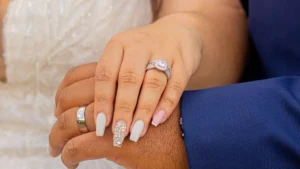
If you wear an engagement ring, the wedding band needs to work with it, not just beside it. A high-set solitaire often leaves a gap with a straight band. A curved, contour or V-shaped band is designed to close that gap and nest against the engagement ring, and a thin spacer ring worn between the two is another simple solution.
Metal colour matters too. Matching metals give a seamless look, while mixed metals can look intentional when one element repeats. If you are still deciding on the engagement ring, our round-up of the best engagement rings for 2027 is a useful place to start, since choosing the two together is easier than matching a band to a ring bought years earlier. Try the pair on together and take a photo of your hand in daylight to look at later.
Set a Budget You Are Comfortable With
Wedding rings span a wide price range, from a few hundred dollars for a simple band in a modern metal to several thousand for platinum or a diamond eternity band, depending on the metal, width, stones and craftsmanship. Decide what you are comfortable spending before you fall in love with a particular ring, and let the budget guide the choices.
There are straightforward ways to make a budget go further. Choosing 14k instead of 18k gold, or palladium instead of platinum, saves money while keeping a precious-metal ring. A half-eternity band gives most of the sparkle of a full eternity at a lower cost and can still be resized. If you are buying diamonds, our diamond buying guide explains the quality factors that affect price, so you can spend where it shows and save where it does not. Budget for the extras too: sizing, engraving, insurance and the occasional professional clean.
| Metal | Look | Durability | Resizing | Relative cost |
|---|---|---|---|---|
| Yellow gold (14k / 18k) | Warm, classic | Good; softer at 18k | Yes | Moderate |
| White gold | Bright, silvery | Good; needs re-plating | Yes | Moderate |
| Rose gold | Warm pink tone | Good | Yes | Moderate |
| Platinum | Naturally white, dense | Excellent; develops patina | Yes | Highest |
| Palladium | White, like platinum | Very good | Yes | Lower than platinum |
| Titanium | Modern grey | Very hard, light | Usually no | Low |
| Tungsten | Dark, polished | Extremely hard | Usually no | Low |
Your Wedding Ring Checklist
- Decide how you will wear the ring daily, and whether it sits beside an engagement ring.
- Set a budget before shopping, including sizing, engraving and insurance.
- Choose a metal you can live with, and ask whether it can be resized later.
- Try the width and profile on your own hand, and wear the ring for a few minutes.
- Check the fit with your engagement ring, and measure your size at a normal temperature.
- Order three to four months before the wedding.
Frequently Asked Questions
When should I start shopping for a wedding ring?
Start three to four months before the wedding. Off-the-shelf rings can take two to four weeks to resize and engrave, and custom designs take longer. Starting early means you can order without rushing, and you have time to change your mind if a style does not feel right.
Should wedding rings match each other?
They do not have to. Many couples choose different metals, widths or styles that suit each person, keeping one shared detail such as the same finish or engraving. A ring that suits its wearer will be worn happily for far longer than one chosen only to match.
How wide should a wedding ring be?
It depends on your hand and taste. A 2–3mm band looks slim, 3–4mm offers more presence, 5–6mm feels substantial, and 7mm or wider makes a bold statement. Try several widths on your own hand, and remember wide bands usually need about half a size more.
Can a wedding ring be resized later?
Most gold and platinum rings can be resized, and half-eternity bands usually can too. Full-eternity bands generally cannot, because stones run all the way around, and titanium and tungsten rings usually cannot be resized conventionally. Ask before you buy.
Is platinum worth the extra cost over white gold?
Platinum is denser, naturally white and never needs re-plating. White gold costs less and looks similar at first, but it usually needs re-plating every few years. If you want the lowest-maintenance white metal, platinum is worth it.
What is the most practical wedding ring for everyday wear?
A plain band in gold or platinum, with a comfort-fit interior and a brushed or matte finish, is the easiest ring to live with. It does not catch on clothing, hides fine scratches, and is simple to clean and resize. If you want sparkle, a half-eternity band with a low-profile setting is the most practical way to add it.
The bottom line
Choosing a wedding ring comes down to three questions: how will you wear it, what feels comfortable on your hand, and what will you still love in twenty years. Answer those honestly and the metal, style and width mostly choose themselves. Try rings on in person and leave enough lead time before the wedding.
A wedding ring is a daily companion, not a fashion purchase. The best choice feels like it belongs on your hand from the first day, and still does decades later.
Note: Prices and availability vary by jeweller and region, and metals and stones should always be checked in person before buying. If you have a metal allergy, ask your jeweller about hypoallergenic options such as platinum or palladium before deciding.