
A pageboy looks simple, which is why it is hard to get right. The cut is one even length, the ends turn under, and the surface is smooth from crown to fringe. There is nowhere for a mistake to hide. Oil is the step that makes the difference between a pageboy that looks like it was cut yesterday and one that looks like it was cut six weeks ago.
The trick is placement and amount. Oil belongs on the lengths and the ends, where it adds weight and shine. It does not belong on the crown, where it flattens the shape, or on the fringe, where it makes the hair separate. One drop, warmed between the palms, is usually enough for the whole cut.
Below are nine steps for using hair oil on a pageboy, from washing and drying to the final smoothing pass, with the timing and care details that make the difference between a pageboy that holds its curve and one that falls flat.
Key takeaways
- Oil goes on the lengths and ends, never on the crown, or the pageboy loses its shape.
- One or two drops, warmed between the palms, is enough for the whole cut.
- Apply oil to dry, styled hair as a finishing step, not to wet roots.
- Fine hair needs the lightest oils, while thick hair can take a richer one.
- No oil will hold a pageboy’s under-curl on its own, because the curve comes from the cut and the brush.
What a pageboy is and why oil helps
A pageboy is a chin-to-shoulder cut with the ends curved under. The curve is created by the cut and by a round brush, and it is the first thing to go when the hair is dry. Dry ends flick outward, and the silhouette changes from a smooth curve to a triangle.
Oil adds weight and slip to the ends, which helps the curve stay turned under. It also smooths the surface, so the light catches the hair evenly instead of breaking up on frizz. A pageboy with oil on the ends looks intentional. A pageboy without it can look unfinished, even when the cut is fresh.
The risk is the crown. A pageboy crown is a flat, smooth sheet, and oil on it shows as a dark patch within an hour. That is why every step in this guide keeps the oil away from the roots and the fringe, and why the amount is measured in drops, not pumps.
The nape is the other spot that tells on a pageboy. Hair at the nape is often finer and drier than the rest, and it is the first place the shape breaks down when the weather turns. A drop of oil smoothed over the nape after styling keeps it lying flat instead of lifting. The same goes for the fringe in damp weather: a trace of oil on the surface stops it from going wavy, while too much makes it separate. Both spots reward a light hand.
Before you start: what you need
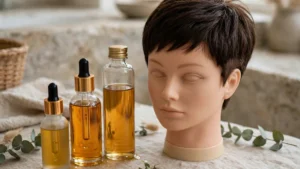
You need very little. A light hair oil with a dropper or a pump, a round brush, a hairdryer, and a few bobby pins. A wide-tooth comb helps for the first pass, and a soft bristle brush helps for the final smoothing. That is the whole kit.
Choose the oil before you start, and pick it for your hair type, not for the bottle. Fine hair needs the lightest oil you can find. Thick hair can take a richer one. If you are not sure, start with a light argan or a light coconut oil, and use one drop. Our guide to using hair oil on a beehive makes the same point about weight, because a beehive and a pageboy both punish a heavy oil in the same way.
Wash and dry the hair first. Oil works best on clean, dry hair that has already been styled, because it is a finishing step, not a treatment. If the hair is dirty, the oil will trap the dirt and the pageboy will look dull instead of glossy.
Think about oil types before you buy. A dry oil disappears fast and suits fine hair. A richer oil stays on the surface longer and suits thick or damaged hair. A multi-purpose oil that also works on skin can be handy for travel, but it is usually lighter than a dedicated hair oil, so very dry ends may need a second pass. Pick the weight first, and let the scent and the bottle come second.
9 steps to use hair oil on a pageboy
Wash the hair and towel-dry it most of the way
What to do: Wash with a light shampoo, condition the ends only, and blow-dry the hair until it is about eighty percent dry, using your fingers to lift the roots.
What to avoid: Conditioning the roots, or drying the hair completely flat, because the roots need lift and the ends need moisture. Best For: Anyone whose pageboy goes flat by midday. Time Needed: Ten minutes. Standout Tip: Condition the ends only, and let the crown stay clean.
The wash sets up everything that follows. Clean roots give the pageboy its lift, and conditioned ends give the oil something to seal in.
Shape the under-curl with a round brush and the dryer
What to do: Take a round brush, wrap the ends around it, and blow-dry them under, working in sections from the back to the front, so the curve is built into the hair.
What to avoid: Drying the ends straight down, or skipping the brush, because the curve will not form on its own. Best For: Building the under-curl that defines the pageboy. Time Needed: Ten minutes. Standout Tip: Roll the brush under, not over, and let the hair cool on the brush for a few seconds.
This is the step that makes the pageboy a pageboy. The oil later only holds what the brush has already shaped.
Spread one drop over both hands
What to do: Put one drop of a light oil onto one palm, rub your hands together until the oil is evenly spread, and check that your palms look barely shiny, not wet.
What to avoid: Pouring oil straight from the bottle onto the hair, or using two drops before you have seen what one does. Best For: Anyone who has ever made a pageboy greasy by accident. Time Needed: Thirty seconds. Standout Tip: If your palms shine, you have used too much, so wipe them on a towel and start again.
Warming the oil first is the difference between an even sheen and a single greasy patch.
Glide the oil down the hair from ear level to the tips
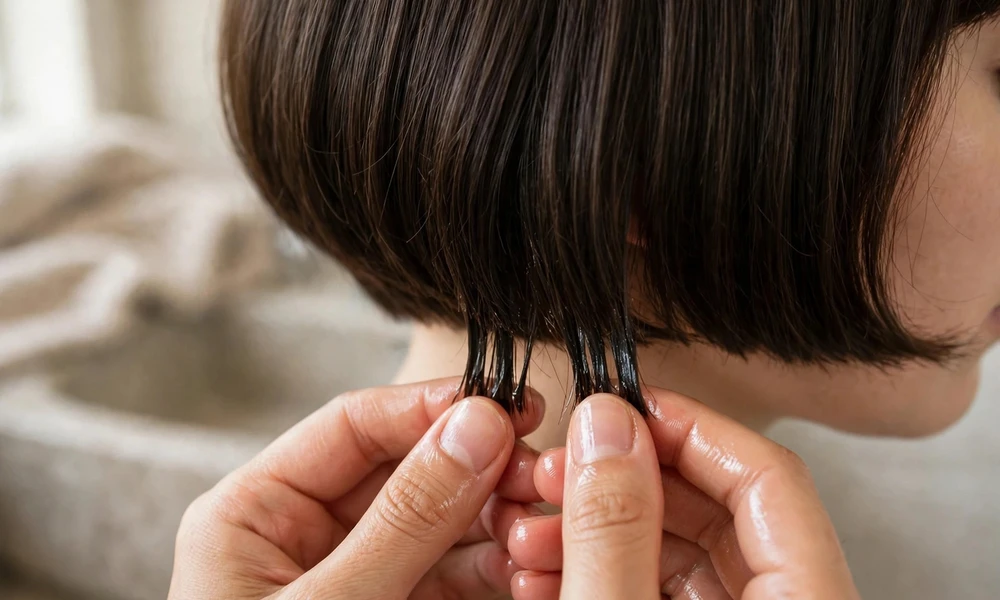
What to do: Run your oiled palms down the lengths of the hair, starting at ear level and working toward the ends, keeping your hands away from the crown and the roots.
What to avoid: Touching the roots or the crown, because oil there flattens the shape within the hour. Best For: Adding shine to the part of the pageboy people actually see. Time Needed: One minute. Standout Tip: Start at the ears, not the roots, and let the hands carry the oil.
The lengths are where the oil earns its place. The crown should feel clean when you are done.
Curl the tips inward using thumb and fingers
What to do: Take the ends between your thumb and fingers, press them gently under, and hold for a few seconds, so the curve sets with the oil sealing it in.
What to avoid: Pulling the ends straight, or pressing too hard, because the curve needs a light touch to hold its shape. Best For: Ends that flick outward no matter what you do. Time Needed: Two minutes. Standout Tip: Work in small sections, and let each one cool before you move on.
Fingertips are better than a brush here, because they follow the curve instead of flattening it.
Brush the fringe once with whatever oil is left
What to do: Take whatever oil is left on your palms, with no new drop, and pass your hands once over the surface of the fringe, following the direction it falls.
What to avoid: Adding a fresh drop for the fringe, or working the oil into the fringe, because it will separate into strands and stick to the forehead. Best For: A fringe that needs shine without going limp. Time Needed: Thirty seconds. Standout Tip: Use the leftover oil only. If your palms feel dry, the fringe is done.
The fringe needs the least oil of all, and the leftover on your palms is exactly the right amount.
Check the shape in profile and fix the back
What to do: Look at the pageboy from the side in a hand mirror, check that the curve is even all the way around, and smooth any section at the back that has flicked out.
What to avoid: Trusting the front view alone, because the back is where the curve usually fails first. Best For: A pageboy that has to look good from every angle. Time Needed: Two minutes. Standout Tip: The profile view tells the truth, and the back needs a second pass with the brush.
The back is the part other people see most, so it deserves the extra minute.
Feed the driest tips a second drop, and stop there
What to do: Look at the ends in daylight, and if they still look dull or frayed, warm one more drop between your palms and smooth it over the ends only, nowhere else.
What to avoid: Adding a second drop to the whole head, or adding it to the crown, because the crown was fine with one drop and the ends were the only dry part. Best For: Very dry ends on a humid or windy day. Time Needed: One minute. Standout Tip: Judge the ends in daylight, not bathroom light, because bathroom light hides dryness.
A second drop is a repair, not a routine. If you need it every day, the ends need a trim or a richer oil.
Use loose pins to hold the shape overnight
What to do: If the pageboy has to last into the evening, pin the sides back loosely with bobby pins, and smooth a single drop over the ends again before you go out, to refresh the shine.
What to avoid: Pinning tightly, or re-oiling the whole head, because tight pins crease the shape and a full re-oil makes it greasy. Best For: A pageboy that has to survive a long day and an evening out. Time Needed: Three minutes. Standout Tip: Loose pins hold the shape without creasing it, and the refresh drop goes on the ends only.
The evening refresh is the last step in the routine, and it is the one that makes a morning pageboy still look deliberate at night.
Matching the oil to your hair type
Fine hair should use the lightest oils and the smallest amounts. A single drop of a light argan or coconut oil is enough, and the oil should be applied to the ends only. Fine pageboys show oil fastest, so they punish a heavy hand more than any other hair type.
Thick hair can take a richer oil, and it may need two drops to cover the ends. A richer argan, a salon oil with heat protection, or a heavier blend will register on thick hair where a light oil disappears. Our guide to using hair oil on victory rolls covers the same weight question for a thicker vintage style.
Wavy pageboys need frizz control more than shine. A light elixir that smooths the surface without straightening the wave is the right pick, and it should be applied to the lengths, not the roots, so the wave keeps its movement.
Colour-treated pageboys need an oil that protects as well as smooths. A salon oil with heat protection, like the Goldwell Kerasilk in our roundup, does both jobs at once, and it keeps the colour looking fresh for longer. Curly pageboys are a different case: the wave needs frizz control, not weight, so a light elixir applied to the lengths is better than a heavy oil that pulls the curl straight. In both cases, the crown stays oil-free.
The caveats that matter
Oil cannot fix a pageboy that was cut without the under-curve, and it cannot repair split ends. If the ends are split, the oil will seal them temporarily, but the split is still there, and the only real fix is a trim. Oil is a finishing step, not a repair.
| Detail | What is known |
|---|---|
| Best time to oil | After styling, on dry hair |
| How much to use | One drop, two at most, warmed between the palms |
| Where to start | At the ears, working down to the ends |
| Where never to oil | The crown and the roots |
| What to do first | Wash, condition the ends, and blow-dry the curve in |
| Who should use less | Fine hair and oily scalps |
| When to add more | Only if the ends still look dry in daylight |
| What oil cannot do | It cannot create the curve, hold it, or repair split ends |
If your scalp is irritated, broken, or sunburned, skip oil until it has healed, because oil can trap irritation against the skin. Check the ingredient list first if you have a nut allergy, since argan, almond, and coconut oils all come from nuts or seeds, and test a little on the inner arm first. Our guide to using hair oil on halo braids covers the same patch-test rule for a style that sits close to the scalp.
Checklist: using hair oil on a pageboy honestly
Use these checks before you start, and again before you leave the house.
- Check the amount: one drop, warmed between the palms, no more to start.
- Check the placement: lengths and ends only, never the crown or the roots.
- Check the fringe: leftover oil only, never a fresh drop.
- Check the shape: look at the profile, not just the front, before you go out.
- Check the ends: if they still look dry in daylight, add one more drop to the ends only.
- Check the dispenser: it should release one drop at a time.
Frequently asked questions
How often should I oil a pageboy?
Every day is fine if you use one drop on the ends, but skip the crown. For very dry hair, a weekly treatment helps more, and one drop after styling covers most people the rest of the time. If your scalp is oily, skip the daily drop and use the oil only on the ends after washing.
Can I oil a pageboy before blow-drying?
Yes, if the oil offers heat protection. Use one drop on damp ends, then finish with a dry oil on the styled hair.
Will oil make my pageboy look greasy?
That happens when you use too much, or when any of it reaches the crown. A single drop on the ends, rubbed between the palms first, should leave shine and no grease.
Can I use oil on a pageboy with a fringe?
Yes, but use only the leftover oil on your palms, and pass it once over the surface. A fresh drop will make the fringe separate.
What if my ends keep flicking out?
The curve comes from the cut and the brush, not the oil. Re-dry the ends under with a round brush, then press them under with oiled fingertips. If the ends still flick out by midday, the cut may be too light at the ends, and a trim will do more than any oil.
Do I still need hairspray if I use oil?
Oil is not a holding product. It adds shine and smoothness, but the curve still needs the brush, and a light mist of spray if you want it to hold.
The bottom line
Using hair oil on a pageboy is a small job done carefully. Wash and dry the hair, build the curve with a round brush, warm one drop of oil between your palms, and smooth it over the lengths and ends. Keep it off the crown and the fringe, and check the shape in profile before you leave.
The oil is the last step, not the first, and the amount is measured in drops, not pumps. Get those two things right, and a pageboy keeps its curve and its shine from morning to evening.