A plaid cardigan is easy to buy and surprisingly easy to wear badly. The check does so much of the talking that the rest of the outfit has to stay quiet, and that is where most people go wrong.
The good news is that styling a plaid cardigan follows a small set of rules, and once you know them, the cardigan becomes one of the most useful pieces in a wardrobe. The scale of the check sets the proportions, so the trousers and the top underneath should be chosen with that scale in mind.
Below are nine steps for styling a plaid cardigan in 2027, from choosing the right check for your frame to keeping the pattern looking fresh after a season of wear.
Key takeaways
- Let the plaid carry the outfit: keep the top underneath and the trousers plain, and avoid a second pattern.
- Match the check’s scale to your frame, with small checks for petite frames and large checks for taller ones.
- Button the top two buttons and leave the rest open for a shape that flatters most figures.
- Dark denim and brown boots are the most reliable companions for a bold tartan.
- No single styling rule suits every plaid, and a cardigan that looks right on a tall frame can overwhelm a petite one.
What styling a plaid cardigan actually means
Styling a plaid cardigan is not about finding a clever trick. It is about restraint. A check is a pattern with a lot of visual energy, and it needs space around it. The moment you add a second pattern, the outfit stops looking considered and starts looking accidental.
The second thing styling means is proportion. A plaid cardigan divides the body into squares, and those squares change how the eye reads your shape. A large check makes a short cardigan look shorter and a long cardigan look longer.
The third thing is context. A plaid cardigan worn with jeans and boots says weekend. The same cardigan worn with tailored trousers and a plain shirt says smart casual. Our guide to how to style a cable knit cardigan makes the same point about texture, because a plain knit and a patterned knit both need the same discipline from the rest of the outfit, even though they solve the problem in opposite ways.
How to approach a plaid cardigan
Start with the check itself. Stand in front of a mirror wearing the cardigan with plain dark trousers and a plain top, and look at where your eye goes. If it goes to the check first and stays there, the check is doing too much, and you need quieter companions or a smaller scale.
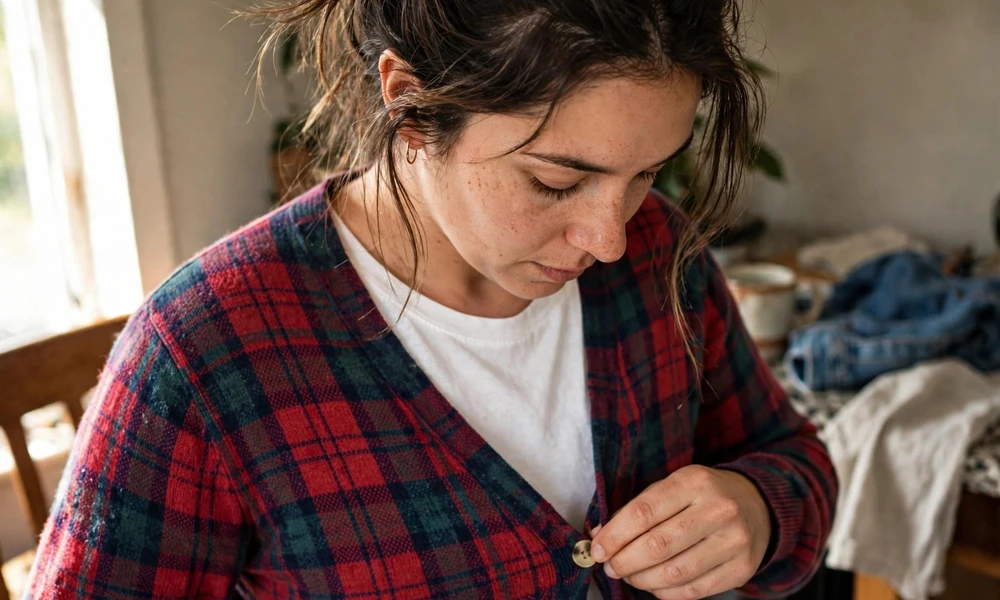
Next, think about the season. A wool tartan is a cold-weather piece, and it looks right with boots, a coat and a scarf. A cotton windowpane is a transitional piece, and it looks right with a tee underneath and lighter shoes.
Finally, think about the occasion before you dress. A plaid cardigan can go to work, to a lunch, or to a walk, but it cannot do all three in the same outfit. Our guide to how to style an oversized cardigan covers the same question of volume, because a plaid cardigan and an oversized cardigan both change the proportions of an outfit, and both need the same honesty about what suits your frame.
9 steps to style a plaid cardigan for women
One pattern is enough: let the plaid speak and quieten everything else
What to do: Choose a plain top in one of the check’s colours and plain trousers in a dark neutral, then add the plaid cardigan as the only pattern. What to avoid: A striped shirt, a floral skirt, or a patterned scarf in the same outfit.
Best For: Anyone wearing plaid for the first time. Time Needed: Five minutes at the mirror. Standout Tip: If you can name a second pattern in the outfit, take it off.
Once the outfit is plain everywhere else, the plaid stops looking like a risk and starts looking like a choice. That is the moment the cardigan earns its place in the wardrobe, because it is no longer fighting the rest of what you wear.
Match the check’s scale to your frame before you buy
What to do: Hold the cardigan against yourself and check whether the squares look in proportion to your height and build, then choose a smaller check if they look too large. What to avoid: A large buffalo check in a long cardigan on a petite frame.
Best For: Petite frames and anyone buying a plaid cardigan online. Time Needed: Two minutes with a mirror. Standout Tip: A check that looks small on the hanger can look large on a small frame.
Online shopping makes this harder, because a photograph flattens the check and hides its true size. If the listing gives measurements for the repeat of the pattern, read them: a repeat of two or three centimetres is a small check, while a repeat of ten centimetres or more is a large one.
Close the top of the cardigan and let the bottom hang loose
What to do: Fasten the top two buttons of the cardigan and let the rest hang open, so the check frames the top underneath without closing the whole front. What to avoid: Buttoning the cardigan all the way to the waist, which pulls the check apart at the buttons.
Best For: A mid-weight cardigan worn as a layer. Time Needed: Thirty seconds. Standout Tip: Two buttons give the cardigan shape; more than two make it a coat.
The V that the two buttons create is doing more work than it looks. It draws the eye upward toward your face, it shows a little of the plain colour underneath, and it stops the cardigan from hanging in one long block of pattern from neck to hem.
Put a solid colour under the plaid, never a second pattern
What to do: Wear a plain tee, camisole or turtleneck in white, black, cream or one of the check’s own colours underneath the cardigan. What to avoid: A striped top, a floral blouse, or a logo tee under a plaid cardigan.
Best For: Every plaid cardigan, in every season. Time Needed: No extra time, just a different top. Standout Tip: The top underneath should be so plain you forget it is there.
A plain turtleneck in winter and a plain camisole in spring do the same job in different seasons. The colour should come from the check itself, because a top that borrows one of the check’s colours ties the outfit together without adding anything new to it.
Show the waist by tucking one corner into your jeans
What to do: Tuck just the front corner of the cardigan into straight-leg jeans, leaving the back loose, so the waist is visible without the cardigan looking tucked in. What to avoid: Tucking the whole cardigan in, which bunches the check at the waist.
Best For: A longer plaid cardigan worn with jeans. Time Needed: One minute. Standout Tip: A corner tuck shows the waist; a full tuck hides the cardigan.
The tuck only needs to be a few centimetres deep. Any more and the cardigan starts to bunch at the waist, which pulls the check out of shape and defeats the purpose. A small, neat corner is all it takes.
Wear the cardigan unbuttoned with a camisole when spring arrives
What to do: Leave the cardigan fully open over a plain camisole, with the sleeves pushed to the elbow, so the plaid becomes a light layer rather than a warm one. What to avoid: Keeping the cardigan buttoned in a warm room, which makes the check feel heavy.
Best For: Spring days and heated rooms. Time Needed: No extra time. Standout Tip: Open and sleeveless underneath is cooler than buttoned and long-sleeved.
This is also the way to make a winter cardigan work in spring without buying a new one. The same wool tartan that felt right in January can feel right in April, as long as it is worn open and the layers underneath are light.
Dark jeans and tan boots ground a loud tartan
What to do: Wear a bold tartan cardigan with dark, unwashed denim and brown leather boots, and keep jewellery to a minimum. What to avoid: Light-wash jeans with a bold tartan, which can make the outfit look washed out.
Best For: A bold tartan or buffalo check on a cold day. Time Needed: No extra time. Standout Tip: Dark denim calms a bold check; light denim competes with it.
A pushed-up sleeve makes the same cardigan feel informal
What to do: Push or fold the cardigan sleeves to just below the elbow, so the forearms show and the outfit looks relaxed. What to avoid: Sleeves that hang past the wrists, which make the cardigan look too big.
Best For: A relaxed weekend outfit. Time Needed: Ten seconds. Standout Tip: Sleeves at the forearm say casual; sleeves at the wrist say formal.
Keep the plaid for day, and swap to a plain knit at night
What to do: Wear the plaid cardigan through the day, then change into a plain knit for an evening out, so the pattern does not have to carry a formal outfit. What to avoid: A large buffalo check at a smart dinner, where it can look too casual for the room.
Best For: Anyone who wants one cardigan for day and another for evening. Time Needed: A change of top before going out. Standout Tip: Plaid is a daytime pattern; a plain knit is an evening one.
Our guide to how to style a bamboo blend cardigan covers the plain alternative, because a soft, unpatterned knit is the natural evening companion to a daytime plaid.
Matching the plaid to the occasion
For work, a fine-gauge windowpane with tailored trousers and plain shoes is the safe combination. The check is small enough to read as texture, the trousers keep the outfit smart, and the shoes stay quiet. A buffalo check has no place in this combination, because its scale fights the formality of the trousers. Keep the work plaid small, the colours muted, and the accessories minimal.
For a lunch or a day out, a mid-scale tartan with dark denim and a simple boot is the natural choice. The tartan has room to show, the denim is dark enough to stay calm, and the boot adds warmth without adding colour. This is the combination most people picture when they think of a plaid cardigan, and it is the one that suits the pattern best.
For an evening, the honest choice is usually a plain knit instead. A small black-and-white check can carry a smart evening if it is worn over a plain dress with dark shoes, but a bold tartan rarely does. If the evening matters, let the plaid rest and reach for something unpatterned. The cardigan will still be there in the morning.
For a weekend walk, the rules relax. A bold buffalo check with jeans, boots and a warm coat is the easiest outfit in this guide, because nothing about it is trying to be smart. The check is allowed to be loud, the boots are allowed to be muddy, and the whole outfit is allowed to look like it was made for being outside rather than being looked at.
The caveats that matter
Styling a plaid cardigan is mostly a matter of restraint, but there are a few traps that catch even experienced dressers. The second trap is the wrong scale. A check that looks right on a hanger can look wrong on a body, and the only way to know is to try it on. The third trap is the wrong season. A heavy wool tartan in warm weather looks as uncomfortable as it feels, and a thin cotton check in a snowstorm looks as cold as it feels.
| Detail | What is known |
|---|---|
| Best first step | Wear the plaid as the only pattern, with a plain top and plain trousers |
| Best buttoning | Top two buttons fastened, the rest open, for a shape that flatters most figures |
| Best jeans with a bold tartan | Dark, unwashed denim, which calms the check rather than competing with it |
| Best top underneath | A plain tee, camisole or turtleneck in a colour taken from the check |
| What to avoid pairing | A second pattern, especially stripes or florals, in the same outfit |
| Who should choose small checks | Petite frames, where a large check can divide the body into blocks |
| Care to watch | Printed checks can fade with washing; wash inside out on a gentle cycle |
| What it does not do | It does not suit every occasion, and a bold tartan is usually a daytime pattern |
If you are styling a plaid cardigan for a photograph, remember that a check can create a moiré effect on camera, especially a small check in a fine gauge. Step back from the camera, or choose a larger check for photographs, because a small check that looks fine in person can shimmer unpleasantly on screen.
Checklist: styling a plaid cardigan honestly
Use these checks before you leave the house.
- Check the patterns: the plaid cardigan should be the only pattern in the outfit.
- Check the scale: the check should look in proportion to your height and build in a mirror.
- Check the buttons: fasten the top two and leave the rest open, unless the cardigan is meant to be worn fully open.
- Check the top underneath: it should be plain, in a colour taken from the check.
- Check the trousers: dark denim or plain tailored trousers, with no pattern of their own.
- Check the season: a wool tartan belongs to cold days, and a cotton windowpane can work through spring.
Frequently asked questions
Can a plaid cardigan work in an office?
Yes, if the check is small and the cut is tailored. A fine-gauge plaid cardigan in a windowpane or a small tartan reads as a texture in a meeting room, especially with tailored trousers and plain shoes. A large buffalo check is better kept for weekends.
What top works best under a plaid cardigan?
A plain top in a colour taken from the check. A white tee, a black camisole, or a plain turtleneck in navy or grey all work well. Skip a second pattern underneath, because two patterns in one outfit rarely sit well together.
How do I stop a plaid cardigan looking too busy?
Keep everything else plain. Plain trousers, a plain top, one quiet accessory, and no second pattern.
Does a plaid cardigan suit a petite frame?
Yes, with a small check. A windowpane or a fine tartan suits a petite frame well, because the squares are in proportion to the body. A large buffalo check in a long cardigan can overwhelm a small frame, so choose a shorter length and a smaller scale.
Can I wear a plaid cardigan in spring?
Yes, in a cotton or cotton-blend windowpane, worn open over a camisole. A heavy wool tartan belongs to autumn and winter, but a light cotton check is a transitional piece that works well in spring, when the mornings are cool and the afternoons are warm.
How do I wash a plaid cardigan without fading the check?
Wash it inside out on a cold, gentle cycle, and dry it flat rather than in a tumble dryer. A woven check will last longer than a printed one, but both benefit from gentle handling, and a plaid cardigan should never be washed with rough fabrics that can pill the knit.
The bottom line
Styling a plaid cardigan is not complicated, but it does ask for discipline. Keep the rest of the outfit plain, match the check’s scale to your frame, button the top two buttons, and choose companions that calm the pattern rather than compete with it. Dark denim and brown boots will carry a bold tartan, a plain top will carry a small check, and a mirror will tell you more than any rule about whether the scale is right.
Wear the plaid through the day, enjoy it for what it is, and swap to a plain knit in the evening. A plaid cardigan that is worn every week is worth more than a beautiful one that stays in the wardrobe, and the right way to wear it is the way that makes you forget you are wearing a pattern at all.