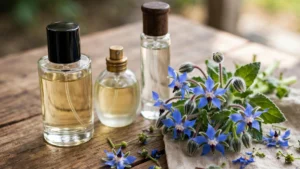
A borage perfume is a fragrance that lists borage, the blue-flowered Mediterranean herb also called starflower, as one of its named notes. It is not a style of perfume, like a chypre or a fougère. It is a single green note, used in small doses, that makes a blend smell cooler, greener, and faintly of cucumber. Most wearers never knew it, because the note almost never leads.
That quietness is the whole story of borage in perfumery. It is a modern note, not a classical one, and it appears in only a handful of perfumes, most of them niche or indie. It is also a note with a naming trap: the word starflower means borage in some perfumes and something entirely different in others. Learning to tell the two apart matters.
This guide explains what borage is, what it smells like, where it sits in a perfume, why there are so few borage perfumes, and how to recognise the real note.
Key takeaways
- Borage is the herb Borago officinalis, also called starflower, and it smells cool, green, and cucumber-like rather than sweet or floral.
- A borage perfume lists borage as a named note, and only 21 perfumes in Parfumo’s database do.
- Borage most often sits in the base, where it cools the drydown, though a few scents put it in the top or heart.
- Starflower is the common name for borage, but some brands use it for a sweet fantasy accord.
- Borage is a supporting note, not a star, so no borage perfume smells strongly of cucumber on its own.
What a borage perfume actually is
A borage perfume is defined by its note list, not by its style. If borage, borage flower, or starflower where the brand confirms it means the plant, appears among the named notes, the perfume counts. Perfumes that smell green, or that use starflower for a sweet floral effect, do not count unless the borage plant is actually named.
The note itself is a reconstruction. Nobody distils perfume from borage flowers in commercial quantities; the smell in a bottle is a perfumer’s accord built to suggest the plant: green, watery, faintly cucumber, with a soft herbal edge. Because the dose is small and the position is usually the base, a borage perfume rarely smells of borage the way a rose perfume smells of rose. The note changes the other notes instead: it cools woods, softens herbs, and gives aquatics a vegetal realism.
How to recognise borage in a perfume
Start with the note list. Borage usually appears in the base, alongside amber, musk, oakmoss, or woods. If you see it in the top, as in Les Saisons Printemps, you are looking at one of the rare perfumes where the note is smellable at the start. If you see starflower in the heart, as in In the Stars, check the brand’s own description: if it talks about cucumber or green, it is borage; if it talks about sparkling sweetness, it is probably the fantasy accord.

Then wear the perfume and pay attention to the drydown, not the opening. A borage perfume reveals itself after an hour or two. If the drydown feels cooler and greener than you expected, and less sweet than the same style of scent usually is, that is the borage. Our best lilac perfumes list is a useful comparison, because lilac is a floral note that also appears in green spring scents.
Finally, check the source of the note list: retailers copy each other, and a single wrong listing can spread across dozens of shops. The brand’s own site, Fragrantica, and Parfumo are the reliable sources. If only one retailer claims borage and the rest do not, treat the claim as unverified.
9 facts about borage as a perfume note
Borage is starflower, and the name is literal
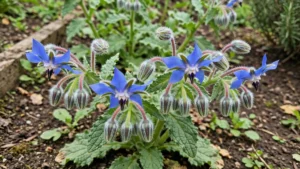
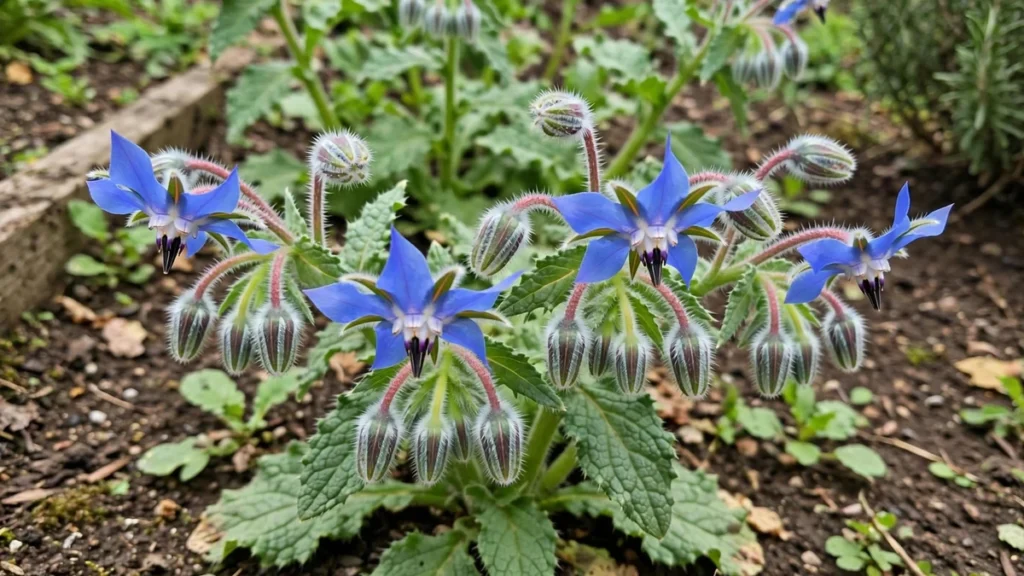
Borage is Borago officinalis, an annual herb in the forget-me-not family, and its common name is starflower. The name comes from the flowers, vivid blue five-pointed stars about two centimetres across, with a dark cone of anthers at the centre. They hang in drooping clusters, on a plant covered in coarse, bristly white hairs, about half a metre tall.
What it shows: The star in starflower describes the flower’s shape, and it is why the note appears under two different names. What to consider: Other plants are also called starflower, so the name alone does not prove borage is in the bottle.
Borage smells of cucumber
Crush a borage leaf and the smell is cool, green, and unmistakably of cucumber, with a faint floral softness underneath. The flowers carry the same character in a gentler form, and the young leaves taste of cucumber too, which is why they are used in salads and summer drinks. Borage does not smell like a flower in the way rose or jasmine do. It smells like a green vegetable.
What it shows: The cucumber character is a property of the plant itself, and it is what makes the note useful in aquatic and green blends. What to consider: If you expect a sweet floral from a borage perfume, the cool cucumber greenness can come as a surprise.
Borage arrived late in perfumery
Borage has almost no history in classical perfumery. The great green notes of the nineteenth and twentieth centuries were galbanum, vetiver, oakmoss, and lavender, and borage appears in none of them. The first perfume in Parfumo’s database to list borage is Longest Night by Possets, from 2008, and later appearances are mostly in niche and indie perfumes. Its use is a modern development, tied to the fashion for photorealistic green and aquatic accords.
What it shows: Borage belongs to contemporary perfumery, not to the classical palette. What to consider: A perfume that claims a traditional character and lists borage is likely a modern composition with an old-fashioned story.
Most borage sits in the base
Of the nine verified borage perfumes in our companion roundup, five list borage in the base, two in the heart or as starflower, and only one puts borage flower in the top. The pattern holds across the wider list of twenty-one: borage is most often a base note, where it works slowly and shapes the drydown. Perfumers use it to anchor a blend and to keep the base from turning heavy or sweet, not to open a scent.
What it shows: The base position is deliberate, because borage’s cooling effect is most useful where a perfume risks becoming warm and cloying. What to consider: A base-note borage will not be smellable in the first minutes, so judging the perfume on its opening alone will miss the note entirely.
Borage works as a watery green, not a herbal blast
Not all green notes behave the same way. Galbanum is sharp and bitter, vetiver is dry and smoky, and rosemary is camphoraceous and medicinal. Borage is none of those. It is a watery green, closer to the inside of a cucumber than to cut grass, and it reads as damp and dewy rather than sharp or dry. That is why it appears in aquatic perfumes and woody aromatics, adding vegetal realism and cooling the woods without a herbal bite.
What it shows: The watery character is what makes borage distinct, and it is why perfumers choose it over galbanum or vetiver. What to consider: If you want a sharp, bitter, or medicinal green, borage will feel too soft.
Starflower on a note list does not always mean borage
The word starflower has two lives in perfumery. In one, it is the common name for Borago officinalis, and a perfume that lists starflower is listing borage, as Bath & Body Works does. In the other, it is a modern fantasy accord, built from sweet almond and cherry, lemon zest, tuberose and maple, and chocolate and vanilla, used to describe a clean, nectarous scent that has nothing to do with the plant. The two uses share a word and almost nothing else.
What it shows: A note name is not always a plant name, and fantasy accords borrow the language of real botanicals. What to consider: If the description mentions cucumber or green, it is real borage; if it mentions almond, cherry, and chocolate, it is the fantasy accord.
The plant is a Mediterranean kitchen herb
Borage is native to the Mediterranean, and it has been a kitchen and medicine herb for far longer than it has been a perfume note. The young leaves and blue flowers are eaten in salads, floated in summer drinks, and candied for cakes, and the plant is a famous bee plant that self-seeds freely. Herbalists valued it as a cooling, soothing herb, called the herb of gladness in some traditions, because it was thought to lift the spirits.
What it shows: The culinary history explains why the note smells of food and gardens rather than of flowers or woods. What to consider: The plant’s edible reputation does not make the perfume note edible or therapeutic, and the two should not be confused.
The seed oil is not the perfume note
Borage seed oil is a skincare ingredient, pressed from the seeds of Borago officinalis and valued for its gamma-linolenic acid, an omega-6 fatty acid used in moisturisers and supplements for dry skin. The borage note in a perfume is a different thing entirely: a reconstructed green accord that suggests the smell of the leaves and flowers. The oil is not used as the perfume note, and the perfume note does not carry the oil’s skincare properties.
What it shows: The confusion between the oil and the note is the most common misunderstanding about borage. What to consider: If you want the oil’s benefits, buy the oil; if you want the smell, buy the perfume, and do not expect one to do the other’s job.
Borage is rare because it whispers
Only twenty-one perfumes in Parfumo’s database list borage, and most of them are niche, indie, or discontinued. The reason is not that the note is hard to make or expensive to use. It is that borage whispers. It supports a blend rather than starring in it, and it does not sell bottles on its own name the way rose, vanilla, or oud do. Perfumers use it because it works, and brands rarely advertise it because it does not sell.
What it shows: The rarity of borage is a commercial fact, not a chemical one. What to consider: A rare note is not automatically a better note.
Where borage comes from
Borage grows wild around the Mediterranean and has been cultivated in European gardens since at least the Middle Ages. It appears in herbals from the sixteenth century onwards, including William Turner’s Herbal of 1548, which calls it bugloss and notes that it is moist and warm. The plant’s reputation was always as a cooling, soothing herb for food and medicine, not as a scented flower, and that shaped how perfumers used it: as a green, cooling modifier, not as a floral star.
The note’s move into perfumery came late, through the modern green and aquatic trend rather than any classical route. The first listed borage perfume, Longest Night, is an indie oil from 2008, and the note’s best-known appearances since then are in small houses: Accendis, Profumi di Pantelleria, V Canto, Black Phoenix Alchemy Lab, and Possets. The two exceptions are instructive. Van Cleef & Arpels used borage flower in a spring scent in 2004, before the note had any currency, and Bath & Body Works built a bestseller around starflower in 2018. Our guide to what a yarrow perfume is tells a similar story for another green herb: both notes are medicinal plants that entered perfumery late, through small houses, and both are still rare.
The caveats that matter
Borage is a safe note in the ordinary sense, and the caveats that matter are practical ones. The first is the starflower trap, where a sweet fantasy accord borrows the plant’s name. The second is expectation: no borage perfume smells strongly of cucumber. The third is availability, because several of the best borage perfumes are seasonal, discontinued, or sold only by small houses.
| Detail | What is known |
|---|---|
| The plant | Borago officinalis, also called starflower, a Mediterranean annual |
| What it smells like | Cool, green, and watery, like fresh cucumber, with almost no sweetness |
| Where it usually sits | In the base of most perfumes, shaping the drydown rather than the opening |
| How many perfumes list it | 21 in Parfumo’s database, mostly niche or indie |
| First appearance | Longest Night by Possets, from 2008 |
| Starflower | The common name for borage, but also a sweet fantasy accord in some mass-market scents |
| Borage seed oil | A skincare ingredient from the seeds, not the same as the perfume note |
| What it does not do | It does not dominate a blend, smell floral, or carry skincare benefits |
If you are pregnant, breastfeeding, or using prescription skincare, the usual caution applies to any new scented product: patch-test first, and check with your clinician if you have a fragrance sensitivity. The borage plant itself contains pyrrolizidine alkaloids, a reason to use the herb sparingly in food and tea, but those compounds are not present in the reconstructed perfume accord.
Checklist: recognising a real borage perfume
Use these checks before you buy.
- Check the note list for borage, and the brand’s own description if it only says starflower.
- Check the pyramid position: a base-note borage shapes the drydown, and only a top-note borage is smellable at once.
- Check the source: the brand’s own site, Fragrantica, and Parfumo are reliable.
- Wear it for a full afternoon before judging it, because borage reveals itself in the drydown.
- Do not expect a cucumber blast: judge the drydown on whether it feels cooler and greener.
- Check availability first: seasonal and small-batch bottles can be hard to replace.
Frequently asked questions
What does borage smell like in a perfume?
Cool, green, and watery, like fresh cucumber, with almost no sweetness. It is used in small doses, usually in the base, so you notice it as a cooling, dewy quality in the drydown rather than as a distinct cucumber smell.
Is borage the same as starflower?
Starflower is the common name for borage, the plant Borago officinalis, named for its blue star-shaped flowers. But some brands use starflower for a sweet fantasy accord made of almond, cherry, tuberose, and vanilla, with no borage in it.
Why are there so few borage perfumes?
Borage is a quiet supporting note, not a star, so perfumers use it in small doses to cool a blend or add a watery green realism. It does not sell bottles on its own name the way rose, vanilla, or oud do, so brands rarely build a fragrance around it.
Is borage a top, heart, or base note?
Most often a base note, where it shapes the drydown, as in Gunther, Cicuta, Lucepura, and Roma. It appears as a top note in Les Saisons Printemps and as a heart note in In the Stars, where it is listed as starflower.
Which borage perfume should I try first?
In the Stars if you want something affordable and easy to find, Longest Night for the most honest green borage for very little money, and Les Saisons Printemps to smell borage flower itself. Our guide to what a chamomile perfume is covers the green herbal note most often confused with borage.
Can I wear a borage perfume in any season?
Yes, but the fresh ones suit spring and summer best, while the dark, green oils suit autumn and winter. Borage is a light note, so it works best when the weather is warm enough for a fresh scent to carry.
The bottom line
A borage perfume is a fragrance that lists the herb Borago officinalis, or starflower, as a named note, and it is one of the rarest things in mainstream perfumery. The note smells of cool green cucumber, it usually sits in the base, and it works by cooling and greening the blend around it rather than by announcing itself. Only twenty-one perfumes list it, most of them niche or indie.
Learn to recognise borage by its effect, not by its smell alone: a drydown that feels cooler, greener, and less sweet than you expected. Once you can spot that, you will start finding the note in places you never expected, and a small, quiet corner of perfumery will open up.