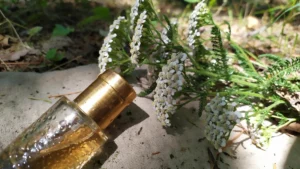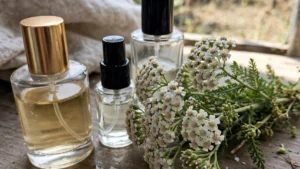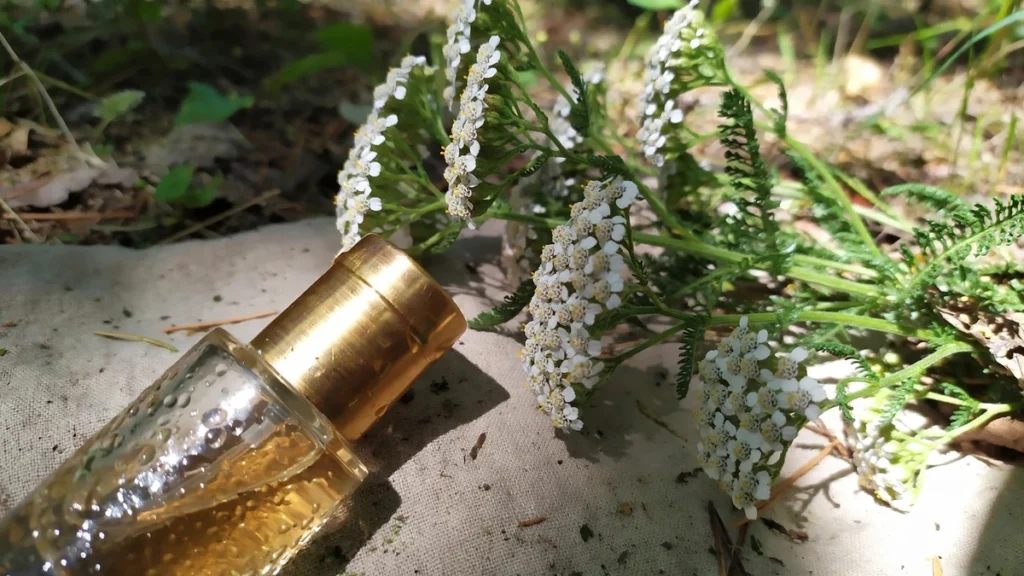
Yarrow is a roadside herb with a battlefield name and a smell that divides everyone who meets it. It grows wild across Europe and North America, a knee-high plant with feathery leaves and flat clusters of white flowers, used as a wound herb since the time of Achilles, for whom it is named. In perfume it is a rare, sharp, bitter-green note that smells of camphor and crushed herbs.
The note is rare because the plant is awkward to work with. Yarrow oil is strongly scented and chemically complex, and perfumers use it in small amounts, usually in the heart of a composition, where it adds a bitter-green edge to sea notes, pine, and violet. A little goes a long way, and too much turns the whole scent medicinal.
Below is a plain guide to what yarrow is, how it gets into a bottle, and how to tell it apart from its lookalikes, so you can read a note list the way a perfumer writes it.
Key takeaways
- Yarrow is Achillea millefolium, a bitter-green herb in the daisy family, named for Achilles.
- The note smells sharp, camphoraceous and herbal, with green and faintly floral facets underneath.
- Yarrow usually appears as a heart note, and the oil can be deep blue from chamazulene.
- Yarrow is easily confused with tansy, chamomile and wormwood, which share its chemistry.
- No note list replaces a skin test, because yarrow’s camphor edge changes with temperature and skin chemistry.
What yarrow is, and where it comes from
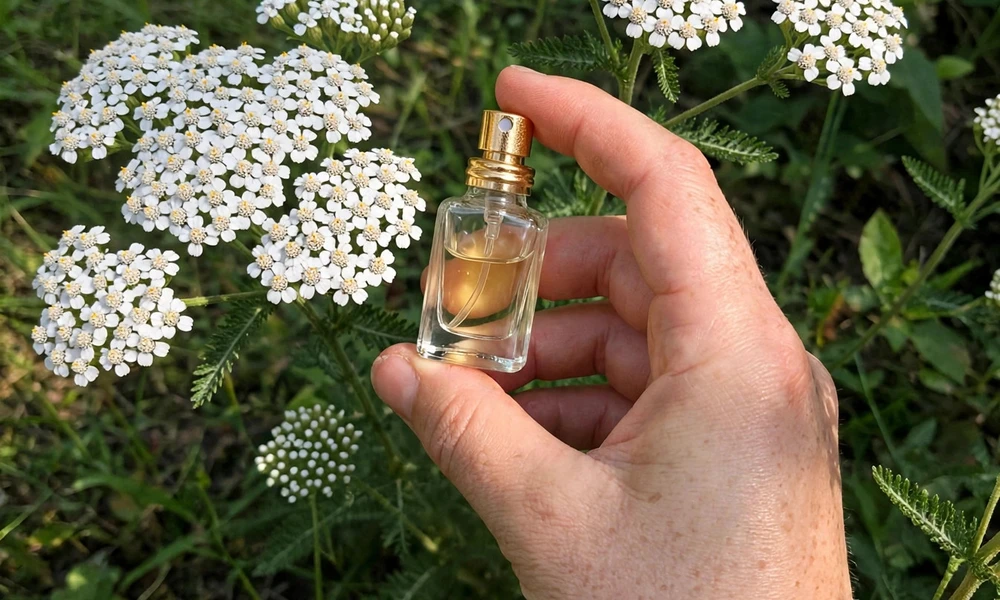
Yarrow is the common name for Achillea millefolium, a hardy perennial in the daisy family that grows wild on roadsides, meadows and mountain slopes across Europe, Asia and North America. The plant stands knee-high, with finely divided feathery leaves and flat-topped clusters of tiny white or pale pink flowers that bloom from early summer into autumn.
The smell of the fresh plant is unmistakable once you know it. Crush a leaf between your fingers and you get a sharp, bitter-green scent with a camphor warmth underneath, dry and herbal, nothing like a garden flower. That smell comes from the volatile oils in the leaves and flowering tops, and it is the same smell, concentrated, that reaches a perfume bottle.
Yarrow is not the same thing as a flower note, and the name on a note list covers more than one material. Our guide to what a lilac perfume is makes a similar point about plant names, because lilac is another flower whose name on a note list covers more than one material, and the same care is needed here.
How yarrow ends up in a perfume bottle
Yarrow reaches a perfume as an essential oil, steam-distilled from the flowering tops of the plant. The distillation is where the note gets its most surprising quality: the oil can come out deep blue, coloured by chamazulene, a compound that forms from its precursor during heating. That blue oil is intensely scented, and perfumers dose it in small amounts.
Inside the bottle, yarrow usually sits in the heart. It is too sharp to open a scent gracefully and too volatile to anchor a drydown, so it works in the middle, giving the composition a bitter-green spine. A perfumer building around it will usually pair it with sea notes, pine, juniper or violet, which give the camphor edge something cool to lean against.
There are limits on how much yarrow oil a perfume can carry. The oil contains compounds that perfumery regulators watch, including eugenol, carvone, farnesol, isothujone and bisabolol, and finished perfumes must keep them within set levels. That is one more reason the note is used sparingly, and one more reason a bottle that lists yarrow rarely lets it dominate.
Nine facts about yarrow in perfume
Yarrow is named for a warrior
Yarrow takes its botanical name from Achilles, the Greek hero of the Trojan War, and the legend says he used the plant to staunch the wounds of his soldiers. The story is old enough that the genus Achillea carries his name in every language, and it explains why the herb has been a wound plant in folk medicine for more than two thousand years. That history tells you what kind of note this is: a medicinal herb, not a garden flower, and the smell follows the history.
What it shows: The bitter, camphoraceous character in a yarrow perfume is a property of the herb itself, not a flaw in the blend. What to consider: If you expect a soft floral, the medicinal edge of true yarrow can come as a surprise.
Yarrow belongs to the daisy family
Yarrow is a member of the Asteraceae, the daisy family, which makes it a close relative of chamomile, tansy, wormwood and arnica. The family connection is not trivia: these plants share much of the same chemistry, including the compounds that give them their sharp, bitter smells. That is why yarrow, chamomile and tansy are so often confused, and why a perfumer who wants a green herbal note can reach for any of them and get a different shade of the same idea.
What it shows: The family resemblance explains why yarrow sits comfortably beside chamomile and tansy in a blend. What to consider: A note list that names yarrow may still smell of chamomile, because the two share so much chemistry.
The oil can be deep blue
Fresh yarrow oil is sometimes a vivid blue, coloured by chamazulene, a compound that forms from matricin during steam distillation. German chamomile oil turns the same blue for the same reason, and the colour is a sign of the oil’s potency rather than a defect. The blue fades as the oil ages and never reaches the finished perfume, but it is a useful clue: a blue yarrow oil is a strong one, and a strong one needs a light hand.
What it shows: The blue colour is evidence of the oil’s strength, which is why perfumers dose it so carefully. What to consider: A perfume that claims a heavy yarrow dose is either exaggerating or badly balanced.
Yarrow smells of camphor first
The first thing you smell in yarrow oil is camphor, driven by 1,8-cineole and sabinene, two of its dominant compounds. The green is sharp rather than soft, the herbal bite is dry rather than sweet, and the faint floral facet that sits underneath only appears once the camphor settles. That order matters: the opening of a yarrow perfume is almost always the sharpest part, and the scent softens as it dries down rather than the other way around.
What it shows: The camphor opening is the note’s signature, and it is what separates yarrow from softer green herbs. What to consider: Judging a yarrow perfume on the first spray alone will almost always make it seem harsher than it is.
Yarrow is usually a heart note
Yarrow most often appears as a heart note, sitting in the middle of a perfume’s pyramid, and that placement shapes everything about it. A heart note is the scent you live with for hours, after the bright top notes have faded and before the warm base notes take over, so yarrow in the heart gives a composition a steady green spine. The few perfumes that put yarrow on top use it as a brief green flash, gone within minutes.
What it shows: Heart-note placement means the yarrow is meant to be lived with, not just noticed. What to consider: A top-note yarrow will disappear fast, so do not buy it expecting an all-day green scent.
Yarrow has flavoured famous liqueurs
Long before it reached perfume, yarrow was a flavouring herb, and it is one of the many botanicals that go into Chartreuse and Bénédictine, two of the oldest herbal liqueurs in Europe. The monks who make them have guarded the recipes for centuries, but yarrow is a known part of the bitter herbal backbone that gives both liqueurs their green, medicinal character. That history is a reminder that yarrow has always been a bitter herb first and a fragrance second.
What it shows: The liqueur connection confirms yarrow’s character as a bitter green, not a sweet floral. What to consider: If you like the herbal bite of Chartreuse, you will probably like yarrow in perfume; if you do not, you may not.
The note is still rare
For all its history, yarrow remains one of the rarest named notes in perfumery. Fragrantica has described the yarrow niche as still vacant, and only a handful of perfumes in its database list the herb at all, most of them from indie or niche houses. The oil is awkward to work with, the dose is small, and the smell divides wearers, so most houses reach for easier green notes instead.
What it shows: The scarcity is real, and a bottle that lists yarrow is genuinely unusual. What to consider: Rarity does not mean quality, and a rare note in a badly made perfume is still a badly made perfume.
Yarrow shares chemistry with wormwood
Yarrow and wormwood share several compounds behind their bitter character, including isothujone and related terpenes, which is why the two herbs smell like cousins. Wormwood is the more famous of the pair, known as the absinthe herb, and it is more tightly regulated in perfume than yarrow is. The shared chemistry means a perfumer can use yarrow to suggest wormwood’s green bitterness without the regulatory burden, and it means wearers who dislike wormwood may dislike yarrow too.
What it shows: The wormwood connection explains why yarrow reads as bitter and slightly dangerous rather than fresh. What to consider: If absinthe-style scents put you off, test a yarrow perfume carefully before buying.
Yarrow changes on skin
Yarrow is one of the notes that changes most from bottle to skin. The camphor edge that smells sharp on a paper strip can soften into a quiet green on cool skin, or sharpen into something almost medicinal on warm skin, and the change happens over the first hour of wear. Temperature, skin chemistry and whatever else you are wearing all push it in one direction or the other, which is why a yarrow perfume can smell like two different scents on two different people.
What it shows: The variability is a property of the note, not a sign of a faulty bottle. What to consider: A paper-strip test tells you almost nothing about yarrow; only a day on skin does.
Yarrow, tansy, and chamomile: telling them apart
Tansy is the sharpest of the three. It is more bitter than yarrow, more thujone-heavy, and rarely used in modern perfume at all, so a bottle that smells intensely bitter and almost acrid is more likely to be tansy than yarrow. Yarrow keeps a herbal softness underneath its camphor edge that tansy does not have, and it is the easier of the two to wear.
Chamomile is the softest of the three, and the easiest to love. It shares yarrow’s blue oil and some of its chemistry, but it smells apple-like and sweet where yarrow smells sharp and camphoraceous. A perfume that lists chamomile will usually be rounder and warmer than one that lists yarrow, and the two are worth smelling side by side to learn the difference. Our guide to what a mimosa perfume is makes a similar point about lookalike flowers, because mimosa is another note that is often confused with its cousins.
Wormwood sits to one side of the trio, more bitter than yarrow and more heavily regulated, and it brings an absinthe character that yarrow only hints at. If a perfume smells green and bitter but also dark and boozy, wormwood is the likelier culprit. Yarrow stays herbal and clean even at its most bitter, which makes it the most wearable of the family.
The caveats that matter
A yarrow note list is a poor predictor of what you will actually smell. It says nothing about the dose, nothing about whether the herb leads the scent or hides in the middle of it, and nothing about how your skin will treat the camphor edge. Wearers split hard on this note: for some it is a fresh green lift, for others it is medicine in a bottle, and the split only shows up after a day of wear. Our guide to what a chamomile perfume is covers a close relative with the same blue-oil chemistry, and the same testing advice applies here.
| Detail | What is known |
|---|---|
| What yarrow is | Achillea millefolium, a bitter-green herb in the daisy family |
| The key molecules | 1,8-cineole, sabinene, camphor and chamazulene |
| Where it usually sits | Heart note in most perfumes, top note in a few |
| How long it lasts | The green edge fades within a couple of hours |
| How it differs from tansy | Less bitter, more herbal, with a faint floral facet |
| How it differs from chamomile | Sharper and more camphoraceous, less sweet and apple-like |
| What it pairs with | Sea notes, pine, juniper, violet, vetiver and amber |
| How to test it | One spray on skin, worn for a full day, in the weather you will wear it in |
Checklist: smelling a yarrow perfume honestly
- Confirm yarrow appears in the published note list, not only in the brand’s marketing copy.
- Find where it sits in the pyramid: a top placement means a brief green flash, a heart placement means the core of the scent.
- Spray once on skin and give it an hour, because the camphor edge shifts as the top notes fade.
- Smell it next to tansy and chamomile perfumes to learn the difference between the cousins.
- Test it in warm weather as well as cool, because heat sharpens the camphor edge.
- Start with the smallest bottle, because yarrow splits opinion more than most herbal notes.
Frequently asked questions
What does a yarrow perfume smell like?
A yarrow perfume opens sharp and bitter-green, with a camphor warmth that recalls eucalyptus and a faint floral sweetness that only shows once the top notes settle. The herb sits closer to wormwood and tansy than to any soft flower, and heat can push the camphor edge toward something medicinal. Most blends use it as a green lift in the heart rather than as the lead.
Is yarrow the same as tansy?
No, yarrow and tansy are different plants, though they are both in the daisy family and share much of the same chemistry. Tansy is more bitter and more thujone-heavy, and it is rarely used in modern perfume, while yarrow keeps a herbal softness underneath its camphor edge. A bottle that smells intensely bitter and almost acrid is more likely to be tansy than yarrow.
Why is yarrow so rare in perfume?
Yarrow is rare because the oil is awkward to work with, the dose is small, and the smell divides wearers. The oil is strongly scented and chemically complex, with compounds that regulators watch, so perfumers use it sparingly, and most houses reach for easier green notes instead.
Does a yarrow perfume last all day?
The green edge itself is gone within a couple of hours, but the woods, amber or musk underneath it keep going. A vetiver or sandalwood base will carry a yarrow perfume into the evening, while a light sea-note version will be faint by the afternoon.
Is yarrow safe to wear?
The oil carries compounds that perfumery regulators monitor, among them eugenol, carvone, farnesol, isothujone and bisabolol, and finished perfumes must stay within set limits for each. Established houses formulate inside those limits, but patch testing is wise for sensitive skin, and for anyone allergic to daisy-family plants.
What should I pair yarrow with?
Reach for sea notes, pine, juniper, violet, vetiver and amber. Sea notes and pine frame the herb in cool green, violet gives it a floral heart to bite into, and vetiver and amber keep the camphor edge from fading too fast. Gourmand sweetness, by contrast, tends to fight yarrow rather than flatter it.
The bottom line
Yarrow suits people who like their green scents sharp rather than sweet, and their perfume with a little bitterness in it. It is a roadside herb with a warrior’s name, a blue oil, and a smell that has divided wearers for centuries, and it remains one of the rarest named notes in modern perfumery.
Learn the difference between yarrow and its cousins, test any bottle on skin for a full day, and buy the one whose camphor edge you enjoy rather than endure. The note is rare enough that buying blind is a risk, but distinctive enough that a single good wear tells you whether it belongs in your collection.