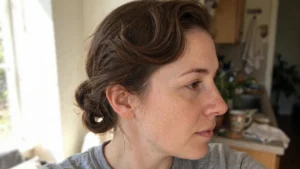
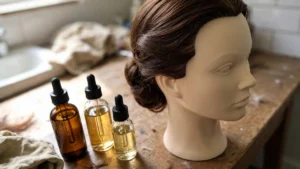
A Gibson tuck is a low, rolled updo that looks simple from the front and hides all its work at the back. The hair is gathered low, looped through itself, and tucked into a soft roll at the nape, with the front left smooth and the ends hidden inside the roll. It was the everyday elegant style of the Gibson Girl era, and it has stayed popular because it suits almost every hair length from shoulder to waist, and because it holds up through a long day without constant checking.
Oil has a narrow job in this style. A Gibson tuck holds because the hair grips itself inside the roll, so too much oil, or oil in the wrong place, turns that grip into a slide and the roll loosens within an hour. Too little oil, and the surface looks dull, the ends poke out, and the style reads as tired rather than polished.
Below are nine oils worth considering for a Gibson tuck in 2027, from a one-dollar almond oil to a bond-repairing serum for blonde hair. Each one is described by what it is good at, what to watch for, and who it suits best, so you can pick by weight and finish.
Key takeaways
- A Gibson tuck needs oil on the lengths and the surface only, never at the roots or inside the roll, or the tuck slides loose.
- Light, fast-absorbing oils suit this style best; richer oils belong on the ends, in a single drop.
- Apply oil to the lengths before you gather the hair, then smooth one drop over the finished roll.
- Light oils suit fine hair, and thick hair can take a richer one, but the amount stays small either way.
- No oil will hold a Gibson tuck up on its own, and an oil applied to the roots of a fresh tuck will pull the shape down.
What a Gibson tuck is and why oil matters
A Gibson tuck starts with the hair swept back and gathered low at the nape. The length is looped through a small opening above the band, or folded up and pinned into a roll, so the ends vanish inside the shape. The front stays smooth, the sides draw back, and the result looks like a single soft roll sitting low. The structure is hidden: the tuck, the pins, and the grip of hair on hair.
That grip is why placement matters more than the oil itself. Oil on the outer surface adds shine and calms flyaways. Oil combed through the roots before gathering is a mistake, because the hair slips through the band and the pocket instead of catching, and the roll loosens from the inside. Oil poured onto a finished tuck soaks the roll, weighs it down, and the shape sags.
The second thing oil does is visual. A low roll has a broad, curved surface, and every stray hair shows against it in daylight. A light oil tames those strays and gives the surface a gentle glow, which reads as finished rather than stiff. It also protects the ends, folded and pinned inside the roll, which take the most bending.
How we chose these oils and what to look for
The first thing to judge is how heavy the oil feels. A low roll wants an oil that vanishes into the lengths and leaves only shine, not a film you can see in daylight. Thin oils such as sweet almond, light argan, and jojoba do this well. Heavier oils such as castor still have a place, but only on the very ends, and only a trace.

Next, think about scent and what the oil leaves behind. The roll sits at the nape, close to the collar and the neck, so a strong fragrance follows you all day, and a slow-absorbing oil can mark clothing. Pick something mild that dries within a few minutes. Our guide to hair oils for victory rolls warns about the same thing in vintage rolls, where the shape must stay clean and the oil must not show.
Last, look at how the bottle gives the oil out. The finishing step needs one or two drops, so a dropper, pump, or narrow spout is worth more here than in a weekly treatment. A wide opening tempts you to pour too much, and too much is the fastest way to undo a tuck. A small bottle that measures its drops is worth the money, even when the oil inside costs little.
The 9 best hair oils for Gibson tuck 2027
Dabur Almond Hair Oil
What we like: A light almond oil with keratin protein, soya protein, and vitamin E, in a bottle that costs about a dollar, spreading evenly through the lengths without a wet look.
What to consider: It is a thin, everyday oil, so very dry hair may want a second drop on the ends, and the scent is a plain nutty note that some people find too simple. Best For: Budget-friendly daily smoothing on straight or wavy hair. Price Range: $1–$2. Standout Feature: The cheapest oil in this list, built on almond with added keratin.
Reach for this when the tuck is already up and you only want the surface to catch the light.
Suave Professionals Keratin Infusion Smoothing Hair Serum
What we like: A keratin smoothing serum promising frizz control for up to 48 hours, in a drugstore bottle, sinking into the lengths quickly with no residue on the collar.
What to consider: It is a serum rather than a pure oil, so it will not give the deep nourishment of a treatment oil, and the scent is a plain salon note. Best For: Frizz control on a budget before pinning. Price Range: $3–$8. Standout Feature: A drugstore serum that keeps frizz down for two days.
A practical pick for humid days, when flyaways need extra help.
Hollywood Beauty Argan Oil Hair Treatment
What we like: A Moroccan argan oil treatment that is alcohol-free, light enough for fine hair, and quick to absorb, with a warm, simple scent and a small bottle that lasts for months at one drop a day.
What to consider: It is a light treatment, so coarse or very dry hair may need a richer oil on the ends, and the bottle has a flip-top cap rather than a dropper. Best For: Dry ends that need shine without weight. Price Range: $9–$14. Standout Feature: A light argan treatment that absorbs fast and suits fine hair.
Argan behaves well: it adds slip where you want it and vanishes where you do not.
Kiehl’s Silk Groom Serum
What we like: A feather-light serum built on sesame oil, sunflower oil, and vitamin E, with a heritage formula that smooths frizz and adds gloss without weighing the hair down or making the roots look oily.
What to consider: It is a serum, not a treatment oil, so it will not repair damage on its own, and the price is higher than a drugstore oil for a small bottle. Best For: Flyaway control on fine to medium hair. Price Range: $18–$26. Standout Feature: A feather-light serum with plant oils and vitamin E.
A finishing serum for a tuck that should look soft, not slick.
Phyto Plage Protective Oil
What we like: A protective oil built on karanja oil and calendula, made for hair exposed to sun, salt, and chlorine, with a light spray texture that spreads evenly over a finished roll.
What to consider: It is designed for sun exposure, so it is less useful as an everyday indoor oil, and the scent is a distinct beach note that not everyone wants near the face. Best For: Outdoor days when the tuck faces sun and wind. Price Range: $28–$32. Standout Feature: The only sun-protective oil in this list.
A smart pick for a wedding or garden party, when the tuck faces hours of sun.
Sachajuan Shine Serum
What we like: A feather-light shine serum in a small 30 ml bottle, with a texture that is absorbed immediately and leaves no residue, and a finish that smooths the cuticle and seals split ends.
What to consider: The bottle is small and the price high for the size, and it is a finishing serum rather than a nourishing treatment, so dry hair may still want an oil underneath. Best For: A glossy finish on the rolled surface. Price Range: $33–$39. Standout Feature: A weightless serum that seals split ends and adds gloss.
Use this last, after the pins are in, when the roll needs gloss rather than moisture.
Virtue Split End Serum
What we like: A keratin-based serum built on Alpha Keratin 60ku, the brand’s bio-identical keratin, with independent testing cited by the brand showing 98 percent of split ends sealed after one use.
What to consider: It is a targeted repair serum rather than a general styling oil, so it adds little shine alone, and the price is high for the size. Best For: Split ends peeking out of the roll. Price Range: $40–$44. Standout Feature: A keratin serum that targets split ends directly.
The repair step for hair tucked and pinned often, when the ends start to fray.
RŌZ Willow Glen Hair Treatment Oil
What we like: A botanical treatment oil from a California salon brand, made as a pre-wash ritual for sun and chlorine damage, with a rich but fast-absorbing texture and a soft garden scent.
What to consider: It is a treatment oil, not a finishing oil, so it belongs on the hair the night before styling, not on a finished tuck, and the price is high. Best For: A pre-wash treatment the night before styling. Price Range: $45–$49. Standout Feature: A garden-inspired treatment oil for sun and chlorine damage.
Use it the evening before, so the tuck starts from smooth hair and the finish needs almost nothing.
Davines Heart of Glass Instant Bonding Glow
What we like: A reinforcing extra-shine serum for natural and treated blondes, with a biacidic bond complex and an illuminating amino concentrate, in a large 300 ml bottle that lasts for months.
What to consider: It is made for blonde hair, so darker hair will not get the same brightening effect, and it is a serum rather than a pure oil, so it will not replace a deep treatment. Best For: Blonde or highlighted hair in a tuck. Price Range: $50–$55. Standout Feature: A bond-repairing serum made for blonde hair.
For blonde hair in a low roll, this makes the curve catch the light.
Which oil suits your hair type
Fine hair needs the lightest oils here, and the smallest amounts. One drop of the Dabur almond oil, the Hollywood Beauty argan treatment, or the Kiehl’s serum covers a whole tuck, and more will show as grease at the nape. Apply to the lengths only, never near the roots, and smooth the surface with your palms so the oil spreads thinly.
Thick or coarse hair can carry a richer oil, and it usually needs one. The Phyto Plage oil and the RŌZ treatment oil suit this hair, with enough body to smooth a coarse surface, and thick ends drink oil faster. Our guide to hair oils for a beehive makes the same point about weight, because a tall style and a low tuck both fail when the oil is too heavy.
Curly or wavy hair needs oil on the lengths before gathering, because the tuck pulls the curl straight at the nape, and dry curls frizz as soon as they stretch. A drop of argan or almond oil, worked through the lengths first, keeps the curl calm inside the roll. Dry or damaged hair needs the repair step too, and the Virtue serum on the ends is the right call.
The caveats that matter
Oil is a finishing step for a Gibson tuck, not a styling product. It will not hold the shape up, replace pins, or fix a tuck built on damp hair. A tuck needs dry, grippy hair, a secure band, and pins where the roll meets the head. If the shape is falling, the answer is more pinning or a tighter pocket, not more oil.
| Detail | What is known |
|---|---|
| Where oil belongs | On the lengths before gathering, and on the surface after pinning |
| Where oil does not belong | At the roots, inside the roll, or on the band area |
| How much to use | One to two drops for the whole style, warmed between the palms first |
| Best weight for fine hair | Light, fast-absorbing oils such as almond or argan |
| Best weight for thick hair | A richer oil or treatment oil, applied to the lengths and ends |
| When to apply | Before gathering for the lengths, after pinning for the surface |
| What to avoid | Pouring oil straight from the bottle onto a finished tuck |
| What oil does not do | It does not hold the tuck up, replace pins, or fix damp hair |
If your scalp is sensitive, patch-test a new oil behind your ear before using it near the hairline, and stop if you notice itching or redness. Oils are not a treatment for hair loss or scalp conditions, and a tuck pulled tight every day can stress the hairline, so vary the style and keep the tension gentle.
Checklist: choosing a hair oil for a Gibson tuck honestly
Use these checks before you buy, and again after a week.
- Check the weight: a light oil for fine hair, a richer one for thick or coarse hair.
- Check the bottle: a dropper, pump, or narrow spout that gives one drop at a time.
- Check the scent: mild or neutral, because the tuck sits close to your face and collar.
- Patch-test first: apply behind the ear for two to three days before full use.
- Start with one drop: warm it between your palms, then smooth the lengths and the surface.
- Keep oil off the roots: the tuck needs grip at the nape, and oil kills that grip.
Frequently asked questions
Can I add oil once the pins are already in?
Yes, but only one drop, warmed between your palms and pressed lightly over the surface. Never pour oil onto the roll, and never oil the band area, because the tuck will loosen from the inside.
Does oil loosen the roll and make it sag?
It will if oil reaches the roots or the inside of the roll. Oil on the lengths and the outer surface does not affect the hold, because the grip lives at the roots and inside the pocket. Our guide to hair oils for halo braids makes the same point about grip, because a braided crown and a tuck both depend on friction.
Which lightweight oil works for fine hair here?
A light, fast-absorbing oil such as almond or argan, or a feather-light serum such as the Kiehl’s Silk Groom Serum. Use one drop only, on the lengths, and smooth the surface with your palms.
Does heavy castor oil spoil a low roll?
Only on the very ends, in a quantity you could fit on a fingertip. Castor oil is thick and heavy, and it will weigh the roll down if it spreads onto the surface. A light oil is a safer choice for this style.
Should the lengths be oiled before gathering?
Yes, on the lengths only. A drop worked through the mid-lengths and ends before you sweep the hair back keeps the surface smooth and the ends calm inside the roll. Keep the roots clean.
What is the gentlest way to wash the oil out afterwards?
Take the pins out one by one, let the hair fall, and shampoo as normal. Do not brush the tuck out while it is still pinned, because the tangled roll will pull and break the hair. One gentle wash removes the oil.
The bottom line
The best hair oil for a Gibson tuck in 2027 is not the most expensive or the most famous. It is the lightest oil that suits your hair type, used in the smallest amount, in the right places. For fine hair, one drop of almond or argan oil is enough. For thick hair, a richer oil on the lengths will do more. For blonde hair, a bond-repairing serum adds the shine that makes the roll stand out.
Choose one oil, use it on the lengths before you gather the hair and on the surface after you pin it, and keep it away from the roots. That is the honest way to get the shine a Gibson tuck deserves, without the slide that makes people give up on the style.