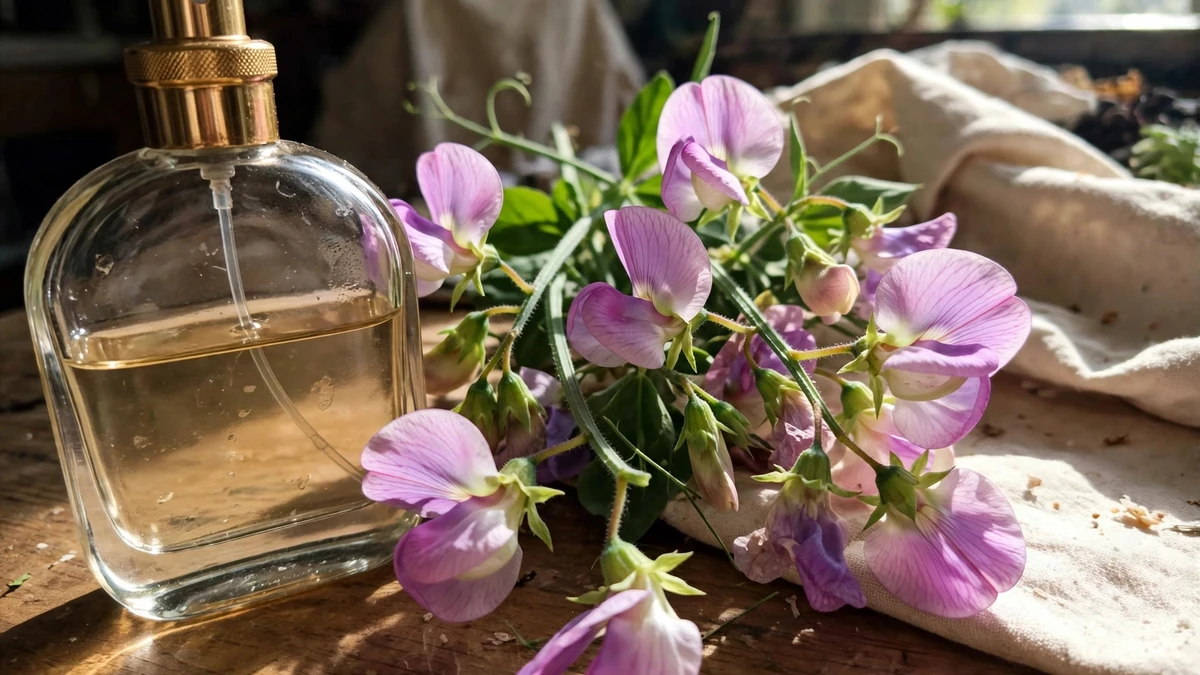
Sweet pea is one of the prettiest flowers in a garden, and one of the strangest notes in perfumery. It is a climbing annual with ruffled, paper-thin petals and a scent that can fill a whole garden on a cool morning, yet there is no bottle of sweet pea oil anywhere in the world. The flower gives up its smell to no still, no press and no solvent, so every perfume that names it is guesswork, built from other flowers and a little chemistry.
That guesswork matters when you buy perfume. A bottle that lists sweet pea may smell of honey and powder, or of green stems and grape, or of almost nothing at all, depending on which materials the perfumer used to stand in for the flower.
Below is a plain guide to what sweet pea is, how it gets into a bottle, and how to tell it apart from its lookalikes, so you can read a note list the way a perfumer writes it.
Key takeaways
- Sweet pea is the flower of Lathyrus odoratus, a climbing annual from Sicily, and it is not the same plant as the garden pea.
- There is no sweet pea essential oil, so every sweet pea perfume is a constructed accord.
- Sweet pea usually appears as a top or heart note and fades within a couple of hours, though a heart-note version can last into the afternoon.
- Note lists use sweet pea loosely, and the same words can describe a fresh green floral or a powdery vintage one.
- No note list replaces a skin test, because sweet pea changes with temperature, skin chemistry and what surrounds it.
What sweet pea is, and where it comes from
Sweet pea is the flower of Lathyrus odoratus, a climbing annual in the legume family from Sicily and southern Italy. The plant grows fast, throws out tendrils that grip anything nearby, and produces clusters of ruffled flowers in pink, purple, white and red, each barely bigger than a thumbnail.
The smell is hard to pin down. It is honeyed and powdery, with a green, stemmy freshness underneath and a faint grape-like sweetness on top, and it changes through the day. In the cool of the morning it is at its strongest, and by the heat of the afternoon it has mostly gone.
Sweet pea is not the same thing as the garden pea. Our guide to what a freesia perfume is makes a similar point about flower names, because freesia is another flower whose name on a note list covers more than one material.
How sweet pea ends up in a perfume bottle
Sweet pea reaches a perfume in one way only: as an accord. The flower produces too little scent material to extract, and the scent it does produce is too fragile to survive distillation, so perfumers build an impression of it from other things: rose and jasmine for the floral heart, green notes for the stems, a powdery musk for the softness, and methyl anthranilate for the grape-like edge.
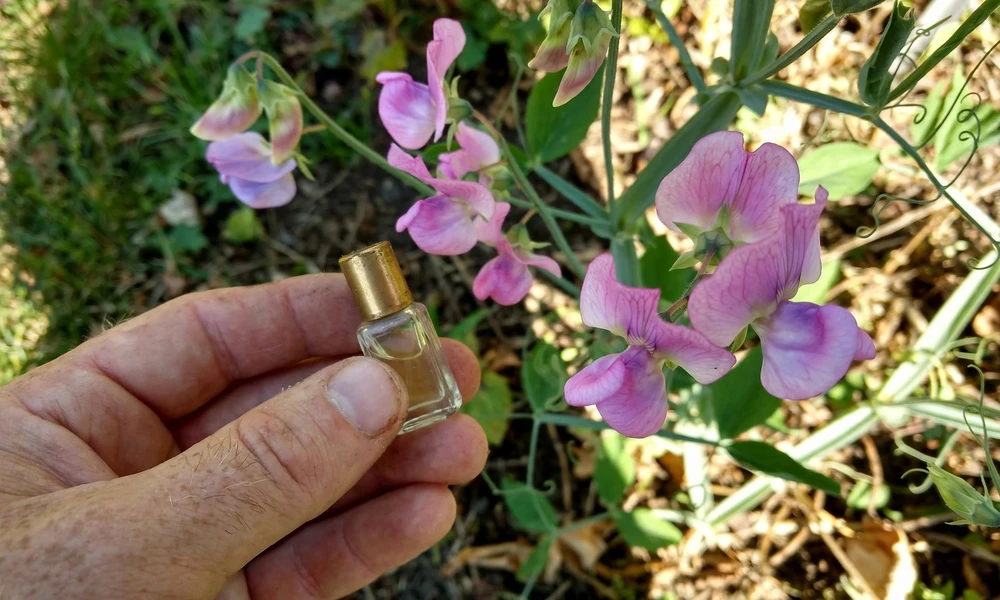
Which building blocks a perfumer chooses changes what you smell. A rose-heavy accord gives a soft, powdery sweetness that reads as old-fashioned. A green-heavy accord gives a fresh, stemmy lift that reads as modern. A note list that simply says sweet pea tells you none of this, which is why two perfumes with the same listed note can smell different.
The amount matters too: sweet pea is a light material, and a little goes a long way. In most perfumes it is used in small doses, as a top note that brightens the opening or as a heart note that softens a powdery base. A lilac perfume works the same way, because lilac is also built as an accord.
Nine facts about sweet pea in perfume
Sweet pea is a flower, not a vegetable
Sweet pea comes from Lathyrus odoratus, a climbing annual in the legume family, and the part that matters is the flower, a ruffled blossom in pink, purple, white or red. The plant is grown for the scent of those flowers, not for food, and has been since the late seventeenth century, when a Sicilian monk sent the first seeds to England. That matters because it explains the smell: sweet pea has a honeyed, powdery quality that no vegetable has, and it comes from the flower itself, not from anything added to it.
What it shows: The honeyed character in a sweet pea perfume is a property of the flower, not a flaw in the blend. What to consider: If you expect a green, vegetable smell, the honeyed sweetness of true sweet pea can come as a surprise.
No bottle of sweet pea oil exists
There is no essential oil of sweet pea, and no absolute, tincture or concrete. The flower produces scent in quantities too small to collect, and the scent compounds break down under heat, so steam distillation destroys the very thing it should capture. Every sweet pea perfume is therefore a reconstruction, and its quality depends entirely on how well the perfumer builds it.
What it shows: The sweet pea in a perfume is always an accord, never an extract. What to consider: A perfume that claims to contain sweet pea oil is either mistaken or misleading, because no such oil is sold anywhere.
Methyl anthranilate is the source of the grape edge
Methyl anthranilate is the molecule behind the faint grape-like edge in a sweet pea scent, the same molecule that gives artificial grape flavour its smell, present in the real flower in small amounts. When you smell a grape note in a sweet pea perfume, you are mostly smelling methyl anthranilate, whether the perfumer added it on purpose or it arrived as part of a larger floral accord.
What it shows: The grape character is a property of the molecule, not of any one flower. What to consider: A perfume that leans too hard on methyl anthranilate can smell like grape sweets rather than a flower, which is why the best sweet pea accords use it sparingly.
Cool mornings are when the flowers give off the most scent
Sweet pea releases its scent in the cool of the morning, and by the heat of the afternoon the flowers have mostly stopped. The scent compounds are volatile, which means they evaporate quickly, and they evaporate faster as the air warms. Gardeners cut sweet peas early for this reason, and perfumers know it too, which is why a sweet pea perfume smells strongest in its first hour and then fades.
What it shows: Sweet pea is a morning flower, not an all-day one, in the garden and in the bottle. What to consider: If you want to smell sweet pea all day, you need a bottle where it sits in the heart, not the top.
A 1927 Caron bottle first put the flower at the centre
One of the earliest perfumes to feature sweet pea as a named note was Caron’s Pois de Senteur, launched in 1927, where the flower sits at the centre of a powdery floral. The note has been in use ever since, through the clean florals of the early two thousands, the gourmands of the twenty tens, and the niche tea florals of today. It is one of the few floral notes that has never gone out of fashion, even though it has never been fashionable either.
What it shows: Sweet pea has been a working perfumery material for nearly a century. What to consider: Its long history means classics and modern niche bottles can smell very different from each other.
The same flower reads fresh or powdery
Sweet pea changes character completely with its neighbours. With green tea, freesia and peony, the classic fresh materials, it reads as clean, green and modern, the smell of a garden in spring, not a dressing table. With iris, heliotrope and powdery musk, it reads as soft, vintage and powdery, the smell of a powder compact, not a garden. The accord is the same in both cases; the company is what changes.
What it shows: The character of sweet pea is set by its neighbours, not by the flower itself. What to consider: If you dislike sweet pea in one style, you may still like it in the other, because the two can smell like different notes.
Sweet pea links the first spray to the base
Perfumers use sweet pea to connect bright top notes to a softer base. Citrus and green tea are light and volatile, musk and powder are heavy and slow, and the gap between them can feel like a jump. Sweet pea sits in the middle, sweet enough to belong with the base and fresh enough to belong with the top, smoothing the transition so the perfume feels like one thing rather than two.
What it shows: Sweet pea is often present to do a structural job, not to be smelled on its own. What to consider: A perfume where sweet pea works as a bridge may never smell of sweet pea at all, even though the note is listed.
The everlasting pea has no scent at all
Sweet pea has a close cousin, the everlasting pea, Lathyrus latifolius, which looks almost identical but has no scent. The two are often confused in gardens, and sometimes in perfume too, because a note list that says sweet pea does not always mean the scented species. A perfume built on the wrong idea of the flower can smell of generic white florals and never show the honeyed, grape-like edge that makes the real thing distinctive.
What it shows: The two peas are lookalikes, not twins, and a perfumer chooses between them for a reason. What to consider: A note list that says sweet pea may still smell like nothing in particular, because the accord was built from the wrong flower.
Heat and cold show two sides of sweet pea
Sweet pea is more volatile than most notes, so it responds to heat. On warm skin, or in warm weather, it evaporates faster and reads sweeter, because the green, stemmy facets burn off first and the honeyed sweetness is what remains. On cool skin, or in cold weather, it lasts longer and reads greener, because the stemmy facets survive and the sweetness stays in check.
What it shows: The same perfume can smell like two different perfumes from one day to the next. What to consider: A bottle you dislike in summer may be the bottle you love in spring, and the other way round.
Sweet pea, garden pea, and everlasting pea: telling them apart
Three plants share the word pea, and they are used loosely enough that even experienced wearers mix them up. Sweet pea is Lathyrus odoratus, a scented climbing flower from Sicily, honeyed and powdery with a grape-like edge. Garden pea is Pisum sativum, a vegetable with almost no scent, grown for food and never used in perfume. Everlasting pea is Lathyrus latifolius, a scentless lookalike of the sweet pea, with the same ruffled flowers and none of the smell.
The differences are small but real. Sweet pea is the only one of the three with a scent worth building a perfume around. Garden pea is the one you eat, and it contributes nothing to a bottle. Everlasting pea is the one that fools gardeners, because it looks like sweet pea and smells like nothing, and a perfume built on that confusion smells like nothing in particular.
Our guide to what a mimosa perfume is makes a similar point about flower names, because mimosa is another flower whose name on a note list covers more than one plant.
The caveats that matter
Sweet pea is a note that rewards curiosity and punishes assumptions. The word on a list does not tell you which plant was meant, which materials were used to build the accord, or whether you will be able to smell it at all. It also does not tell you whether you will like it, because the powdery character divides wearers more than almost any other floral note. Some love it instantly and some find it old-fashioned, and no amount of blending changes that.
| Detail | What is known |
|---|---|
| What sweet pea is | The flower of Lathyrus odoratus, a climbing annual from Sicily |
| The key molecule | Methyl anthranilate, which gives the faint grape-like edge |
| Where it usually sits | Top note in most perfumes, heart note in the richer ones |
| How long it lasts | Loudest in the first hour, faint sweetness after that |
| How it differs from garden pea | Scented and honeyed; garden pea has almost no scent at all |
| What it pairs with | Green tea and freesia for fresh, iris and powder for vintage, mint for cool |
| How to test it | One spray on skin, worn for a full day, in the weather you will wear it in |
| What it does not do | It does not stay loud all day, and it does not smell the same in every bottle |
Checklist: smelling a sweet pea perfume honestly
- Check which plant the note list names: sweet pea, garden pea and everlasting pea are different plants.
- Check where it sits: a top-note sweet pea fades fast, a heart-note sweet pea stays longer and smells softer.
- Check the neighbours: green tea and freesia mean fresh, iris and powder mean vintage, mint and musk mean cool.
- Smell it on skin, not on paper: sweet pea changes on skin, and the drydown is what you will actually live with.
- Test it in the right weather: cool weather shows the green side, warm weather shows the sweet side.
- Ask whether you like powdery florals: if not, pick a perfume where sweet pea stays in the background.
Frequently asked questions
Can perfume ever match a living sweet pea?
Partly. A good accord captures the honey, the powder and the green stems, and the best ones add the grape-like edge. No perfume captures the flower exactly, because there is no extract to compare it with, so the honest answer is that it smells like a good impression, not the flower itself.
What makes sweet pea hard for perfumers to use?
Because it cannot be extracted, and the accord is hard to build. A perfumer has to reconstruct the flower from other materials, and most houses would rather use a flower that can be distilled, like rose or jasmine. That is why sweet pea appears mostly in niche bottles and heritage houses.
Is sweet pea only a spring scent?
Mostly, but not entirely. The fresh, green sweet pea perfumes work best in spring and warm weather, because the note reads as cool and bright. The powdery, vintage ones work well in cooler weather too, because the powder softens the green.
Is sweet pea for everyone?
Anyone. Sweet pea appears in perfumes made for men, for women and for everyone, and its character depends on what surrounds it rather than on who wears it. The green, woody versions are more common in masculine perfumes, the powdery, sweet ones in feminine ones, but there is no rule.
Will sweet pea still be there by the evening?
The flower itself usually will not last all day. It peaks in the first hour, then fades and leaves the base notes to carry the perfume. The richer bottles, where sweet pea sits in the heart, last longer, because the base holds the flower in place.
Which notes sit best alongside sweet pea?
Green tea and freesia for a fresh floral, iris and powdery musk for a vintage one, mint and white musk for a cool one, and fig and nougat for a sweet one. The worst pairing is a heavy gourmand in summer, when the sweetness turns cloying and the flower disappears.
The bottom line
Sweet pea is a small note with a large shadow. It is a flower, not a vegetable, and it shares its name with two plants that have no scent at all, which is why note lists use the words sweet pea, garden pea and everlasting pea almost interchangeably. What matters is not the word on the list but the accord in the bottle, where it sits in the pyramid, and the company it keeps.
The honest way to buy a sweet pea perfume is to test it on your own skin, in the weather you will wear it in, and judge it on the drydown rather than the opening. Do that, and the note stops being confusing and starts being useful, which is exactly what a good floral note should be.