


Have you ever stared at the humming box on your counter and wondered how a machine that heats food in seconds actually gets made? The story of how microwaves are built is stranger than most people expect. It starts with a melted chocolate bar in a lab, passes through a 340-kilogram commercial monster, and ends with a factory in Asia stamping out millions of countertop units a year. This article walks through the whole journey: the parts, the history, the safety rules, and the practical details that separate a good build from a bad one.
The Accidental Origin of the Microwave Oven
The technology behind every microwave oven was born in 1945, when an engineer named Percy Spencer was working with radar equipment at Raytheon. Spencer noticed a chocolate bar melting near a magnetron, the vacuum tube that generates microwave energy. Raytheon filed a patent that same year, and the “Radarange” brand was born.
One honest caveat here: the melting-chocolate anecdote is repeated everywhere, but it rests on later retellings rather than contemporaneous records. Treat it as tradition, not documented fact. What is documented is the engineering: the cavity magnetron, invented in 1940, is the component that makes domestic microwaves possible, generating energy at roughly 2.45 GHz in most ovens.
From Radarange to Countertop
The first commercial microwave, launched in 1947, was a tall, water-cooled unit built for commercial kitchens. It stood about 1.7 meters high and weighed around 340 kilograms. Figures vary by source, so treat those numbers as approximate. Domestic models followed in the 1950s and 1960s, with Tappan introducing a home unit around 1955 and Amana pushing countertop designs by 1967. Exact claims about the very first domestic model conflict across sources, so it is safer to describe this as a gradual transition than a single eureka moment.
What Goes Inside a Microwave Oven
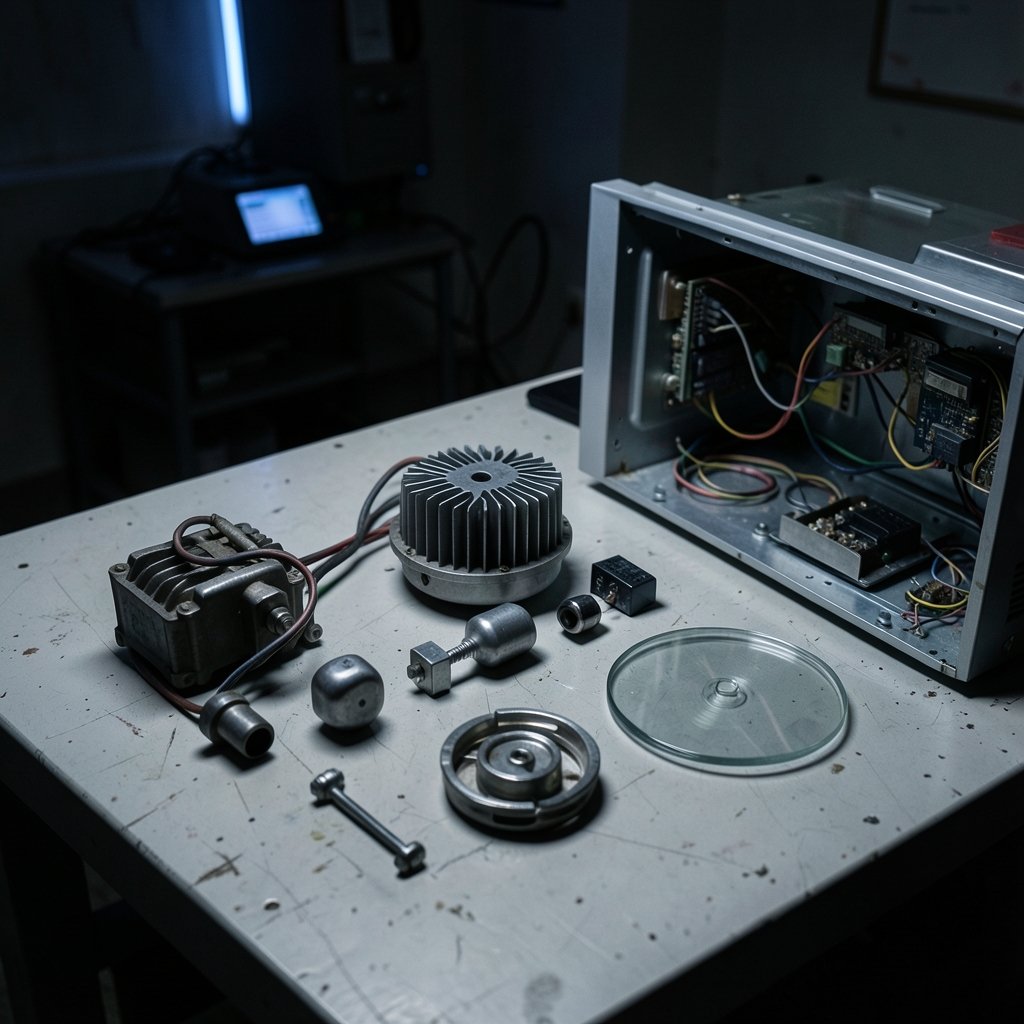
A modern microwave is a surprisingly simple machine at heart. Strip away the keypad and the marketing, and you find a handful of core systems working together.
The Magnetron and High-Voltage System
The magnetron is the engine. It converts electrical energy into microwaves, and it needs serious voltage to do it. A transformer and a high-voltage capacitor step up household current, and a diode rectifies it. This is why microwave repairs are genuinely dangerous: the capacitor can hold a lethal charge long after the oven is unplugged. Any practical guide to working on a microwave starts with discharging that capacitor, and honestly, most people should not open the case at all.
The Waveguide and Stirrer
Once the magnetron produces microwaves, a waveguide channels them into the cooking cavity. Because waves do not distribute evenly on their own, most ovens include a stirrer fan or a rotating turntable to spread the energy around. This is also why food heats unevenly: standing-wave patterns create hot and cold spots, and microwaves do not cook “from the inside out” in the way people often assume. Penetration depth is limited, and polar molecules, chiefly water, do most of the absorbing.
The Cavity, Door, and Choke Seal
The metal box itself is part of the design. The cavity reflects microwaves back into the food, and the door uses a choke seal, a series of grooves that trap leakage, plus a mesh screen with holes small enough to block microwaves while letting light through. The door interlocks are safety-critical: if they fail, the oven should refuse to run. A well-built microwave treats the door assembly as seriously as the electronics.
Controls and Sensors
Modern units add inverter technology, humidity sensors, and weight sensors that adjust cooking time automatically. Inverter models vary power output continuously rather than cycling the magnetron on and off, which tends to produce more even results for delicate foods. These are the features that separate budget builds from premium ones.
How Microwaves Are Built Today: The Manufacturing Process
Most microwaves sold worldwide are assembled in Asia, with major production by Chinese, Korean, and Japanese firms. Galanz is often described as the world’s largest microwave maker, though market-share claims come from company or trade-press sources and deserve caution. Regardless of brand, the assembly line follows a similar rhythm.
- Stamping and forming. Sheet steel is cut and pressed into cavity bodies, outer cabinets, and door frames. Tolerances here matter because a warped cavity affects wave distribution.
- Coating. Cavities get enamel or similar coatings to resist rust and make cleaning easier. Cheap coatings flake; good ones survive years of tomato sauce.
- Sub-assembly. Magnetrons, transformers, capacitors, and wiring harnesses are built and tested as separate modules before they meet the chassis.
- Final assembly. Workers or robots fit the magnetron, waveguide, stirrer, turntable motor, and control board into the cavity, then attach the door and interlocks.
- Leakage and function testing. Every unit should be checked for microwave leakage and basic function before packing. This is the step that separates serious factories from careless ones.
- Packaging and shipping. Finished ovens are boxed, palletized, and shipped by container.
What Actually Matters in Practice
Having watched how these units are specified and sold, a few practical lessons stand out. First, weight is a rough proxy for build quality: heavier transformers and thicker steel usually mean a sturdier oven. Second, the door hinge is a common failure point, so open and close a display model a few times before buying. Third, avoid models with flimsy keypads if you cook often; membrane panels wear through. And a common mistake is assuming a higher wattage always means better cooking. A well-designed 900-watt oven with a good stirrer often outperforms a badly designed 1200-watt unit.
The Safety Rules That Shape Every Build
Microwave manufacturing is not a free-for-all. In the United States, a performance standard for microwave ovens set a leakage limit of 5 mW/cm² measured 5 cm from the surface, checked before sale and again after purchase. That standard took effect in 1971 and has been amended since. Internationally, the IEC 60335-2-25 standard covers microwave safety, and national regulators enforce their own leakage limits.
For buyers, this means a certified oven from a reputable brand is a known quantity. The riskier territory is secondhand and vintage units: an old oven with a damaged door seal may exceed leakage limits, and there is no easy way to check without a meter. If you inherit a decades-old microwave, inspect the door and seals carefully, and consider retiring it if anything looks worn.
A Short Timeline of Microwave Milestones
| Year | Milestone |
|---|---|
| 1940 | Cavity magnetron invented in the UK |
| 1945 | Percy Spencer’s discovery at Raytheon; patent filed |
| 1947 | First commercial Radarange, roughly 1.7 m tall |
| c. 1955 | Tappan introduces a domestic model |
| 1967 | Amana launches a countertop Radarange |
| 1971 | US leakage performance standard takes effect |
| Mid-1970s | US microwave sales overtake conventional ovens |
That last row is widely cited but the precise year and source vary, so verify before quoting a specific figure. The broader point holds: within about three decades, the microwave went from a commercial curiosity to a fixture in most American kitchens.
Design Details That Change How a Microwave Feels
Build quality shows up in small places. The interior coating determines how long the oven stays clean. A flatbed design without a turntable offers more usable space but demands better wave distribution. Door handle construction, the feel of the keypad, and the noise of the fan all reflect how much the manufacturer invested.
There is also a styling layer. Appliance finishes follow kitchen trends the same way beauty trends follow their own cycles, and the matte black and brass accents popular in kitchens echo the same minimalist mood you see in something like micro black french tips on a nail set. It sounds like a stretch, but the design language of a modern kitchen is consistent from the countertop to the smallest detail.
Practical buyers should also think about how the oven fits their actual habits. Someone reheating leftovers needs little more than a reliable 900-watt unit with a turntable. Someone steaming vegetables or defrosting meat regularly will notice the difference an inverter and a humidity sensor make. And anyone with a small kitchen should measure the counter depth before falling for a sleek oversized model.
Maintenance and the Mistakes People Make
Most microwave failures are avoidable. Running the oven empty is a classic error: with nothing to absorb the energy, the magnetron can overheat and fail. Metal in the cavity causes arcing that pits the interior. A dirty door seal can look bad, and food residue can compromise the seal over time.
Cleaning matters more than people think. A bowl of water heated for a few minutes loosens grime, and wiping the cavity weekly prevents the baked-on layer that eventually affects performance. For households that cook a lot of rice, beans, or stews, splatter guards are cheap insurance.
There is also a cultural dimension to how these appliances get used. In households with coily, fragile hair, a microwave is sometimes used for heat treatments, and the same care applies: never heat anything sealed, and always test temperature first. If you are managing 4c hair and using heated tools or treatments, the microwave is a convenience, not a shortcut for careful handling.
Buying a Microwave: What the Build Tells You
When comparing models, look past the wattage sticker. Check the interior coating, the door mechanism, the warranty length, and whether the control panel feels solid. A longer warranty usually signals that the manufacturer trusts its own build. Also check the noise level if the oven sits near a living space; cheap fans whine.
One more practical note: installation matters as much as construction. A microwave needs clearance for ventilation, and an over-the-range unit needs proper mounting. A great oven badly installed will underperform. If you are outfitting a kitchen from scratch, plan the microwave’s position alongside the rest of your layout rather than squeezing it in last, the same way you would think through the row of cabinets and appliances as a single composition rather than isolated pieces.
Conclusion
How microwaves are built is really a story about convergence: a wartime radar component, a melted chocolate bar, and decades of manufacturing refinement all meeting in a box that costs less than a nice dinner out. The machine itself is elegant in its simplicity, and the differences between a good build and a bad one come down to materials, testing, and the small design choices that determine whether an oven lasts two years or fifteen. Next time you press start, you will know exactly what is happening behind that mesh screen.
FAQ
How long does a microwave typically last?
Most well-built microwaves last around seven to ten years with normal use. Longevity depends heavily on the magnetron, the door seal, and whether the oven is kept clean. Cheaper units often fail earlier at the door hinge or control panel.
Is it safe to use a microwave with a damaged door seal?
No. A compromised door seal can allow leakage beyond safe limits. Stop using the oven and have it inspected or replaced. This is especially important for older units, where the seal material may have degraded.
Do microwaves cook food from the inside out?
No, that is a myth. Microwaves penetrate only a short distance into food and are absorbed mostly by water molecules near the surface. Heat then spreads inward by conduction. Uneven heating comes from standing-wave patterns, which is why turntables and stirrers exist.
Why do some microwaves heat more evenly than others?
Even heating depends on the stirrer or turntable design, the cavity shape, and whether the oven uses inverter technology. Inverter models vary power continuously rather than pulsing on and off, which generally produces more consistent results.
Can a microwave oven leak radiation through the window?
The mesh screen on the door blocks microwaves while letting visible light through. As long as the door and seal are undamaged, leakage stays within regulated limits. The US standard caps leakage at 5 mW/cm² measured 5 cm from the surface.
What is the most common cause of microwave failure?
Running the oven empty is a leading cause, because there is nothing to absorb the energy and the magnetron can overheat. Arcing from metal objects and worn door interlocks are other frequent culprits.









