

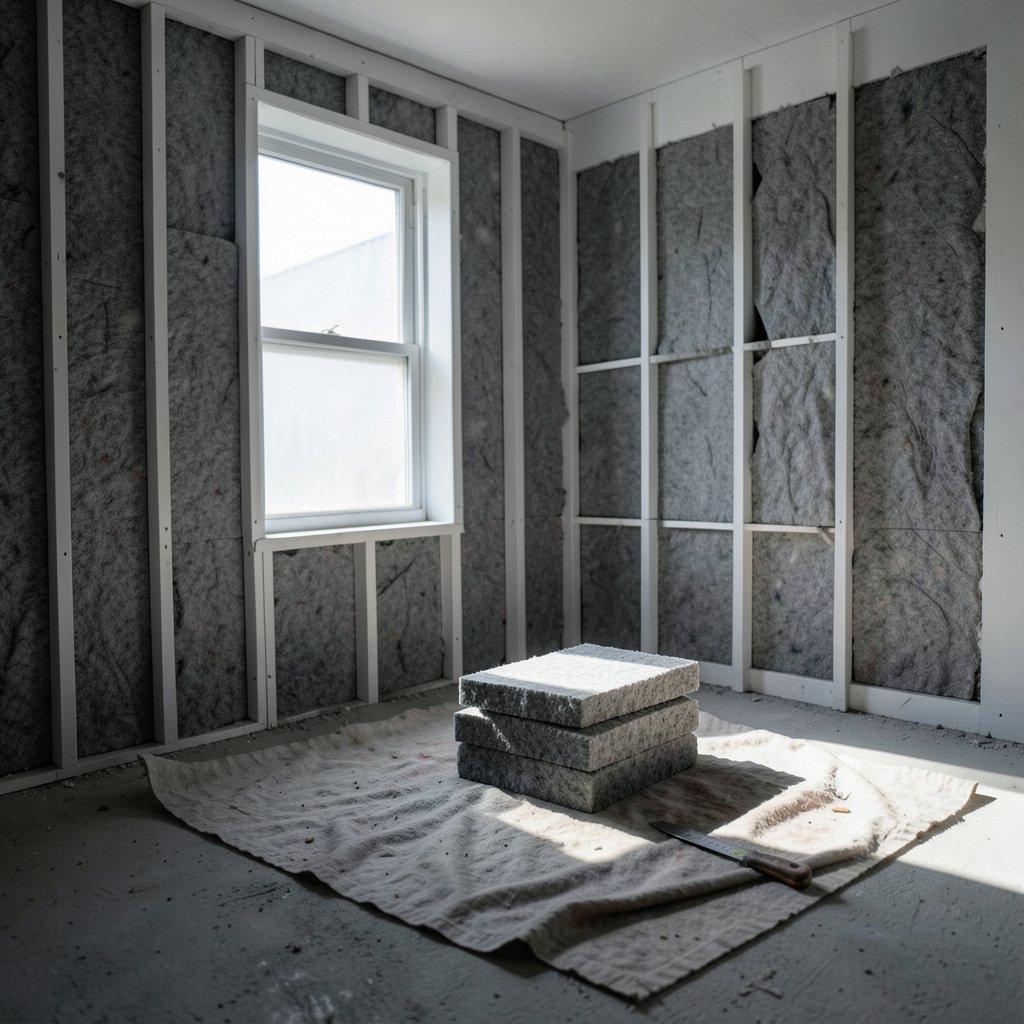
What makes a wall stop a fire from spreading while quietly cutting your heating bill at the same time? For builders, renovators, and homeowners across Europe and North America, one answer keeps coming up: rockwool, also called stone wool or mineral fiber insulation. It comes in slabs, batts, and loose fill, it feels like a dense grey sponge, and it behaves very differently from the pink fiberglass most people picture when they hear the word “insulation.”
This article looks at what rockwool actually is, how it performs in fire and thermal tests, where it makes sense for a project, and where it falls short. No hype, no sales pitch, just the practical picture.
What Rockwool Actually Is
Rockwool is a fibrous insulation made by melting basalt and other rock at roughly 1,500 °C, spinning the molten material into fibers, and binding those fibers together with a cured resin binder. The result is a dense, springy mat that traps air between millions of fine fibers. That trapped air is what slows heat transfer, while the rock-based fibers themselves give the product its fire and moisture behavior.
The process was commercialized in the 1930s, and the Danish manufacturer Rockwool traces its own stone wool production back to 1937 in Copenhagen. That long production history matters for one practical reason: the material has been installed in buildings, ships, and industrial plants for nearly nine decades, so there is a large body of field experience behind it.
One naming trap to clear up early: “mineral wool” is an umbrella term that covers stone wool, slag wool, and glass wool. Their health and fire claims differ by fiber type and by whether a product meets specific regulatory criteria. A claim that is true for stone wool is not automatically true for every mineral wool product on the shelf, so always check the label on the specific bundle.
How It Performs in a Fire

This is where stone wool earns its reputation. The material is typically rated non-combustible under the European fire classification standard EN 13501-1, landing in Euroclass A1 or A2-s1,d0 depending on the product. In plain terms, it does not fuel a fire and contributes very little smoke.
That property is why rockwool shows up in places where fire containment matters more than R-value alone: party walls between terraced houses, steel column protection, penetration seals around pipes, and cavity barriers inside rainscreen facades. In a fire, stone wool stays put and keeps blocking the gap it was installed to fill. Glass wool and foam boards can melt, shrink, or burn away, which is exactly the failure mode fire-stopping details are designed to prevent.
A practical tip from site experience: fire performance only holds if the wool is packed tight with no gaps. A perfectly rated slab with a 20 mm gap around a pipe is a hole in the fire barrier. Cutting slightly oversized and compressing the wool into place is the standard fix, and it is the step most often rushed.
Thermal Performance in Numbers
Typical thermal conductivity for stone wool sits around 0.035 to 0.045 W/(m·K), depending on density and product type. Lower numbers mean better insulation. That range puts stone wool in roughly the same league as glass wool, though usually slightly behind the best rigid foam boards per centimeter of thickness.
| Insulation type | Typical thermal conductivity | Fire behavior | Moisture behavior |
|---|---|---|---|
| Stone wool (rockwool) | 0.035–0.045 W/(m·K) | Non-combustible (A1/A2) | Repellent, breathable |
| Glass wool | Similar range | Non-combustible | Repellent, less dense |
| Rigid foam (EPS/XPS/PIR) | Often lower | Combustible, needs protection | Can trap moisture |
| Natural fibers | Higher | Varies, usually combustible | Moisture-sensitive |
The trade-off is density. Stone wool products typically range from roughly 30 to 200 kg/m³. Light batts around 30 to 50 kg/m³ are fine for lofts and stud walls, while denser slabs of 80 kg/m³ and up are used for acoustic separation and fire applications. Denser is not automatically better for thermal performance; it is better for sound and fire, and heavier on the wallet.
For anyone comparing wall build-ups, it helps to think in whole assemblies rather than single products. A wool living room carpet and a rockwool cavity slab solve completely different problems, even though both are wool-based products sold on comfort claims. Insulation decisions belong to the wall, roof, and floor assembly, not the showroom.
Health Questions, Answered Honestly
Mineral fiber insulation has a complicated reputation, largely inherited from older asbestos-era fears. The current picture is more reassuring but not blanket-simple.
In the EU, mineral wool fibers are assessed under Note Q of Regulation (EC) No 1272/2008, the CLP regulation. Biosoluble stone wool fibers that meet the Note Q criteria are not classified as carcinogenic. “Biosoluble” means the fibers dissolve in lung fluid rather than persisting, which is the property regulators care about. In 2002, IARC classified certain mineral wools, including rock and slag wool and glass wool, in Group 3, meaning they are not classifiable as to carcinogenicity to humans, based on evidence that did not show excess cancer among production workers.
Two caveats deserve airtime. First, Note Q is a regulatory carve-out for fibers that meet specific chemistry and biosolubility criteria, not a statement that every mineral fiber is harmless. Second, installation dust is still an irritant. Cut wool outdoors or in a ventilated space, wear gloves and a dust mask, and vacuum rather than sweep. These are basic site habits, and skipping them is the most common mistake DIY installers make.
Moisture, Mold, and Durability
Stone wool is generally moisture-repellent and rot-resistant, which is why it appears in cavity walls, roofs, and below-grade applications where damp is a constant risk. Water-repellent additives help the fibers shed liquid water, while the open fiber structure still lets vapor move through the assembly.
That does not make it waterproof. A rockwool batt sitting in a puddle will eventually take on water, and wet insulation insulates poorly until it dries. The practical rules are simple: fix the leak first, keep the cavity ventilated, and never trap stone wool between two vapor-tight layers where moisture cannot escape. In retrofit work, the failures almost always trace back to a sealed-in damp problem rather than the wool itself.
Rodents are another field reality. Stone wool is not a snack the way some softer materials are, and its density makes it awkward to tunnel through, but it is not a certified pest barrier. Mesh, flashing, and sealed penetrations do that job.
Where Rockwool Makes the Most Sense
Not every project needs stone wool, and using it everywhere is an expensive habit. It earns its price in specific situations:
- Party walls and separating floors between homes, where fire and acoustic performance both matter.
- Steel-framed buildings, where columns and beams need fire protection that stays in place.
- Rainscreen and cavity facades, where cavity barriers must resist fire and shed water.
- Rooms needing acoustic control, such as home studios, bedrooms above garages, and internal walls near bathrooms.
- High-humidity areas like bathrooms, kitchens, and basements, where moisture resistance matters.
For a simple loft top-up over a well-ventilated cold roof, cheaper glass wool usually does the job perfectly well. Paying a premium for stone wool there buys fire performance you may not need and weight your ceiling may not want.
Acoustic claims deserve a skeptical eye too. Rockwool helps, but density is only half the story. Flanking paths, resilient bars, and sealed joints often matter more than the insulation itself. A dense slab in a leaky stud wall will still let sound through the gaps. If noise from a neighboring unit is the real complaint, treat the whole assembly, rather than the cavity alone.
Installation Mistakes That Undo the Benefits
The most common failures seen on real jobs are consistent and avoidable:
- Compressing batts into thin cavities. Squashing stone wool raises its density and can hurt thermal performance. Buy the right thickness instead.
- Leaving gaps at edges and services. Air moves through gaps far faster than through the wool. Cut snug, fill around pipes and cables.
- Skipping the vapor control layer. In cold climates, warm moist air reaching the wool can condense inside the assembly. The control layer belongs on the warm side, sealed at every joint.
- Ignoring the wind barrier. In ventilated facades, wind washing pulls heat straight out of the insulation. A proper membrane keeps it working.
- Forgetting protection during construction. An open bundle of stone wool left in the rain for a week is a problem waiting to happen. Keep it wrapped until installation.
None of these are exotic. They are the difference between a wall that performs as designed and one that quietly underperforms for decades.
Cost, Recycling, and the Sustainability Picture
Stone wool is generally priced above basic glass wool and below high-performance rigid foam, though regional prices vary widely. Its raw material is abundant volcanic rock, and production is energy-intensive because of the melting step, which is why manufacturers increasingly publish environmental product declarations and run electric melting trials.
On the end-of-life side, stone wool can be recycled, and some producers operate take-back schemes. It also has a second life as a soil-free growing medium in horticulture, sold under names like grodan, which keeps production waste out of landfill. For projects with strict circularity targets, asking the supplier for a take-back commitment is a fair question, and the answer varies a lot between brands and countries.
One more practical note for anyone specifying materials for a textured finish: the tag “the row” style of finish and trim detailing is a reminder that surface choices and hidden insulation choices should be planned together, not in separate conversations. And for homeowners thinking about fiber-based products more broadly, from 4c hair care routines to carpet fibers, the lesson is the same one that applies to insulation: fiber structure and treatment determine how a material behaves, not the marketing name on the box.
Conclusion
Rockwool mineral fiber insulation is not a miracle product, and it is not a risky one either. It is a dense, non-combustible, moisture-resistant material with a thermal performance that sits comfortably in the middle of the market and a fire performance that sits near the top. Its real strengths show up in party walls, steel structures, facades, and acoustic assemblies, where staying put in a fire and resisting damp actually matter. Its weaknesses are cost, weight, and the fact that no insulation performs well when it is compressed, gapped, or soaked.
The honest approach is to match the product to the job. Use stone wool where fire, sound, or moisture demand it. Use cheaper alternatives where they do not. Cut it snug, keep it dry, seal the vapor layer, and wear a mask while you work. Do those things, and the material will do exactly what nearly nine decades of field use suggest it should.
Frequently Asked Questions
Is rockwool safe to breathe during installation?
The fibers in modern stone wool are designed to dissolve in lung fluid, and biosoluble products meeting EU Note Q criteria are not classified as carcinogenic. That said, cutting and handling generates dust that irritates eyes, skin, and airways. Wear gloves, long sleeves, and a dust mask, ventilate the space, and clean up with a vacuum rather than a broom.
Is rockwool better than fiberglass?
It depends on the job. Stone wool wins on fire resistance, acoustic density, and moisture tolerance, which matters for party walls, facades, and steel protection. Glass wool is usually cheaper and lighter, making it a sensible choice for simple loft insulation. For thermal performance alone, the two are close.
Does rockwool insulation burn?
No. Stone wool is typically classified as non-combustible under EN 13501-1, usually Euroclass A1 or A2-s1,d0. It does not fuel a fire and produces very little smoke. The binders and facings on some products can have minor reaction-to-fire contributions, so check the specific product’s classification.
Can rockwool get wet?
It is moisture-repellent and rot-resistant, so occasional damp does not destroy it the way it destroys some other materials. But soaked wool insulates poorly until it dries, and trapped moisture causes bigger problems in the wall assembly. Fix leaks, keep cavities ventilated, and never seal damp insulation behind vapor-tight layers.
How long does rockwool insulation last?
Stone wool is dimensionally stable and does not rot, so it can last the life of the building when installed correctly and kept dry. The realistic failure modes are installation errors, water damage from building defects, and physical disturbance during renovations, not the material aging out on its own.
Is rockwool worth the extra cost?
For fire-rated walls, acoustic partitions, facades, and humid areas, yes. The premium buys performance that cheaper materials cannot match in those spots. For a simple, well-ventilated loft top-up, the extra cost rarely pays back, and a standard glass wool product will do the same thermal job for less.














