

What does it mean when someone says a building site needs shuttering and, in the same breath, that the shop down the road is shuttering too? Same word, two completely different worlds. One involves wet concrete, plywood, and steel props. The other involves locked doors, unsold stock, and a sign that never comes back down. If that sounds confusing, you’re not alone. The word “shuttering” carries at least two major meanings in everyday English, and mixing them up can turn a construction conversation into a comedy of errors.
This article untangles both senses. It looks at what shuttering means in construction, why it matters so much to the strength of a finished building, and how it differs from related terms like formwork and falsework. Then it turns to the business sense, where shuttering means closing premises for good or for a while. Along the way, it covers the practical tips, common mistakes, and small details that separate people who know the trade from people who just repeat the word.
Why one word means two very different things
English has a habit of recycling words. “Shutter” started life as a noun for a hinged cover over a window, and from that simple object grew a whole family of meanings. A camera has a shutter that opens and closes to let in light. A shop puts up its shutters when it closes for the day. A concrete wall gets poured inside a temporary box that builders also call shuttering, because it shuts the wet material in until it hardens.
So “shuttering and shuttering” isn’t a single technical phrase. It’s a homonym pair: two unrelated ideas wearing the same spelling. There’s no evidence that it’s an established idiom or a recognized term of art. In practice, it’s usually either a headline device, a translation artifact, or simply a coincidence of two conversations happening at once.
That matters for anyone searching the term. If you’re here for construction, the business meaning is noise. If you’re here because a local shop is closing, the concrete meaning is noise. The rest of this article handles both, clearly separated, so you can take what you need and leave the rest.
Shuttering in construction: the temporary mould that makes concrete permanent

In construction, shuttering is the temporary structure that holds wet concrete in place until it sets and gains enough strength to stand on its own. Once the concrete can carry its own weight, the shuttering is removed. The material is a mould, a support, and a shape-giver all at once.
The term is chiefly British and Commonwealth usage. In the United States, most trades say formwork instead. Same job, different label. A British site manager calls for shuttering; an American one calls for forms. Neither is wrong, and on international projects you’ll hear both within the same meeting.
Shuttering shows up wherever concrete needs a shape:
- Walls and columns, where vertical panels hold the mix in a straight face.
- Slabs and beams, where horizontal decks support the wet weight from below.
- Foundations and footings, where trenches or boxes define the footprint.
- Stairs and architectural features, where curved or angled shapes need custom-built moulds.
The job sounds simple. Pour, wait, remove. In reality, it’s one of the highest-stakes parts of any concrete build. Get it wrong and you get bulging walls, honeycombed surfaces, or, in the worst case, a collapse while the concrete is still wet and heavy.
Formwork, shuttering, and falsework: sorting out the vocabulary
These three words get used interchangeably by people who should know better, and that causes real confusion on site. The distinctions are worth learning.
| Term | What it refers to | Main job |
|---|---|---|
| Shuttering (formwork) | The contact surface that touches the concrete | Shapes the wet concrete and gives it a finish |
| Falsework | The supporting structure underneath | Carries the weight of wet concrete and the formwork |
| Centering | The curved or arched support for spans | Holds the shape of arches and vaults during curing |
| Mould | The cavity itself | Defines the final geometry of the pour |
A simple way to remember it: shuttering touches the concrete, falsework holds the shuttering up. If you’re talking about the plywood face, you mean shuttering. If you’re talking about the steel props and beams beneath it, you mean falsework. Mixing the two in a quote or a spec can cost real money, because they’re priced and engineered separately.
Materials that actually work
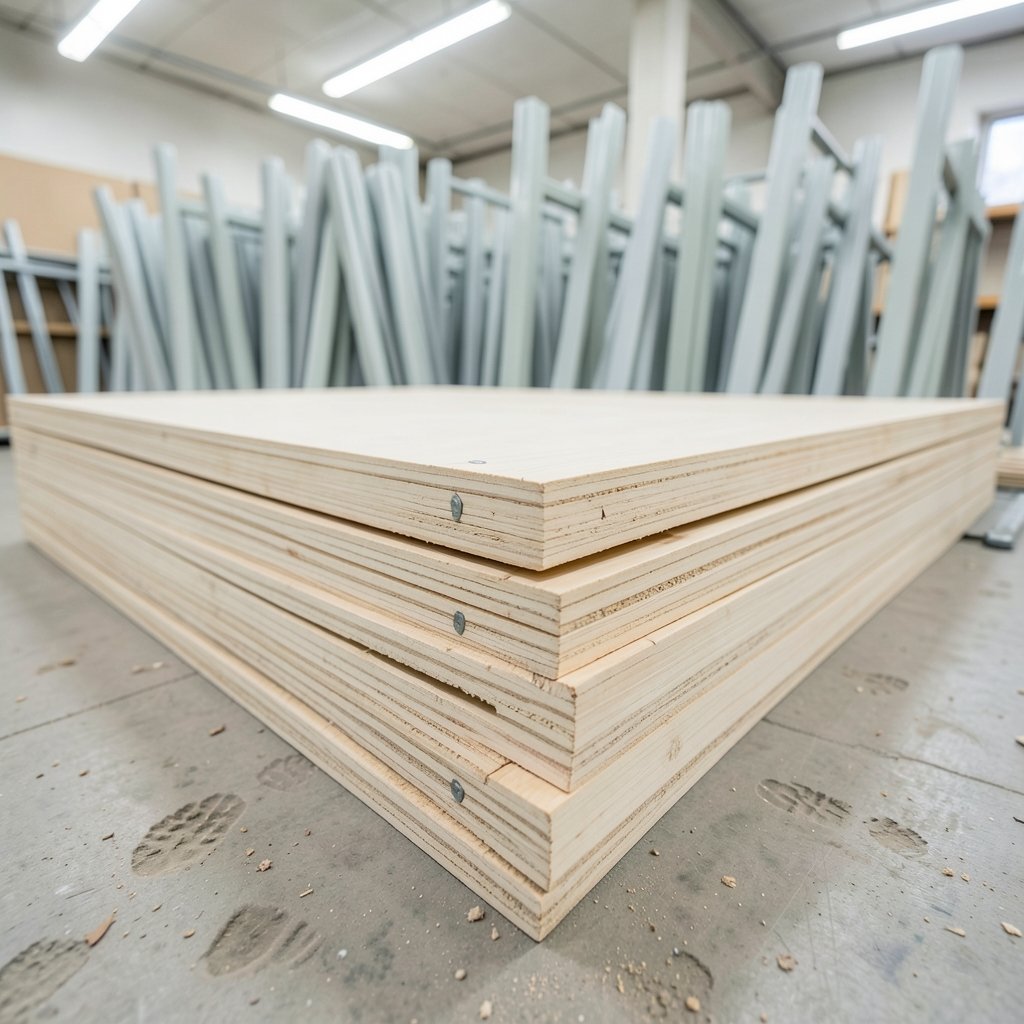
Timber is the classic choice. Plywood panels, often coated, give a smooth finish and are easy to cut and adapt. Steel forms last longer and produce very consistent surfaces, which is why they dominate repeated work like apartment towers. Aluminium is light and quick to handle. Plastic and composite systems are gaining ground for complex shapes and for projects where weight matters.
The choice comes down to three things: how many times you’ll reuse the mould, what finish you need, and how complex the shape is. A one-off curved feature wall might justify custom timber. A twenty-storey building with identical floor plates almost always pays for steel or aluminium systems that can be craned from floor to floor.
Striking: when to take the shuttering down
Removing shuttering is called striking. Timing is everything. Take it down too early and the concrete sags, cracks, or fails. Leave it too long and you slow the whole project down and tie up expensive material.
The general principle is that shuttering comes down only after the concrete has reached a specified proportion of its design strength. That threshold depends on the type of member, the mix design, and the temperature. Warm weather speeds curing; cold weather slows it dramatically. Vertical elements like walls can often be struck sooner than horizontal slabs and beams, which carry bending loads.
In practice, experienced crews combine specified curing periods with on-site strength testing rather than guessing. The common mistake is treating curing time as a fixed number regardless of conditions. A pour in winter is not the same as a pour in summer, and a mix with accelerators behaves differently from a plain mix.
Practical tips that separate good crews from rushed ones
- Plan the striking sequence before the pour, not after. Know which props come out first and in what order.
- Use release agents properly. A thin, even coat saves hours of cleaning and protects the concrete face.
- Check tie rods and fixings twice. Most blowouts trace back to a single missed fixing.
- Keep an eye on the weather. Sudden rain can wash out a fresh face; sudden cold can stall strength gain.
- Label and store panels flat. Warped shuttering produces warped walls, and no amount of finishing hides it.
The most common mistake on smaller jobs is underestimating the weight of wet concrete. It’s heavy, far heavier than most people expect, and it pushes outward as well as down. Bracing and propping aren’t optional extras. They’re the difference between a clean pour and an incident report.
Shuttering in business: when the shutters come down for good
Now switch scenes. In business and journalism, shuttering means closing premises or ceasing operations. A retailer shutters a branch. A manufacturer shutters a plant. A restaurant shutters for the winter. The word appears constantly in coverage of retail closures, and it carries a slightly softer tone than “closing” or “going bust.” It suggests a deliberate decision rather than a sudden collapse.
There’s a useful nuance here. To shutter something often implies a considered move, sometimes temporary, sometimes permanent. A shop that shuts for the night just closes. A shop that shutters is putting up the physical shutters, and the implication is that they may stay up for a while.
The business sense matters because it shapes how readers interpret headlines. “High street chain shutters 40 stores” tells you more than “chain closes stores,” because it suggests a formal, planned withdrawal from locations rather than a single closure. Words carry weight in business communication, and shuttering is one of the more evocative ones.
Where the two meanings collide
The collision happens more often than you’d think. Property developers shutter sales offices while construction crews are still shuttering concrete on the same site. Trade publications covering a contractor’s collapse use the word in both senses in a single issue. And anyone learning English hits the wall fast: the same word describes building something and abandoning something.
For readers, the fix is context. Ask what kind of sentence you’re in. If there’s concrete, props, or curing involved, you’re in the construction sense. If there are leases, redundancies, or footfall figures, you’re in the business sense. The surrounding words give it away almost every time.
Regional usage: why American readers get confused
The construction sense is strongly British and Commonwealth. In the UK, India, Australia, and much of Africa, shuttering is the everyday word on site. In the US, the same thing is formwork, and “shuttering” in a construction context will draw blank looks or a correction.
This regional split explains most of the confusion around the term. A US reader searching for shuttering may find only business-news results, while a UK reader searching for the same word may find only concrete. Neither is seeing the full picture. Knowing the split makes you a better reader of international coverage, and a better communicator on cross-border projects.
There’s a related wrinkle in hair and beauty content, where terms like 4c hair and 2b hair describe curl patterns with their own precise vocabulary. Different field, same lesson: shared words need shared definitions, or the conversation goes sideways. The same applies to the row of terraced houses you might see shuttered during a redevelopment, where both meanings can appear in one street.
Common mistakes people make with the word
A few errors show up again and again, and they’re easy to avoid once you know them.
- Using shuttering and formwork as if they’re different things. In British usage they’re synonyms. In American usage, formwork is the standard term.
- Confusing shuttering with falsework. They’re separate systems with separate engineering and separate costs.
- Assuming striking time is fixed. It depends on strength gain, which depends on mix and temperature.
- Reading a business headline as construction news, or vice versa. Check the context before you react.
- Treating “shuttering and shuttering” as a technical term. It isn’t one. It’s two words that happen to match.
Conclusion
Shuttering is one of those words that rewards a second look. In construction, it’s the temporary mould that gives concrete its shape and holds it safe until it can stand alone, a system where the difference between shuttering and falsework, and between good timing and bad, can decide whether a project runs smoothly or fails loudly. In business, it’s the act of closing premises, a word that signals a deliberate decision rather than a simple daily close.
The phrase “shuttering and shuttering” isn’t a recognized technical term. It’s a collision of two meanings that share a spelling and almost nothing else. Once you know which sense you’re reading, the confusion evaporates. Context does the work: concrete on one side, closed doors on the other. And if you ever find yourself on a site where someone is shuttering a building while the sales office next door is shuttering for good, you’ll be the only one in the room who knows exactly what both of them mean.
What does shuttering mean in construction?
Shuttering is the temporary mould or structure that holds wet concrete in place until it sets and gains enough strength to support itself. It shapes the concrete and gives it its surface finish. The term is common in British and Commonwealth English; in the United States, the same thing is usually called formwork.
Is shuttering the same as formwork?
In British and Commonwealth usage, yes. The two words are used interchangeably for the contact structure that touches the concrete. In American usage, formwork is the standard term and shuttering is rarely used on site. The underlying job is identical either way.
What is the difference between shuttering and falsework?
Shuttering is the surface that touches and shapes the concrete. Falsework is the supporting structure underneath that carries the weight of the wet concrete and the shuttering itself. Shuttering touches the concrete; falsework holds the shuttering up. They are engineered, priced, and installed as separate systems.
When should shuttering be removed?
Shuttering is removed, or struck, only after the concrete has reached a specified proportion of its design strength. The exact timing depends on the type of element, the concrete mix, and the temperature. Vertical elements like walls can often be struck sooner than horizontal slabs and beams, which carry bending loads.
What does shuttering mean in business?
In business and journalism, shuttering means closing premises or ceasing operations, either permanently or temporarily. A retailer shutters a branch, or a factory shutters a plant. The word often implies a deliberate, planned decision rather than a sudden collapse, which is why it appears so often in coverage of retail closures.
Is “shuttering and shuttering” a real phrase?
Not as a technical term. It is best understood as a homonym pair: two unrelated words spelled the same way. One refers to concrete formwork, the other to closing premises. There is no evidence that the phrase is an established idiom or a recognized term of art, so treat it as wordplay or coincidence rather than a definition.














