

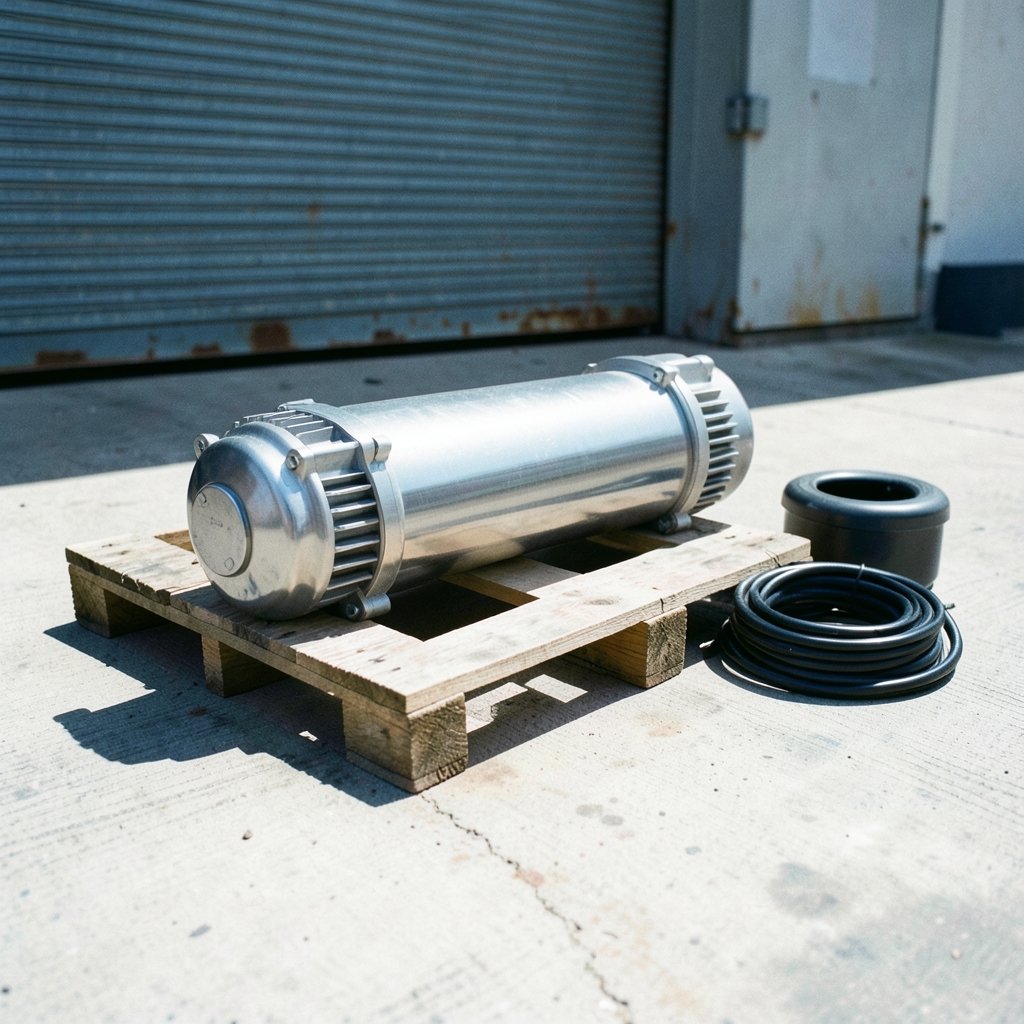
What happens when the water you need sits hundreds of feet below your feet, far out of reach of any suction pump? That’s the everyday problem a submersible well pump solves. It drops down the well casing, sits underwater, and pushes water up to the house. Simple idea, but the details matter. Get the sizing wrong and you’ll burn out a motor. Get the installation wrong and you’ll pay for it every month on your power bill.
This guide walks through how these pumps work, how to choose one, what goes wrong, and what to check before you spend money.
What a Submersible Well Pump Actually Is
A submersible pump is a pump that runs completely underwater, fully submerged in the fluid it moves. In a well, the pump and its motor are bolted together as one unit and lowered into the casing on a drop pipe, sitting below the water level. The motor spins an impeller stack, and each stage adds a bit of pressure. Water goes up the pipe and into a pressure tank in the house.
The design has roots in the oil fields. The first submersible deep-well pump is generally credited to Armais Arutunoff, who developed it in the 1920s for oil wells. The idea was later adapted for water wells, and the basic layout hasn’t changed much since.
Why does depth matter so much? Because a pump that pulls water upward is fighting physics. A standard jet pump relies on suction, and suction is capped by atmospheric pressure at roughly 25 feet (about 7.6 meters) of lift at sea level. That’s the theoretical limit, not a practical target. A submersible pump doesn’t pull. It pushes. That single difference is why submersible pumps are generally more efficient than jet pumps at greater depths.
How the Pump and Motor Stay Cool

Here’s something most homeowners never think about until it fails: the motor is cooled by the water flowing past it. Manufacturers specify a minimum flow past the motor for exactly this reason. When a pump runs dry, or when the well can’t supply enough water, the motor has nothing to shed heat into, and it overheats.
This is why dry running is one of the most common killers of submersible pumps. A pump that’s the right size for the well but runs dry because the water table dropped is a pump on borrowed time. Protection matters: low-water cutoffs, flow sleeves, and careful pump setting depth all exist to keep water moving past the motor.
Matching the Pump to the Well: The Numbers That Matter
Sizing isn’t guesswork, but it does require actual measurements. Two water levels drive everything:
| Measurement | What It Means | Why It Matters |
|---|---|---|
| Static water level | The water level when the pump is off and the well is undisturbed | Establishes the baseline depth of water in the well |
| Pumping water level | The water level while the pump is running, after drawdown | Shows how far the water drops under load; the pump must stay submerged |
Both are measured with a water-level meter or sounder, a small probe on a tape that beeps or lights up when it hits water. If you’re sizing a pump, you need the pumping water level, and the static level alone will not do. A well that looks deep enough at rest can draw down far enough under load to starve the pump.
Beyond water levels, you need the yield of the well (how many gallons per minute it can supply), the total dynamic head (the vertical lift plus friction losses in the pipe plus the pressure you want at the tap), and the flow rate the household needs. A typical home might want 8 to 12 gallons per minute at peak demand. A pump sized for 20 GPM in a well that only yields 5 GPM will cycle constantly and run dry.
The practical rule: size the pump to the well’s yield, not to your dreams of lawn irrigation.
Reading a Pump Curve Without a Engineering Degree
Every submersible pump has a performance curve, a graph showing flow rate against head (pressure). The curve slopes down: as flow increases, the pressure the pump can deliver drops. Your job is to find the point on that curve where your required flow and your required head meet. That’s your operating point.
A few things to watch:
- Don’t size to the shutoff head. That’s the maximum pressure at zero flow, and it’s not where the pump will run.
- Don’t size to the max flow point either. That’s the wide-open end of the curve, where pressure is lowest.
- Aim for the middle of the curve. Pumps run most efficiently near their best efficiency point. Running far off it wastes energy and wears parts faster.
Pump performance testing has a formal standard behind it. ISO 9906 defines acceptance grades and tolerances for testing rotodynamic pumps, which is why two pumps with similar specs can perform differently in the field. A pump tested to a tighter acceptance grade gives you a more reliable curve to work from.
Constant Pressure vs. Traditional Pressure Tanks
One of the biggest changes in well systems over the past couple of decades is the rise of variable-frequency drives (VFDs). A traditional system uses a pressure switch and a tank: the pump kicks on at, say, 40 PSI and off at 60 PSI. A VFD varies the pump’s speed to match demand, holding a steady pressure and reducing the number of on-off cycles.
That’s a real benefit. Fewer cycles means less wear on the motor and starting components. But VFDs aren’t free of complications. They can introduce electrical issues, including harmonics and bearing currents, that need mitigation. If you’re considering a constant-pressure system, budget for proper electrical design; the drive is only one part.
| System Type | How It Works | Best For |
|---|---|---|
| Pressure switch + tank | Pump cycles on and off between two pressure setpoints | Simple setups, tight budgets, low-demand households |
| VFD constant pressure | Pump speed varies to hold steady pressure | Households with variable demand, irrigation, multiple fixtures |
Installation Mistakes That Cost Real Money
Most submersible pump failures aren’t manufacturing defects. They’re installation and setup problems. Here are the ones that show up again and again.
Setting the pump too shallow. If the pump sits above the pumping water level, it sucks air and runs dry. It needs to be deep enough to stay submerged even during drawdown, with a margin for seasonal water table changes.
Skipping the torque arrestor or cable guards. The motor’s start-up torque twists the pump assembly. Without proper restraint, the pump can spin, chafe the cable, and eventually fail.
Cheaping out on the drop pipe. A failing pipe means pulling the whole assembly. That’s a costly job, and it’s worth doing right the first time.
Ignoring the check valve. A check valve keeps water from draining back down the pipe when the pump stops. Without one, the pump restarts against a full column of water every cycle, which is hard on the motor.
Forgetting the well cap and venting. A properly sealed well cap keeps surface contamination out. That matters more than people realize.
Water Quality, Testing, and the Rules That Apply
If you’re on a private well, you’re largely on your own for water quality. In the United States, private wells serving fewer than 15 connections or fewer than 25 people are generally not regulated under the Safe Drinking Water Act. Owners are responsible for testing their own water. (The row)
That’s not a small responsibility. Test for bacteria, nitrates, and any contaminants of local concern, and test on a schedule; do not wait for a smell. A submersible pump doesn’t treat water. It just moves it. If the water needs treatment, that’s a separate system downstream.
Well construction itself is typically regulated at the state level in the US. Industry standards for well construction exist too, such as the ANSI/NGWA standards published by the National Ground Water Association. If you’re having a well drilled or a pump replaced, ask whether the work follows those standards.
When to Repair and When to Replace
Submersible pumps don’t last forever, and the decision to repair or replace usually comes down to age, symptoms, and the cost of pulling the pump.
Signs the pump is failing:
- Water pressure that drops gradually or fluctuates
- The pump runs but delivers no water
- Breakers trip when the pump starts
- Sediment or grit in the water
- The pump short-cycles constantly
If the pump is old and the well is deep, pulling it is the expensive part. Replacing the pump while it’s out often makes more sense than reinstalling an aging unit. If the pump is relatively new and the problem is a failed pressure switch or a bad check valve, repair is usually the smarter call.
One practical tip: keep a record of the pump’s install date, model, depth setting, and the well’s static and pumping water levels. When something goes wrong, that record saves hours of diagnostic guessing.
Efficiency, Energy, and the Long View
Submersible pumps are efficient by design because they push rather than pull. But efficiency in the field depends on matching the pump to the operating point. A pump running far off its best efficiency point wastes energy every hour it runs.
If you’re thinking about wellness living and reducing your household’s energy footprint, the well pump is a reasonable place to look. A properly sized pump, a correctly set pressure tank, and a system that doesn’t short-cycle will quietly save power year after year. It’s not glamorous, but it works.
And if you’re managing a household with high water demand, from laundry to landscaping, the pump sizing conversation gets more important, not less. The same principles that apply to caring for 4c hair apply here: the right routine and the right products make all the difference, and shortcuts tend to show up later.
A Note on Maintenance Rhythm
Submersible pumps are low-maintenance, but “low” isn’t “none.” Check the pressure tank’s air charge once or twice a year. Watch for changes in pressure. Test the water annually. Listen for unusual noises when the pump starts. If the well is in an area with seasonal water table swings, check the pumping water level periodically to make sure the pump is still staying submerged.
For households thinking about broader wellness living, reliable water is foundational. You can’t build much on top of a system that fails every summer.
Conclusion
A submersible well pump is a straightforward piece of engineering: a motor and impeller stack that sit underwater and push water up a pipe. The complexity lives in the details. Static versus pumping water levels. Flow rate versus well yield. Pump curves, check valves, torque arrestors, and the cooling flow that keeps the motor alive. Get those right, and the system runs quietly for years. Get them wrong, and you’ll learn the hard way what a dry-running motor sounds like.
The takeaway is simple. Measure before you buy. Size to the well, not to wishful thinking. Follow the standards, test your water, and keep records. Do that, and the pump becomes one of those parts of the house you never have to think about.
How deep should a submersible well pump be set?
Deep enough that it stays submerged during drawdown, with margin for seasonal water level changes. The pump must sit below the pumping water level, rather than the static level by itself. Setting depth is determined by measuring both levels and adding a safety margin, and it should account for the lowest water level the well is likely to see.
Can a submersible pump run dry without damage?
No. The motor is cooled by water flowing past it, and running dry removes that cooling. Dry running is one of the most common causes of pump failure. Low-water cutoffs and careful sizing help protect against it, but the real fix is making sure the pump is set deep enough and matched to the well’s yield.
What is the difference between static and pumping water level?
Static water level is the water level when the pump is off and the well is undisturbed. Pumping water level is the level while the pump is running, after the water has drawn down. The difference between them is the drawdown, and it tells you how much the water level drops under load. Both are measured with a water-level meter or sounder.
Is a submersible pump better than a jet pump?
For deep wells, generally yes. A jet pump relies on suction, which is limited by atmospheric pressure to roughly 25 feet of lift at sea level. A submersible pump pushes water instead of pulling it, so it handles greater depths and is generally more efficient there. For shallow wells, a jet pump can still make sense.
How long does a submersible well pump last?
Lifespan varies widely by water quality, cycling, sizing, and installation quality, so no single number fits every well. What’s more useful is watching for the warning signs: dropping pressure, short cycling, tripping breakers, or grit in the water. Keeping a record of the install date and model helps you decide between repair and replacement when problems start.
Do I need a variable-frequency drive for my well pump?
Not necessarily. A VFD holds steady pressure and reduces on-off cycling, which can extend equipment life. But it adds cost and can introduce electrical issues like harmonics and bearing currents that need mitigation. A traditional pressure switch and tank setup is simpler and cheaper, and it works well for many households.














