

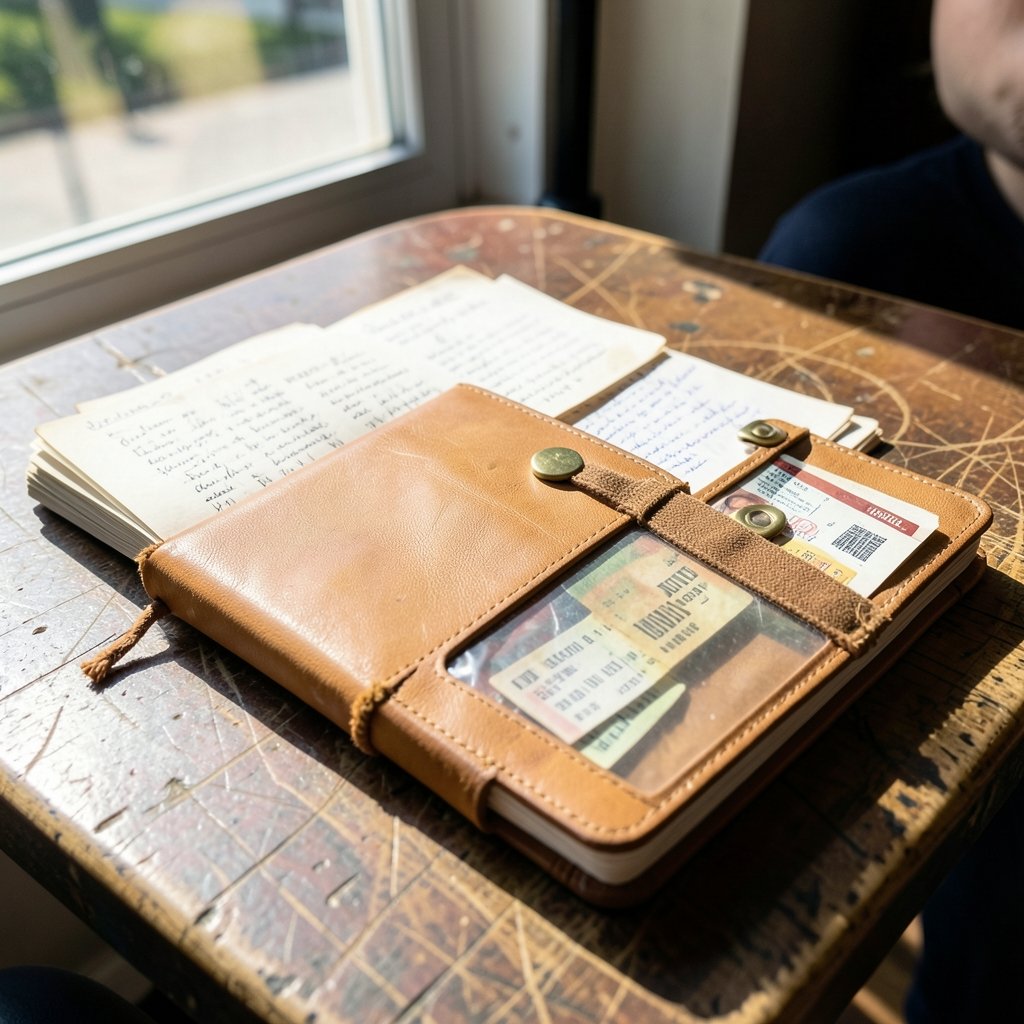
What do you picture when someone says “traveler’s notebook”? A dog-eared journal stuffed with train tickets and café receipts? A slim leather cover with elastic bands and a brass clip? Or a notebook you simply toss in a bag before a trip?
All three answers are reasonable, and that is the first thing worth knowing about this term. In everyday English, a traveler’s notebook is any notebook kept while travelling. In stationery shops, the phrase usually points to something much more specific: a refillable leather-cover system built around slim, elastic-bound inserts. The two meanings overlap, but they lead to different buying decisions. This guide separates them, explains how the format actually works in daily use, and covers the practical details that reviews tend to skip.
Traveler’s Notebook: Brand Name or Generic Category?
The capitalised “Traveler’s Notebook” is most strongly associated with the Japanese company Traveler’s Company, formerly known as Midori. The leather-cover system launched in 2006, according to the company’s own account of its history. That makes the term a brand name first and a product category second.
Here is the catch: the format was so widely imitated that “traveler’s notebook” now functions as a generic label too. Countless makers sell leather covers with elastic bands and swap-in paper refills. Some call them “traveller’s notebooks” with a double L, following British spelling. Others use “fauxdori,” a playful nod to the Midori name.
So how should a buyer read the label?
| Usage | What it means | What to check |
|---|---|---|
| Capitalised brand name | The Traveler’s Company product line | Sold by authorised stockists; branded inserts and covers |
| Generic category | Any cover-and-refill leather notebook | Cover material, insert size, elastic quality |
| “Fauxdori” or similar | An imitation or homage | Paper quality, stitching, refill compatibility |
The practical upshot: if a listing says “traveler’s notebook style,” expect a generic product. If it names the brand, expect brand pricing and brand-specific insert sizes. Neither is automatically better, but confusing the two leads to disappointing purchases, especially when refills do not fit.
How the Refillable Format Actually Works

The core idea is simple. A leather or fabric cover holds two or more slim, staple-bound paper inserts. Elastic bands run through the spine and grip each insert. A cotton case or band keeps the whole thing closed, and small brass clips hold pages or attach extras.
This design solves a problem that bound notebooks cannot: it lets you carry several books at once without carrying several notebooks. A typical setup might include:
- A dated weekly or monthly diary insert
- A blank insert for notes and sketches
- A lightweight insert for lists, budgets, or addresses
- A plastic pocket for tickets, stamps, and receipts
When one insert fills up, you slide it out and archive it on a shelf. The cover stays. Over years, that means one worn, personal object and a growing stack of thin books behind it.
Two sizes dominate the market. Passport size measures roughly 3.5 by 5 inches, small enough for a jacket pocket. The larger “regular” size runs roughly 4.3 by 8.3 inches, closer to a slim paperback. Exact dimensions vary by maker, so check the specification before buying refills from a different brand.
Paper, Ruling, and the Fountain Pen Question
Insert paper varies enormously, and this is where most buying mistakes happen. Thin paper in the 52 gsm range keeps inserts light and is popular with fountain pen users because it handles ink well without bleeding. Heavier stock feels more substantial and suits pencil, ballpoint, and marker. Ruling options typically include blank, lined, grid, and dot grid.
Practical advice from long-term users: buy one insert and test your actual pen on it before stocking up. A pen that feathers or ghosts on thin paper will annoy you for an entire book. Also note that insert page counts differ, so a cheaper refill with half the pages is not a bargain.
Who the Format Suits, and Who It Frustrates
The refillable system is not for everyone, and honest reviews say so. It rewards people who like tinkering, customising, and archiving. It frustrates people who want a single, finished object with a spine and an index.
It tends to suit:
- Frequent travellers who want one small cover for diary, notes, and documents
- Writers and sketchers who fill notebooks quickly and want to keep finished ones tidy
- Planners who like mixing dated and undated pages
- Minimalists who prefer one worn object over a shelf of half-used books
It tends to frustrate:
- People who want a bound notebook with a rigid spine and page numbers
- Budget buyers, since a cover plus several inserts costs more than a single notebook
- Heavy writers who fill a thin insert in a week and tire of swapping
- Anyone who dislikes elastic bands pressing on the pages
If you are planning a big trip and weighing gear, it helps to think about how the notebook fits your whole kit rather than buying it in isolation. A compact cover pairs naturally with the kind of luxury luggage carry on that keeps essentials within reach, and it earns its place on longer journeys covered in a 2026 travel guide. For anyone building a broader packing list around a luxury travel trip, a notebook is one of the few items that gets more useful the longer the trip runs.
Travel Journals as a Practice, Not a Product
It is worth separating the object from the habit. Travel journals have a long documentary tradition. Explorers, naturalists, and ordinary diarists kept field notebooks long before any branded leather cover existed. The refillable format did not invent travel writing; it just made the physical object more adaptable.
That history matters for one practical reason. People often buy a beautiful notebook and then freeze, unsure what to write. The fix is to treat the notebook as a working tool rather than an artefact. Notes about a delayed train, a sketch of a street corner, a list of what a meal cost: all of it counts. The archival habit of keeping finished inserts also gives you something a phone cannot: a dated, physical record you can flip through years later.
If you are choosing a destination as much as a notebook, the same principle applies. A September travel destinations shortlist often includes places where slow mornings and café writing are part of the appeal, and the best islands to visit in 2026 tend to reward travellers who keep notes on ferries, tides, and small guesthouses. Closer to home, a California travel itinerary through national parks gives a notebook plenty to record, and anyone planning Yosemite travel will find that trail notes and weather observations are far more useful than memory.
A Simple Setup That Works in Practice
Beginners often overbuy. A cover, five inserts, three clips, and a sticker set arrive, and the system becomes too precious to use. A leaner start works better:
- Choose one cover in the size that matches how you carry things: passport size for pockets, regular size for bags.
- Add two inserts only: one dated planner and one blank or lined notebook.
- Include one pocket insert for tickets and receipts.
- Test your main pen on the paper before buying more inserts.
- Add a second elastic band only when you genuinely need a third insert.
Common mistakes worth avoiding: buying refills from a different maker without checking dimensions, over-stuffing the cover until the spine bulges and the elastic stretches, and choosing thin paper for markers that bleed straight through. Each of these is cheap to prevent and annoying to fix.
Care, Wear, and the Long Game
Leather covers are meant to age. Scratches, darkening, and softened edges are part of the appeal, not damage. Basic care is minimal: keep the cover dry, wipe off salt and sand after beach trips, and avoid leaving it in direct sun for hours. Elastic bands lose tension over time; replacements are inexpensive and easy to fit.
The long game is where the format earns its cost. A cover that lasts a decade and holds twenty archived inserts is a different kind of object from a notebook you finish and lose. That durability is also why the system appeals to travellers who care about buying fewer, better things, a theme that runs through much of the luxury travel conversation about gear that lasts.
Conclusion
The traveler’s notebook is two things at once: a generic phrase for a notebook kept on the road, and a specific refillable leather system that grew from one Japanese brand into a whole category. Understanding which one you want is the decision that matters. If you want a bound book with a spine, buy that. If you want one cover that holds a planner, a sketchbook, and a pocket for tickets, and that archives finished pages on a shelf, the refillable format is hard to beat. Start small, test the paper, and let the wear accumulate. The notebook gets better as it gets older, which is more than most travel gear can claim.
Frequently Asked Questions
What is the difference between a traveler’s notebook and a regular notebook?
A regular notebook is a single bound object with fixed pages. A traveler’s notebook uses a cover with elastic bands that hold slim, replaceable inserts, so you can carry several books at once and archive finished ones while keeping the same cover.
Is Traveler’s Notebook a brand or a generic term?
Both. The capitalised name is most associated with Traveler’s Company, formerly Midori, which launched the leather-cover system in 2006. The lowercase phrase is also used generically for any cover-and-refill notebook, including many imitations.
What size should a first traveler’s notebook be?
Passport size, roughly 3.5 by 5 inches, suits pockets and light carrying. The larger regular size, roughly 4.3 by 8.3 inches, suits bag carry and more writing per page. Match the size to how you actually carry your things, not to how the notebook looks on a desk.
Can I use refills from different brands?
Sometimes, but check dimensions first. Insert sizes are not fully standardised across makers, and a refill that is slightly too tall or too wide will bulge the cover or strain the elastic. Measure your cover and compare before buying in bulk.
Is the paper good for fountain pens?
It depends on the insert. Thin paper in the 52 gsm range is popular with fountain pen users because it handles ink without heavy bleed, while heavier stock suits pencil and marker. Test your own pen on a single insert before committing to a full set.
How long does a leather cover last?
With basic care, a leather cover can last many years and is expected to show wear, darkening, and scratches as part of its character. Keep it dry, wipe off sand and salt after beach trips, and replace stretched elastic bands as needed.
The practical test is simple: carry it for a month before you judge it. A cover that felt stiff and oversized on day one often becomes the most natural thing in your bag by week four, once the leather softens and you stop thinking about which insert holds what. Conversely, a system that feels fussy from the start rarely improves with time. Trust that early instinct.
One last note on cost. The cover is the expensive part, and it is also the part you keep. Refills are cheap, which means the system rewards patience: you can experiment with a new ruling or a lighter paper for the price of a coffee, without committing to a whole new notebook. That flexibility, more than any single feature, is the real argument for the format. Buy the cover once, then let the contents change as your trips and habits do.














