
What do you get when you divide a mouse’s body weight by its body length? A number that looks simple, means different things to different labs, and quietly causes more arguments in rodent research than almost any other measurement. That is the short answer to “w/l mouse.” The long answer is worth understanding, because weight-for-length ratios shape how scientists judge whether an animal is thriving, wasting away, or simply growing at a normal pace.
This article unpacks w/l as a body-condition metric in mice, explains why it is not the same as a body mass index, walks through how to measure it without introducing avoidable error, and covers the places where the approach breaks down. It is written for lab staff, students, and curious readers who want a straight answer rather than a formula dumped on a page.
What does w/l mean for a mouse?
In rodent work, w/l is shorthand for weight divided by length. You record the animal’s body mass in grams, its body length in centimeters or millimeters, and divide one by the other. The result is a ratio in grams per centimeter (or grams per millimeter). Labs that track body condition over time often plot this ratio against age or treatment group.
The logic is intuitive. A mouse that gains weight without gaining length is putting on mass relative to its frame. A mouse that gains length without gaining weight is growing but thinning out. A ratio captures both changes in one number, which is convenient when you are monitoring dozens of animals and want a quick flag for the ones that need a closer look.
The catch is that the ratio is only as good as the measurements feeding it, and it carries assumptions about how mouse bodies scale. Those assumptions deserve scrutiny.
Why weight-for-length matters in practice
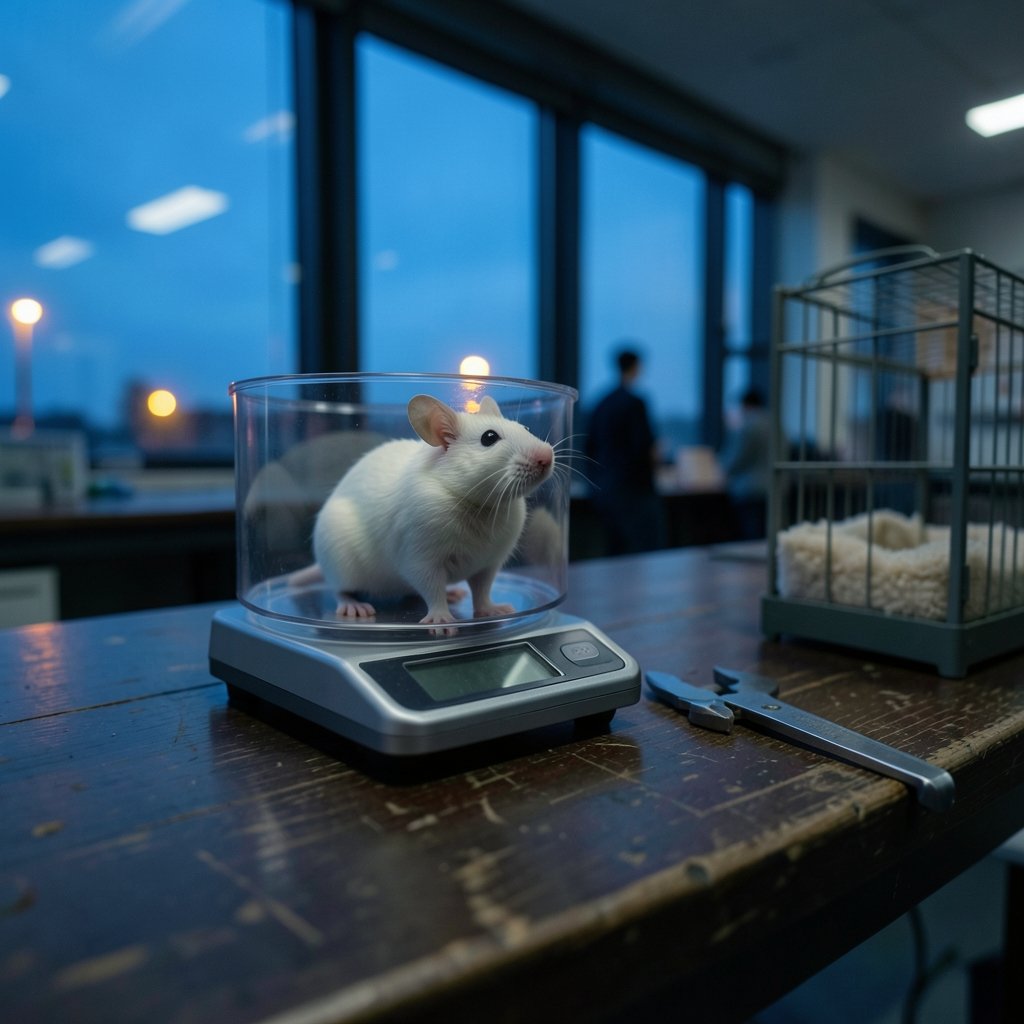
Body weight alone tells you something, but it is blunt. A young mouse gaining weight is usually just growing. An adult mouse losing weight is usually a welfare concern. Without a frame of reference, you cannot tell which is which from a single number on a scale.
Pairing weight with length gives context. A technician checking a cage can see that an animal’s weight dropped, check its length, and work out whether the ratio shifted or stayed flat. That distinction changes the response. Flat ratio with lower weight often means normal growth. Falling ratio means the animal is losing condition and needs attention.
Body condition scoring, where a handler palpates the spine and hips, does similar work and is widely used in welfare monitoring. The w/l ratio is the objective, numeric cousin of that hands-on check. The two work well together: the ratio flags a trend, and the hands-on score confirms what it means.
How body length is measured, and why it matters
Length measurement conventions vary, and mixing them up is one of the most common mistakes in w/l data. In rodents, body length is usually measured nose to anus, excluding the tail. Tail length is recorded separately as its own variable. If one technician measures nose-to-anus and another measures nose-to-tail-tip, the ratios from those two people are not comparable, and nobody will spot the problem until the data look strange.
A practical checklist for getting length right:
- Use a consistent landmark pair across every animal and every session. Nose-to-anus is the standard choice.
- Measure on a flat surface with the animal gently restrained, not stretched and not curled.
- Record to the nearest millimeter and note the method in the study log.
- Train every handler on the same technique before data collection starts, and spot-check between handlers.
- Measure at a consistent time of day where possible, since body weight fluctuates with feeding and hydration.
Small inconsistencies compound. A few millimeters of measurement drift is a large percentage error on a mouse that is only eight or nine centimeters long. That is why method notes matter as much as the numbers themselves.
W/L versus body mass index: not the same thing
Some studies report a mouse body mass index, calculated as weight divided by length squared. It borrows the human BMI formula, and that borrowing is where trouble starts. Human BMI has decades of population reference data behind it. Mouse BMI does not have an equivalent validated clinical standard, and practice varies from lab to lab.
The core problem is allometric scaling. Body mass in mammals does not scale linearly with length. It scales as a power law, with mass proportional to length raised to some exponent, typically near three for isometric scaling. That means a simple linear ratio is an approximation, and a squared term is a different approximation. Neither is a universal truth about mouse condition.
| Metric | Formula | What it captures | Main limitation |
|---|---|---|---|
| W/L ratio | Weight ÷ length | Mass relative to frame | Assumes linear scaling |
| Mouse BMI | Weight ÷ length² | Mass relative to frame, squared | No validated rodent standard |
| Scaled mass index | Adjusted for allometry | Condition relative to a reference | Needs population data to calibrate |
| Body condition score | Hands-on palpation | Fat and muscle reserves | Subjective, needs trained handlers |
The scaled mass index, described in the ecological literature by Peig and Green in 2009, takes a different route. It adjusts body mass for length using an allometric exponent estimated from the study population itself, rather than assuming a fixed formula. For researchers who need a defensible condition index, that approach is often more robust than a raw ratio. For routine colony monitoring, the plain w/l ratio is usually good enough, fast, and easy to explain to a technician holding a caliper.
What the numbers actually tell you
A w/l ratio is a trend tool, not a diagnosis. A single value in isolation says little. What matters is the trajectory across weeks and the comparison against a reference group of the same strain, sex, and age.
Reference growth data helps enormously here. Inbred strains have well-documented body-weight curves by age, and commercial suppliers publish strain-specific reference data that labs can use as a baseline. Comparing an animal’s weight against its strain’s expected curve, then layering length on top, gives a far richer picture than either measurement alone.
A few patterns are worth knowing:
- Rising ratio in a young animal usually reflects normal growth and fat deposition, not a problem.
- Falling ratio in an adult is a red flag for illness, pain, or inadequate access to food and water.
- Flat ratio with rising weight and length together is the picture of healthy, proportionate growth.
- Sudden ratio shifts after a procedure deserve a welfare review before anything else.
The practical tip here is to plot the ratio over time for each animal rather than comparing raw numbers across animals. Individual variation in mice is real, and a within-animal trend is more informative than a between-animal snapshot.
Where the w/l approach breaks down
Honesty matters here, because the w/l ratio has genuine limits and pretending otherwise leads to bad science.
No single agreed standard exists. Ecology, laboratory animal science, and veterinary medicine each use different indices and different conventions. A ratio reported in one paper may not be comparable to a ratio reported in another, even when both use the same units. Anyone reviewing the literature on this topic should expect inconsistency and should read the methods section closely.
Length measurement is error-prone. Restraint, posture, and handler technique all shift the number. On a small animal, those shifts are proportionally large.
The ratio hides body composition. Two mice with identical w/l ratios can have very different fat and lean mass. If body composition is the actual question, the ratio is the wrong tool and imaging or carcass analysis is the right one.
Reporting standards do not require it. The ARRIVE guidelines for in vivo animal research, updated to version 2.0 in 2020, require reporting of animal characteristics including body weight, but they do not mandate a w/l index. That means the metric is a choice, and the choice should be justified in the methods.
Practical tips that save time and data
Experienced labs tend to converge on the same handful of habits. None of them are glamorous, and all of them prevent headaches later.
Calibrate the scale before every session. A drifting balance quietly corrupts weeks of data before anyone notices.
Use one caliper and one measurement protocol per study. Switching instruments mid-study introduces a systematic offset that is hard to untangle afterwards.
Log the method alongside the number. A ratio without a note on how length was measured is only half a data point.
Build the spreadsheet before the first animal. Columns for date, animal ID, weight, length, ratio, handler, and method notes take ten minutes to set up and save hours of reconstruction later.
Review trends weekly, not at the end of the study. A falling ratio caught in week two is a welfare intervention. The same ratio caught in week twelve is a retrospective observation with no chance to help the animal.
Train new handlers against a reference set. Have them measure the same animals as an experienced handler and compare. The gap tells you how much drift to expect.
Common mistakes, in short: measuring nose-to-tail-tip by accident, mixing units between grams per centimeter and grams per millimeter, comparing ratios across strains without thinking, and treating a single timepoint as meaningful. Each one is easy to make and easy to prevent.
Where the term might mean something else
A fair warning for readers who arrived here looking for something different. “W/L mouse” is not a standard term in computer hardware. It does not appear in mainstream specifications for peripherals, and there is no authoritative source treating it as shorthand for a wireless or wired mouse. If that is what brought you here, the rodent metric is probably not your answer, and a hardware-focused search will serve you better.
The term is also occasionally confused with hair-typing shorthand in beauty and grooming content, where curl patterns get labeled with number-letter codes. Those systems describe curl diameter and shape, not rodents or peripherals, and they belong to a completely different vocabulary. Context is everything with a three-letter abbreviation.
For readers working through curl-pattern terminology, resources on 2b hair and 4c hair cover that classification system in detail. It is a useful reminder that abbreviations travel badly between fields, and that a quick check of context saves a lot of confusion. The same principle applies to lab shorthand, where a term like the row in one setting means something entirely different in another.
Conclusion
The w/l mouse metric is a simple tool with a surprisingly complicated backstory. Weight divided by length gives researchers a fast, objective way to track body condition in rodents, and when it is paired with consistent measurement technique, reference growth data, and hands-on body condition scoring, it earns its place in the monitoring toolkit. It is not a diagnostic test, it is not a validated clinical standard, and it is not interchangeable with mouse BMI or the scaled mass index. Treat it as a trend signal, document your method carefully, and it will serve you well. Treat it as a precise measurement with universal meaning, and it will mislead you. The difference between those two outcomes comes down to technique and honesty about limits, which is true of most measurements worth taking.
Frequently asked questions
What does w/l stand for in mouse research?
It stands for weight divided by length, a body-condition ratio calculated by dividing body mass in grams by body length in centimeters or millimeters. Researchers use it to track whether an animal’s mass is rising or falling relative to its frame, which helps distinguish normal growth from a welfare concern.
Is a mouse BMI the same as a w/l ratio?
No. A mouse BMI divides weight by length squared, while a w/l ratio divides weight by length once. Neither is a validated clinical standard for rodents, and both assume a scaling relationship that real mouse bodies only approximate. Researchers who need a more rigorous index often use the scaled mass index instead.
How should body length be measured in a mouse?
The standard convention is nose to anus, excluding the tail, with tail length recorded separately. The animal should be gently restrained on a flat surface, neither stretched nor curled, and measured to the nearest millimeter. Every handler in a study should use the same landmarks and technique.
Why does my mouse’s w/l ratio change between measurements?
Small measurement errors loom large on small animals, so a few millimeters of drift or a slightly different restraint technique can shift the ratio noticeably. Body weight also fluctuates with feeding and hydration. Consistent timing, one caliper, and one trained handler reduce this noise substantially.
Do reporting guidelines require a w/l index?
No. The ARRIVE guidelines for in vivo animal research require reporting of animal characteristics including body weight, but they do not mandate a weight-for-length index. If a study reports one, the methods should explain why it was chosen and how it was measured.
Does a falling w/l ratio always mean a mouse is sick?
Not always, but it deserves a prompt welfare check. A falling ratio in an adult mouse commonly signals illness, pain, or reduced food and water intake. Confirm with a hands-on body condition score and a veterinary review before drawing conclusions, and compare against the animal’s own trend rather than a group average.