A chandelier earring is the most dramatic earring you can wear with an ordinary lobe piercing. It fans out below the ear in tiers of stones, beads, or shaped metal, catches the light from every angle, and turns a simple dress into an evening outfit. It is the style people reach for at weddings, at parties, and on nights when the jewellery is meant to be noticed.
The name comes from the shape. Like a chandelier, the earring is narrow at the top and wide at the bottom, with several levels that spread outwards as they fall. That shape is also what makes the style tricky to shop for.
This guide sets out what a chandelier earring actually is, how it differs from a drop and a dangle, and what to check before you buy. It covers the nine facts that define the style, which occasions and face shapes suit it best, and the practical checks that keep a bold pair comfortable for a whole evening.
Key takeaways
- A chandelier earring is a drop earring with tiers: narrow at the top, wide at the bottom, with several linked pieces.
- The sparkle comes from many small stones, not one big one, which is why the style looks bright without a single heavy gem.
- Weight is the first thing to check, because a chandelier has more metal and more stones than a simple drop.
- Chandelier earrings suit evening best, but a small, light pair can work in the day with a simple outfit.
- A chandelier earring does not suit every occasion, and a heavy pair is not a good choice for a long day or a first pair.
What a chandelier earring actually is
A chandelier earring is an earring with several decorative pieces arranged in tiers below the earlobe. The top of the earring is a stud, a hook, or a small post that goes through the piercing, and below it the earring spreads outwards, level by level, like the arms of a chandelier. Each tier holds stones, beads, or shaped pieces of metal, and the lowest tier is usually the widest.
What makes a chandelier a chandelier is the tiered shape. A drop earring has one piece hanging below the lobe. A dangle earring is long and often made of a chain of beads. A chandelier earring has width as well as length, and it is the width, the fan of stones spreading out from the ear, that gives the style its name and its drama.
It frames the face with light. When you turn your head, the tiers move at slightly different speeds, so the earring seems to shimmer, and that movement is what makes it so striking in photographs and in candlelight.
How to tell a chandelier earring from the rest
Start with the shape. Hold the earring up and look at its outline. A chandelier earring is narrow at the top and wide at the bottom, with at least two tiers of decoration. If the earring is a single piece hanging straight down, it is a drop, not a chandelier. If it is long and narrow with no real width, it is a dangle. The fan shape is the test.
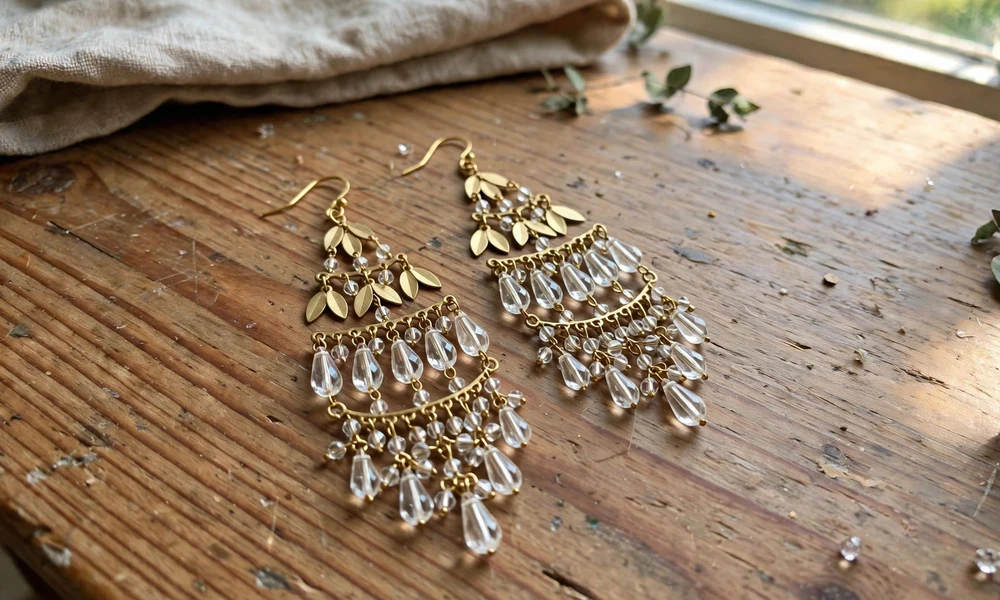
Next, count the pieces. A chandelier earring is built from several linked parts, and you should be able to see the joins between the tiers. Those joins are what let the tiers move independently, and that independent movement is what makes the earring shimmer. Our guide to the best chandelier earrings of 2027 shows the shape in gold, crystal, and pearl, and comparing those pairs side by side is the fastest way to train your eye.
Finally, check the fitting and the weight together. Most chandelier earrings use a post with a butterfly back, because a post holds the weight closer to the ear. If the pair feels heavy in your hand, it will feel heavier on your ear, and no fitting can fix that.
The 9 facts that define a chandelier earring
A chandelier earring is a drop earring with tiers
What it shows: the style starts where a drop earring ends. A drop has one piece below the lobe. A chandelier has two or more tiers, each one wider than the one above it, joined by small links.
What to consider: a pair with only one tier is a drop, however wide it is. The tiers are what make the chandelier, and without them the earring will not move or shimmer in the same way. Best for: evening events, weddings, and parties. Material: gold vermeil, sterling silver, or crystal. Price range: $45 to $250. Standout feature: tiers that spread out like a fan.
The shape fans out like a chandelier, narrow at the top and wide at the bottom
What it shows: the outline of the earring is a triangle or a fan. The top is a single stud or hook, and the bottom is a row of stones or beads that can be three or four centimetres wide.
What to consider: a very wide bottom tier can overwhelm a small face, and a very narrow pair can look like a drop rather than a chandelier. The width should suit your face, not just your outfit. Best for: round and oval faces, which suit the width of the fan. Material: gold vermeil, crystal, or pearl. Price range: $45 to $280. Standout feature: a fan shape that frames the face.
Chandelier earrings are built from several linked pieces
What it shows: each tier is joined to the one above it by a small link or ring, and those joins let the tiers move on their own. That is why the earring seems to shimmer when you turn your head.
What to consider: more links mean more places where the earring can bend or break, so check the joins before you buy. A link that looks thin or rough is a weak point, and it will be the first thing to fail. Best for: anyone who wants movement and sparkle in one pair. Material: gold vermeil, sterling silver, or brass. Price range: $40 to $240. Standout feature: tiers that move independently.
They are the most dramatic earring that still uses a standard piercing
What it shows: you do not need a second piercing, a cartilage piercing, or a stretched lobe. A chandelier earring is designed for the ordinary lobe piercing most people already have, and it gives you the drama of a statement earring without any new piercing.
What to consider: the drama comes with weight, and a heavy pair on a standard piercing can pull and ache. If your lobes are sensitive, choose the lightest pair you can find, or wear the pair for a few hours rather than all day. Best for: a first statement pair, and formal occasions. Material: gold vermeil, crystal, or freshwater pearl. Price range: $45 to $260. Standout feature: maximum drama from a standard piercing.
The sparkle comes from many small stones, not one big one
What it shows: a chandelier earring uses dozens of small crystals or beads, spread across the tiers, rather than a single large stone. That is why it looks bright from every angle, and why it catches the light even in a dim room.
What to consider: small stones can fall out, especially on a cheap pair, so check that each stone is set firmly before you buy. A loose stone is a warning sign, and a missing stone is hard to replace. Best for: evening, candlelight, and photographs. Material: crystal, cubic zirconia, or glass bead. Price range: $45 to $300. Standout feature: many small stones that sparkle from every angle.
Weight is the first thing to check before you buy
What it shows: a chandelier earring has more metal and more stones than a simple drop, so it is almost always heavier. A pair that feels light in your hand can still feel heavy after three hours on your ear, and a pair that feels heavy in your hand will feel heavier still.
What to consider: check the weight in the listing if it is given, and if it is not, hold the pair in your hand and then try it on at home for an hour before wearing it out. Best for: evening wear, where a few hours is enough. Material: hollow gold vermeil, titanium, or resin. Price range: $50 to $280. Standout feature: a pair that looks bold but feels light.
Chandelier earrings suit evening best, but lighter pairs work in the day
What it shows: the style was made for evening, and a full crystal chandelier with a formal dress is one of the classic combinations in jewellery. But a small chandelier in gold or pearl, with short tiers and no crystals, can work in the day with a simple outfit.
What to consider: a large crystal chandelier in daylight can look out of place, especially at work. Save the biggest, sparkliest pairs for the evening, and keep the daytime pairs small and plain. Best for: weddings, parties, and dinners, with smaller pairs for daytime. Material: gold vermeil, pearl, or crystal. Price range: $45 to $300. Standout feature: one style, two moods, depending on size.
They frame the face and suit most face shapes
What it shows: the width of the fan draws the eye outwards, which balances a long face, and the vertical drop draws the eye downwards, which flatters a round face. The combination of width and length is why the style suits so many people.
What to consider: a very wide pair can overwhelm a small or narrow face, and a very long pair can make a long face look longer. The size of the fan should suit the size of your face. Best for: round, oval, and long faces. Material: gold vermeil, crystal, or pearl. Price range: $45 to $260. Standout feature: width and length working together.
A chandelier earring needs a simple outfit to work
What it shows: the earring is the statement, so the rest of the outfit should be quiet. A plain dress, a simple neckline, and no necklace, or a very fine chain, let the earring do its job without competing for attention.
What to consider: a busy print, a high collar, or a statement necklace will fight with the earring, and the result is an outfit that looks crowded rather than elegant. If the outfit is loud, choose a simpler earring. Best for: a small jewellery box, where one bold pair does the work of several. Material: gold vermeil, crystal, or pearl. Price range: $50 to $300. Standout feature: the earring as the whole statement.
Which chandelier earring suits your occasion and face
Occasion is the best place to start. A chandelier earring was made for evening, and it is at its best at a wedding, a party, or a dinner, where the light is low and the outfit is formal. See our guide to earrings for weddings for the same tiered shape in bridal pairs.
Face shape is the second check. A round face suits a longer, narrower chandelier, because the length balances the width of the cheeks. A long face suits a wider, shorter chandelier, because the width adds balance without adding length. An oval face suits almost any size, and a square face suits a pair with curved tiers, because the curves soften the jawline.
Hair matters just as much. With hair worn up, a chandelier earring is fully visible, and you can choose a bolder pair. With hair worn down, a shorter chandelier is easier, because a long pair can tangle in the ends of your hair and disappear behind it.
The caveats that matter
| Detail | What is known |
|---|---|
| What a chandelier earring is | An earring with two or more tiers below the lobe, narrow at the top and wide at the bottom |
| Typical size | Three to six centimetres long, and two to four centimetres wide at the lowest tier |
| Fitting | Post with a butterfly back, or a hook; posts hold the weight closer to the ear |
| Piercing needed | A standard lobe piercing; no second or cartilage piercing required |
| Weight | Heavier than a drop, because of the extra metal and stones; the most important comfort factor |
| Best occasions | Evening, weddings, parties, and dinners; smaller pairs can work in the day |
| Who should be careful | People with sensitive or stretched lobes, and anyone who finds heavy earrings painful |
| What it does not do | It does not suit a busy outfit or a high collar, and it is not a good choice for sport, sleep, or a long day |
If your lobes are sensitive, or if you have worn heavy earrings for years and your piercings have stretched, choose the lightest chandelier you can find, wear it for a few hours rather than all day, and consider a larger earring back to spread the weight. A heavy pair can be worn for an evening, but it is not a good daily choice, and it can make stretching worse over time.
Checklist: buying a chandelier earring honestly
Use these checks before you buy, and again after a day of wearing the pair.
- Check the shape: narrow at the top, wide at the bottom, with at least two tiers of decoration.
- Check the weight: hold the pair in your palm, and try it on at home for an hour before wearing it out.
- Check the joins: each tier should move freely, and no link should look thin, rough, or bent.
- Check the stones: every stone should be set firmly, with no loose or missing stones in the tiers.
- Check the size against your face: a long narrow pair suits a round face, and a wide short pair suits a long face.
- Check the outfit: a plain dress and no necklace let the earring do its job without competing for attention.
Frequently asked questions
What is the difference between a chandelier earring and a drop earring?
A drop earring has one piece hanging below the lobe. A chandelier earring has two or more tiers, narrow at the top and wide at the bottom, like a fan. The chandelier is the wider, more dramatic version of the same idea, and it is usually heavier.
Are chandelier earrings comfortable to wear all day?
Usually not. A chandelier earring is heavier than a drop, and most people find it comfortable for a few hours at an evening event, rather than a full day.
Do chandelier earrings suit short hair?
Yes, and they are often at their best with short hair or hair worn up, because the earring is fully visible. A crystal chandelier with a pixie cut or an updo frames the face beautifully, and there is no hair for the tiers to tangle in.
Can I wear chandelier earrings to a wedding?
Yes, they are one of the most popular choices for weddings, both for brides and for guests. Choose a pair that suits the formality of the wedding, and keep the rest of your jewellery simple so the earrings are the statement.
How do I store chandelier earrings so they do not tangle?
Hang them or lay them flat in separate compartments, and fasten the backs before you put them away. The tiers tangle easily if two pairs are thrown into a box together, and a tangled pair is more likely to bend or lose a stone when you pull it apart. Our guide to how to store earrings covers the same storage rules for every style.
Are chandelier earrings still in fashion in 2027?
Yes. The style has been worn for centuries and it comes back every time formal dressing does. In 2027 the most popular pairs are smaller and lighter than the very large chandeliers of a decade ago..
The bottom line
A chandelier earring is a drop earring with tiers: narrow at the top, wide at the bottom, with several linked pieces that move independently and catch the light. It is the most dramatic earring you can wear with a standard lobe piercing, and it suits evening, weddings, and parties best. The two things to check before you buy are the shape and the weight, because a true chandelier fans out in tiers, and a light pair in the right size is the pair you will actually enjoy wearing.
Start with a small chandelier in gold or pearl, with short tiers and no heavy stones, and wear it for an evening at home before you take it out. If it feels comfortable after an hour, and it still looks right with a plain dress, you have found a pair that will earn its place in your jewellery box.