Earrings are the jewellery most likely to be lost, tangled, or damaged, and the reason is rarely the earrings themselves. It is how they are stored. A pair tossed into a drawer will separate, a stud will lose its backing, a hook will bend, and a pearl will pick up scratches from the metal sitting next to it. Most earring damage happens in storage, not while the earrings are being worn.
The fix is not expensive or complicated. Earrings need three things: to be kept in pairs, to be kept apart from other pieces, and to be kept away from light, air, and damp. A system that does those three things will protect a ten-pound pair and a thousand-pound pair equally well. The system does not need to be a luxury jewellery box, but it does need to be deliberate.
Below are nine steps for storing earrings properly in 2027, from sorting your collection to auditing it twice a year. Each step is described by what to do, what to avoid, and how long it takes, so you can set up a system that works in a real bedroom, not just in a photograph.
Key takeaways
- Most earring damage happens in storage, not while wearing: pairs separate, backs go missing, hooks bend, and stones scratch against other pieces.
- Earrings need three things in storage: kept in pairs, kept apart from other pieces, and kept away from light, air, and damp.
- Studs, hoops, drops, and statement earrings need different storage, because they tangle, bend, and scratch in different ways.
- Silver tarnishes fastest in open air and damp, so airtight or anti-tarnish storage matters more for silver than for gold.
- No storage system protects earrings that are put away dirty or wet, and a pair stored with its backs off is a pair that will lose a piece.
Why earrings need their own storage
Earrings are small, and small things get lost. A stud is barely a centimetre across, and its backing is smaller still. In a shared drawer or a crowded jewellery box, a stud can slip behind a lining, under a tray, or into a seam, and it is often gone for good. A pair stored together in its own slot or compartment is a pair you will find again.
Tangling is the second problem. Hook earrings and drop earrings catch on each other, on chains, and on the edges of compartments. A hook that has been bent by tangling will not sit straight again without careful reshaping, and a drop earring pulled free from a tangle can lose a stone. Hanging hooks separately, or laying drops flat in their own slots, prevents most of this damage.
The third problem is scratching. Diamonds scratch other stones and metals, pearls scratch easily, and gold is softer than most people expect. Earrings stored loose in a pile will scratch each other every time the box is moved. Individual compartments, soft pouches, or a lined tray with dividers keep each pair apart. Our guide to storing diamond jewellery covers the same principle for harder stones, and it applies to earrings too.
How to set up earring storage that actually works
Start by looking at what you own. Count your pairs, note the types, and notice which ones you wear most. Everyday studs need to be reachable in seconds. Statement earrings you wear twice a year can live further back. A system that puts your favourite pair at the bottom of a box will not be used, and earrings that are hard to reach are earrings that end up on the dressing table instead.
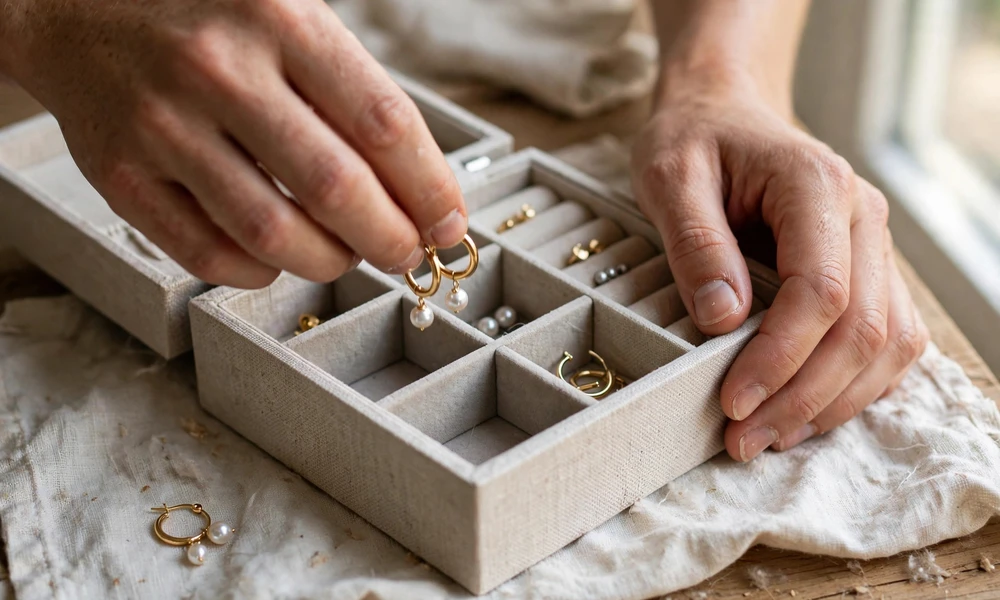
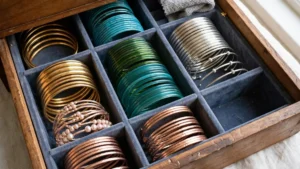
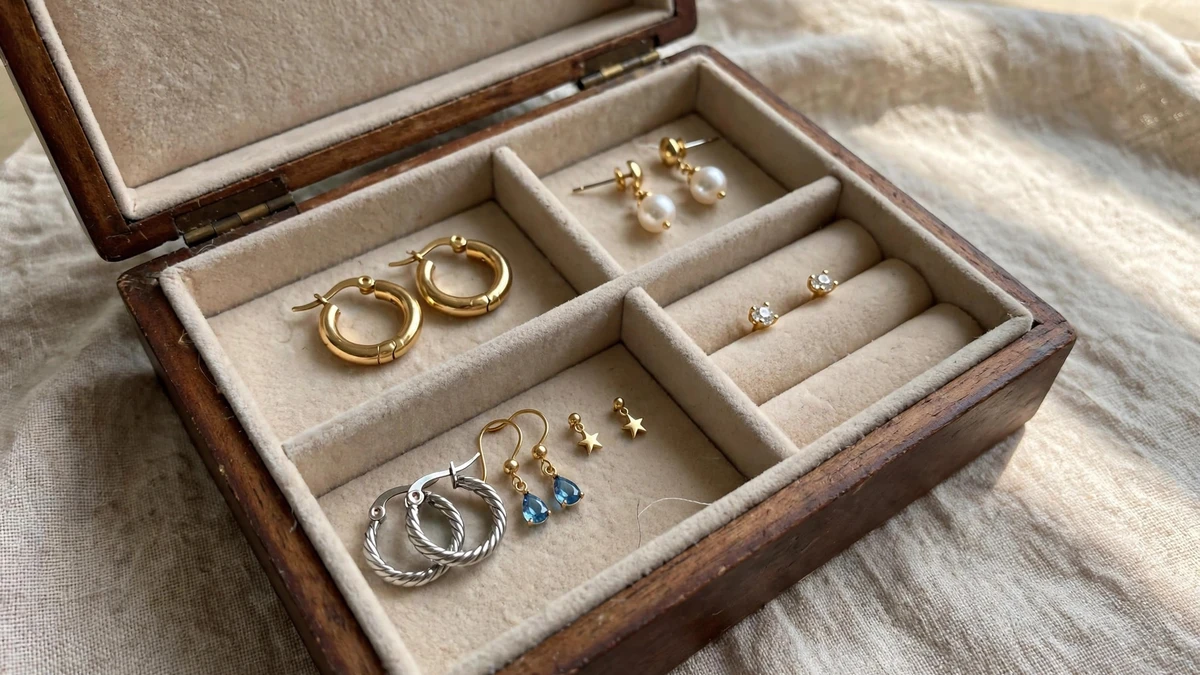
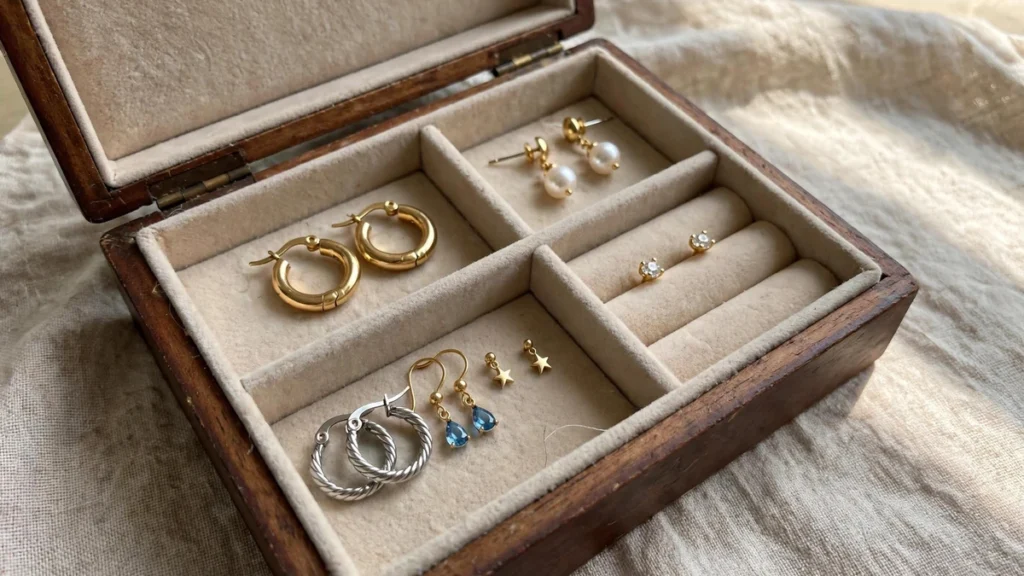
Then choose a storage style that fits your collection. A lined jewellery box with small compartments suits most people. A hanging organiser with clear pockets suits a large collection and lets you see everything at once. A travel roll with individual slots suits frequent travellers. What matters is not the container but whether each pair has its own place and whether you can see what you own without digging.
Finally, put the system where you get dressed. Storage that lives in another room will not be used, and earrings will end up loose on a surface instead. A box on the dressing table, a tray in the top drawer, or a hanging organiser on the inside of a wardrobe door all work, as long as putting earrings away is easier than leaving them out.
The 9 steps to storing earrings properly
Sort your earrings before you store them
What to do: Lay every pair out, match them up, and sort them by type: studs, hoops, drops, and statement pieces. What to avoid: Do not store a mixed pile and sort it later; that is how pairs get separated. Best For: Anyone setting up storage for the first time. Time Needed: 20 to 30 minutes. Standout Tip: Discard broken backs and bent hooks now, and replace them before you store the pair.
Sorting first tells you how much storage you actually need. Most people own more earrings than they think, and a box that is too small will be overfilled, which defeats the purpose. Sort once, then choose storage that fits the sorted collection, not the other way round.
Choose a storage style that fits your collection
What to do: Pick a lined box with compartments for a small collection, a hanging organiser for a large one, or a travel roll if you travel often. What to avoid: Do not use an unlined box or a single open tray; pieces will scratch and slide together. Best For: Every collection, once sorted. Time Needed: 10 minutes to choose, plus delivery or shopping time. Standout Tip: Clear pockets or a glass lid let you see your earrings without opening every compartment.
Keep pairs together, always
What to do: Store each pair in the same compartment, with the backs on, so the two earrings never separate. What to avoid: Do not store one earring in one place and its partner in another, even temporarily. Best For: Studs and small earrings, which separate most easily. Time Needed: A few seconds per pair. Standout Tip: If a compartment is too small for both earrings, the compartment is wrong, not the pair.
A single earring is the most common jewellery loss, and it almost always happens in storage. Keeping the pair together, backs on, in one compartment is the simplest and most effective habit in this guide. Our roundup of jewellery organisers includes boxes designed with paired compartments for exactly this reason.
Separate metals and stones
What to do: Keep diamond and hard-stone earrings apart from pearls and soft stones, and keep silver apart from gold where possible. What to avoid: Do not let diamonds sit against pearls, gold, or other stones; diamonds scratch almost everything. Best For: Mixed collections with diamonds, pearls, and coloured stones. Time Needed: A few minutes while sorting. Standout Tip: A soft pouch inside a compartment is enough separation for a single valuable pair.
Scratching is invisible until it is not. A pearl that has been stored against a diamond will show fine marks that cannot be polished out, and gold stored against a harder metal will pick up scratches over time. Separation does not need separate boxes; a divider, a pouch, or a different compartment is enough.
Protect delicate and statement pieces
What to do: Wrap delicate, beaded, or statement earrings in soft tissue or a small pouch, and lay them flat rather than hanging them. What to avoid: Do not hang heavy statement earrings from a hook for months; the weight stretches the hook and stresses the setting. Best For: Statement, beaded, and vintage earrings. Time Needed: A minute per pair. Standout Tip: Tissue paper is better than cotton wool, which can catch on prongs and hooks.
Delicate earrings are the ones most often damaged in storage, because they are put away in a hurry after an occasion. Taking one extra minute to wrap them and lay them flat is the difference between a pair that lasts years and a pair that loses a bead the next time it is worn.
Control light, air and humidity
What to do: Store earrings in a closed box, away from windows and bathrooms, with a small anti-tarnish strip or silica gel packet inside. What to avoid: Do not store earrings in a bathroom, where steam and humidity speed up tarnishing, or on a sunny windowsill. Best For: Silver earrings, which tarnish fastest, and all fine jewellery. Time Needed: A few minutes to set up. Standout Tip: A closed box in a bedroom drawer protects earrings better than an open display on a dressing table.
Keep everyday pairs within easy reach
What to do: Put your three or four most-worn pairs in the front compartments or top tray, where you can reach them in seconds. What to avoid: Do not bury everyday pairs under occasion pieces you wear twice a year. Best For: Anyone who wears earrings daily. Time Needed: A few minutes to rearrange. Standout Tip: If you reach past a pair every day without wearing it, move it to the back or consider letting it go.
A system that makes your everyday pairs hard to reach will not be used. Earrings left on a dressing table because the box is awkward are earrings that will get knocked off, lost, or scratched. Front-load the pairs you wear, and let the rest live further back.
Clean before you put them away
What to do: Wipe earrings with a soft, dry cloth after wearing, and clean them properly before storing them for weeks or months. What to avoid: Do not store earrings that are damp, sticky with hairspray, or coated in lotion; residue causes tarnish and dulls stones. Best For: All earrings, especially after an evening out. Time Needed: 30 seconds per pair. Standout Tip: Apply hairspray and perfume before putting earrings on, never after.
Most tarnish and dullness comes from what is left on the earring, not from the air alone. Makeup, lotion, and hairspray leave a film that traps moisture and dulls the finish. A quick wipe after wearing takes seconds and prevents most of it. Our guide to cleaning gold vermeil earrings explains the gentle method that works for most everyday pairs.
Audit your collection twice a year
What to do: Twice a year, take every pair out, check for loose stones, bent hooks, missing backs, and tarnish, and clean or repair as needed. What to avoid: Do not skip the audit; small problems become lost stones if they are left for a year. Best For: Every collection, especially larger ones. Time Needed: 30 to 45 minutes. Standout Tip: Keep a small pot of spare backs and a jeweller’s contact in the same place as your earring box.
An audit catches the loose stone before it falls out, the bent hook before it snaps, and the missing back before the stud is lost. It is also the moment to notice pairs you no longer wear and to free up space for the ones you do. Put it in the calendar for spring and autumn, and it becomes a habit rather than a chore.
Which storage suits your earrings
Studs need small, paired compartments with the backs on, and they need to be shallow enough that you can see the pair without tipping the box. Hoops need a compartment wide enough that the hoop is not bent to fit, or a hanging hook that lets them hang straight. Drops and statement earrings need to lie flat, ideally wrapped, so they do not tangle or pull on their settings.
For travel, a roll with individual slots is the safest option, because it keeps pairs apart and stops anything moving during the journey. Never travel with earrings loose in a bag pocket or a zip compartment. For a large collection, a hanging organiser with clear pockets lets you see everything at once and stops you buying duplicates of pairs you already own.
If you own valuable pieces, consider a box with a lock, or keep the most valuable pairs in a separate, smaller box that lives in a safe place. Insurance and safe storage go together, and a photograph of each valuable pair, kept separately, makes any claim far easier.
The caveats that matter
No storage system fixes earrings that are already damaged. A loose stone will still fall out in a perfect box, and a bent hook will still catch on fabric. Storage protects earrings in good condition; it does not repair them. Check for damage before you store a pair, and take anything loose or bent to a jeweller rather than putting it away and hoping.
| Detail | What is known |
|---|---|
| Most common loss | A single stud separated from its pair, or a backing lost in a shared drawer |
| Most common damage | Scratches from pieces stored loose together, and bent hooks from tangling |
| Best container | A lined box with individual compartments, or a hanging organiser with clear pockets |
| Worst place to store | A bathroom, where steam and humidity speed up tarnishing, or an open tray in sunlight |
| Silver tarnish | Fastest in open air and damp; use a closed box with an anti-tarnish strip |
| Pearls in storage | Keep away from diamonds and hard stones, which scratch them easily |
| Before storing | Wipe with a soft dry cloth; never store earrings damp or coated in hairspray |
| How often to audit | Twice a year, checking for loose stones, bent hooks, and missing backs |
Children and pets are a real risk to earring storage. A box left open on a low surface is an invitation, and small earrings are a choking hazard. Keep your box closed, out of reach, and never leave earrings loose on a bedside table overnight if there are small children in the house.
Checklist: storing earrings honestly
Use these checks when you set up storage, and again at each six-month audit.
- Check the pairs: every earring should be stored with its partner, backs on, in one compartment.
- Check the separation: diamonds apart from pearls and soft stones, and no pieces loose in a pile.
- Check the container: lined, divided, and closed, with room for a few more pairs than you own.
- Check the location: a bedroom drawer or dressing table, never a bathroom or a sunny windowsill.
- Check the condition: wipe each pair before storing, and never put away a damp or dirty earring.
- Check the audit: twice a year, look for loose stones, bent hooks, missing backs, and tarnish.
Frequently asked questions
Can I store all my earrings together in one box?
Yes, as long as each pair has its own compartment or pouch. The problem is not one box, it is pieces touching each other. Dividers, pouches, and individual slots solve it.
How do I stop silver earrings from tarnishing in storage?
Keep them in a closed box away from air and damp, with an anti-tarnish strip or silica gel packet inside. A bathroom is the worst place to store silver.
Should I keep earring backs on in storage?
Yes. Backs keep studs from slipping out of their compartment and stop the pair separating. Store each stud with its back on, in the same compartment as its partner.
What is the best way to store earrings when travelling?
Use a travel roll with individual slots, or small pouches, one pair per pouch. Never put earrings loose in a bag pocket, where they will tangle, scratch, and separate.
Can I hang my earrings instead of boxing them?
Yes, for light hoops and drops, a hanging organiser works well and lets you see everything. Heavy statement earrings should lie flat, because hanging stretches the hooks over time.
How often should I clean earrings before storing them?
Wipe them with a soft dry cloth after every wear, and clean them properly before storing them for weeks or months. Never store an earring that is damp or coated in hairspray or lotion.
The bottom line
The best way to store earrings in 2027 is not the most expensive box or the prettiest display. It is a simple system that keeps pairs together, keeps pieces apart, and keeps everything away from light, air, and damp. A lined box with compartments, used every time you take earrings off, will protect your collection better than any display that looks good but lets pieces touch.
Start by sorting what you own, give each pair its own place, and wipe earrings before you put them away. Do that consistently, audit twice a year, and the earrings you love will still be whole, matched, and ready to wear years from now.